
As a high-performance mechanical transmission device, the Planetary Roller Screw (PRS) mechanism transmits power through multi-point contact between thread teeth. My research focuses on extending the advantages of the single-stage planetary roller screw—such as high stiffness, compact design, and long service life—to applications requiring greater stroke and speed. For large-scale actuation systems, a single-stage planetary roller screw often falls short in travel distance and velocity. The two-stage planetary roller screw mechanism presents a compelling solution, enabling higher extension speeds and longer strokes, which is crucial for the full electrification of many heavy-duty systems. This article delves into the parameter matching, theoretical kinematics, and dynamic simulation of a two-stage planetary roller screw mechanism.
Structural Configuration and Operational Principle
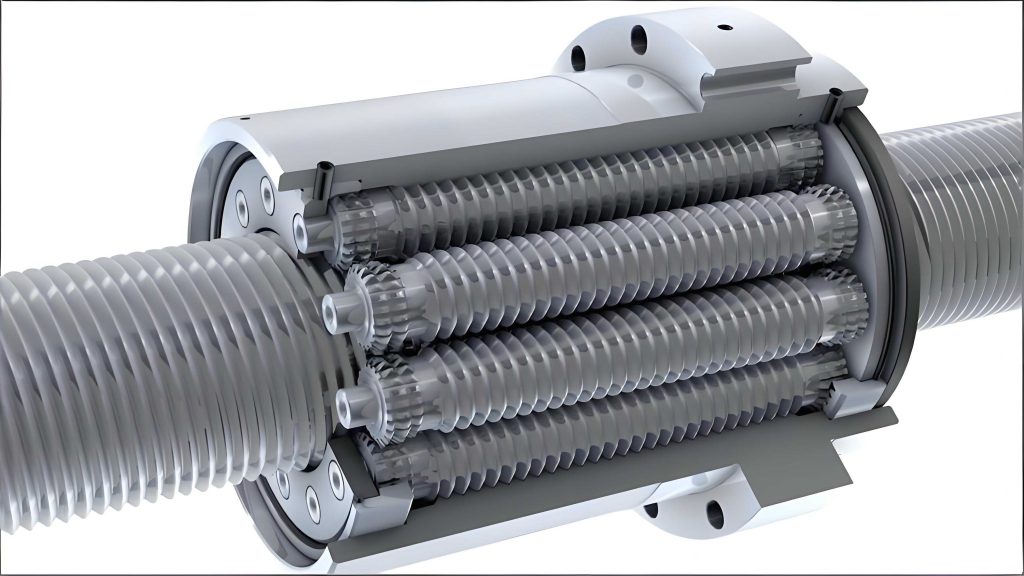
The two-stage planetary roller screw mechanism features a more complex architecture compared to its single-stage counterpart. Its core components include a primary screw, a primary nut, a secondary hollow screw, a secondary nut, rollers for each stage, a retainer (or planet carrier), internal gear rings, and thrust bearings.
The primary screw acts as the input driver. Its rotation induces planetary motion in the first-stage rollers, which are meshed between the primary screw and the primary nut’s internal threads. Since the primary nut is constrained from rotating, it translates axially. This axial motion is transferred to the entire second-stage assembly via a sleeve and thrust bearings. Crucially, the primary screw also features a hexagonal profile at its end, which engages with a corresponding profile inside the secondary hollow screw. This coupling allows the primary screw to drive the rotation of the secondary hollow screw while permitting relative axial movement between them. Consequently, the secondary hollow screw both rotates and translates axially. This rotation, in turn, drives the second-stage rollers, causing the secondary nut—which is also rotationally constrained—to translate. The secondary nut is connected to a push rod, which delivers the final linear output. The overall stroke and speed are the sum of the contributions from both stages.
Parameter Matching Design Methodology
The design of a two-stage planetary roller screw must first satisfy all established parameter matching conditions for a single-stage planetary roller screw. These typically include geometric relationships for proper meshing, such as the lead equality condition and the tooth engagement condition for the spur gears on the roller ends. Beyond these, the two-stage design imposes two critical additional constraints.
1. Strength Conditions
The primary screw and the secondary hollow screw must be checked for mechanical strength under the applied axial load \(F_a\). Using the material’s yield strength limit \(\sigma_{\text{max}}\) and a chosen safety factor \(K\), the allowable stress \([\sigma]\) is:
$$[\sigma] = \frac{\sigma_{\text{max}}}{K}$$
The tensile/bending stresses must satisfy:
$$\sigma_1 = \frac{4F_a}{\pi d_{01}^2} < [\sigma] \quad \text{(for the solid primary screw)}$$
$$\sigma_2 = \frac{4F_a}{\pi (d_{02}^2 – d_{01}^2)} < [\sigma] \quad \text{(for the hollow secondary screw)}$$
where \(d_{01}\) and \(d_{02}\) are the pitch diameters of the primary and secondary screws, respectively.
2. Column (Buckling) Stability
When operating under high compressive loads, the screw/push rod assembly may experience elastic instability (buckling). This is a critical design consideration for long-stroke actuators. The slenderness ratio \(\lambda\) is calculated as:
$$\lambda = \frac{\mu L}{r_{\text{min}}}$$
where \(\mu\) is the column effective length factor (depending on end conditions), \(L\) is the extended length, and \(r_{\text{min}}\) is the minimum radius of gyration of the cross-section. The critical stress \(\sigma_{cr}\) is determined based on \(\lambda\):
$$\sigma_{cr} =
\begin{cases}
\sigma_s, & \lambda < \lambda_s \\
a – b\lambda, & \lambda_s \leq \lambda \leq \lambda_p \\
\frac{\pi^2 E}{\lambda^2}, & \lambda > \lambda_p
\end{cases}$$
Here, \(\sigma_s\) is the material yield strength, \(a\) and \(b\) are material constants, \(\lambda_s\) and \(\lambda_p\) are the slenderness limits for yield and proportional limit, respectively, and \(E\) is the elastic modulus. For large slenderness ratios (\(\lambda > \lambda_p\)), Euler’s formula applies for the critical load \(F_{cr}\):
$$F_{cr} = \frac{\pi^2 E I}{(\mu L)^2}$$
where \(I\) is the minimum area moment of inertia. For a two-stage planetary roller screw mechanism with variable cross-section, the overall stability must be analyzed considering the changing moment of inertia along the length. The critical load can be expressed in a generalized form:
$$F_{cr} = \frac{\pi^2 E I_1}{(\mu_1 \mu_2 L)^2}$$
where \(\mu_1\) accounts for end support conditions and \(\mu_2\) is a correction factor for the stepped (variable) cross-section. The applied axial load \(F_a\) must be significantly less than \(F_{cr}\).
| Condition Category | Description | Key Equations/Checks |
|---|---|---|
| Single-Stage PRS Conditions | Geometric meshing, lead matching, gear engagement. | \(P_s = P_R + P_N\), \(z_R / z_{ig}\) matching, etc. |
| Strength (Added) | Stress in primary and secondary screws under axial load. | \(\sigma_1 = \frac{4F_a}{\pi d_{01}^2} < [\sigma]\), \(\sigma_2 = \frac{4F_a}{\pi (d_{02}^2 – d_{01}^2)} < [\sigma]\) |
| Buckling Stability (Added) | Prevention of elastic instability under compression. | \(F_a \ll F_{cr} = \frac{\pi^2 E I_1}{(\mu_1 \mu_2 L)^2}\) |
Theoretical Kinematic Model
Roller Angular Velocities
In a standard planetary roller screw assembly, the nut is fixed against rotation. When the screw rotates with an angular velocity \(\omega_s\), it imparts motion to the rollers. The kinematics can be derived from the pure rolling condition at the screw-roller and roller-nut interfaces (considering ideal conditions).
The revolution (or planet carrier) angular velocity \(\omega_c\) of the roller around the screw axis is given by:
$$\omega_c = \frac{\omega_s d_{0s}}{2(d_{0s} + d_{0R})}$$
where \(d_{0s}\) is the screw pitch diameter and \(d_{0R}\) is the roller pitch diameter.
The rotation (spin) angular velocity \(\omega_R\) of the roller about its own axis is:
$$\omega_R = \frac{d_{0s} + 2d_{0R}}{d_{0R}} \omega_c = \frac{d_{0s} + 2d_{0R}}{2(d_{0s} + d_{0R})} \omega_s$$
For a two-stage planetary roller screw where the secondary hollow screw is driven at the same input speed \(\omega_s\) via a coupling, these formulas apply independently to each stage using the respective pitch diameters.
Nut Linear Velocity and Displacement
The linear velocity of a nut in a single-stage planetary roller screw, where the screw rotates and the nut translates, is:
$$v_N = \frac{\omega_s}{2\pi} \cdot n_s \cdot p = \frac{\omega_s}{2\pi} L_s$$
where \(n_s\) is the number of screw thread starts, \(p\) is the pitch, and \(L_s = n_s \cdot p\) is the lead. The axial displacement \(S_N\) over time \(t\) is:
$$S_N = \frac{\omega_s t}{2\pi} L_s$$
In the two-stage configuration:
- The primary nut’s velocity \(v_{N1}\) and displacement \(S_{N1}\) follow the single-stage formula directly.
- The secondary hollow screw assembly (including its nut) is pushed axially by the primary nut. Therefore, it possesses a base velocity equal to \(v_{N1}\).
- Simultaneously, the rotation of the secondary hollow screw (\(\omega_s\)) drives its own nut relative to itself. The relative velocity of the secondary nut with respect to the secondary hollow screw is also given by the single-stage formula, \(v_{N2, rel} = \frac{\omega_s}{2\pi} L_{s2}\), where \(L_{s2}\) is the lead of the second stage.
Thus, the total absolute linear velocity of the secondary nut \(v_{N2}\) is the sum:
$$v_{N2} = v_{N1} + v_{N2, rel} = \frac{\omega_s}{2\pi}(L_{s1} + L_{s2})$$
Similarly, its total displacement is:
$$S_{N2} = \frac{\omega_s t}{2\pi}(L_{s1} + L_{s2})$$
This additive principle is the key performance advantage of the multi-stage planetary roller screw, effectively multiplying the output speed and stroke for a given input speed.
| Component | Angular Velocity | Linear Velocity | Linear Displacement |
|---|---|---|---|
| Primary Screw | \(\omega_s\) (Input) | 0 | 0 |
| Primary Nut | 0 | \(v_{N1} = \frac{\omega_s}{2\pi} L_{s1}\) | \(S_{N1} = \frac{\omega_s t}{2\pi} L_{s1}\) |
| Secondary Hollow Screw | \(\omega_s\) | \(v_{N1}\) (from 1st stage) | \(S_{N1}\) |
| Secondary Nut | 0 | \(v_{N2} = \frac{\omega_s}{2\pi} (L_{s1} + L_{s2})\) | \(S_{N2} = \frac{\omega_s t}{2\pi} (L_{s1} + L_{s2})\) |
| Stage 1 Rollers (Revolution) | \(\omega_{c1} = \frac{\omega_s d_{01}}{2(d_{01} + d_{0R1})}\) | – | – |
| Stage 1 Rollers (Rotation) | \(\omega_{R1} = \frac{d_{01} + 2d_{0R1}}{2(d_{01} + d_{0R1})} \omega_s\) | – | – |
| Stage 2 Rollers (Revolution) | \(\omega_{c2} = \frac{\omega_s d_{02}}{2(d_{02} + d_{0R2})}\) | – | – |
| Stage 2 Rollers (Rotation) | \(\omega_{R2} = \frac{d_{02} + 2d_{0R2}}{2(d_{02} + d_{0R2})} \omega_s\) | – | – |
Multi-Body Dynamics Simulation Model
To validate the theoretical kinematic models and study the dynamic behavior, a detailed multi-body dynamics model of the two-stage planetary roller screw was developed using ADAMS software.
Model Preparation and Simplification
A three-dimensional CAD model was created based on a specific set of design parameters. To reduce computational complexity while preserving the essential kinematics, the model was simplified: each stage was represented with only two rollers positioned symmetrically (instead of the full set of 10), and non-essential components like guide sleeves were removed. The model was then imported into ADAMS.
Applying Boundary Conditions and Contacts
Joints and constraints were applied to reflect the real mechanism’s kinematics:
- Fixed Joints: Applied between internal gear rings and their respective nuts, and between certain bearings and housings.
- Revolute Joints: Applied between rollers and their planet carrier (retainer) to allow rotation, and at the input location for the primary screw.
- Translational Joints: Applied to allow axial translation of the primary nut, secondary nut, and the relative axial motion between the primary and secondary screws.
- Planar Joint: Used between the secondary screw and a thrust bearing to allow both rotation and translation.
- Driving Motion: A rotational motion \(\omega_s = 800^\circ/\text{s}\) was applied to the revolute joint of the primary screw.
Contact Forces: The core interactions in the planetary roller screw mechanism are governed by contact. The IMPACT function in ADAMS was used to model these contacts (screw-roller, roller-nut, roller-internal gear). This function calculates normal force based on penetration and a damping force based on relative velocity. The general form is:
$$\text{IMPACT} = \max(0, K \delta^e – C \cdot \text{STEP}(\delta, 0, d_{\text{max}}, 0) \cdot \dot{\delta})$$
where \(\delta\) is penetration, \(K\) is stiffness, \(e\) is the force exponent, \(C\) is damping, \(d_{\text{max}}\) is the maximum penetration for full damping, and \(\dot{\delta}\) is penetration velocity. Friction was also included using the Coulomb model. Representative parameters used were: \(K = 1.0 \times 10^5 \text{ N/mm}\), \(e=1.5\), \(C=50 \text{ N·s/mm}\), static friction coefficient \(\mu_s=0.23\), dynamic friction coefficient \(\mu_d=0.16\).
Simulation Results and Validation
The simulation was run with an input speed of \(\omega_s = 800^\circ/\text{s}\) (or \(\frac{40\pi}{9}\) rad/s) for a duration of 1 second. An axial load of 340 kN was applied to the secondary nut, scaled proportionally due to the reduced number of rollers in the model.
Velocity and Displacement Analysis
The simulation results for linear velocities and displacements were extracted and compared against theoretical predictions. The theoretical values were calculated using the formulas derived earlier with the specific lead values \(L_{s1}=L_{s2}=20 \text{ mm}\) (5 starts \(\times\) 4 mm pitch).
- Primary Nut & Secondary Screw Velocity: Theory: \(v_{N1} = \frac{(40\pi/9)}{2\pi} \times 20 \approx 44.44 \text{ mm/s}\). Simulation average: ~44.35 mm/s. Error: ~0.20%.
- Secondary Nut Velocity: Theory: \(v_{N2} = \frac{(40\pi/9)}{2\pi} \times (20+20) \approx 88.88 \text{ mm/s}\). Simulation average: ~87.56 mm/s. Error: ~1.49%.
- Primary Nut Displacement: Theory: \(S_{N1} = 44.44 \text{ mm}\). Simulation: 42.07 mm. Error: ~5.33%.
- Secondary Nut Displacement: Theory: \(S_{N2} = 88.88 \text{ mm}\). Simulation: 86.67 mm. Error: ~2.49%.
The slightly lower simulated values and the presence of oscillation at the start of motion are attributed to several realistic factors not present in the ideal theoretical model: 1) The inclusion of friction in contacts, 2) Initial clearance/backlash in the threaded meshes which causes transient impact and slip before full engagement, and 3) The dynamic response of the system under load.
Roller Angular Velocity Analysis
The absolute angular velocities of the rollers were measured from the simulation. The revolution (\(\omega_c\)) and spin (\(\omega_R\)) components can be inferred. For the first-stage planetary roller screw assembly:
- Theoretical: \(\omega_{c1} = 300^\circ/\text{s}\), \(\omega_{R1} = 1500^\circ/\text{s}\).
- Simulation (derived): \(\omega_{c1} \approx 286.64^\circ/\text{s}\), \(\omega_{R1} \approx 1414.02^\circ/\text{s}\). Error: ~4.45% and ~5.73%.
For the second-stage planetary roller screw assembly:
- Theoretical: \(\omega_{c2} = 300^\circ/\text{s}\), \(\omega_{R2} = 1500^\circ/\text{s}\).
- Simulation (derived): \(\omega_{c2} \approx 293.35^\circ/\text{s}\), \(\omega_{R2} \approx 1448.14^\circ/\text{s}\). Error: ~2.22% and ~3.46%.
The discrepancies are consistent with the effects of sliding friction and dynamic interactions between components, which deviate from the assumption of pure rolling used in the theoretical kinematic derivation for the planetary roller screw mechanism.
| Performance Parameter | Theoretical Value | Simulation Value | Relative Error |
|---|---|---|---|
| Primary Nut Velocity \(v_{N1}\) (mm/s) | 44.44 | 44.35 | 0.20% |
| Secondary Nut Velocity \(v_{N2}\) (mm/s) | 88.88 | 87.56 | 1.49% |
| Primary Nut Displacement \(S_{N1}\) (mm) | 44.44 | 42.07 | 5.33% |
| Secondary Nut Displacement \(S_{N2}\) (mm) | 88.88 | 86.67 | 2.49% |
| Stage 1 Roller Revolution \(\omega_{c1}\) (°/s) | 300.00 | 286.64 | 4.45% |
| Stage 1 Roller Rotation \(\omega_{R1}\) (°/s) | 1500.00 | 1414.02 | 5.73% |
| Stage 2 Roller Revolution \(\omega_{c2}\) (°/s) | 300.00 | 293.35 | 2.22% |
| Stage 2 Roller Rotation \(\omega_{R2}\) (°/s) | 1500.00 | 1448.14 | 3.46% |
Conclusion
This study presents a comprehensive analysis of a two-stage planetary roller screw mechanism. The work successfully extended the design methodology for single-stage planetary roller screws by formulating and incorporating essential strength and buckling stability conditions specific to the two-stage configuration. Clear theoretical models were derived to describe the kinematics, including the additive velocity principle of the secondary nut and the angular velocities of the rollers in each stage. A high-fidelity multi-body dynamics model was constructed, incorporating realistic contact forces with friction. The simulation results demonstrated good agreement with the theoretical predictions, with all relative errors within an acceptable engineering margin (less than 6%). The observed discrepancies are rationally explained by the non-ideal factors modeled in the simulation, such as friction, clearance, and dynamic effects, which are absent in the ideal kinematic theory. This validates the proposed parameter matching methodology and theoretical models for the two-stage planetary roller screw mechanism. The analysis confirms that the two-stage planetary roller screw is a viable and effective design for achieving high linear speeds and long strokes from a compact rotary actuator, making it a strong candidate for advanced electromechanical actuation systems in demanding applications.