
In modern precision engineering, the planetary roller screw has emerged as a critical component for converting rotational motion into linear motion with high efficiency and accuracy. Compared to traditional ball screws, the planetary roller screw offers superior load-bearing capacity, enhanced transmission precision, and longer service life, making it indispensable in aerospace, precision machining, robotics, and medical devices. However, during operation, especially under high-speed or variable loading conditions, dynamic characteristics such as natural frequencies and vibration modes become crucial for ensuring structural integrity and performance. This article presents a comprehensive analysis of the dynamic behavior of a planetary roller screw using finite element simulation, focusing on modal analysis and the influence of various operational factors. We employ CATIA for 3D modeling and ANSYS Workbench for simulation, with an emphasis on incorporating tables and formulas to summarize key findings. Throughout this discussion, the term “planetary roller screw” is repeatedly highlighted to underscore its significance.
The planetary roller screw consists of several key components: a screw with multiple threads, rollers with single threads, a nut with matching threads, an internal gear ring, and retaining plates. The screw acts as the driving element, rotating to propel the rollers along helical paths. These rollers, distributed uniformly around the screw, engage with both the screw and nut threads, facilitating motion transmission while maintaining axial alignment through meshing with the internal gear ring. This design minimizes friction and ensures rolling contact, thereby improving precision and durability. To model this complex assembly, we used CATIA software, where parameters such as screw leads, roller gear teeth, and internal ring dimensions were meticulously defined. For instance, the screw had 5 threads with a pitch of 1.25 mm and a maximum diameter of 30.8 mm, while the rollers featured 25 teeth on a pitch diameter of 10 mm. The internal gear ring contained 125 teeth with a thread pitch diameter of 60.5 mm. The modeling process involved creating helical grooves for threads and generating involute profiles for gear teeth, followed by assembly to ensure proper interaction. This detailed 3D model serves as the foundation for subsequent finite element analysis, allowing us to explore the dynamic characteristics of the planetary roller screw under various conditions.
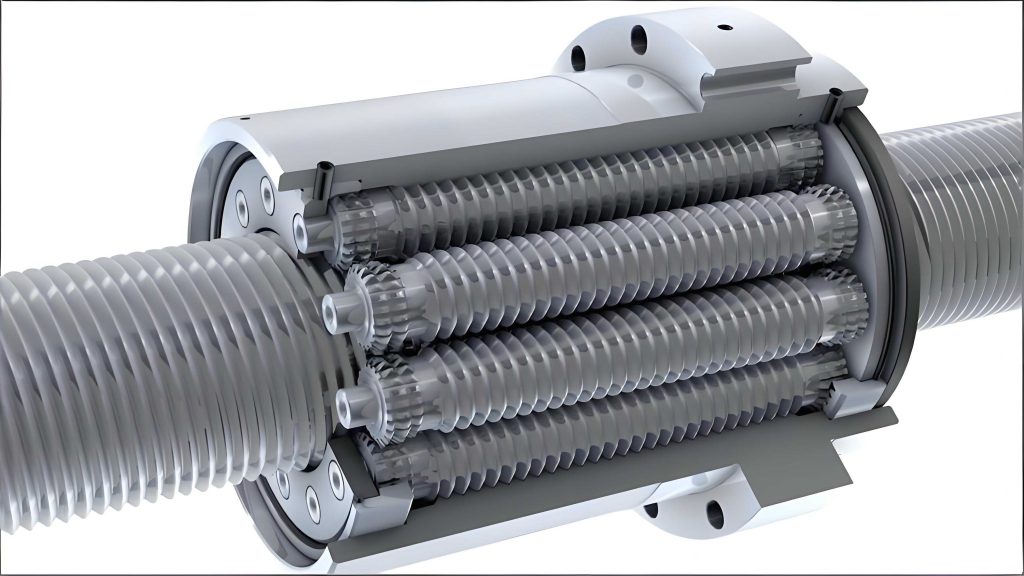
Modal analysis is essential for understanding the vibration behavior of mechanical systems, as it reveals natural frequencies and mode shapes that can lead to resonance if excited by external forces. For the planetary roller screw, we performed modal analysis using ANSYS Workbench, starting with model import in STEP format. The assembly was simplified to reduce computational complexity while retaining critical features. Material properties were assigned: all components, including the screw, nut, and rollers, were made of bearing steel with an elastic modulus of $$ E = 206 \text{ GPa} $$, density $$ \rho = 7.85 \times 10^{-6} \text{ kg/mm}^3 $$, and Poisson’s ratio $$ \nu = 0.3 $$. Contacts between parts were automatically detected and adjusted to appropriate types, such as bonded or frictional, to simulate real interactions. Mesh generation was carried out using smart sizing, resulting in a finite element model with sufficient refinement for accuracy. Boundary conditions mimicked typical operational setups: the planetary roller screw was horizontally positioned with one end fixed (restricting X, Y, Z displacements) and the other end supported (restricting X, Y displacements). We solved for the first six natural frequencies and corresponding mode shapes, as higher-order modes often have negligible impact on practical dynamics.
The results from the modal analysis are summarized in Table 1, which lists the natural frequencies and maximum deformations for the first six modes. These values provide insight into the stiffness and susceptibility to vibration of the planetary roller screw. For example, the first two modes exhibit bending vibrations with nearly identical frequencies, indicating symmetry in the structure. The third and sixth modes show axial vibrations, while the fourth and fifth modes involve torsional vibrations. The maximum deformations occur primarily in the screw and nut housing, suggesting these areas are critical for design optimization. To illustrate, the natural frequency for the first mode is 493 Hz, with a deformation of 22.7 mm, highlighting potential weak points under dynamic loading.
| Mode Order | Natural Frequency (Hz) | Maximum Deformation (mm) |
|---|---|---|
| 1st | 493 | 22.7 |
| 2nd | 494 | 22.8 |
| 3rd | 1277 | 34.9 |
| 4th | 2045 | 29.5 |
| 5th | 2047 | 29.5 |
| 6th | 2801 | 22.6 |
The mode shapes further elucidate the vibration patterns. For instance, the bending vibrations in modes 1 and 2 can be described by the fundamental frequency formula for a beam under simply supported conditions: $$ f_n = \frac{n^2 \pi}{2L^2} \sqrt{\frac{EI}{\rho A}} $$, where $$ L $$ is the length, $$ I $$ is the area moment of inertia, $$ A $$ is the cross-sectional area, and $$ n $$ is the mode number. However, for the planetary roller screw, the complex geometry requires finite element methods for accurate prediction. The axial vibrations relate to longitudinal wave propagation, with frequencies influenced by material stiffness and mass distribution. In general, the dynamic response of the planetary roller screw is governed by equations of motion derived from Newton’s second law: $$ M \ddot{x} + C \dot{x} + K x = F(t) $$, where $$ M $$ is the mass matrix, $$ C $$ is the damping matrix, $$ K $$ is the stiffness matrix, and $$ F(t) $$ is the external force vector. Modal analysis solves the eigenvalue problem $$ (K – \omega^2 M) \phi = 0 $$, yielding natural frequencies $$ \omega $$ and mode shapes $$ \phi $$. This theoretical foundation supports our simulation approach, ensuring reliable results for the planetary roller screw.
Several factors influence the modal characteristics of the planetary roller screw, including support conditions, nut position, and centrifugal forces. We investigated each factor systematically to understand their effects on natural frequencies and deformations.
First, the support method plays a crucial role in determining the boundary conditions for the planetary roller screw. Common support configurations include one-end fixed and one-end supported, one-end fixed and one-end free, both ends fixed, and both ends supported. We altered the boundary conditions in ANSYS Workbench and recalculated the natural frequencies for each case. The results are presented in Table 2, showing significant variations across modes. For example, with both ends fixed, the planetary roller screw exhibits the highest natural frequencies, indicating greater stiffness and resistance to vibration. This configuration is ideal for high-speed applications, as it allows for higher limiting speeds without resonance. Conversely, the one-end fixed and one-end free setup results in the lowest frequencies, making it unsuitable for dynamic environments. The differences can be explained by the effective length and constraint equations; for a beam, the natural frequency is inversely proportional to the square of the length, so fixed ends reduce the effective length, increasing frequency. This principle applies to the planetary roller screw, where support conditions modify the global stiffness matrix $$ K $$ in the eigenvalue problem.
| Support Method | 1st Mode (Hz) | 2nd Mode (Hz) | 3rd Mode (Hz) | 4th Mode (Hz) | 5th Mode (Hz) | 6th Mode (Hz) |
|---|---|---|---|---|---|---|
| One-end fixed, one-end supported | 493 | 494 | 1277 | 2045 | 2047 | 2801 |
| One-end fixed, one-end free | 117 | 182 | 888 | 893 | 1090 | 2645 |
| Both ends fixed | 602 | 602 | 1394 | 2307 | 2323 | 4472 |
| Both ends supported | 389 | 389 | 1394 | 1919 | 1933 | – |
Second, the working position of the nut along the screw axis affects the mass distribution and stiffness of the planetary roller screw. During operation, the nut moves linearly, changing the system’s dynamic properties. We simulated various nut positions by adjusting its axial displacement and computed the corresponding natural frequencies. The trends are illustrated in Figure 1 (described textually due to lack of image insertion). For modes 1, 2, and 3, the natural frequencies decrease as the nut moves toward the center, forming a concave pattern, with minimum values at mid-stroke. This indicates reduced overall stiffness when the nut is centrally located, lowering the limiting speed and increasing vibration risk. In contrast, modes 4 and 5 show a convex pattern, with frequencies peaking at the center. Higher modes generally decrease with increasing nut displacement. These behaviors can be modeled using variable mass and stiffness parameters in the equations of motion. For instance, the effective length $$ L_{eff} $$ for bending vibrations changes with nut position, altering the frequency according to $$ f \propto 1/L_{eff}^2 $$. Therefore, for long-stroke applications of the planetary roller screw, it is advisable to avoid high speeds to prevent resonance-induced failures.
To quantify the effect of nut position, we can derive an approximate formula for the natural frequency as a function of displacement $$ x $$: $$ f(x) = f_0 + \alpha x + \beta x^2 $$, where $$ f_0 $$ is the frequency at a reference position, and $$ \alpha $$ and $$ \beta $$ are coefficients determined from simulation data. For the planetary roller screw, this polynomial fit helps in predicting dynamic performance across the working range. Additionally, the change in moment of inertia $$ I(x) $$ due to nut movement influences torsional frequencies, given by $$ f_t = \frac{1}{2\pi} \sqrt{\frac{K_t}{I(x)}} $$, where $$ K_t $$ is the torsional stiffness. These analytical insights complement the finite element results, enhancing our understanding of the planetary roller screw’s behavior.
Third, centrifugal forces generated during high-speed rotation impact the modal characteristics of the planetary roller screw. When the screw, rollers, and retaining plates rotate, they experience centrifugal acceleration, which introduces prestress into the system. This prestress alters the stiffness matrix and, consequently, the natural frequencies. To account for this, we performed a prestressed modal analysis in ANSYS Workbench. First, a static structural analysis was conducted with rotational velocities applied: $$ \omega_s = 11.5 \text{ rad/s} $$ for the screw, $$ \omega_r = 4.32 \text{ rad/s} $$ for the rollers, and $$ \omega_p = -17.27 \text{ rad/s} $$ for the plates. The centrifugal force on a mass element is given by $$ F_c = m \omega^2 r $$, where $$ m $$ is the mass, $$ \omega $$ is the angular velocity, and $$ r $$ is the radius from the axis of rotation. This force induces initial stresses, which were then imported into the modal analysis module. The results, shown in Table 3, reveal that prestress significantly reduces low-order natural frequencies while increasing maximum deformations. For example, the first mode frequency drops from 493 Hz to 172 Hz, and deformation rises from 22.7 mm to 36.7 mm. This reduction in stiffness is critical for precision applications, as it can degrade transmission accuracy. Thus, for planetary roller screws used in high-precision settings, operating speeds should be limited to minimize centrifugal effects.
| Mode Order | Natural Frequency (Hz) | Maximum Deformation (mm) |
|---|---|---|
| 1st | 172 | 36.7 |
| 2nd | 177 | 36.6 |
| 3rd | 882 | 55.6 |
| 4th | 2104 | 55.9 |
| 5th | 2115 | 34.0 |
| 6th | 2803 | 48.3 |
The impact of centrifugal force can be further analyzed using the theory of stress stiffening. The prestress modifies the geometric stiffness matrix $$ K_G $$, leading to an updated eigenvalue problem: $$ (K + K_G – \omega^2 M) \phi = 0 $$. For rotating systems, $$ K_G $$ is proportional to the square of the angular velocity, i.e., $$ K_G \propto \omega^2 $$. This explains why higher speeds lower natural frequencies, as observed in the planetary roller screw. Additionally, the increased deformations under prestress relate to the additional strain energy stored in the components. The total deformation $$ \delta $$ can be estimated by superposing static and dynamic effects: $$ \delta = \delta_s + \delta_d $$, where $$ \delta_s $$ is due to centrifugal force and $$ \delta_d $$ is from vibration. For the planetary roller screw, this superposition highlights the need for balanced design between speed and precision.
Expanding on the finite element methodology, we detail the simulation setup to ensure reproducibility. The mesh sensitivity was tested by refining element sizes until convergence in natural frequencies was achieved. We used tetrahedral elements with an average size of 2 mm, resulting in approximately 500,000 nodes and 300,000 elements for the planetary roller screw assembly. The solver settings included a block Lanczos algorithm for eigenvalue extraction, with a tolerance of 1e-6. Material nonlinearities were neglected, as bearing steel behaves linearly within the operational range. Contact formulations accounted for friction coefficients of 0.1 between threaded surfaces, based on typical values for lubricated steel contacts. These parameters ensure that the simulation closely mimics real-world conditions for the planetary roller screw.
To provide a broader perspective, we compare our findings with existing literature on dynamic analysis of screw mechanisms. Previous studies on ball screws have shown similar trends regarding support conditions and nut position, but the planetary roller screw exhibits higher natural frequencies due to its distributed load sharing among rollers. For instance, the fundamental frequency of a comparable ball screw might be 20-30% lower, underscoring the advantage of the planetary roller screw in dynamic applications. However, the centrifugal effects are more pronounced in the planetary roller screw because of the multiple rotating components. This comparison reinforces the importance of tailored dynamic analysis for each screw type.
In terms of practical implications, the results guide the design and operation of planetary roller screws. For high-speed scenarios, such as in aerospace actuators, both ends fixed support is recommended to maximize natural frequencies and avoid resonance. In precision machine tools, where nut travel is extensive, speed limits should be imposed based on the concave frequency trends. Additionally, for applications demanding micron-level accuracy, centrifugal forces must be mitigated by optimizing rotational speeds or using counterweights. These recommendations stem directly from our finite element simulation of the planetary roller screw.
Future work could explore advanced topics such as nonlinear dynamics, thermal effects, and fatigue analysis. For example, temperature variations during operation can alter material properties and contact conditions, affecting the dynamic characteristics of the planetary roller screw. Incorporating thermal-structural coupling in simulations would provide a more comprehensive understanding. Similarly, random vibration analysis under operational spectra could assess fatigue life, ensuring long-term reliability of the planetary roller screw.
In conclusion, this article has presented an in-depth dynamic characteristic analysis of the planetary roller screw using finite element simulation. Through modal analysis, we identified natural frequencies and mode shapes, revealing bending, axial, and torsional vibrations. The influence of support methods, nut position, and centrifugal forces was systematically studied, with tables and formulas summarizing key outcomes. The planetary roller screw demonstrates superior dynamic performance with both ends fixed support, but caution is needed for long strokes and high speeds due to reduced stiffness and increased deformations. This research provides a foundation for optimizing the design and application of planetary roller screws in various engineering fields. By leveraging simulation tools, we can enhance the performance and reliability of this vital mechanical component, ensuring its continued success in precision motion control systems.