
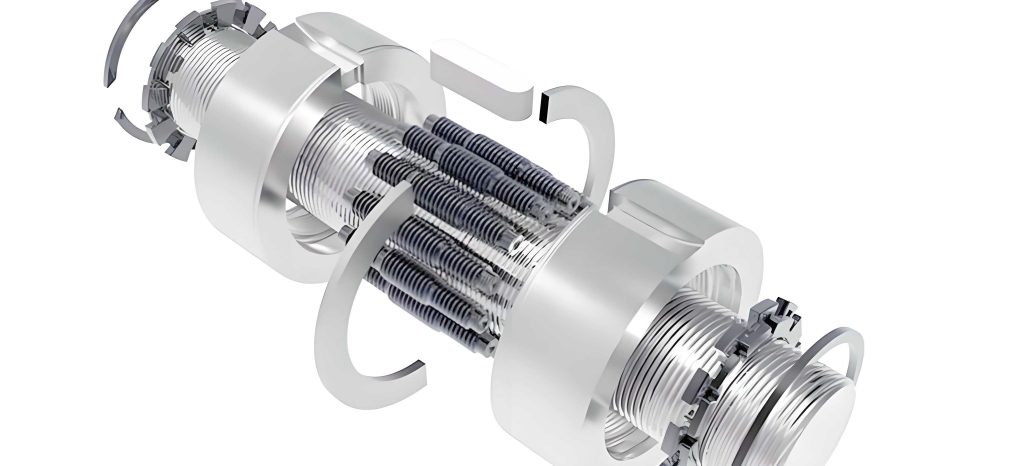
The planetary roller screw (PRS) is a precision mechanical transmission mechanism capable of converting rotary motion into linear motion and vice versa. Characterized by its high load capacity, accuracy, and impact resistance, the planetary roller screw has become a key actuator in linear servo systems for military and industrial applications. Its unique architecture features the synchronized meshing of a threaded pair (screw-roller-nut) and a gear pair (roller gear-internal ring gear). Understanding the dynamic interaction between these pairs is crucial for predicting performance, reliability, and lifespan. This article presents a comprehensive investigation into the dynamic contact load characteristics of this synchronized meshing system using a validated finite element model.
1. Fundamentals of Planetary Roller Screw Mechanism
1.1 Structural Configuration and Working Principle
The standard-type planetary roller screw mechanism, where the screw is the driving element, consists of several key components. The screw features a multi-start thread, typically with a 90° thread profile angle. Multiple rollers, each with a matching single-start thread, are arranged circumferentially around the screw. The nut possesses an internal thread matching the screw’s lead and profile. A critical element is the gear system: the ends of each roller are machined with spur teeth that mesh with an internal ring gear fixed to the nut or housing. This prevents the rollers from tilting due to the screw’s helix angle. A retainer (or cage) ensures even circumferential spacing of the rollers. When the screw rotates, it drives the rollers, which undergo both planetary revolution around the screw axis and rotation about their own axes. This motion, constrained by the gear mesh, translates into linear movement of the nut.
1.2 Kinematic Analysis
The kinematics of the standard planetary roller screw are derived from the relative motions at the contact points. Let $d_S$, $d_R$, and $d_N$ be the pitch diameters of the screw, roller, and nut threads, respectively. Let $d_P$ be the pitch diameter of the roller’s revolution ($d_P = d_S + d_R$). The angular velocities of the screw, roller rotation, and roller revolution are denoted as $\omega_S$, $\omega_R$, and $\omega_P$, respectively. The lead of the screw is $L = n_S \cdot P$, where $n_S$ is the number of screw thread starts and $P$ is the pitch.
Considering pure rolling conditions at the roller-nut interface and the kinematic constraints imposed by the gear mesh, the following relationships are established. The revolution speed of the roller is proportional to the screw speed:
$$ \omega_P = \frac{d_S}{2d_P} \omega_S = \frac{k}{2(k+1)} \omega_S $$
where $k = d_S / d_R$ is the pitch diameter ratio.
The rotation speed of the roller about its own axis is derived from the gear ratio (roller teeth $z_R$ to ring gear teeth $z_N$) and the revolution:
$$ \omega_R = \left( \frac{z_N}{z_R} \right) \omega_P $$
For the standard configuration with fixed ring gear, the relationship simplifies. More fundamentally, from the condition of no axial slip between roller and nut threads (same helix angle), the rotation and revolution are linked by:
$$ \frac{\omega_R}{\omega_P} = \frac{d_N}{d_R} = k + 2 $$
Thus,
$$ \omega_R = \omega_S \frac{k(k+2)}{2(k+1)} $$
The linear displacement $L_N$ and velocity $v_N$ of the nut per screw revolution and per unit time are given by:
$$ L_N (\text{per rev}) = n_S \cdot P $$
$$ L_N(t) = \frac{\omega_S t}{2\pi} n_S P $$
$$ v_N = \frac{\omega_S}{2\pi} n_S P $$
1.3 Static Force Analysis
Under an axial load $F_a$ on the nut, contact forces develop along the thread flanks. The normal contact force $F_n$ at a thread interface can be resolved into three orthogonal components: axial ($F_a$), tangential ($F_t$), and radial ($F_r$). For a thread with helix angle $\lambda$ and thread profile half-angle $\beta$, the relationships are:
$$ F_t = F_a \tan \lambda $$
$$ F_r = F_a \tan \beta $$
$$ F_n = F_a \sqrt{1 + \tan^2 \lambda + \tan^2 \beta} $$
These component forces are essential for analyzing load distribution, friction, and stress states within the planetary roller screw assembly.
2. Development of the Finite Element Numerical Model
To capture the complex, coupled dynamic contact behavior of the synchronized thread and gear meshes, a three-dimensional finite element model of the planetary roller screw was developed.
2.1 Model Simplification and Discretization
Given the cyclic symmetry of the planetary roller screw, the model was simplified to reduce computational cost while preserving essential physics. The model includes one screw, one nut, one internal ring gear, one retainer, and three rollers spaced 120° apart. Non-essential components like seals and pins were omitted, with their functions approximated by boundary conditions. Each roller was modeled with five complete thread teeth to capture load distribution adequately. Small fillets and chamfers were neglected. The material for all components was set as GCr15 bearing steel with properties: density $\rho = 7810 \text{ kg/m}^3$, Young’s modulus $E = 212 \text{ GPa}$, and Poisson’s ratio $\mu = 0.29$.
The geometry was meshed with tetrahedral elements. A critical aspect was mesh refinement in the contact regions of both the thread pairs and the gear pairs to ensure accurate resolution of contact pressures and stresses. The final model contained approximately 955,519 elements and 1,555,868 nodes.
| Parameter | Symbol | Value | Unit |
|---|---|---|---|
| Screw Pitch Diameter | $d_S$ | 44 | mm |
| Number of Screw Thread Starts | $n_S$ | 6 | – |
| Pitch | $P$ | 2 | mm |
| Helix Angle | $\lambda$ | 4.962 | ° |
| Thread Profile Half-Angle | $\beta$ | 45 | ° |
| Roller Pitch Diameter | $d_R$ | 11 | mm |
| Number of Threads per Roller | – | 5 | – |
| Nut Pitch Diameter | $d_N$ | 66 | mm |
| Circular Profile Radius | $\rho_a$ | 7.778 | mm |
| Parameter | Roller Gear | Ring Gear | Unit |
|---|---|---|---|
| Module | 0.55 | 0.55 | mm |
| Number of Teeth | 20 | 120 | – |
| Pressure Angle | 37.5 | 37.5 | ° |
| Tip Diameter | 10.0 | 64.0 | mm |
| Root Diameter | 8.73 | 65.27 | mm |
2.2 Boundary and Load Conditions
Appropriate constraints were applied to simulate the operational kinematics:
- Screw: A revolute joint about its axis, with a prescribed angular velocity $\omega_S$.
- Nut: A translational (prismatic) joint along its axis, with an applied axial resisting force $F_{load}$.
- Ring Gear: Fixed to the nut, sharing its translational constraint.
- Roller & Retainer: A cylindrical joint was applied between the roller end and the retainer hole, allowing rotation (simulating roller spin) and translation (simulating revolution with the nut). The retainer itself was connected to the nut’s translation.
Contact interactions were defined with a penalty method. Frictional contact was specified for the thread pairs (screw-roller and roller-nut), while frictionless contact was initially assumed for the gear pair and roller end-retainer contact for baseline comparison. The friction coefficient $\mu$ for thread contacts was varied in parametric studies.
2.3 Model Validation
The numerical model was validated against theoretical kinematic predictions and static load distribution models.
2.3.1 Kinematic Validation
Simulations were run with a constant nut load of 5 kN and screw speeds of 10, 20, and 30 rad/s. The nut’s axial displacement and velocity from the simulation were compared to theoretical values from the kinematic equations. The results showed excellent agreement.
| Screw Speed $\omega_S$ (rad/s) | Theoretical $v_N$ (mm/s) | Numerical $v_N$ (mm/s) | Relative Error (%) |
|---|---|---|---|
| 10 | 19.099 | 18.556 | 2.80 |
| 20 | 38.197 | 38.148 | 0.13 |
| 30 | 57.296 | 56.828 | 0.82 |
2.3.2 Static Load Distribution Validation
A static load distribution model for the planetary roller screw thread teeth, based on deformation compatibility and represented as a spring system, provides a theoretical reference. For a 5 kN nut load, this model predicts an average axial load per engaged thread on the roller. Converting this axial load to a normal contact force $F_n^{theory}$ using Eq. (7) yields a theoretical value. Under dynamic simulation ($\omega_S=30$ rad/s, $F_{load}=5$ kN, $\mu=0.02$), the steady-state normal contact forces on the screw-roller and roller-nut interfaces were extracted and averaged.
$$ F_n^{theory} \approx 2.363 \text{ kN} $$
$$ F_n^{num, S-R} \approx 2.381 \text{ kN} \quad (\text{Error: } 0.76\%) $$
$$ F_n^{num, R-N} \approx 2.372 \text{ kN} \quad (\text{Error: } 0.38\%) $$
The close agreement, with errors below 1%, validates the model’s accuracy in representing the load-carrying behavior of the planetary roller screw assembly.
3. Analysis of Dynamic Contact Load Characteristics
3.1 Dynamic Load Behavior of Individual Contact Pairs
Under a baseline condition ($\omega_S=30$ rad/s, $F_{load}=5$ kN, $\mu=0.02$), the dynamic contact loads for each interface were analyzed.
Thread Pair (Screw-Roller & Roller-Nut): After an initial transient period (approx. 0.008 s) where gaps are taken up and deformation occurs, the contact loads stabilize. The screw-roller interface shows a slightly higher mean load (2.381 kN) and greater fluctuation amplitude compared to the roller-nut interface (2.372 kN). This is attributed to the mixed rolling-sliding kinematics on the screw side and the marginally larger contact area on the nut (internal) side. Crucially, both steady-state loads exhibit small-amplitude, high-frequency fluctuations. These are induced by the meshing excitation from the synchronized gear pair and represent the coupled dynamic response of the system.
Gear Pair (Roller Gear-Ring Gear): The contact force displays clear periodic fluctuations characteristic of spur gear meshing. The mean steady-state load is significantly lower, approximately 0.059 kN. Its periodic excitation is a primary source of vibration in the planetary roller screw.
Roller End-Retainer Contact: This contact, which guides the roller’s revolution, carries a substantial load with a mean value of about 0.61 kN—over ten times that of the gear pair. Its dynamic load also shows pronounced periodic fluctuations, directly influenced by the gear meshing excitation transmitted through the roller. This highlights that the retainer is a critically loaded component often overlooked in simplified analyses.
3.2 Influence of Operational Parameters
3.2.1 Effect of Screw Rotational Speed
Simulations were conducted with $F_{load}=5$ kN and $\omega_S$ varying from 10 to 30 rad/s.
- Thread Pairs: Higher speeds reduce the initial transient time as inertial effects overcome gaps faster. However, the amplitude of fluctuations in the steady-state contact load increases with speed due to heightened dynamic effects and vibration.
- Gear Pair & Roller-Retainer Contact: The mean load remains largely unchanged. The primary effect is on the fluctuation period $T$. The roller’s rotational speed $\omega_R$ increases with $\omega_S$, leading to a higher gear meshing frequency $f_m = \omega_R \cdot z_R / (2\pi)$. Consequently, the period of load fluctuation decreases: $T = 1/f_m$. The phase difference between curves at different speeds is also evident.
$$ f_m = \frac{\omega_R \cdot z_R}{2\pi} = \frac{\omega_S}{2\pi} \cdot \frac{k(k+2)}{2(k+1)} \cdot z_R $$
$$ T \propto \frac{1}{\omega_S} $$
3.2.2 Effect of Nut Axial Load
Simulations were conducted with $\omega_S=30$ rad/s and $F_{load}$ varying from 5 to 7 kN.
| Nut Load $F_{load}$ (kN) | Screw-Roller $F_n^{mean}$ (kN) | Roller-Nut $F_n^{mean}$ (kN) | Gear Pair $F^{mean}$ (kN) | Roller-Retainer $F^{mean}$ (kN) |
|---|---|---|---|---|
| 5 | 2.381 | 2.372 | 0.059 | 0.610 |
| 6 | 2.856 | 2.846 | 0.055 | 0.733 |
| 7 | 3.332 | 3.321 | 0.051 | 0.855 |
The results reveal a key finding: while the thread pairs and the roller-retainer contact show a nearly proportional increase in mean load with applied nut load, the gear pair contact load exhibits a slight decrease. This indicates a load-sharing mechanism within the planetary roller screw assembly. As the external load increases, a greater proportion is carried by the elastic deformation of the thread flanks and the retainer guidance, somewhat offloading the gear teeth. This non-intuitive behavior underscores the importance of system-level analysis.
3.2.3 Effect of Friction Coefficient
The influence of the thread contact friction coefficient $\mu$ was studied from 0.01 to 0.2 under the baseline speed and load.
- Low Friction Regime ($\mu = 0.01$ to $0.03$): Contact loads are relatively low and show minimal change. The system operates efficiently with small fluctuations.
- High Friction Regime ($\mu = 0.1$ to $0.2$): A significant increase in all contact loads is observed. The mean steady-state forces rise substantially due to increased resistance to sliding. More critically, the amplitude of dynamic fluctuations becomes markedly larger and more erratic, especially during the initial transient. High friction induces stick-slip tendencies and exacerbates dynamic instabilities, which can lead to increased wear, noise, and reduced positioning accuracy in the planetary roller screw.
4. Conclusions
This investigation into the synchronized meshing dynamics of the planetary roller screw has yielded several important conclusions regarding its dynamic contact load characteristics:
- Coupled System Dynamics: The dynamic behavior of the planetary roller screw is governed by the coupled interaction between the thread pairs and the gear pair. The gear meshing excitation introduces periodic fluctuations into the otherwise steady thread contact loads, and vice-versa, the thread load deformation influences gear engagement.
- Critical Role of the Retainer: The contact between the roller shaft ends and the retainer carries a significant load—an order of magnitude greater than the gear pair. Its dynamic load is strongly modulated by the gear meshing frequency. This component must be carefully designed for load capacity and wear resistance.
- Speed Effects: Increasing the screw rotational speed amplifies dynamic fluctuations in thread contact loads and reduces the fluctuation period of gear-related loads (gear pair and roller-retainer), but does not alter their mean steady-state values.
- Load Effects: Increasing the nut axial load proportionally increases the mean contact loads on the thread pairs and the roller-retainer interface. Counter-intuitively, the mean gear pair contact load slightly decreases, indicating a complex internal load-sharing mechanism where the thread stiffness and retainer guidance absorb an increasing share of the external load.
- Friction Effects: A high coefficient of friction in the thread contacts is detrimental. It leads to a substantial increase in the magnitude of all contact loads and, more importantly, causes severe amplification of dynamic load fluctuations. Minimizing friction is therefore paramount for ensuring smooth operation, high efficiency, and longevity of the planetary roller screw mechanism.
The finite element modeling approach presented provides a powerful tool for capturing these complex interactions. The insights gained are essential for the advanced design, performance prediction, and reliability enhancement of high-performance planetary roller screw systems used in demanding applications.