
In my research on precision transmission systems, I focus on the rotary vector reducer, a critical component in heavy-duty applications such as robotics, aerospace, and military vehicles. The rotary vector reducer is renowned for its high torque capacity, compact design, and excellent stiffness, but under heavy loads, dynamic performance becomes paramount. This study aims to delve into the natural frequency characteristics and sensitivity analysis of a heavy-load rotary vector reducer based on a detailed dynamics model. I establish a 16-degree-of-freedom model using the lumped parameter method, analyze how system parameters influence inherent frequencies, and provide insights for optimizing the design of rotary vector reducers. The rotary vector reducer’s complexity necessitates a thorough understanding of its vibrational behavior to prevent resonance and ensure reliability.
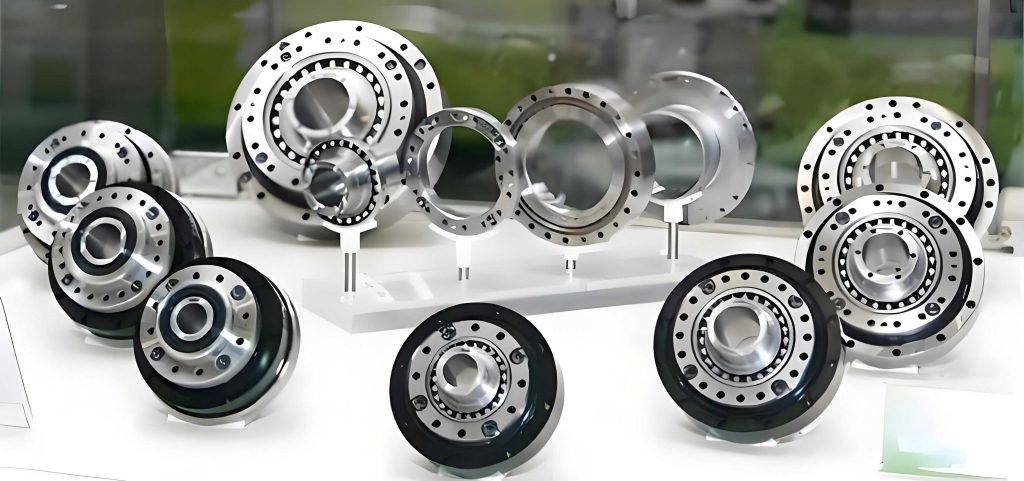
The rotary vector reducer operates as a two-stage gear system, combining planetary gear transmission with cycloidal pin-wheel mechanisms. Its structure includes a sun gear, planetary gears, crank shafts, cycloidal gears, a planet carrier, and a pin-tooth shell. The rotary vector reducer achieves high reduction ratios through this configuration, making it ideal for applications requiring precise motion control under substantial loads. In this analysis, I consider the unique aspects of heavy-load rotary vector reducers, where components like the pin-tooth shell experience significant forces, potentially affecting overall dynamics. Thus, unlike previous studies that often assume infinite pin-tooth shell stiffness, I incorporate its flexibility into my model to better reflect real-world conditions.
To develop the dynamics model for the rotary vector reducer, I begin with several assumptions to simplify the analysis while retaining accuracy. I assume uniform mass distribution for all components, with centers of mass aligned at geometric centers. Stiffness values, including gear mesh stiffness and bearing stiffness, are averaged and represented as equivalent springs, neglecting nonlinear variations. The engagement angle between cycloidal gears and pin teeth is calculated based on established methods, and I ignore friction, damping effects, and assembly errors. Additionally, bending deformations of the crank shaft are disregarded due to their high stiffness relative to bearings. These assumptions allow me to focus on the essential dynamic interactions within the rotary vector reducer.
The rotary vector reducer model comprises 16 degrees of freedom: 11 rotational freedoms around individual axes (sun gear, planet carrier, pin-tooth shell, two cycloidal gears, three planetary gears, and three crank shafts) and 5 translational freedoms for the cycloidal gears and crank shafts as they orbit around the planet carrier axis. I define coordinate systems to describe these motions, such as a rotating frame attached to the planet carrier and local frames on the cycloidal gears. The displacements along mesh lines are expressed as functions of angular vibrations. For instance, the torsional displacement for the sun gear is given by \( u_s = r_s \theta_s \), where \( r_s \) is the pitch radius and \( \theta_s \) is the angular displacement. Similar expressions apply to other components, as summarized in the following equations:
$$ u_{pi} = r_p \theta_{pi}, \quad u_{hi} = a \theta_{hi}, \quad u_{cj} = r_h \theta_{cj}, \quad u_o = r_h \theta_o, \quad u_r = r_r \theta_r $$
Here, \( i = 1 \sim 3 \) and \( j = 1 \sim 2 \) denote the indices for planetary gears and cycloidal gears, respectively, with \( a \) as the eccentricity, \( r_h \) as the distribution radius of crank shafts, and \( r_r \) as the pin-teeth distribution radius. These displacements form the basis for deriving the equations of motion.
Using Newton’s second law, I formulate the system of differential equations for the rotary vector reducer. The equations account for inertia, stiffness, and external torques. For example, the equation for the sun gear is:
$$ I_s \ddot{\theta}_s + k_a \theta_s + k_{spi} r_s \sum_{i=1}^{3} (u_s – u_{pi} – \eta_{hi} \cos \alpha) = T_0 $$
where \( I_s \) is the moment of inertia, \( k_a \) is the torsional stiffness, \( k_{spi} \) is the mesh stiffness between sun and planetary gears, \( \alpha \) is the pressure angle, \( \eta_{hi} \) is the translational displacement of the crank shaft, and \( T_0 \) is the input torque. Similar equations are derived for planetary gears, crank shafts, cycloidal gears, the planet carrier, and the pin-tooth shell. The relative displacements between components, such as between crank shafts and cycloidal gears, are defined as:
$$ \Delta_{cij} = u_{hi} – \eta_{hi} \cos(\phi_i + (j-1)\pi) + u_{cj} \cos(\phi_i + (j-1)\pi) – \eta_{cj} $$
and between cycloidal gears and the pin-tooth shell as:
$$ \Delta_{ccjr} = u_{cj} + \eta_{cj} \cos \beta – u_r $$
where \( \phi_i \) is the phase angle of the crank shaft and \( \beta \) is the equivalent engagement angle. Combining these, the overall dynamics can be expressed in matrix form:
$$ M \ddot{X} + C \dot{X} + K X = F $$
For natural frequency analysis, I simplify to the undamped free vibration case: \( M \ddot{X} + K X = 0 \). Solving this eigenvalue problem yields the natural frequencies of the rotary vector reducer.
I apply this model to a specific heavy-load rotary vector reducer, the RV-550E type, with parameters detailed in the tables below. The masses and moments of inertia are obtained from CAD models, while stiffness values are calculated based on standard mechanical formulas. The rotary vector reducer’s key parameters include gear teeth numbers, moduli, and radii, which influence its dynamic behavior.
| Parameter | Value |
|---|---|
| Sun gear teeth | 14 |
| Planet gear teeth | 42 |
| Cycloidal gear teeth | 59 |
| Pin teeth number | 60 |
| Module (mm) | 3 |
| Pressure angle (°) | 20 |
| Eccentricity a (mm) | 2.2 |
| Sun gear base radius r_s (mm) | 21 |
| Planet gear base radius r_p (mm) | 63 |
| Crank shaft distribution radius r_h (mm) | 84 |
| Pin-teeth distribution radius r_r (mm) | 165 |
| Input speed (rpm) | 6900 |
| Component | Mass (kg) | Moment of Inertia (kg·m²) | Stiffness Type | Value (N/m or N·m/rad) |
|---|---|---|---|---|
| Sun gear | 5.083 | 2.43×10⁻³ | Torsional stiffness k_s | 3.62×10⁶ |
| Planet gear | 1.326 | 2.87×10⁻³ | Mesh stiffness k_sp | 3.92×10⁹ |
| Crank shaft | 1.761 | 4.73×10⁻⁴ | Torsional stiffness k_h | 1.56×10⁶ |
| Cycloidal gear | 8.562 | 0.14 | Bearing stiffness k_hc | 1.18×10⁸ |
| Planet carrier | 42.96 | 0.513 | Bearing stiffness k_oh | 3.15×10⁸ |
| Pin-tooth shell | 51.209 | 1.986 | Torsional stiffness k_r | 1.0×10¹⁰ |
| Additional stiffness | Cycloidal-pin mesh stiffness k_cr = 3.15×10¹⁰ N/m | |||
Solving the eigenvalue problem, I obtain the natural frequencies of the rotary vector reducer. The lower-order frequencies are particularly critical as they are more likely to coincide with excitation sources, such as input speeds or mesh frequencies. The first six natural frequencies are listed in the table below, showcasing the dynamic characteristics of this rotary vector reducer.
| Mode Order | Natural Frequency (Hz) |
|---|---|
| 1 | 305 |
| 2 | 830 |
| 3 | 864 |
| 4 | 1686 |
| 5 | 1739 |
| 6 | 1750 |
To understand the influence of the pin-tooth shell stiffness, which is often overlooked in lighter rotary vector reducers, I vary its torsional stiffness \( k_r \) and observe changes in the first three natural frequencies. The results indicate that as \( k_r \) increases, the first and second natural frequencies rise, but they plateau beyond certain thresholds. Specifically, the first frequency stabilizes when \( k_r \) exceeds about \( 2 \times 10^7 \, \text{N·m/rad} \), while the second frequency stabilizes above \( 8 \times 10^7 \, \text{N·m/rad} \). The third frequency remains unaffected, suggesting it corresponds to a translational mode. This analysis helps in designing the pin-tooth shell for the rotary vector reducer: a minimum stiffness of \( 2 \times 10^7 \, \text{N·m/rad} \) is recommended to avoid significant shifts in natural frequencies that could lead to resonance.
The relationship can be expressed mathematically. For instance, the sensitivity of natural frequency \( \omega_r \) to a parameter \( p_m \) is derived from the eigenvalue problem. Starting with \( (-\omega_r^2 M + K) \phi_r = 0 \), where \( \phi_r \) is the eigenvector, differentiation yields:
$$ \frac{\partial \omega_r}{\partial p_m} = -\frac{1}{2\omega_r} \left( \omega_r^2 \phi_r^T \frac{\partial M}{\partial p_m} \phi_r – \phi_r^T \frac{\partial K}{\partial p_m} \phi_r \right) $$
For mass and stiffness elements \( m_{ij} \) and \( k_{ij} \), the sensitivities are:
$$ \frac{\partial \omega_r}{\partial m_{ij}} = \begin{cases} -\omega_r \phi_{ir} \phi_{jr} & (i \neq j) \\ -\frac{1}{2} \omega_r \phi_{ir}^2 & (i = j) \end{cases} $$
$$ \frac{\partial \omega_r}{\partial k_{ij}} = \begin{cases} \phi_{ir} \phi_{jr} / \omega_r & (i \neq j) \\ \phi_{ir}^2 / (2\omega_r) & (i = j) \end{cases} $$
I apply these formulas to compute the sensitivity of the first three natural frequencies with respect to various parameters in the rotary vector reducer. The results are normalized and presented in graphical form through the following descriptions. The sensitivity analysis reveals that low-order natural frequencies are most sensitive to the crank shaft’s moment of inertia, the bearing stiffness of the crank arm ( \( k_{hc} \) ), and the support bearing stiffness of the planet carrier ( \( k_{oh} \) ). This is crucial for optimizing the rotary vector reducer, as modifying these parameters can effectively shift natural frequencies away from excitation ranges.
For example, the sensitivity curves show that the first natural frequency has high sensitivity to the planet carrier’s moment of inertia and the crank arm bearing stiffness. In contrast, the second and third frequencies are more sensitive to the crank shaft’s moment of inertia. Regarding stiffness, the bearing stiffnesses \( k_{hc} \) and \( k_{oh} \) have pronounced effects, with \( k_{hc} \) being particularly influential due to its lower value compared to other stiffnesses in the rotary vector reducer. This underscores the importance of selecting appropriate bearings in the design of rotary vector reducers to enhance dynamic performance.
To illustrate, I plot how the first natural frequency changes with \( k_{hc} \). As \( k_{hc} \) decreases from its nominal value, the first frequency drops sharply, potentially nearing the input frequency and causing resonance. This highlights the need for maintaining high bearing stiffness in the rotary vector reducer through quality materials or design enhancements. Similarly, variations in the crank shaft’s torsional stiffness \( k_h \) have minimal impact until it falls below \( 4 \times 10^4 \, \text{N·m/rad} \), indicating that the rotary vector reducer is relatively robust to changes in this parameter under normal conditions.
The sensitivity findings are summarized in the table below, which lists the normalized sensitivity values for key parameters. This provides a quantitative basis for prioritizing design modifications in the rotary vector reducer.
| Parameter | Sensitivity to Mode 1 | Sensitivity to Mode 2 | Sensitivity to Mode 3 |
|---|---|---|---|
| Crank shaft inertia I_h | 0.15 | 0.45 | 0.40 |
| Planet carrier inertia I_o | 0.60 | 0.10 | 0.05 |
| Sun gear inertia I_s | 0.05 | 0.02 | 0.01 |
| Crank arm bearing stiffness k_hc | 0.70 | 0.30 | 0.25 |
| Planet carrier bearing stiffness k_oh | 0.40 | 0.20 | 0.15 |
| Pin-tooth shell stiffness k_r | 0.25 | 0.35 | 0.00 |
| Cycloidal-pin mesh stiffness k_cr | 0.10 | 0.05 | 0.05 |
In conclusion, my analysis of the heavy-load rotary vector reducer demonstrates the importance of dynamic modeling for predicting natural frequencies and assessing parameter sensitivities. The rotary vector reducer’s performance is highly influenced by components like bearings and crank shafts, which should be optimized to avoid resonance. Specifically, ensuring sufficient pin-tooth shell stiffness and selecting high-stiffness bearings can significantly improve the stability of the rotary vector reducer. This study provides a theoretical foundation for designing and optimizing rotary vector reducers in heavy-duty applications, contributing to advancements in transmission technology. Future work could explore nonlinear effects or experimental validation to further refine the dynamics of rotary vector reducers.