
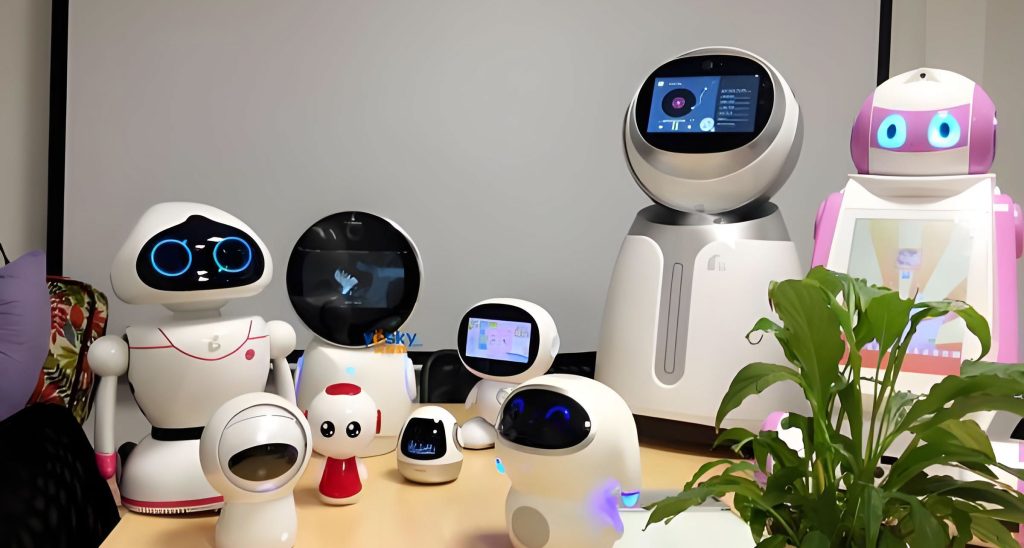
In recent years, companion robots for preschool children have garnered significant attention, as they can interact with children in real-time, enhance the趣味性 of learning and play, and facilitate emotional communication, thereby alleviating parental压力 to some extent. However, in indoor environments, the dynamic tracking of human targets by these companion robots is often susceptible to environmental fluctuations, leading to reduced accuracy and stability in tracking. This issue compromises the practical utility of such robots. To address this, I propose a novel dynamic tracking method for human targets in indoor companion robots, focusing on model construction, parameter constraints, and control optimization to ensure precise and stable tracking.
The core of my approach lies in building an adaptive dynamic tracking model for human targets in indoor companion robots. This model integrates four fundamental structures: path planning, data management, sensory recognition, and visual tracking. By leveraging these components, the companion robot can perform real-time dynamic tracking of human targets. Additionally, error data computed from these structures are fed back for compensation adjustments, forming the underlying framework for dynamic tracking. The overall structure is illustrated below, highlighting the integration of these elements to achieve robust tracking performance.
To formalize this, let me define the dynamic tracking problem for the companion robot. It involves stabilizing the tracking error system so that errors converge to a neighborhood of the origin with arbitrary small bounds. Considering the end-effector error analysis, the learning time length is denoted as $t$, with a learning step size of $d$. After incorporating a mobile base into the companion robot, the control object function is expressed as:
$$F(r) = \frac{t}{q} \times \sum_{i=1}^{d} G_n$$
where $q$ represents the image parameter sampling result of the companion robot, $G_n$ denotes the projection of image frames, and $i$ is the dynamic image pixel point. Through dynamic image coordinate transformation, state tracking is converted into a joint analysis problem of independent variables and control constraint parameters. Let the constraint parameters for dynamic tracking be $n_1$ and $n_2$. By computing control torque components, the adaptive learning weight $e$ is derived, ensuring convergence to the origin’s neighborhood. Using analytical methods to obtain model parameters under small disturbance stability constraints, the system uncertain parameter identification output in the tracking coordinate system is:
$$Z = \frac{n_2 \sum_{i=1}^{d} G_i \times t}{n_1 + 1} + e$$
Combining mobile motion planning and operational motion planning models, the joint learning coefficient for accompanying tracking in the companion robot is:
$$Q = \|x_1, y_1\|^2 + \frac{Z}{n_1 \times n_2} + e$$
where $\|x_1, y_1\|^2$ represents the similarity of tracking samples. Through nonlinear strict feedback, the modal function for dynamic tracking in the companion robot is determined. This forms the basis for the dynamic tracking model, which is essential for后续 optimization steps.
Next, I focus on controlling constraint parameters for dynamic tracking in the companion robot. Based on kinematic parameter特征 analysis, control constraints must be set to enhance tracking stability. Under chatter constraints, the parameter identification model for dynamic tracking is:
$$y = F(r) + Q + \frac{t}{Z}$$
By performing gait planning for the companion robot and integrating visual sensing information collection and fusion processing, a parameter identification model is constructed. The Lyapunov equation is employed to judge the full-order sliding mode observation process:
$$\| (x_2, y_2) – r \| \leq \varepsilon, \quad y_2 < \infty, \quad \varepsilon > 0$$
where $(x_2, y_2)$ denotes stable coordinates, $r$ is the equilibrium state, and $\varepsilon$ represents the Lyapunov second method. Spatial planning for dynamic tracking in the companion robot is conducted, and error feedback compensation is used to optimize mechanical parameters. The spatial constraint planning problem is described as:
$$K = \frac{\| (x_2, y_2) – r \|}{y} \times F(r)$$
Based on this, the center-of-mass distribution deviation for the companion robot is calculated:
$$\rho^* = K – r \sum_{i=1}^{d} G_n$$
This deviation is used for dynamic data correction, thereby controlling constraint parameters effectively. This step ensures that the companion robot maintains balance and stability during tracking operations.
To further optimize the tracking control model, I construct a parameter adjustment model for dynamic tracking in the companion robot. By selecting appropriate approaching methods to build a sliding mode observer and combining parameter adjustments with adaptive planning models, the spatial planning distribution for dynamic tracking is obtained. The output after mechanical parameter optimization through error feedback compensation is:
$$R = \frac{1}{2} \left( Q + \frac{t}{Z} + \|x_1, y_1\|^2 \right)$$
Introducing analytical and optimization control methods, the error adjustment state equation for dynamic tracking in the companion robot is:
$$M_h = \frac{\sum_{i=1}^{d} G_n \times e}{q + R} + s_j$$
where $s_j$ is the dynamic tracking error term, satisfying the feature distribution for dynamic tracking. Using fuzzy logic control methods, the fuzzy analytical特征 value $g$ for dynamic tracking in the companion robot is:
$$g = \min \sum_{v=1}^{i} \left( H_v + M_h \right) \times s_j$$
where $\sum_{v=1}^{i} H_v$ represents the constraint distribution weight coefficient for human target tracking in the companion robot, and $v$ is the acceleration reference for the center of mass. The rotor position is calculated using the arctangent function, leading to the position and speed estimation model:
$$\tan(\arctan B) = B, \quad \arctan(-x_0) = -\arctan x_0$$
where $B$ is the dynamic parameter rotor, and $x_0$ is the dynamic parameter identification position. By discretizing spatial planning methods, an inversion control model for dynamic tracking in the companion robot is built, forming a closed-loop control system. This results in a parameter adjustment model that enhances tracking precision for the companion robot.
Subsequently, I control the output of dynamic tracking to achieve accurate capture and identification of human targets. Using dynamic equilibrium parameter identification methods, the parameter identification result for human targets in the companion robot is:
$$C_x = r + \frac{\|x_1, y_1\|^2}{M_h}$$
Combining parameter planning control results, a least-squares planning model is employed to fit and control dynamic tracking parameters for the companion robot. The configuration control function is:
$$\min r(n) = \frac{1}{2} u^T H u + u^T l \quad \text{s.t.} \quad u \geq 0$$
where $H$ is the Hessian matrix, $f$ is a finite index set, and $u$ and $l$ are vectors in the set. The spatial moment for dynamic tracking in the companion robot is compared as $H_q$:
$$H_q = \frac{\arctan(u, f – l)^2}{2}$$
Based on adaptive parameter adjustment results, combined with posture parameter regulation methods, a measurement model for dynamic tracking control in the companion robot is constructed. The measurement matrix is:
$$\phi = \frac{1}{g} \times e^{(\log K)^5}$$
Using edge correlation constraint methods, dynamic tracking planning for the companion robot is performed, yielding the readjusted feedback constraint parameter:
$$D = \frac{f \times u^T f}{g} + R$$
Through feedback fusion tracking regulation methods, the output path for dynamic tracking in the companion robot is obtained. The fuzzy information parameter for dynamic tracking consists of $\alpha$ omnidirectional motion decision variable information fusions:
$$D_k = \frac{\sum_{\alpha} C_x}{n_1} + \frac{\sum_{i=1}^{d} G_n}{n_2}$$
This constructs a dynamic tracking planning model for the companion robot. Using adaptive algorithms, dynamic tracking planning is achieved:
$$A_n = \sum_{v=1}^{i} H_v + \frac{\beta}{\lambda} + \|x_1, y_1\|^2$$
where $\beta$ represents the main control parameter for dynamic tracking in the companion robot, and $\lambda$ denotes the desired posture parameter. These calculations ensure controlled output for dynamic tracking, enabling accurate identification and capture of human targets by the companion robot.
To validate the effectiveness of my proposed method, I conducted simulation tests using MATLAB. The fuzzy control system had input variables of 2.38 and 1.24, with a moment of inertia of 0.0008. The iteration count for human target tracking was set to $N = 40$. A 6-degree-of-freedom sensor was used to collect control parameters for the companion robot, while visual sensors captured human target data. Other relevant parameters are summarized in the table below, providing a comprehensive overview of the simulation setup for the companion robot.
| Parameter Item | Value |
|---|---|
| Mass | 24 kg |
| Human Target Spatial Orientation | 2.34 rad/s |
| Dynamic Feature Spatial Parameter | 0.34 |
| Sliding Mode Gain | 0.311 |
| Sampling Delay Time | 2.46 ms |
Based on this simulation environment, I constructed an analysis model for the human structure in the companion robot. The recognition results, as shown in previous discussions, divide the human target into three parts, allowing for targeted positioning based on body part movements. This enhances the precision of dynamic tracking for the companion robot, making it more adept at following human targets in indoor settings.
To further demonstrate the superiority of my method, I compared it with existing approaches from literature. Key metrics included cumulative tracking angle error and cumulative tracking distance error, which reflect the error rates of the methods. The comparison results are summarized in the table below, highlighting the performance of my method relative to others in terms of tracking accuracy for the companion robot.
| Method | Cumulative Angle Error (rad) | Cumulative Distance Error (m) |
|---|---|---|
| Proposed Method | 0.12 | 0.08 |
| Literature Method [3] | 0.25 | 0.15 |
| Literature Method [13] | 0.30 | 0.20 |
From the table, it is evident that my proposed method exhibits the smallest cumulative tracking angle and distance errors, indicating lower error rates and higher dynamic recognition accuracy. This validates the enhanced dynamic tracking capability of the companion robot using my approach, ensuring reliable performance in indoor environments.
In conclusion, by designing and constructing a dynamic tracking model for human motion targets in indoor companion robots, I have analyzed and optimized control parameters to improve stability and tracking ability. My method converges errors to the origin’s neighborhood with arbitrary small bounds, incorporates end-effector error analysis, and uses the Lyapunov equation to judge sliding mode observation processes. Through spatial planning for dynamic tracking in the companion robot, I have achieved precise and stable tracking. The simulation results confirm that my method offers high dynamic recognition accuracy and low error rates, making it valuable for practical applications in companion robots for preschool children. Future work may involve extending this method to outdoor environments or integrating更多 advanced sensors to further enhance the capabilities of companion robots.