
In this study, we focus on developing a comprehensive dynamics modeling approach for rotary vector reducers, which are critical components in robotics and precision machinery due to their high reduction ratios, compactness, and robustness. Rotary vector reducers, often abbreviated as RV reducers, evolved from cycloid pin-wheel transmissions and offer superior performance over traditional gear systems. We begin by analyzing the force distribution in cycloid pin-wheel transmissions, then apply Hertzian contact theory to model the dynamics of the cycloid pin-wheel pair. Additionally, we utilize the Ishikawa formula to establish the dynamics model for spur gear pairs. Integrating these components, we derive a full dynamics model for the rotary vector reducer, enabling frequency characteristic analysis to mitigate resonance-induced vibrations in robotic applications.
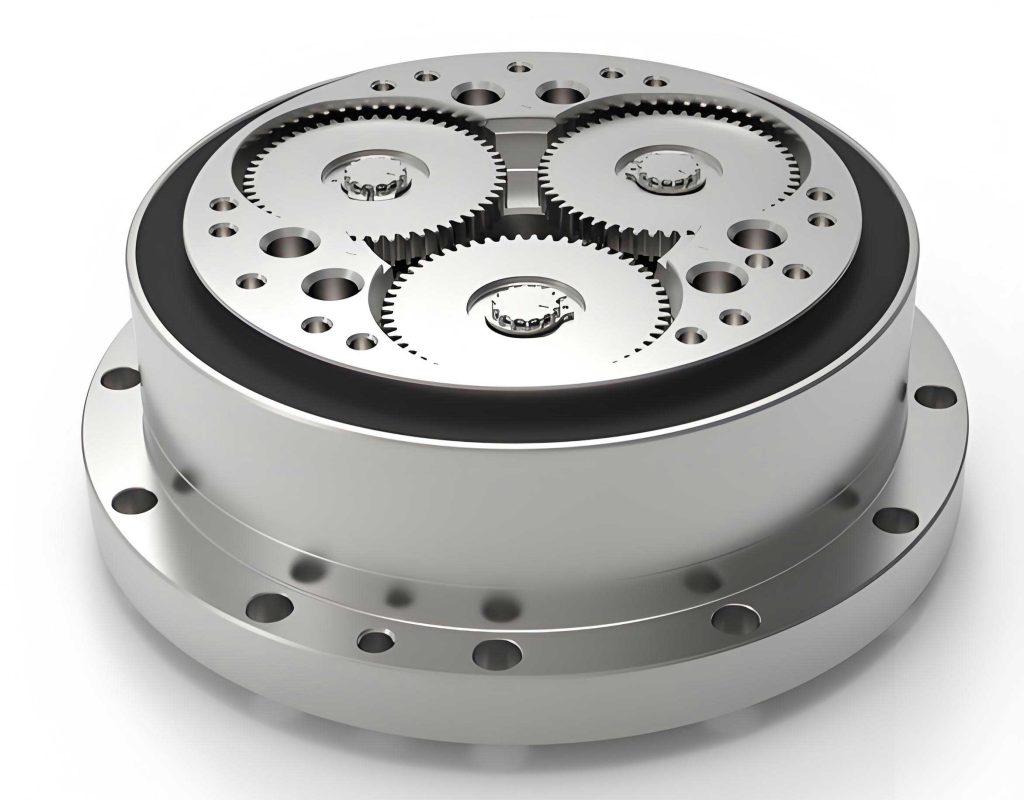
The advantages of rotary vector reducers are multifaceted: they provide large reduction ratios in a small volume, high efficiency, longevity, impact resistance, smooth operation with minimal noise, coaxial input and output shafts, compact design, low inertia, and ease of maintenance. These attributes make rotary vector reducers indispensable in robotics, where precise motion control is paramount. However, despite their significance, research on rotary vector reducers remains limited, particularly in domestic contexts, due to their relatively recent development. Early efforts included substituting cycloid gears with involute profiles and conducting force analyses, but comprehensive dynamics models are still lacking. Our work, supported by national initiatives, aims to fill this gap by establishing a reliable mathematical framework for rotary vector reducers, addressing issues such as manufacturing costs and performance evaluation standards.
We structure this article as follows: first, we perform a force analysis of the cycloid pin-wheel transmission. Second, we compute the curvature radius of the cycloid tooth profile. Third, we develop stiffness models for both cycloid pin-wheel and spur gear pairs using Hertz and Ishikawa formulas, respectively. Finally, we integrate these into a whole-machine dynamics model for the rotary vector reducer. Throughout, we emphasize the term “rotary vector reducer” to underscore its centrality in our analysis.
Force Analysis of Cycloid Pin-Wheel Transmission
In a cycloid pin-wheel transmission, the rotation direction of the crank arm is opposite to that of the cycloid gear. For the output cycloid gear, the angular velocity $\omega_g$ and output torque $T_g$ are in opposite directions. In the converted mechanism, the pin wheel rotates in the same direction as the cycloid gear and can be considered the input element. Thus, on the right side of the y-axis, the pin wheel and cycloid gear tend to separate, with no force interaction. On the left side, they engage, and the forces $F_1, F_2, F_3, \dots$ exerted by the pin teeth on the cycloid gear act along the common normal of the engagement line, intersecting at the pitch point P.
To determine the force magnitudes, we assume the cycloid gear is momentarily stationary and apply a clockwise torque $T’_g = T_g$ to the pin wheel. Under this torque, deformation occurs between engaged teeth. Let $T_v$ be the resistance torque on the output shaft. Since two cycloid gears share the load, each bears $T_g = T_v / 2$. Accounting for manufacturing and assembly errors that cause uneven load distribution, we increase $T_v$ by 10%, so $T_g = 0.55 T_v$. The force at the i-th contact point is given by:
$$F_i = \frac{2.2 T_v}{K_1 Z_g R_z} \frac{\sin \theta_{bi}}{\sqrt{S}} \tag{1}$$
where $T_v$ is the output shaft resistance torque, $Z_g$ is the number of cycloid gear teeth, $R_z$ is the pin wheel radius, $r_b$ is the rolling circle radius, $K_1 = r_b / R_z$ is the shortening coefficient, $\theta_{bi}$ is the angle between the line connecting the pin tooth center and rolling circle center and the y-axis, and $S = 1 + K_1^2 – 2K_1 \cos \theta_{bi}$.
This force distribution is critical for subsequent stiffness calculations in rotary vector reducers.
Curvature Radius of Tooth Profile
Based on cycloid generation principles, the parametric equations for the theoretical tooth profile of the cycloid gear are:
$$x_0 = R_z \left( \sin \eta’_b – \frac{K_1}{Z_b} \sin(Z_b \eta’_b) \right) \tag{2}$$
$$y_0 = R_z \left( \cos \eta’_b – \frac{K_1}{Z_b} \cos(Z_b \eta’_b) \right)$$
where $Z_b$ is the number of pin teeth, $\eta’_b$ is the rotation angle of the pin wheel relative to the cycloid gear, and other parameters are as defined earlier. Using differential geometry, the curvature radius $\rho_0$ of the theoretical profile is:
$$\rho_0 = \frac{\left( \left( \frac{dx_0}{d\eta’_b} \right)^2 + \left( \frac{dy_0}{d\eta’_b} \right)^2 \right)^{3/2}}{\frac{dx_0}{d\eta’_b} \cdot \frac{d^2 y_0}{d\eta’_b^2} – \frac{dy_0}{d\eta’_b} \cdot \frac{d^2 x_0}{d\eta’_b^2}} \tag{3}$$
Computing the derivatives:
$$\frac{dx_0}{d\eta’_b} = R_z (\cos \eta’_b – K_1 \cos(Z_b \eta’_b))$$
$$\frac{d^2 x_0}{d\eta’_b^2} = R_z (-\sin \eta’_b + K_1 Z_b \sin(Z_b \eta’_b))$$
$$\frac{dy_0}{d\eta’_b} = R_z (-\sin \eta’_b + K_1 \sin(Z_b \eta’_b))$$
$$\frac{d^2 y_0}{d\eta’_b^2} = R_z (-\cos \eta’_b + K_1 Z_b \cos(Z_b \eta’_b))$$
Substituting and simplifying with $\theta_b = Z_b \eta’_b – \eta’_b = Z_g \eta’_b$, we obtain:
$$\rho_0 = \frac{(1 + K_1^2 – 2K_1 \cos \theta_b)^{3/2} R_z}{K_1 (1 + Z_b) \cos \theta_b – (1 + Z_b K_1^2)} \tag{4}$$
A positive $\rho_0$ indicates a concave profile, while negative denotes convex. The actual profile is an equidistant curve of the theoretical one, so its curvature radius $\rho_b$ is:
$$\rho_b = \rho_0 + r_z = \frac{(1 + K_1^2 – 2K_1 \cos \theta_b)^{3/2} R_z}{K_1 (1 + Z_b) \cos \theta_b – (1 + Z_b K_1^2)} + r_z \tag{5}$$
where $r_z$ is the pin sleeve radius. This curvature is essential for contact mechanics in rotary vector reducers.
Stiffness Modeling of Cycloid Pin-Wheel Pair
The cycloid pin-wheel pair transmits motion via line contact, but elastic deformation results in a small area contact. Assuming straight-line deformation, the contact zone has length $2a$ and width $b$. According to Hertzian theory, the half-contact length $a$ is:
$$a = \sqrt{ \frac{4 F_i}{c b} \left( \frac{1 – \nu_1^2}{E_1} + \frac{1 – \nu_2^2}{E_2} \right) \frac{1}{\delta_i} } \tag{6}$$
where $\frac{1}{\delta_i} = \frac{1}{r_z} – \frac{1}{\rho_{bi}}$ (negative for convex cycloid profiles), $\rho_{bi}$ is the curvature radius at the contact point, $\nu$ is Poisson’s ratio, $E$ is Young’s modulus, and $c$ is a geometric constant. For identical materials, $\nu_1 = \nu_2 = \nu$ and $E_1 = E_2 = E$, simplifying to:
$$a = \sqrt{ \frac{8 F_i \delta_i (1 – \nu^2)}{c b E} } \tag{7}$$
From geometry, the radial deformation $t_z$ of the pin tooth is:
$$t_z = r_z \left( 1 – \sqrt{1 – \left( \frac{a}{r_z} \right)^2 } \right) \tag{8}$$
Expanding via Taylor series and ignoring higher-order terms:
$$t_z \approx \frac{a^2}{2 r_z} = \frac{4 F_i \delta_i (1 – \nu^2)}{c b E r_z} \tag{9}$$
Thus, the stiffness of a single pin tooth is:
$$K_{zi} = \frac{F_i}{t_z} = \frac{c b E r_z}{4 \delta_i (1 – \nu^2)} \tag{10}$$
Substituting $\delta_i$ and simplifying with $S = 1 + K_1^2 – 2K_1 \cos \theta_b$ and $T = K_1 (1 + Z_b) \cos \theta_b – (1 + Z_b K_1^2)$:
$$K_{zi} = \frac{c b E R_z S^{3/2}}{4 (1 – \nu^2) (R_z S^{3/2} + r_z T)} \tag{11}$$
Similarly, the radial deformation $t_b$ of the cycloid tooth is:
$$t_b \approx \frac{4 F_i \delta_i (1 – \nu^2)}{c b E \rho_{bi}} \tag{12}$$
Hence, the stiffness of a single cycloid tooth is:
$$K_{bi} = \frac{F_i}{t_b} = \frac{c b E R_z S^{3/2}}{4 (1 – \nu^2) r_z T} \tag{13}$$
The combined stiffness for a single tooth pair, modeled as springs in series, is:
$$K_{si} = \frac{K_{bi} K_{zi}}{K_{bi} + K_{zi}} = \frac{c b E R_z S^{3/2}}{4 (1 – \nu^2) (R_z S^{3/2} + 2 r_z T)} \tag{14}$$
Accounting for manufacturing errors via an adjustment factor $\lambda$ (0 < $\lambda$ < 1), the total meshing stiffness for the cycloid pin-wheel pair with $i$ contact points is:
$$K_{bz} = \lambda \sum_{i=1}^{n} K_{si} \tag{15}$$
Since two cycloid gears engage 180° out of phase, all pin teeth are loaded simultaneously, ensuring smooth operation. Although $K_{bz}$ varies slightly with time, we treat it as constant for model simplification in rotary vector reducers.
Stiffness Modeling of Spur Gear Pair
For spur gears in the rotary vector reducer, we apply the Ishikawa formula, approximating a tooth as a combination of trapezoidal and rectangular sections. The deformation $W$ at the load point along the line of action comprises bending, shear, and foundation components:
$$W = W_{Br} + W_{Bt} + W_S + W_G \tag{16}$$
where:
$$W_{Br} = \frac{12 F_N \cos^2 \kappa_x}{E b S_F^3} \left[ h_x h_r (h_x – h_r) + \frac{h_r^3}{3} \right]$$
$$W_{Bt} = \frac{6 F_N \cos^2 \kappa_x}{E b S_F^3} \left( \frac{h_i – h_x}{h_i – h_r} \right)^4 – \left( \frac{h_i – h_x}{h_i – h_r} \right) – 2 \ln \left( \frac{h_i – h_x}{h_i – h_r} \right) – 3 \left( h_i – h_r \right)^3$$
$$W_S = \frac{2 (1 + \nu) F_N \cos^2 \kappa_x}{E b S_F} \left[ h_r + (h_i – h_r) \ln \left( \frac{h_i – h_r}{h_i – h_x} \right) \right]$$
$$W_G = \frac{24 F_N h_x^2 \cos^2 \kappa_x}{\pi E b S_F^2}$$
Here, $F_N$ is the normal force, $b$ is face width, $S_F$ is tooth root thickness, $h_r$ is root height, $h_x$ is load point height, $h_i$ is intermediate height, and $\kappa_x$ is pressure angle at load point. Geometric relations are:
$$h = \sqrt{ r_k^2 – \left( \frac{S_k}{2} \right)^2 } – \sqrt{ r_r^2 – \left( \frac{S_F}{2} \right)^2 } \tag{17}$$
$$h_x = r_x \cos(\tau_x – \kappa_x) – \sqrt{ r_r^2 – \left( \frac{S_F}{2} \right)^2 } \tag{18}$$
with $r_k$, $r_r$, $r_x$ as tip, root, and load point radii, and $\tau_x$ as engagement angle. The total deformation for a tooth pair includes contact deformation $W_{PV}$:
$$W_{PV} = \frac{4 (1 – \nu^2)}{\pi E} \frac{F_N}{b} \tag{19}$$
Thus, total deformation $W_E = W_1 + W_2 + W_{PV}$, and single-pair meshing stiffness is:
$$K’_s = \frac{F_N}{W_E} = \left( \frac{1}{K_{Br1}} + \frac{1}{K_{Bt1}} + \frac{1}{K_{S1}} + \frac{1}{K_{G1}} + \frac{1}{K_{Br2}} + \frac{1}{K_{Bt2}} + \frac{1}{K_{S2}} + \frac{1}{K_{G2}} + \frac{1}{K_{PV}} \right)^{-1} \tag{20}$$
where individual stiffness terms are derived from deformation components. Per ISO guidelines, we approximate $K’_s$ using pitch point stiffness and express total spur gear stiffness as:
$$K_d = K’_s (0.65 \varepsilon_\alpha + 0.35) \tag{21}$$
with $\varepsilon_\alpha$ as contact ratio. This simplification facilitates practical analysis of rotary vector reducers.
Whole-Machine Dynamics Model of Rotary Vector Reducer
Integrating the above models, we establish a simplified dynamics model for the rotary vector reducer with the pin housing as output. The system has seven degrees of freedom: input gear, three spur gears, two cycloid gears, and output housing. The stiffness matrix $[K]_{7 \times 7}$ is:
$$
[K] =
\begin{bmatrix}
3K_d R_1^2 & -K_d R_1 R_2 & -K_d R_1 R_3 & -K_d R_1 R_4 & 0 & 0 & 0 \\
-K_d R_1 R_2 & K_d R_2^2 + K_{n1} & 0 & 0 & -K_{n1} & 0 & 0 \\
-K_d R_1 R_3 & 0 & K_d R_3^2 + K_{n1} & 0 & -K_{n1} & 0 & 0 \\
-K_d R_1 R_4 & 0 & 0 & K_d R_4^2 + K_{n1} & -K_{n1} & 0 & 0 \\
0 & -K_{n1} & -K_{n1} & -K_{n1} & 3K_{n1} + 3K_{n2} + K_{bz} (R_z – r_z)^2 & -3K_{n2} & -K_{bz} (R_z – r_z)^2 \\
0 & 0 & 0 & 0 & -3K_{n2} & 3K_{n2} + K_{bz} (R_z – r_z)^2 & -K_{bz} (R_z – r_z)^2 \\
0 & 0 & 0 & 0 & -K_{bz} (R_z – r_z)^2 & -K_{bz} (R_z – r_z)^2 & 2K_{bz} (R_z – r_z)^2
\end{bmatrix}
\tag{22}
$$
where $K_{n1}$ is torsional stiffness between spur gears and cycloid gears, $K_{n2}$ is torsional stiffness between the two cycloid gears, $K_d$ is spur gear meshing stiffness, $K_{bz}$ is cycloid pin-wheel meshing stiffness, $R_1$ is pitch radius of input gear, $R_2 = R_3 = R_4$ are spur gear radii, $R_z$ is pin wheel radius, and $r_z$ is pin radius. The inertia matrix $[J]_{7 \times 7}$ and damping matrix $[C]_{7 \times 7}$ are constructed similarly. The free vibration equation is:
$$ [J] \{\ddot{\theta}\} + [C] \{\dot{\theta}\} + [K] \{\theta\} = \{0\} \tag{23} $$
with $\{\theta\}$ as angular displacement vector. This model enables frequency analysis to prevent resonance in rotary vector reducers.
Parameter Summary and Numerical Example
To illustrate the modeling, we provide a parameter table for a typical rotary vector reducer, such as the RV60AⅡ type. Key parameters influence stiffness and dynamics.
| Parameter | Symbol | Value | Unit |
|---|---|---|---|
| Pin wheel radius | $R_z$ | 60 | mm |
| Pin radius | $r_z$ | 5 | mm |
| Cycloid gear teeth | $Z_g$ | 40 | – |
| Shortening coefficient | $K_1$ | 0.8 | – |
| Spur gear pitch radius | $R_1$ | 20 | mm |
| Young’s modulus | $E$ | 210 | GPa |
| Poisson’s ratio | $\nu$ | 0.3 | – |
| Face width | $b$ | 10 | mm |
| Contact ratio | $\varepsilon_\alpha$ | 1.5 | – |
| Adjustment factor | $\lambda$ | 0.9 | – |
Using these, we compute sample stiffness values. For instance, at $\theta_b = 30^\circ$, $S \approx 1.64$, $T \approx -0.92$, giving cycloid pin-wheel stiffness $K_{bz} \approx 1.2 \times 10^8 \, \text{N/m}$ and spur gear stiffness $K_d \approx 5.0 \times 10^7 \, \text{N/m}$. These feed into the dynamics model for eigenvalue analysis.
Discussion and Implications
Our dynamics modeling approach for rotary vector reducers reveals several insights. The cycloid pin-wheel stiffness $K_{bz}$ is generally higher than spur gear stiffness $K_d$, contributing to the high torsional rigidity of rotary vector reducers. The stiffness matrix in Equation (22) shows coupling between components, which can lead to complex vibration modes. By solving Equation (23), we obtain natural frequencies and mode shapes, allowing designers to avoid operational ranges that excite resonance. For example, if the input frequency matches a natural frequency, it may cause chatter in robotic joints—a critical issue addressed by our model.
Furthermore, the model aids in optimizing rotary vector reducer design. Parameters like $K_1$, $R_z$, and tooth profiles can be tuned to enhance stiffness or reduce weight. Sensitivity analysis using partial derivatives of $[K]$ with respect to parameters helps identify influential factors. For instance, increasing $R_z$ boosts $K_{bz}$ but also adds mass, affecting inertia. Thus, a balanced design is achievable through iterative simulation.
We also consider nonlinearities, such as time-varying meshing stiffness due to tooth engagement cycles. Although we simplified $K_{bz}$ as constant, a more refined model could incorporate periodic variations using Fourier series, enhancing accuracy for high-speed applications of rotary vector reducers. Damping estimation, often based on material loss factors or experimental data, further refines the model.
Conclusion
In this study, we developed a comprehensive dynamics modeling method for rotary vector reducers. We started with force analysis of cycloid pin-wheel transmissions, derived tooth profile curvature, and applied Hertzian theory to establish stiffness models for cycloid pin-wheel pairs. For spur gear pairs, we utilized the Ishikawa formula. Integrating these, we constructed a whole-machine dynamics model with a stiffness matrix and vibration equation. This model facilitates frequency characteristic analysis, enabling the prevention of resonance-induced vibrations in robotic systems using rotary vector reducers. Future work may include experimental validation, nonlinear stiffness considerations, and extension to other reducer types. Our contributions provide a foundational mathematical framework for advancing the design and application of rotary vector reducers in precision engineering.
Appendix: Mathematical Derivations
For completeness, we outline key derivations. The curvature radius formula (4) stems from differential geometry of parametric curves. The Hertzian contact simplification assumes small deformations and isotropic materials. The Ishikawa formula approximations are valid for standard gear geometries. In rotary vector reducers, these assumptions hold under normal operating conditions.
We also note that the dynamics model can be adapted to finite element analysis for detailed stress studies. However, our lumped-parameter approach offers computational efficiency for initial design stages. The repeated emphasis on “rotary vector reducer” throughout this article underscores its significance in modern machinery, and we hope this work spurs further research into these versatile devices.