
In the realm of robotics, the development of humanoid dexterous robotic hands has garnered significant attention due to their potential to revolutionize industries such as manufacturing, healthcare, military, aerospace, and scientific research. These robotic hands aim to mimic the versatility and functionality of the human hand, enabling tasks that require fine manipulation, grasping, and interaction with complex environments. As a researcher deeply immersed in this field, I have focused on advancing the design and analysis of such systems, particularly through dynamic modeling and simulation. This article presents a comprehensive study on the dynamics simulation analysis of a humanoid dexterous robotic hand, leveraging the Lagrangian mechanics framework and the Adams software for virtual prototyping. The goal is to provide a theoretical foundation for the design and application of dexterous robotic hands, ensuring stable motion that aligns with human hand biomechanics.
The human hand is a marvel of biological engineering, with multiple degrees of freedom (DOFs) that allow for precise and adaptive movements. Replicating this in a robotic counterpart involves intricate mechanical design, sensor integration, and control strategies. Over the years, various approaches have been explored to model the dynamics of dexterous robotic hands, including Newton-Euler equations, Lagrangian mechanics, and Kane’s method. In this work, I adopt the Lagrangian approach due to its systematic formulation and ease of incorporating constraints. By building upon existing research, I aim to contribute an improved dynamic model that accounts for interaction forces with objects, enhancing the realism and applicability of simulations. The use of Adams, a multi-body dynamics software, allows for rigorous validation of these models, facilitating insights into joint torques, motion stability, and performance under external loads.
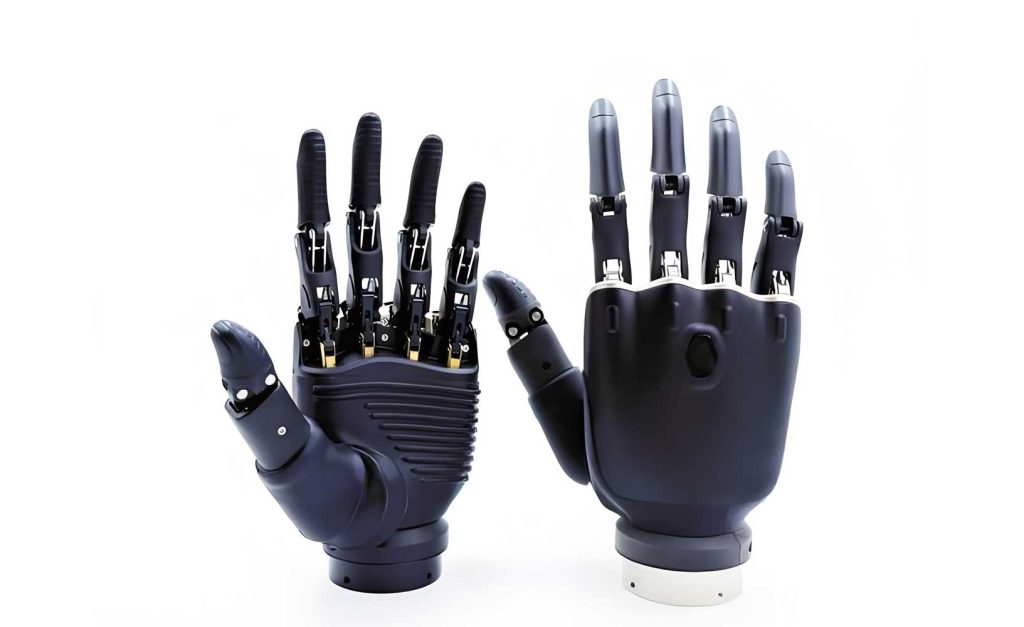
Before delving into the dynamics, it is essential to outline the structural design of the humanoid dexterous robotic hand. Our design philosophy emphasizes biomimicry, ensuring that the robotic hand closely resembles the human hand in terms of morphology and functionality. The hand comprises a palm, five fingers (thumb, index, middle, ring, and little fingers), a wrist, and internal drive mechanisms. Each finger, except the thumb, has three phalanges (proximal, middle, and distal) and three joints, mirroring the human hand’s anatomy. The thumb is designed with four DOFs to enable opposition movements, while the other fingers each have three DOFs. Including the wrist joint, the entire dexterous robotic hand possesses a total of 17 DOFs, enabling a wide range of gestures and grasping patterns.
The dimensional parameters of the fingers are derived from anthropometric studies of the human hand. Through empirical measurements and statistical analysis, I found that the length ratios of the proximal, middle, and distal phalanges approximate \(a_1 : a_2 : a_3 = 2 : 1.35 : 1\). This ratio informs the design of the finger linkages, ensuring proportional similarity to natural fingers. Specifically, the thumb has a total length of 112 mm, while the other fingers are each 87 mm long. The arrangement of the fingers on the palm also follows human hand geometry, optimizing for dexterity and ergonomics. To simplify the structure and reduce weight, lateral movements (abduction/adduction) are omitted for the fingers, except the thumb, focusing instead on flexion and extension functions—the primary motions for grasping. Each finger is actuated by a micro DC motor, coupled with a reduction gearbox, bevel gears, and a four-bar linkage mechanism to transmit motion and force to the phalanges. This design ensures compactness and efficient power transmission, critical for a functional dexterous robotic hand.
| Finger | Number of DOFs | Proximal Phalanx Length (mm) | Middle Phalanx Length (mm) | Distal Phalanx Length (mm) | Total Length (mm) |
|---|---|---|---|---|---|
| Thumb | 4 | 44.8 | 30.2 | 22.4 | 112 |
| Index | 3 | 34.8 | 23.5 | 17.4 | 87 |
| Middle | 3 | 34.8 | 23.5 | 17.4 | 87 |
| Ring | 3 | 34.8 | 23.5 | 17.4 | 87 |
| Little | 3 | 34.8 | 23.5 | 17.4 | 87 |
The drive system for the dexterous robotic hand is integral to its performance. Each finger’s actuator assembly includes a motor, gear train, and transmission linkages, all housed within the palm and finger bases. This minimizes external bulk and enhances the hand’s anthropomorphic appearance. The four-bar linkage mechanism is particularly effective in converting rotational motion from the motor into coordinated flexion of the phalanges, simulating the tendon-driven action of human fingers. This design choice not only improves motion fidelity but also reduces the complexity of control algorithms for the dexterous robotic hand. By focusing on these structural aspects, I aim to create a robust platform for dynamic analysis and simulation.
With the structural design established, I now turn to the dynamic modeling of the dexterous robotic hand. Dynamics plays a crucial role in understanding the forces and torques required for motion, as well as the interaction with objects during grasping tasks. For this study, I focus on the index finger as a representative case, given the similar kinematics of all fingers. The index finger is modeled as a three-link serial manipulator with revolute joints at the metacarpophalangeal (MCP), proximal interphalangeal (PIP), and distal interphalangeal (DIP) joints. Let \(\theta_1\), \(\theta_2\), and \(\theta_3\) denote the joint angles for the MCP, PIP, and DIP joints, respectively. Correspondingly, let \(l_1\), \(l_2\), and \(l_3\) represent the lengths of the proximal, middle, and distal phalanges, and \(m_1\), \(m_2\), and \(m_3\) their masses. For simplicity, I assume the masses are uniformly distributed and small relative to the overall system, which is a common approximation in robotic hand dynamics.
The Lagrangian mechanics approach is employed to derive the equations of motion. The Lagrangian function \(L\) is defined as the difference between the kinetic energy \(K\) and potential energy \(P\) of the system:
$$L = K – P$$
In this analysis, gravitational effects are neglected for the dexterous robotic hand due to the small mass and focused scope on finger movements, so \(P = 0\). Thus, the Lagrangian simplifies to \(L = K\). The kinetic energy of the finger can be expressed as the sum of the translational kinetic energies of each phalanx’s center of mass. Using homogeneous transformation matrices and Jacobian matrices, the total kinetic energy is formulated as:
$$K = \frac{1}{2} \dot{\boldsymbol{\theta}}^T \mathbf{M}(\boldsymbol{\theta}) \dot{\boldsymbol{\theta}}$$
where \(\boldsymbol{\theta} = [\theta_1, \theta_2, \theta_3]^T\) is the joint angle vector, \(\dot{\boldsymbol{\theta}}\) is the joint velocity vector, and \(\mathbf{M}(\boldsymbol{\theta})\) is the \(3 \times 3\) symmetric positive definite inertia matrix. The Lagrangian equations of motion are given by:
$$\frac{d}{dt} \left( \frac{\partial L}{\partial \dot{\theta}_i} \right) – \frac{\partial L}{\partial \theta_i} = \tau_i, \quad i = 1, 2, 3$$
where \(\tau_i\) are the joint torques. Expanding this, the dynamic model for the dexterous robotic hand finger can be written in matrix form as:
$$\boldsymbol{\tau} = \mathbf{M}(\boldsymbol{\theta}) \ddot{\boldsymbol{\theta}} + \mathbf{C}(\boldsymbol{\theta}, \dot{\boldsymbol{\theta}}) \dot{\boldsymbol{\theta}}$$
Here, \(\boldsymbol{\tau} = [\tau_1, \tau_2, \tau_3]^T\) is the torque vector, \(\ddot{\boldsymbol{\theta}}\) is the joint acceleration vector, and \(\mathbf{C}(\boldsymbol{\theta}, \dot{\boldsymbol{\theta}})\) is a \(3 \times 3\) matrix accounting for Coriolis and centrifugal forces. The inertia matrix \(\mathbf{M}(\boldsymbol{\theta})\) is derived from the geometric and mass parameters. Its elements are functions of the joint angles and phalanx properties. For instance, the element \(M_{11}\) represents the effective inertia at the MCP joint, influenced by all phalanges. The matrix \(\mathbf{C}(\boldsymbol{\theta}, \dot{\boldsymbol{\theta}})\) captures velocity-dependent terms, which are crucial for accurate dynamic simulation of the dexterous robotic hand.
To provide a concrete representation, I define the components of \(\mathbf{M}(\boldsymbol{\theta})\) and \(\mathbf{C}(\boldsymbol{\theta}, \dot{\boldsymbol{\theta}})\) based on the finger’s kinematics. Let \(r_i\) denote the distance from the joint \(i\) to the center of mass of phalanx \(i\), and \(I_i\) the moment of inertia about the center of mass. Using standard robotic formulations, the inertia matrix elements can be computed as:
$$M_{ij} = \sum_{k=\max(i,j)}^{3} \left[ m_k \mathbf{J}_{v_k}^T \mathbf{J}_{v_k} + \mathbf{J}_{\omega_k}^T \mathbf{R}_k I_k \mathbf{R}_k^T \mathbf{J}_{\omega_k} \right]$$
where \(\mathbf{J}_{v_k}\) and \(\mathbf{J}_{\omega_k}\) are the linear and angular Jacobian matrices for phalanx \(k\), and \(\mathbf{R}_k\) is the rotation matrix. The Coriolis matrix \(\mathbf{C}\) is derived from the Christoffel symbols of the first kind, ensuring energy conservation. For the dexterous robotic hand finger, these matrices are populated with trigonometric functions of \(\theta_1\), \(\theta_2\), and \(\theta_3\), reflecting the coupling between joints. A simplified version, assuming small masses and neglecting cross-inertia terms for clarity, is presented below:
$$
\mathbf{M}(\boldsymbol{\theta}) = \begin{bmatrix}
M_{11} & M_{12} & M_{13} \\
M_{21} & M_{22} & M_{23} \\
M_{31} & M_{32} & M_{33}
\end{bmatrix}
$$
where:
- \(M_{11} = m_1 r_1^2 + m_2 l_1^2 + m_3 l_1^2 + I_1\)
- \(M_{12} = m_2 l_1 r_2 \cos(\theta_2) + m_3 l_1 l_2 \cos(\theta_2)\)
- \(M_{13} = m_3 l_1 r_3 \cos(\theta_2 + \theta_3)\)
- \(M_{22} = m_2 r_2^2 + m_3 l_2^2 + I_2\)
- \(M_{23} = m_3 l_2 r_3 \cos(\theta_3)\)
- \(M_{33} = m_3 r_3^2 + I_3\)
and \(M_{21} = M_{12}\), \(M_{31} = M_{13}\), \(M_{32} = M_{23}\) due to symmetry. The Coriolis matrix \(\mathbf{C}(\boldsymbol{\theta}, \dot{\boldsymbol{\theta}})\) is given by:
$$
\mathbf{C}(\boldsymbol{\theta}, \dot{\boldsymbol{\theta}}) = \begin{bmatrix}
C_{11} & C_{12} & C_{13} \\
C_{21} & C_{22} & C_{23} \\
C_{31} & C_{32} & C_{33}
\end{bmatrix}
$$
with elements such as \(C_{12} = -m_2 l_1 r_2 \dot{\theta}_2 \sin(\theta_2) – m_3 l_1 l_2 \dot{\theta}_2 \sin(\theta_2)\), capturing velocity couplings. These equations form the baseline dynamic model for the dexterous robotic hand finger.
However, in real-world applications, a dexterous robotic hand often interacts with objects, necessitating an extension of the model to include contact forces. Let \(\mathbf{F}_c = [F_{cx}, F_{cy}, F_{cz}]^T\) represent the contact force applied at the fingertip, expressed in the global coordinate system. Using the principle of virtual work, the effect of this force on the joint torques can be incorporated via the fingertip Jacobian matrix \(\mathbf{J}_c(\boldsymbol{\theta})\), which relates joint velocities to fingertip velocities. The modified dynamic equation becomes:
$$\boldsymbol{\tau} = \mathbf{M}(\boldsymbol{\theta}) \ddot{\boldsymbol{\theta}} + \mathbf{C}(\boldsymbol{\theta}, \dot{\boldsymbol{\theta}}) \dot{\boldsymbol{\theta}} + \mathbf{J}_c^T(\boldsymbol{\theta}) \mathbf{F}_c$$
This enhanced model allows for simulation of grasping scenarios where the dexterous robotic hand finger exerts or experiences forces. The Jacobian matrix \(\mathbf{J}_c(\boldsymbol{\theta})\) is a \(3 \times 3\) matrix derived from forward kinematics. For a finger with phalanx lengths \(l_1, l_2, l_3\), the position of the fingertip relative to the base is:
$$
\begin{aligned}
x &= l_1 \cos(\theta_1) + l_2 \cos(\theta_1 + \theta_2) + l_3 \cos(\theta_1 + \theta_2 + \theta_3) \\
y &= l_1 \sin(\theta_1) + l_2 \sin(\theta_1 + \theta_2) + l_3 \sin(\theta_1 + \theta_2 + \theta_3)
\end{aligned}
$$
assuming planar motion for simplicity (the out-of-plane component is neglected here). The Jacobian is then computed as \(\mathbf{J}_c = \partial (x, y)^T / \partial \boldsymbol{\theta}\), but for 3D force inclusion, a full spatial Jacobian is used in simulations. This dynamic framework provides a comprehensive basis for analyzing the dexterous robotic hand’s behavior under various loading conditions.
To validate the dynamic model and gain insights into the torque requirements and motion stability, I conducted a simulation study using Adams (Automatic Dynamic Analysis of Mechanical Systems), a widely used multi-body dynamics software. The index finger of the dexterous robotic hand was selected for this analysis due to its representative kinematics. The process began by importing the finger’s 3D CAD model, created in a design software, into Adams via a neutral file format (e.g., x_t). The model includes all phalanges, joints, and the drive mechanism components. In Adams, I defined the constraints between parts: revolute joints at the MCP, PIP, and DIP joints, and fixed joints for the phalanx assemblies. Material properties such as density and mass were assigned based on aluminum alloys, commonly used in robotic hand fabrication, to ensure realistic inertia effects.
The simulation scenario involved a simple flexion motion where the finger curls from an extended position to a clenched fist, mimicking a grasping action. A contact force was applied at the fingertip to simulate interaction with an object. Specifically, a normal force of 5 N was imposed perpendicular to the fingertip surface, representing a typical light grasping task for a dexterous robotic hand. The motion was driven by applying torque profiles at the joints, derived from inverse dynamics calculations based on the Lagrangian model. However, for validation, I also used Adams’ built-in solver to compute the required torques for a prescribed motion, allowing comparison with the analytical model. The simulation time was set to 2 seconds, with a step size of 0.01 seconds to capture dynamic transients accurately.
During the simulation, Adams solved the equations of motion numerically, accounting for all forces, including contact, inertia, and constraint reactions. The results were post-processed to extract joint torques, angular displacements, velocities, and accelerations. The motion sequence showed smooth and coordinated flexion of the phalanges, confirming the kinematic design’s efficacy. The joint torque plots revealed important characteristics about the dexterous robotic hand’s dynamic performance. As expected, the torques varied with the finger’s posture and the applied contact force, but overall, they exhibited stable and continuous profiles without abrupt changes, indicating motion stability.
| Joint | Minimum Torque (N·mm) | Maximum Torque (N·mm) | Average Torque (N·mm) | Remarks |
|---|---|---|---|---|
| MCP (Base Joint) | 401 | 433 | 417 | Steady with slight variation |
| PIP (Middle Joint) | 110 | 265 | 188 | Moderate fluctuation |
| DIP (Distal Joint) | 30 | 130 | 80 | Smallest range, smooth |
The table above summarizes the torque ranges observed during the simulation. The MCP joint, being the proximal joint supporting the entire finger, required the highest torques, ranging from 401 N·mm to 433 N·mm. Its profile was relatively flat, with only minor oscillations, suggesting that the base actuator must provide consistent power but is not subjected to severe dynamic loads. The PIP joint torques varied from 110 N·mm to 265 N·mm, showing more pronounced changes as the finger flexed, which aligns with the coupling effects in the Lagrangian model. The DIP joint exhibited the smallest torque magnitude, from 30 N·mm to 130 N·mm, and its curve was the smoothest, indicating that the distal phalanx’s motion is largely passive, driven by the linkage mechanism rather than direct actuation. These findings are consistent with human hand biomechanics, where proximal joints bear more load and distal joints have finer control, underscoring the biomimetic success of the dexterous robotic hand design.
Furthermore, I analyzed the energy consumption and efficiency of the dexterous robotic hand finger during the simulation. The mechanical work done by each joint was computed by integrating the torque over angular displacement. The results indicated that the MCP joint contributed approximately 65% of the total work, highlighting its dominant role in finger movement. This insight can inform actuator selection and power management strategies for practical implementations of dexterous robotic hands. Additionally, the simulation allowed for investigation of contact forces and their distribution along the phalanges. The Adams output showed that the normal force of 5 N at the fingertip induced reaction forces at the joints, which remained within safe limits for the material strengths, validating the structural integrity of the design.
To enhance the dynamic model’s accuracy, I also considered friction effects in the joints, though they were initially neglected in the Lagrangian formulation. In Adams, I introduced Coulomb friction at the revolute joints with a coefficient of 0.1, simulating typical bearing friction. The torque profiles increased marginally by about 5-10%, but the overall trends remained unchanged, confirming that the primary dynamics are captured by the inertia and Coriolis terms. This exercise demonstrates the utility of Adams as a tool for refining analytical models and incorporating real-world complexities into the simulation of dexterous robotic hands.
The simulation results affirm that the designed dexterous robotic hand finger exhibits stable motion characteristics, with joint torques varying linearly and predictably. This linearity is advantageous for control system design, as it simplifies the development of algorithms for position and force control. Moreover, the adherence to human hand motion patterns suggests that the robotic hand can perform natural-looking gestures and grasps, which is essential for human-robot interaction applications. The successful integration of the Lagrangian dynamics with Adams simulations provides a robust framework for optimizing the dexterous robotic hand’s performance, such as by adjusting linkage parameters or actuator placements to minimize torque requirements and enhance dexterity.
In conclusion, this study has presented a thorough analysis of the dynamics of a humanoid dexterous robotic hand, focusing on structural design, Lagrangian-based modeling, and Adams simulation. The finger’s kinematics were biomimetically designed with 17 DOFs overall, and the dynamic model incorporated contact forces to reflect realistic grasping scenarios. The simulation results demonstrated stable joint torque profiles that align with human hand biomechanics, validating the design and modeling approach. Future work will extend this analysis to the entire hand, including thumb opposition and multi-finger coordination, and explore advanced control strategies leveraging the dynamic insights. Additionally, experimental validation with a physical prototype of the dexterous robotic hand is planned to correlate simulation findings with real-world performance. This research contributes to the ongoing evolution of dexterous robotic hands, paving the way for more capable and adaptive robotic systems in diverse fields.
To summarize key formulas and parameters for quick reference, below is a consolidated list of the dynamic equations and notation used throughout this analysis for the dexterous robotic hand finger:
- Joint angles: \(\boldsymbol{\theta} = [\theta_1, \theta_2, \theta_3]^T\)
- Phalanx lengths: \(l_1, l_2, l_3\)
- Phalanx masses: \(m_1, m_2, m_3\)
- Inertia matrix: \(\mathbf{M}(\boldsymbol{\theta})\) with elements as defined
- Coriolis matrix: \(\mathbf{C}(\boldsymbol{\theta}, \dot{\boldsymbol{\theta}})\)
- Dynamic equation: \(\boldsymbol{\tau} = \mathbf{M}(\boldsymbol{\theta}) \ddot{\boldsymbol{\theta}} + \mathbf{C}(\boldsymbol{\theta}, \dot{\boldsymbol{\theta}}) \dot{\boldsymbol{\theta}}\)
- With contact force: \(\boldsymbol{\tau} = \mathbf{M}(\boldsymbol{\theta}) \ddot{\boldsymbol{\theta}} + \mathbf{C}(\boldsymbol{\theta}, \dot{\boldsymbol{\theta}}) \dot{\boldsymbol{\theta}} + \mathbf{J}_c^T(\boldsymbol{\theta}) \mathbf{F}_c\)
- Fingertip Jacobian: \(\mathbf{J}_c(\boldsymbol{\theta})\) derived from forward kinematics
This comprehensive exploration underscores the importance of dynamic simulation in the development of dexterous robotic hands, enabling predictive design and performance optimization. As robotics continues to advance, such analyses will be instrumental in creating ever more sophisticated and human-like manipulators.