
In the field of precision motion control and robotics, harmonic drive gears are widely utilized due to their compact design, high torque capacity, and exceptional positioning accuracy. However, the longevity and reliability of these systems are often compromised by inadequate lubrication at the tooth contact interfaces, particularly in the conjugate meshing domains where high loads and low sliding velocities prevail. In this study, we investigate the influence of tooth profile geometry on the mixed lubrication behavior within the conjugate meshing regions of harmonic drive gears. By comparing a double-circular-arc tooth profile with a traditional involute profile, we aim to elucidate how geometric design can enhance tribological performance. Our analysis incorporates real surface roughness, finite tooth contact geometry, and dynamic operating conditions to provide a comprehensive understanding of lubrication mechanisms. The findings underscore the critical role of tooth profile optimization in mitigating wear and improving the fatigue life of harmonic drive gears, which is essential for applications in aerospace, satellite systems, and other high-precision domains.
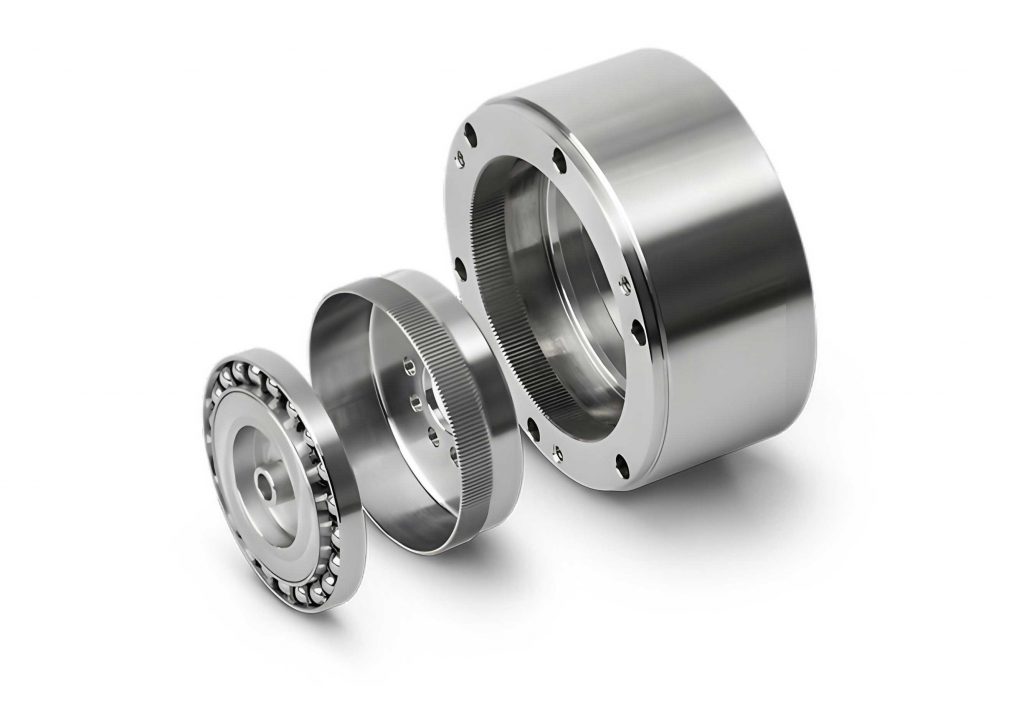
The fundamental operation of a harmonic drive gear relies on the elastic deformation of a flexible spline, typically driven by a wave generator, to mesh with a rigid spline. This unique mechanism results in multiple tooth engagements, but the conjugate meshing zones—where teeth are in ideal contact—experience the most severe lubrication challenges due to concentrated stresses and minimal fluid entrainment. Historically, involute tooth profiles have been common in harmonic drive gears, but alternative geometries like the double-circular-arc profile offer potential advantages in load distribution and lubrication enhancement. In our work, we adopt a public tangent double-circular-arc profile for the flexspline, as defined by standards such as TOCT 15023-69, and derive the conjugate tooth profiles for both the flexspline and rigid spline using envelope theory. This approach allows us to accurately model the contact kinematics and establish a mixed lubrication framework that accounts for transient effects and surface imperfections.
To begin, we detail the tooth profile models. For the double-circular-arc profile, the flexspline tooth is characterized by segmented arcs: a convex arc near the addendum, a straight-line segment, and a concave arc near the dedendum. The geometric parameters include module \(m\), addendum height \(h_a = 0.45m\), dedendum height \(h_f = 0.525m\), and specific radii such as the convex arc radius \(\rho_a = 0.5735m\) and concave arc radius \(\rho_f = 0.6535m\). The profile equations are expressed parametrically with arc length \(u\) as the variable. For instance, the convex arc segment from point \(a\) to \(b\) can be represented as:
$$ x(u) = \rho_a \sin\left(\frac{u}{\rho_a}\right) + l_a, \quad y(u) = \rho_a \cos\left(\frac{u}{\rho_a}\right) + e_a, $$
where \(l_a\) and \(e_a\) are offset parameters. Similarly, the involute profile for comparison is given by standard equations based on pressure angle \(\alpha\) and base circle radius \(r_b\). The choice of tooth profile significantly affects the curvature radii at meshing points, which in turn influences the lubrication film thickness and pressure distribution in harmonic drive gears.
Next, we establish the conjugate meshing principles for harmonic drive gears. Assuming the wave generator as the input and the flexspline as the output, the kinematic relationships involve angular displacements and elastic deformations. Let \(\phi_H\) be the wave generator angle, \(\phi\) the rotation angle of the undeformed flexspline, and \(i\) the gear ratio. The relative angle between the flexspline and rigid spline at the meshing point is derived as:
$$ \beta = \Delta\phi + \mu, \quad \text{where} \quad \Delta\phi = \phi_1 – \phi_H, \quad \mu = \frac{s'(\phi)}{r_m}. $$
Here, \(\phi_1\) is the angle at the meshing end, \(r_m\) is the neutral circle radius, and \(s(\phi)\) represents radial displacement due to deformation. Using envelope theory, we transform the flexspline tooth profile equations into the rigid spline coordinate system and solve for the conjugate conditions. This yields discrete points for the conjugate tooth profiles, and we apply the least-squares method to fit these points into circular arcs for the rigid spline. The fitting results, such as the convex arc radius \(\rho_{2a} = 0.6200\,\text{mm}\) and concave arc radius \(\rho_{2f} = 0.5882\,\text{mm}\), ensure minimal interference and accurate contact geometry in harmonic drive gears. The conjugate meshing domain exhibits a “double-conjugate” phenomenon, where two different arc lengths on the flexspline profile satisfy the meshing conditions simultaneously for most conjugate angles, highlighting the complexity of tooth interactions.
To analyze the lubrication performance, we develop a mixed lubrication model for the finite-length tooth contact surfaces in harmonic drive gears. The contact between the flexspline and rigid spline is simplified as two finite cylinders with radii \(R_1\) and \(R_2\) at the meshing point. The model incorporates the following key factors: entrainment velocity, normal load at the meshing point, real surface roughness measured from actual harmonic drive gear components, and tooth contact geometry. The governing equations include the transient Reynolds equation for non-steady elastohydrodynamic lubrication (EHL), which accounts for pressure-dependent viscosity and density, as well as surface elastic deformation.
The Reynolds equation in dimensionless form is given by:
$$ \frac{\partial}{\partial X}\left(\frac{\bar{\rho} H^3}{\bar{\eta}} \frac{\partial \bar{P}}{\partial X}\right) + \frac{\partial}{\partial Y}\left(\frac{\bar{\rho} H^3}{\bar{\eta}} \frac{\partial \bar{P}}{\partial Y}\right) = \frac{\partial (\bar{\rho} H)}{\partial X} + \frac{\partial (\bar{\rho} H)}{\partial T}, $$
where \(X = x/c\), \(Y = 2y/d\), and \(T\) is time; \(c\) is the Hertzian half-width, \(d\) is the tooth width (contact length), \(\bar{\rho}\) is dimensionless density, \(\bar{\eta}\) is dimensionless viscosity, \(H\) is dimensionless film thickness, and \(\bar{P}\) is dimensionless pressure. The film thickness equation considers the composite surface roughness:
$$ h = D(t) + f(x,y,t) + \delta_1(x,y,t) + \delta_2(x,y,t) + V_e(x,y,t), $$
where \(D(t)\) is the initial gap, \(f(x,y,t)\) is the macroscopic geometry, \(\delta_1\) and \(\delta_2\) are roughness amplitudes, and \(V_e\) is the elastic deformation calculated using the fast Fourier transform (FFT) method:
$$ V_e(x,y,t) = \frac{2}{\pi E’} \iint_\Omega \frac{p(\xi,\zeta,t)}{\sqrt{(x-\xi)^2 + (y-\zeta)^2}} d\xi d\zeta. $$
The effective elastic modulus \(E’\) is defined as \(1/E’ = (1-\nu_1^2)/E_1 + (1-\nu_2^2)/E_2\), with \(E_1, E_2\) and \(\nu_1, \nu_2\) being the Young’s moduli and Poisson’s ratios of the flexspline and rigid spline, respectively. The viscosity-pressure relationship follows the Barus equation: \(\eta = \eta_0 e^{\alpha p}\), and the density-pressure equation is: \(\rho = \rho_0 \left[1 + \frac{0.6 \times 10^{-9} p}{1 + 1.7 \times 10^{-9} p}\right]\). The load balance equation ensures that the integrated pressure equals the applied normal load \(w(t)\).
The numerical solution employs a multi-grid method with composite iteration. We discretize the domain into a 256 × 256 grid over normalized coordinates \(-3.1 \leq X \leq 1.5\) and \(-1.3 \leq Y \leq 1.3\), corresponding to the Hertzian contact region. Convergence is achieved when the relative error in pressure between iterations is below \(10^{-4}\). The contact loads at different meshing points are determined from deformation compatibility and torque equilibrium equations, considering the number of teeth in contact. For the harmonic drive gear, the relative surface velocities at meshing points combine rotational and elastic deformation components, affecting the entrainment velocity crucial for film formation.
We define two critical meshing points within the conjugate domain: the tooth root meshing point and the addendum circle meshing point. For the double-circular-arc profile, when the convex side is active, the curvature radii are \(R_{01} = \rho_{1a}\) for the flexspline and \(R_{02} = \rho_{2f}\) for the rigid spline; for the concave side, \(R_{11} = \rho_{1f}\) and \(R_{12} = \rho_{2a}\). For the involute profile, the radii are \(R_{21} = \sqrt{\rho_{k1}^2 – r_{b1}^2}\) and \(R_{22} = \sqrt{\rho_{k2}^2 – r_{b2}^2}\). These radii directly influence the equivalent radius \(R’ = \left(1/R_1 + 1/R_2\right)^{-1}\) used in Hertzian contact calculations and lubrication analysis.
The operating parameters for our simulation are based on a typical harmonic drive gear setup: flexspline teeth number \(Z_r = 200\), rigid spline teeth number \(Z_g = 202\), module \(m = 0.5\), transmission ratio \(i = 100\), pressure angle \(\alpha = 20^\circ\), wave generator input speeds ranging from 10 to 3000 rpm, output torque \(T = 300\,\text{N·m}\), and tooth width \(12\,\text{mm}\). Material properties include Young’s modulus of 196 GPa for the flexspline and 200.1 GPa for the rigid spline, with Poisson’s ratios of 0.3 and 0.277, respectively. Lubricant properties are initial viscosity \(\eta_0 = 0.095\,\text{Pa·s}\) and pressure-viscosity coefficient \(\alpha = 1.82 \times 10^{-8}\,\text{Pa}^{-1}\). Real surface roughness data are sampled over a \(3.3\,\text{mm} \times 2.6\,\text{mm}\) area, with root-mean-square roughness values of 0.3535 μm for the flexspline and 0.3627 μm for the rigid spline in harmonic drive gears.
To summarize the geometric and material parameters, we present the following table:
| Parameter | Symbol | Value for Double-Circular-Arc | Value for Involute |
|---|---|---|---|
| Module | \(m\) | 0.5 mm | 0.5 mm |
| Convex Arc Radius (Flexspline) | \(\rho_a\) | 0.5735 mm | — |
| Concave Arc Radius (Flexspline) | \(\rho_f\) | 0.6535 mm | — |
| Base Circle Radius | \(r_b\) | — | \(m Z_r \cos(\alpha)/2\) |
| Tooth Width | \(d\) | 12 mm | 12 mm |
| Young’s Modulus (Flexspline) | \(E_1\) | 196 GPa | 196 GPa |
| Poisson’s Ratio (Flexspline) | \(\nu_1\) | 0.3 | 0.3 |
Our results focus on the average film thickness \(h_a\), defined as the two-thirds Hertzian area-weighted mean, the maximum film pressure \(p_{\text{max}}\), the contact load ratio \(W_{ct}\) (proportion of load carried by asperity contacts), and the film thickness ratio \(\lambda = h_a / \sigma\), where \(\sigma\) is the composite roughness. We analyze these metrics at varying wave generator speeds for both tooth profiles. The table below illustrates the maximum pressure peaks along the \(Y\)-direction at \(X=0\) for different speeds, highlighting the contrast between profiles in harmonic drive gears:
| Wave Generator Speed (rpm) | Max Pressure at Tooth Root (Involute) [GPa] | Max Pressure at Tooth Root (Double-Arc) [GPa] | Max Pressure at Addendum (Involute) [GPa] | Max Pressure at Addendum (Double-Arc) [GPa] |
|---|---|---|---|---|
| 10 | 14.95 | 5.38 | 17.02 | 1.46 |
| 500 | 10.27 | 4.15 | 11.68 | 1.45 |
| 3000 | 5.81 | 1.49 | 6.86 | 1.02 |
The data clearly show that the double-circular-arc profile consistently yields lower maximum pressures compared to the involute profile across all speeds, with the difference becoming more pronounced at lower speeds. This reduction in pressure peaks is beneficial for minimizing surface fatigue and wear in harmonic drive gears. Furthermore, we observe that the average film thickness increases with speed for both profiles, but the double-circular-arc profile maintains thicker films. For instance, at 3000 rpm, the average film thickness at the tooth root meshing point is approximately 0.45 μm for the double-circular-arc profile versus 0.28 μm for the involute profile. This enhancement is attributed to the favorable curvature match and load distribution provided by the double-circular-arc geometry, which promotes better fluid entrainment in harmonic drive gears.
The contact load ratio \(W_{ct}\) and film thickness ratio \(\lambda\) are critical indicators of lubrication regime. We find that at speeds below 50 rpm, \(W_{ct}\) exceeds 75% for both profiles, indicating dominant boundary lubrication. However, the double-circular-arc profile reduces \(W_{ct}\) significantly at low speeds; for example, at 10 rpm, \(W_{ct}\) is about 65% for the double-circular-arc profile versus 85% for the involute profile at the tooth root. The film thickness ratio \(\lambda\) remains above 1 for the double-circular-arc profile across most speeds, suggesting mixed lubrication, whereas for the involute profile, \(\lambda\) falls below 1 at speeds under 200 rpm for the tooth root and under 2000 rpm for the addendum, indicating boundary lubrication. This disparity underscores the superior lubrication performance of the double-circular-arc design in harmonic drive gears, especially under slow-speed or start-stop conditions common in precision applications.
To quantify the speed dependence, we derive empirical relationships for the average film thickness. Based on our simulations, the film thickness \(h_a\) scales with speed \(n_H\) (in rpm) approximately as:
$$ h_a \approx k \cdot n_H^{0.7} \cdot R’^{0.5}, $$
where \(k\) is a constant dependent on tooth profile and load. For the double-circular-arc profile, \(k\) is about \(1.2 \times 10^{-3}\), while for the involute profile, it is \(0.8 \times 10^{-3}\), reflecting the enhanced film formation capability. Additionally, the maximum pressure \(p_{\text{max}}\) can be correlated with the film thickness via:
$$ p_{\text{max}} \propto \frac{w}{(h_a \cdot d)^{0.8}}, $$
which explains the lower pressures observed with thicker films. These formulas highlight the interplay between geometry, speed, and lubrication in harmonic drive gears.
In discussion, we emphasize that the double-circular-arc tooth profile improves lubrication by increasing the equivalent radius of curvature at meshing points, which reduces contact stress and enhances hydrodynamic lift. The segmented arc design also facilitates smoother transitions between engagement phases, reducing impact loads and promoting a more stable oil film. Conversely, the involute profile, with its inherent curvature variations, tends to concentrate stress near the root and addendum, exacerbating asperity contact. Our mixed lubrication model, incorporating real roughness, validates that surface imperfections play a significant role, particularly at low speeds where the film is thin. The “double-conjugate” phenomenon in harmonic drive gears further complicates the contact dynamics, but the double-circular-arc profile mitigates this by providing more consistent conjugate zones.
From a practical standpoint, these insights suggest that optimizing tooth profile geometry is a viable strategy for enhancing the durability of harmonic drive gears. In aerospace applications, where reliability is paramount, adopting double-circular-arc profiles could lead to longer service intervals and reduced maintenance costs. Future work could explore hybrid profiles or surface treatments to further improve tribological performance. Additionally, our numerical approach, combining FFT for elastic deformation and multi-grid methods for Reynolds equation, offers a robust framework for analyzing other gear types or operating conditions in harmonic drive systems.
In conclusion, our study demonstrates that tooth profile shape has a profound impact on the lubrication performance within the conjugate meshing domains of harmonic drive gears. The double-circular-arc profile significantly increases average film thickness, reduces maximum oil film pressure, and maintains a favorable mixed lubrication regime across a wide speed range compared to the traditional involute profile. As wave generator speed decreases, lubrication deteriorates for both profiles, but the double-circular-arc design offers better resilience, making it advantageous for low-speed or intermittent operations. These findings provide a theoretical foundation for designing more efficient and reliable harmonic drive gears, ultimately contributing to advancements in high-precision mechanical systems. By prioritizing geometric optimization, engineers can address lubrication challenges and extend the fatigue life of harmonic drive gears in demanding environments.