
In the field of robotics, simulating legged systems like quadruped robots or robot dogs presents significant challenges due to the complexity of environmental modeling and robot attribute configuration. Traditional approaches often require extensive setup across multiple software platforms, leading to inefficiencies and increased error rates. To address this, we propose a streamlined workflow that leverages Solidworks for modeling, exports the design as a URDF (Unified Robot Description Format) file, and integrates it directly into Simulink for simulation. This method eliminates the need for manual rigid-body property assignments and coordinate transformations, significantly reducing simulation overhead while maintaining accuracy. Our approach demonstrates that high-fidelity simulations of quadruped robots can be achieved with minimal software dependencies, making it accessible for researchers and developers focusing on robot dog locomotion and control algorithms.
The adaptability of quadruped robots in unstructured terrains has driven extensive research into their motion planning and control. Unlike wheeled or tracked systems, robot dogs exhibit superior terrain negotiation capabilities with minimal environmental disruption. However, the complexity of their control algorithms necessitates robust simulation frameworks. Existing methods, such as co-simulation with Webots or manual configuration in MATLAB toolboxes, involve tedious parameter tuning and multi-software coordination. By contrast, our URDF-based Simulink integration simplifies the process, enabling rapid prototyping and validation of gait patterns and dynamic behaviors for quadruped robots.
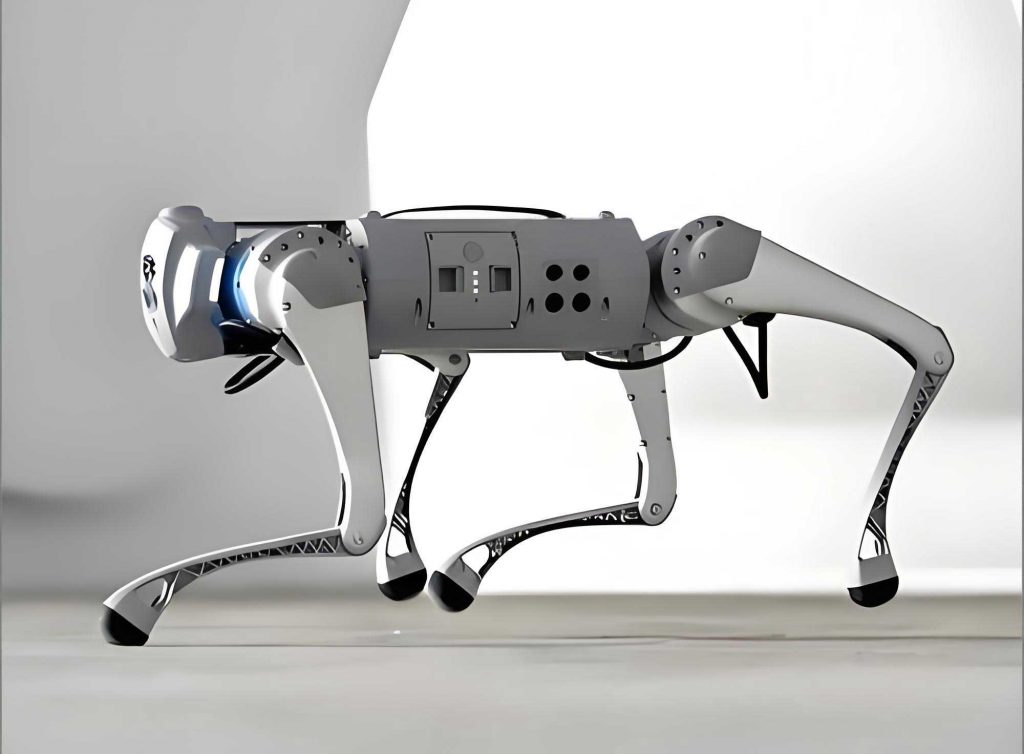
URDF serves as a standardized format in ROS (Robot Operating System) for defining robot morphology, including links, joints, and their properties. A typical URDF structure comprises hierarchical elements that describe the quadruped robot’s physical attributes. The table below summarizes key URDF tags and their functions:
| URDF Tag | Description |
|---|---|
| <robot> | Top-level element encapsulating the entire robot dog model |
| <link> | Defines a rigid body segment with visual, collision, and inertial properties |
| <joint> | Specifies kinematic and dynamic relationships between links |
| <calibration> | Sets reference positions for joint calibration |
| <dynamics> | Describes physical properties like damping and friction |
| <limit> | Imposes motion constraints on joint position, velocity, and torque |
To export a URDF model, we first construct the quadruped robot in Solidworks, defining links (e.g., legs, torso) and joints (e.g., revolute, continuous). The sw_urdf_exporter plugin generates a structured URDF file alongside supporting directories for meshes, textures, and configuration files. This model tree ensures accurate representation of the robot dog’s kinematic chain, as illustrated in the following hierarchical schema:
| Parent Link | Child Link | Joint Type |
|---|---|---|
| base_link | LF1 | Revolute |
| LF1 | LF2 | Revolute |
| LF2 | LF3 | Revolute |
| base_link | RF1 | Revolute |
Importing the URDF into Simulink is straightforward using the smimport('model.urdf') command. The resulting Simulink block diagram automatically configures the quadruped robot’s dynamics, including mass distribution and joint constraints. To simulate ground interaction, we incorporate Sphere-to-Plane Force modules that model contact forces between the robot dog’s feet and the terrain. This setup replicates real-world conditions without manual coordinate system adjustments, a common bottleneck in traditional methods.
For gait validation, we implement a composite cycloid trajectory planning algorithm optimized for trot gait—a diagonal leg movement pattern where two legs swing while the others support the body. The trajectory equations ensure zero velocity and acceleration at ground contact, minimizing impact forces. The swing phase equations for the quadruped robot are defined as:
$$ x(t) = \frac{S \left( \frac{2\pi t}{T_{sw}} – \sin\left(\frac{2\pi t}{T_{sw}}\right) \right)}{2\pi}, \quad 0 < t < T_{sw} $$
$$ z(t) = \begin{cases}
\frac{H}{2} \left( \frac{2t}{T_{sw}} – \frac{1}{2\pi} \sin\left(\frac{4\pi t}{T_{sw}}\right) \right), & 0 < t < \frac{T_{sw}}{2} \\
\frac{H}{2} \left( 2 – \frac{2t}{T_{sw}} + \frac{1}{2\pi} \sin\left(\frac{4\pi t}{T_{sw}}\right) \right), & \frac{T_{sw}}{2} < t < T_{sw}
\end{cases} $$
The support phase equations for the robot dog are:
$$ x(t) = \frac{S \left( \frac{2\pi (T – t)}{T – T_{sw}} + \sin\left( \frac{2\pi (t – T_{sw})}{T – T_{sw}} \right) \right)}{2\pi}, \quad T_{sw} < t < T $$
$$ z(t) = -h, \quad T_{sw} < t < T $$
Here, \( T_{sw} \) denotes the swing phase duration, \( T \) is the total gait cycle period, \( S \) is stride length, \( H \) is leg lift height, and \( h \) is the quadruped robot’s centroid height. The parameters used in our simulation are summarized below:
| Parameter | Symbol | Value |
|---|---|---|
| Swing Phase Period | \( T_{sw} \) | 0.25 s |
| Total Gait Cycle | \( T \) | 0.5 s |
| Stride Length | \( S \) | 40 mm |
| Lift Height | \( H \) | 15 mm |
| Centroid Height | \( h \) | Optimized dynamically |
We simulate the quadruped robot’s motion over 10 seconds, with right-front and left-hind legs moving in phase, followed by the left-front and right-hind legs after half a swing cycle. The foot trajectory plots in the x and z directions confirm adherence to the composite cycloid pattern. The robot dog’s centroid displacements in x, y, and z axes are monitored to assess stability. The results indicate oscillations within acceptable limits, validating the gait’s efficiency for a quadruped robot navigating flat terrain.
The centroid trajectory analysis reveals minor deviations in the x and y directions, primarily due to dynamic transitions between swing and support phases. The z-axis displacement remains stable, underscoring the method’s effectiveness in maintaining balance. The table below quantizes the maximum centroid offsets observed during simulation:
| Axis | Maximum Displacement | Unit |
|---|---|---|
| x | 1.8 mm | Millimeters |
| y | 15 µm | Micrometers |
| z | 70 µm | Micrometers |
These findings demonstrate that the URDF-Simulink integration accurately captures the dynamics of a quadruped robot without compromising simulation fidelity. The workflow’s simplicity allows researchers to focus on high-level control strategies for robot dogs, such as adapting trot gaits to inclined surfaces or obstacles. Future work will extend this approach to simulate complex terrains and integrate sensor data for closed-loop control.
In conclusion, our URDF-based Simulink methodology offers a pragmatic solution for simulating quadruped robots. By reducing software dependencies and automating configuration steps, it accelerates the development cycle for advanced robot dog applications. The compatibility with standard modeling tools like Solidworks ensures broad applicability, while the simulation outcomes align closely with theoretical expectations. This framework sets a foundation for exploring sophisticated behaviors in quadruped robotics, from dynamic galloping to adaptive locomotion in unpredictable environments.