
As a high-precision, high-load mechanical transmission component, the planetary roller screw mechanism has become indispensable in demanding fields such as aerospace actuation, robotics, and advanced machine tools. Its superior load capacity and compact design stem from the multi-point thread contact between the screw, the planetary rollers, and the nut. However, these very contacts are also the potential source of performance degradation. In applications involving short-duration shock or overload, the contact stresses can exceed the material’s yield limit, leading to localized plastic deformation. This permanent deformation not only alters the load distribution among the threads in subsequent cycles, accelerating fatigue failure, but also directly results in a loss of positional accuracy—a critical performance metric. Furthermore, in real-world installations, pure axial loading is an ideal; radial loads induced by misalignment or external forces are often present. These radial loads significantly redistribute the contact forces among the rollers, potentially exacerbating uneven plastic deformation and accuracy loss. Therefore, a thorough investigation into the elasto-plastic contact behavior of the planetary roller screw mechanism under combined axial and radial loading is essential for predicting its long-term reliability and precision.
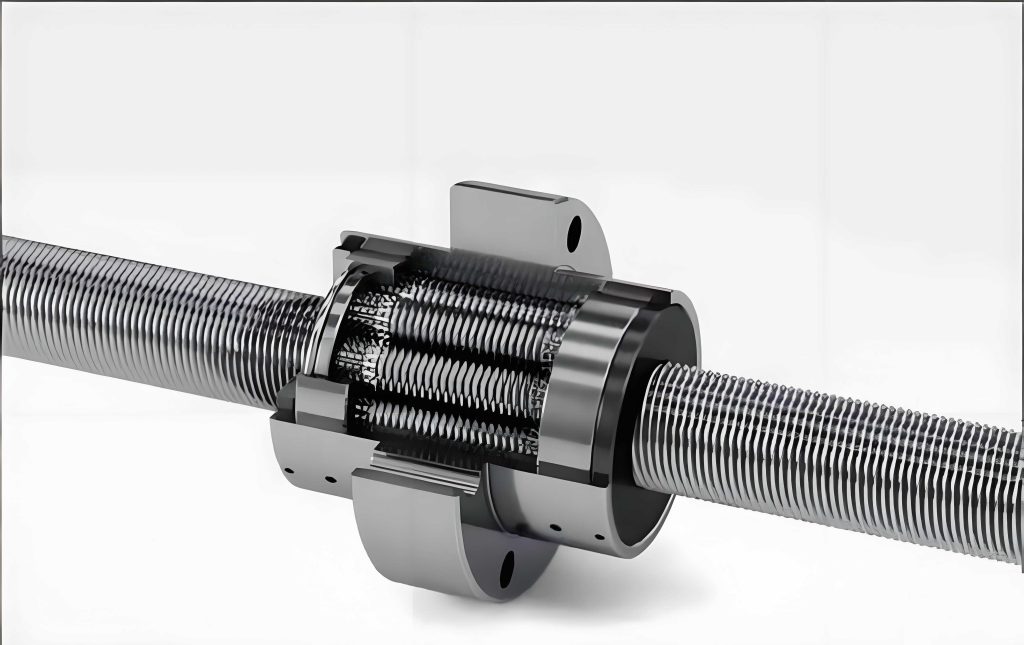
The core of analyzing a planetary roller screw mechanism lies in modeling the complex contact interactions at the thread interfaces. Under normal operating conditions, these contacts are typically treated as elastic, often employing Hertzian contact theory for point contact analysis. However, when loads surpass a critical threshold, the material undergoes yield, rendering purely elastic models inadequate. The transition from elastic to plastic contact involves a nonlinear relationship between load and deformation. During unloading, a permanent residual plastic deformation remains. This residual deformation, when accumulated across multiple engaged threads and rollers, manifests as backlash or lost motion, fundamentally constituting the mechanism’s accuracy loss. To model this, one must first establish the critical condition for yield initiation at the contact point. For a point contact subjected to a normal load $Q$, the maximum shear stress occurs beneath the surface. According to the Von Mises yield criterion, yielding begins when this stress reaches the material’s shear yield strength. This allows for the derivation of a critical contact load $Q_s$ and its corresponding critical elastic deformation $\delta_s$.
The contact geometry of a planetary roller screw mechanism is defined by several key parameters derived from the thread profiles: the helix angle $\lambda$, the contact angle $\beta$, and the pitch $P$. The contact angle $\beta$ is particularly crucial as it defines the inclination of the contact normal relative to the axial direction, directly influencing the load-sharing between axial and radial components on the thread flank. The effective radius of curvature at the contact point between the screw and a roller, which governs the contact pressure, is a function of these geometric parameters and the thread geometry.
Once the critical point $(Q_s, \delta_s)$ is determined, the load-deformation relationship in the elasto-plastic loading regime can be approximated. A common approach is to consider the post-yield loading curve as a tangent continuation from the elastic curve at the yield point. The governing equation for loading can be expressed as:
$$ Q = Q_s + \left( \frac{\pi m_a}{K(e)} \right)^{\frac{3}{2}} \bar{E} (R^H)^{\frac{1}{2}} \delta_s (\delta – \delta_s) $$
where $\bar{E}$ is the equivalent elastic modulus, $m_a$ is a Hertzian coefficient related to the contact ellipse, $K(e)$ is the complete elliptic integral of the first kind, and $R^H$ is the effective radius of curvature based on Hertzian theory. Upon unloading from a maximum load $Q^*$ and deformation $\delta^*$, the behavior is assumed to be purely elastic but with a modified (larger) effective curvature radius $R^H_c$, accounting for the permanent change in surface geometry due to plastic flow. The unloading curve is given by:
$$ Q = \frac{2}{3} \left( \frac{\pi m_a}{K(e)} \right)^{\frac{3}{2}} \bar{E} (R^H_c)^{\frac{1}{2}} (\delta – \delta_c)^{\frac{3}{2}} $$
where $\delta_c$ is the final residual plastic deformation after complete unloading. The relationship between the modified radius and the original one is $R^H_c = \left( \frac{\delta^*}{\delta^* – \delta_c} \right) R^H$. By solving the system of equations at the unloading point $(Q^*, \delta^*)$, the residual deformation $\delta_c$ for a given contact load history can be calculated.
The accuracy loss $\Delta \delta_a$ of the planetary roller screw mechanism is defined as the irreversible axial displacement resulting from the accumulated residual plastic deformations across all active contacts when the mechanism is unloaded. It can be formulated based on the minimum residual deformation found on the screw-roller and nut-roller interfaces, transformed into the axial direction:
$$ \Delta \delta_a = \left( \min_{1 \le i \le \tau} \delta_{c,sr}^i + \min_{1 \le i \le \tau} \delta_{c,nr}^i \right) \sin \beta \cos \lambda $$
Here, $\tau$ is the number of engaged threads per roller, $\delta_{c,sr}^i$ and $\delta_{c,nr}^i$ are the residual deformations on the i-th screw-roller and nut-roller contact, respectively. This definition captures the idea that the “tightest” or least-deformed pair of contacts will determine the final resting position of the nut relative to the screw after an overload cycle.
To apply this theory to an entire planetary roller screw assembly, one must first determine the load distribution—the normal force $Q_i$ on each individual thread contact. This is a statically indeterminate problem solved by enforcing compatibility of deformations across all elastic and plastic contacts. The direct stiffness method is effective here, building a system of equations where the total axial displacement of the nut must be compatible with the sum of deformations (elastic and plastic) along each load path through the rollers and threads. When a thread’s load exceeds $Q_s$, its deformation is calculated using the elasto-plastic loading equation instead of the purely Hertzian one, iteratively updating the load distribution until equilibrium and compatibility are satisfied.
| Parameter | Symbol | Value | Unit |
|---|---|---|---|
| Screw Pitch Diameter | $d_s$ | 22.5 | mm |
| Roller Pitch Diameter | $d_r$ | 7.5 | mm |
| Nut Pitch Diameter | $d_n$ | 37.5 | mm |
| Pitch | $P$ | 1.5 | mm |
| Number of Rollers | $N$ | 8 | – |
| Number of Thread Starts | $Z$ | 3 | – |
| Threads per Roller | $\tau$ | 23 | – |
Finite Element Analysis (FEA) provides a powerful tool to validate the analytical elasto-plastic contact model and to investigate complex loading scenarios that are difficult to handle analytically, such as the combined effect of axial and radial loads with pitch errors. A sector model of the planetary roller screw mechanism, representing a single roller and the corresponding portions of the screw and nut, is often used to reduce computational cost while preserving the essential contact mechanics. The model incorporates material nonlinearity using a true stress-plastic strain curve for a typical bearing steel like GCr15. Symmetry boundary conditions are applied, axial load is applied to the screw end, and the nut is constrained. Contact pairs are defined between the roller threads and both the screw and nut threads, typically using a frictionless formulation initially to isolate the normal contact behavior.
| Property | Symbol | Value | Unit |
|---|---|---|---|
| Young’s Modulus | $E$ | 207,000 | MPa |
| Poisson’s Ratio | $\nu$ | 0.29 | – |
| Yield Strength | $\sigma_y$ | 1,617 | MPa |
A comparison between the analytical model and FEA results for a single screw-roller contact pair under increasing normal load shows good agreement in the predicted residual plastic deformation $\delta_c$ for loads up to a certain threshold (e.g., ~700 N in a specific case). The relative error remains below 5% in this range. Discrepancies at higher loads can be attributed to the limitations of Hertzian theory when the plastic zone size becomes significant relative to the contact area and the simplified assumptions in the analytical unloading model. The FEA contour plots clearly show the evolution of the plastic deformation zone, starting as a subsurface ellipsoid and, at very high loads, expanding and causing noticeable deformation at the thread crest edges.
The influence of fundamental design parameters of the planetary roller screw mechanism on its susceptibility to plastic deformation and accuracy loss is profound. Increasing the number of engaged threads per roller $\tau$ is one of the most effective ways to reduce both residual deformation and accuracy loss. This is because the total axial load is shared among more contact points, lowering the average load per thread and reducing the likelihood of any single thread exceeding the yield limit. The relationship is nonlinear, with diminishing returns as $\tau$ increases, as shown in the analysis.
$$ \text{Average Load per Thread} \approx \frac{F_a}{N \cdot \tau \cdot \sin \beta \cos \lambda} $$
However, simply increasing the thread count has trade-offs, such as higher manufacturing cost, increased friction, and potentially more pronounced effects from pitch errors.
The contact angle $\beta$ and the helix angle $\lambda$ have competing effects. A larger contact angle $\beta$ increases the normal force component required to support a given axial load ($Q \propto 1/\sin \beta$), which would tend to increase contact stress. However, it also alters the contact geometry and the principal curvatures. Analysis reveals that the geometric effect often dominates, leading to a higher equivalent contact stress and thus greater residual plastic deformation as $\beta$ increases from 30° to 60°. Conversely, a larger helix angle $\lambda$ generally reduces the residual plastic deformation. This is primarily because a larger $\lambda$ increases the number of contact points along the helix for a given nut length and also changes the load transformation. There exists an optimal window for minimizing accuracy loss, which for typical designs appears to be in the range of $\beta = 36°$–$40°$ and $\lambda = 1°$–$5°$.
| Parameter | Trend in Residual Deformation | Trend in Accuracy Loss | Primary Reason |
|---|---|---|---|
| Number of Threads ($\tau$) ↑ | Decreases | Decreases | Improved load sharing |
| Contact Angle ($\beta$) ↑ | Increases | Increases (non-linear) | Increased contact stress due to geometry |
| Helix Angle ($\lambda$) ↑ | Decreases | Decreases (optimal range exists) | Increased number of load-bearing threads |
The presence of radial load $F_r$ fundamentally alters the operational state of the planetary roller screw mechanism. It induces bending, causing a radial displacement of the screw relative to the nut. This misalignment leads to a highly uneven distribution of load among the planetary rollers. Rollers positioned in the direction of the radial load vector (e.g., Roller #1 in a given coordinate system) become heavily loaded, while those on the opposite side (e.g., Roller #5) may be virtually unloaded, merely following the motion without carrying significant force. This redistribution is calculated by modeling the screw as a beam on elastic supports (the rollers) and combining this radial compliance with the axial thread contact compliance.
The consequence for plastic deformation is severe asymmetry. Under a combined axial ($F_a$) and radial ($F_r$) load, the most heavily loaded roller will experience thread contact forces far exceeding those on other rollers. Therefore, while the overall accuracy loss $\Delta \delta_a$ might be calculated based on the minimum residual deformation across *all* rollers (which could be very small from an unloaded roller), the local damage on the critical roller is extensive. This concentrated plastic deformation creates a “high spot” on that roller’s thread path, which will lead to increased vibration, noise, and non-uniform wear during subsequent operation, ultimately accelerating failure. The analysis clearly shows that increasing $F_r$ dramatically increases the maximum residual plastic deformation on the worst-case threads while reducing the deformation on the lightly loaded ones.
Manufacturing imperfections, specifically pitch deviation $e_p$, interact synergistically with radial loads to further deteriorate performance. Pitch errors break the perfect symmetry of the thread spacing, causing some threads to engage earlier or later than others. This disrupts the ideal uniform load distribution even under pure axial load. When combined with a radial load, the effects compound. The load distribution becomes not only uneven across rollers but also highly erratic across the threads of a single roller. Threads with a negative pitch error (shorter effective pitch) on the heavily loaded side of the planetary roller screw mechanism may bear a disproportionate share of the load, leading to localized plastic yielding even if the average load seems acceptable. This makes the prediction of the worst-case plastic deformation and the resultant accuracy loss more challenging and highlights the importance of tight pitch tolerance control for high-precision, high-reliability applications.
| Loading Condition | Effect on Load Distribution | Effect on Max. Plastic Deformation | Effect on Accuracy Loss ($\Delta \delta_a$) |
|---|---|---|---|
| Axial Load ($F_a$) ↑ | Remains symmetric but magnitude ↑ | Increases proportionally | Increases |
| Radial Load ($F_r$) ↑ | Becomes highly asymmetric | Sharply increases on critical roller | May decrease* (but misleading) |
| Pitch Error ($e_p$) present | Becomes erratic across threads | Increases local maxima | Increases variability |
| $F_a$ ↑ + $F_r$ ↑ | Severe asymmetry & high magnitude | Dramatic increase (critical failure risk) | Unpredictable, often high |
*Accuracy loss may decrease because the minimum residual deformation used in its calculation could come from an unloaded roller. This does not reflect the severe localized damage.
Based on the integrated analytical and numerical findings, several design and operational guidelines can be proposed to mitigate elasto-plastic deformation and accuracy loss in planetary roller screw mechanisms. First, for applications expecting occasional overloads, the number of engaged threads should be maximized within practical limits of size and friction. Second, the selection of the contact angle and helix angle should target the identified “sweet spot” (e.g., $\beta \approx 36°$–$40°$, $\lambda \approx 1°$–$5°$) to balance load capacity, efficiency, and resistance to precision loss. Third, control of pitch error is not just about precision under light loads; it is a critical factor in preventing localized plastic failure under heavy or combined loads. Fourth, system design must strive to minimize external radial loads through precise alignment and proper bearing support. If radial loads are unavoidable, the planetary roller screw mechanism should be derated, meaning the allowable axial load should be reduced to account for the highly uneven load distribution it creates. Finally, for critical applications, a finite element analysis incorporating both material nonlinearity and the actual load case (axial + radial) is recommended to identify potential plastic strain hotspots and to perform a virtual accuracy loss assessment before physical prototyping.
In conclusion, the performance degradation of a planetary roller screw mechanism under short-term overload is a multifaceted problem governed by elasto-plastic contact mechanics. The residual plastic deformation accumulated at the thread interfaces directly translates into a loss of positioning accuracy. While increasing the number of threads and optimizing the helix and contact angles can reduce this risk, the introduction of radial loads presents a severe challenge. Radial loads cause catastrophic uneven load distribution among the rollers, concentrating plastic deformation on a subset of components and masking the true severity of damage if only the global accuracy loss metric is considered. Furthermore, manufacturing imperfections like pitch errors exacerbate these issues. Therefore, a comprehensive design approach for a reliable planetary roller screw mechanism must account for these elasto-plastic phenomena under combined loading scenarios, ensuring not just initial precision but also the retention of that precision over its service life in demanding environments.