
As a researcher deeply immersed in the convergence of robotics, artificial intelligence, and sustainable industrial practices, I have witnessed firsthand the transformative potential of technology in traditional sectors. The global push towards carbon neutrality, coupled with rapid advancements in AI and electrification, has created an unprecedented opportunity for the mining industry. This sector, long characterized by hazardous conditions and significant environmental impact, is now at the cusp of a revolution. In my view, the synergistic integration of electrification and embodied AI represents the most promising path forward for achieving truly green and intelligent mines. This article elaborates on this perspective, analyzing the technological drivers, current progress, and critical challenges that will define the future of mining operations.
The concept of an embodied AI robot is central to this evolution. Unlike traditional automation or software-based intelligence, an embodied AI robot possesses a physical form that interacts with the real world through sensors and actuators, driven by an AI “brain” that enables perception, reasoning, and adaptive action. When powered by electricity, these robots become clean, efficient, and highly controllable agents of change. The mining environment, with its complex, dynamic, and often dangerous workings, is an ideal but demanding proving ground for such embodied AI robots. Their deployment promises not only to enhance safety and productivity but also to fundamentally redefine the environmental footprint of mining activities.
Electrification: The Power Catalyst for a New Mining Era
The transition from fossil-fuel-based powertrains to electric drives is not merely a change in energy source; it is the foundational enabler for the next generation of intelligent mining equipment. My analysis of industry trends confirms that electrification is accelerating at a remarkable pace, driven by lessons from the automotive sector and the specific needs of modern mining.
Accelerating the Transformation of Mining Equipment Powertrains
Traditional mining machinery, reliant on diesel engines, faces inherent limitations: exhaust emissions, high noise levels, thermal management challenges in confined spaces, and relatively slow response times for precise control. The shift to electric drives, comprising high-energy-density batteries, high-torque motors, and sophisticated power electronics, addresses these issues directly. The advantages are quantifiable. Electric motors offer near-instantaneous torque response, a critical feature for the precise movements required by an embodied AI robot engaged in drilling, loading, or manipulation tasks. The control bandwidth of an electric drive system far surpasses that of hydraulic or diesel systems.
We can model the superior dynamic response mathematically. The torque production of a Permanent Magnet Synchronous Motor (PMSM), commonly used in high-performance drives, can be expressed in the d-q reference frame as:
$$
\begin{aligned}
T_e &= \frac{3}{2} p [\psi_f i_q + (L_d – L_q) i_d i_q] \\
\end{aligned}
$$
where \(T_e\) is the electromagnetic torque, \(p\) is the number of pole pairs, \(\psi_f\) is the permanent magnet flux linkage, \(L_d\) and \(L_q\) are the d- and q-axis inductances, and \(i_d\), \(i_q\) are the stator currents. This model allows for precise, millisecond-level control of torque via current regulators, a level of fidelity essential for the delicate operations an embodied AI robot must perform.
The energy efficiency of the entire electric powertrain is another key metric. The overall system efficiency \(\eta_{sys}\) from battery to mechanical work can be represented as:
$$
\eta_{sys} = \eta_{batt} \cdot \eta_{inv} \cdot \eta_{motor} \cdot \eta_{gear}
$$
where \(\eta_{batt}\) accounts for battery discharge efficiency, \(\eta_{inv}\) for inverter efficiency, \(\eta_{motor}\) for motor efficiency, and \(\eta_{gear}\) for gearbox efficiency. Modern systems can achieve \(\eta_{sys}\) values above 90% under optimal conditions, drastically reducing energy waste compared to diesel engines, which typically operate at 30-40% thermal efficiency. This directly contributes to the “green” aspect of mining by lowering the operational carbon footprint per ton of material handled.
The following table contrasts the core characteristics of traditional diesel-powered systems with modern electric powertrains in the context of mining robotics:
| Feature | Traditional Diesel Powertrain | Electric Powertrain for Embodied AI Robots |
|---|---|---|
| Energy Source | Diesel Fuel | Battery (Li-ion, Solid-state, etc.) |
| Typical System Efficiency | ~35% | >85% |
| Torque Response Time | 100s of milliseconds | <10 milliseconds |
| Emissions at Point of Use | CO2, NOx, Particulates | Zero |
| Noise Level | High (85-100 dB) | Low (60-75 dB) |
| Thermal Signature | High (Exhaust heat) | Low (Managed waste heat) |
| Compatibility with Digital Control | Low (Complex interface needed) | High (Native digital signals) |
| Maintenance Complexity | High (Fluids, filters, engine parts) | Lower (Fewer moving parts) |
This table underscores why electrification is indispensable. The clean, quiet, and digitally-native nature of electric power is a prerequisite for deploying sensitive AI algorithms and sensor suites on a mobile embodied AI robot. It simplifies the robot’s architecture, making it more reliable and easier to maintain in remote mining locations.
Empowering the Intelligent Development of Mining Robots
Electrification does more than just provide clean power; it acts as the nervous system for intelligentization. An embodied AI robot relies on a constant stream of data from its own systems and the environment. Electric drives are inherently sensor-rich and software-defined. Parameters like motor current, voltage, rotor position, and temperature are monitored in real-time, providing a precise digital twin of the robot’s physical state. This data stream is the lifeblood for the AI control systems.
Consider the motion control loop of an embodied AI robot. The AI planner generates a desired trajectory. The electric drive system executes this trajectory with high fidelity. The closed-loop control can be described by a state-space representation, integrating both the robot’s dynamics and the controller’s logic:
$$
\begin{aligned}
\dot{x}(t) &= A x(t) + B u(t) \\
y(t) &= C x(t) + D u(t) \\
u(t) &= K \cdot (r(t) – y(t)) + \text{AI\_Policy}(s(t))
\end{aligned}
$$
Here, \(x(t)\) is the state vector (positions, velocities), \(u(t)\) is the control input (motor currents), \(y(t)\) is the output, and \(K\) represents the classic controller gain. The term \(\text{AI\_Policy}(s(t))\) is crucial—it represents the corrective or adaptive action generated by the robot’s AI brain based on the comprehensive scene state \(s(t)\) from its cameras, LiDAR, and force sensors. The fast, deterministic response of the electric drive allows this AI policy to be effective at operational timescales.
Furthermore, the removal of bulky hydraulic systems and exhaust after-treatment units leads to more compact designs. This saved space and weight can be reallocated to larger battery packs for longer endurance or to more powerful computing hardware for advanced AI processing, directly enhancing the capabilities of the embodied AI robot.
Embodied Intelligence: The Cognitive Engine for Autonomous Mining
While electrification provides the physical prowess, embodied intelligence provides the cognitive capabilities. The evolution from disembodied AI to embodied AI marks a paradigm shift for robotics in unstructured environments like mines.
The Rise of Disembodied Intelligence and Its Limits
The recent breakthroughs in large language models (LLMs) and vision transformers represent the pinnacle of disembodied intelligence—AI that excels in the symbolic realm of text, code, and images. Their power lies in pattern recognition and reasoning across vast datasets. However, as I have observed in field tests, a disembodied AI lacks a fundamental connection to physical reality. It cannot understand friction, weight, balance, or the unpredictable consequences of actions in a messy, three-dimensional world. Deploying a pure LLM to command a mining robot would be fraught with danger, as it has no innate sense of physics or embodiment.
Embodied AI: The Path to True Autonomy in Mining
An embodied AI robot bridges this gap. Its intelligence is grounded in its physical interaction with the environment. It learns not just from data, but from the consequences of its actions—a concept formalized in reinforcement learning (RL). The goal for a mining embodied AI robot is to learn an optimal policy \(\pi^*\) that maps states \(s\) (perceived environment) to actions \(a\) (robot movements) to maximize the cumulative reward \(R\), which could be “ore extracted safely” or “distance inspected without collision”:
$$
\pi^* = \arg\max_{\pi} \mathbb{E}_{\pi}\left[ \sum_{t=0}^{\infty} \gamma^t R(s_t, a_t) \right]
$$
where \(\gamma\) is a discount factor. This learning process requires the robot to be embodied; simulation can only go so far. The most promising architectural trend is the end-to-end model, where raw sensor inputs (pixels, point clouds) are mapped directly to control outputs (steering, throttle, arm joint angles). This eliminates the “siloing” and error accumulation common in modular pipelines (perception -> planning -> control). A simplified end-to-end learning objective for an autonomous haulage embodied AI robot could be:
$$
\mathcal{L}(\theta) = \mathbb{E}_{(o, a^*) \sim \mathcal{D}} \left[ \| f_{\theta}(o) – a^* \|^2 \right] + \lambda \cdot \Omega(\theta)
$$
Here, \(f_{\theta}\) is the AI model with parameters \(\theta\), \(o\) is the observation (e.g., camera image), \(a^*\) is the expert demonstration action, \(\mathcal{D}\) is the training dataset, and \(\Omega(\theta)\) is a regularization term. The fusion of LLMs for high-level reasoning and task understanding with these end-to-end control models is creating a new breed of embodied AI robot that can understand natural language commands (“inspect the fissure on the north wall”) and execute the sequence of physical actions needed to complete the task.
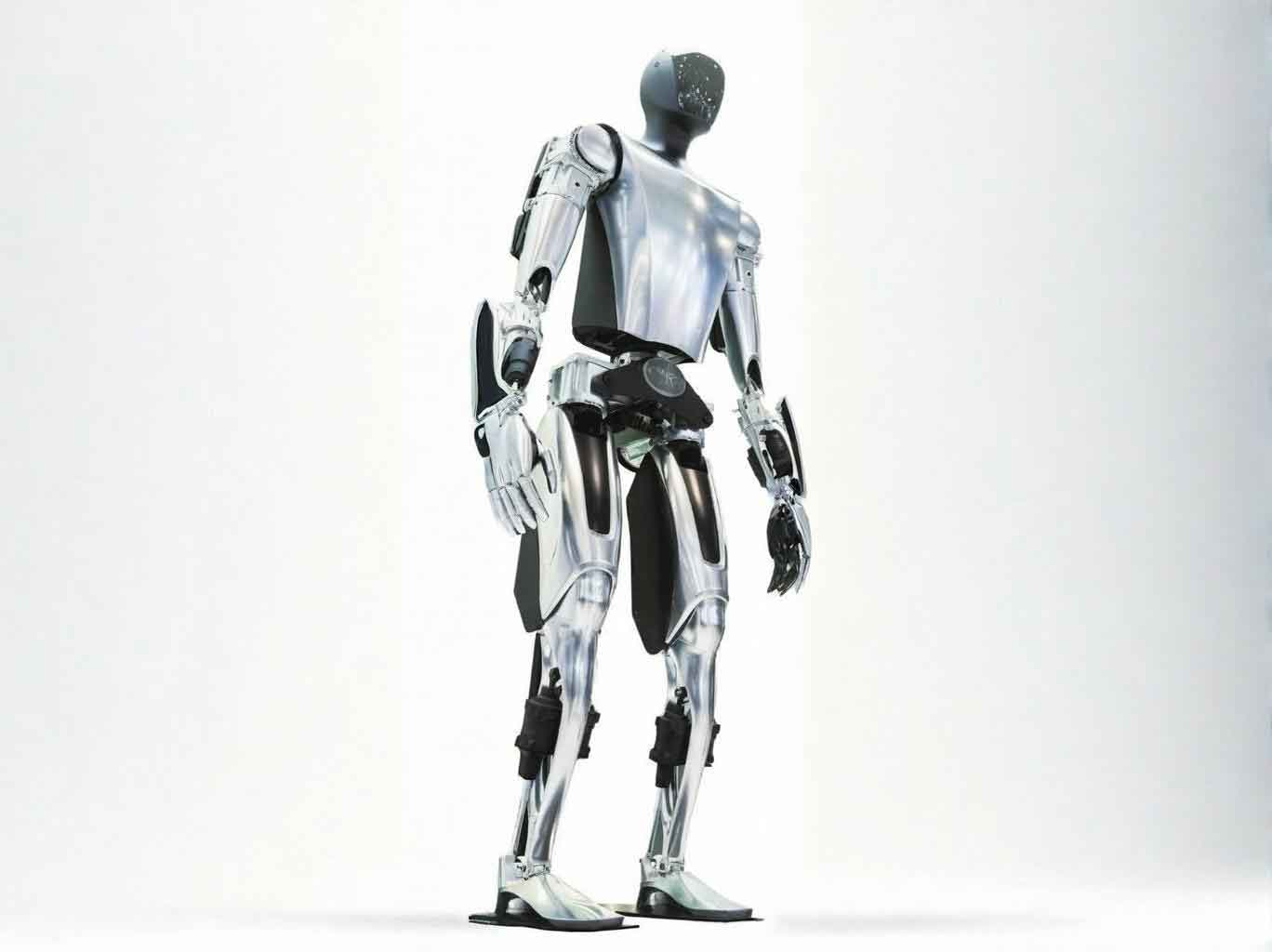
The physical form of these robots is diversifying. Beyond unmanned haul trucks, we now see embodied AI robots for drilling, explosive charging, bolting, scaling, and detailed inspection. Their designs incorporate robust, lightweight materials and specialized sensors (e.g., hyperspectral cameras for ore grading, gas detectors for safety) that allow them to perceive the mine in ways humans cannot. This sensor fusion is key. The state \(s_t\) for the AI is a multi-modal tensor:
$$
s_t = \mathcal{F}(I_t^{RGB}, I_t^{Thermal}, P_t^{LiDAR}, \mathbf{v}_t^{IMU}, F_t^{Force/Torque})
$$
where \(\mathcal{F}\) is the fusion network, \(I\) denotes images, \(P\) point cloud, \(\mathbf{v}\) inertial data, and \(F\) force data. This rich state representation enables the embodied AI robot to make robust decisions in confusing environments filled with dust, water, and uneven lighting.
Bottlenecks and Challenges for Mining Embodied AI Robots
Despite the compelling vision, the widespread deployment of electric embodied AI robots in mining faces significant hurdles. My research and industry engagements highlight three interconnected challenges that must be solved for常态化 (commonplace) application.
The Critical Shortcoming of High-Power Explosion-Proof Battery Technology
The energy requirements for a heavy-duty mining embodied AI robot are immense. It needs to power not only locomotion and tool actuation but also energy-hungry AI computers and sensor suites for hours in remote, rugged environments. The current limitation lies in achieving high energy density, high power density, and absolute safety in a potentially explosive atmosphere. While automotive batteries have advanced, mining applications demand “Mining Grade” robustness.
The fundamental challenge can be framed around the Ragone plot, which charts the specific power against specific energy of energy storage devices. Mining embodied AI robots need to operate in the high-specific-energy AND high-specific-power region. Current lithium-ion chemistries involve trade-offs. Let \(E\) be the usable energy and \(P_{max}\) the maximum power. For a battery pack, we have:
$$
E = C \cdot V \cdot \text{DoD} \cdot \eta_{discharge}
$$
$$
P_{max} \approx \frac{V^2}{4 R_{internal}}
$$
where \(C\) is capacity in Ah, \(V\) is nominal voltage, DoD is depth of discharge, and \(R_{internal}\) is the internal resistance. For explosion-proof designs, added safety layers (like thick casings, advanced Battery Management Systems (BMS) with distributed temperature sensing) increase weight and \(R_{internal}\), thus reducing effective \(E\) and \(P_{max}\). The search for solid-state electrolytes, which promise higher energy density and intrinsic safety, is paramount. The industry needs batteries that satisfy the following combined constraint for widespread adoption:
$$
\text{Mining Battery Suitability Index } (MBSI) = \frac{E_{usable} \cdot P_{max, sustained} \cdot S_{safety}}{Weight \cdot Cost} > \tau
$$
where \(S_{safety}\) is a quantified safety score from 0 to 1, and \(\tau\) is a required threshold. Currently, few solutions meet the required \(\tau\) for the most demanding underground applications.
Insufficient Data-Driven Resources for Mining-Scene Embodied AI
AI models, especially for embodied intelligence, are voracious data consumers. The unique and harsh conditions of mines—low light, dust, fog, complex geometries, and varying ore types—create a domain that is underrepresented in public robotics datasets. Training a robust perception model for an embodied AI robot requires millions of labeled frames from actual mine sites, covering diverse weather, lighting, and operational states. This data scarcity is a major bottleneck.
We can quantify the data need using the concept of sample complexity from computational learning theory. To achieve a generalization error \(\epsilon\) with probability \(1-\delta\), the number of required independent samples \(m\) often follows a rule like:
$$
m = \Omega \left( \frac{VC(\mathcal{H}) + \ln(1/\delta)}{\epsilon^2} \right)
$$
where \(VC(\mathcal{H})\) is the Vapnik-Chervonenkis dimension of the hypothesis space \(\mathcal{H}\) (the set of possible models). For deep neural networks used in modern embodied AI robot perception, the effective complexity is huge, demanding correspondingly large \(m\). The table below summarizes key data types needed and the current gap:
| Data Type | Critical for Robot Function | Current Availability & Challenge |
|---|---|---|
| Multi-view Stereo Imagery | 3D mapping, obstacle detection | Low. Commercially sensitive, difficult to capture in active mines. |
| LiDAR Point Clouds with Semantic Labels | Navigation, structure inspection | Very Low. Manual labeling of 3D points is extremely labor-intensive. |
| Long-term Operational Telemetry | Predictive maintenance, control policy learning | Medium. Collected by OEMs but rarely shared; lacks standardization. |
| Simulation Environments (Digital Twins) | Safe, scalable training and testing | Improving. Physics fidelity (rock fragmentation, dust dynamics) remains a major challenge. |
| Human-Robot Interaction Logs | Learning from expert operators | Minimal. Crucial for learning complex manipulation skills. |
Creating open, standardized mining datasets and high-fidelity simulators is as vital as developing new algorithms for the advancement of embodied AI robots.
The Limitations of Underground Autonomous Driving Technology
Surface mining has seen successful pilots of autonomous haulage systems. The underground realm, however, presents a qualitatively different challenge, effectively acting as the “final exam” for an embodied AI robot‘s navigation stack. The core problems are degraded perception, unreliable positioning, and extreme path planning complexity.
First, perception in tunnels suffers from signal degradation. Dust and water droplets scatter LiDAR beams and camera light. The effective sensing range \(d_{effective}\) can be modeled as:
$$
d_{effective} = d_{nominal} \cdot e^{-\beta(\lambda, \rho) \cdot z}
$$
where \(d_{nominal}\) is the nominal range in clear air, \(\beta\) is the attenuation coefficient depending on wavelength \(\lambda\) and particle density \(\rho\), and \(z\) is distance. In dense dust, \(d_{effective}\) can fall below the safe stopping distance.
Second, GPS denial makes localization reliant on SLAM (Simultaneous Localization and Mapping). The error in a SLAM estimate grows with distance traveled (drift). For a robot traveling a path length \(L\), the positional uncertainty \(\sigma_x\) often scales as:
$$
\sigma_x \propto \epsilon_{sensor} \cdot L^{\kappa}
$$
where \(\epsilon_{sensor}\) is sensor noise and \(\kappa\) is typically between 0.5 and 1 for visual-inertial systems. In long, feature-less tunnels, this drift becomes unacceptable for precise operations like aligning a drill.
Third, path planning is not merely point-to-point. The robot must navigate tight spaces, avoid dynamic obstacles (like other vehicles or falling debris), and sometimes operate on steep, muddy inclines. The planning problem becomes a high-dimensional optimization in continuous space with dynamic constraints, requiring real-time computation. These combined factors mean that a fully autonomous, production-ready underground embodied AI robot fleet is still on the horizon, awaiting breakthroughs in resilient sensor fusion and algorithmic robustness.
Conclusion
The fusion of electrification and embodied intelligence is not just an incremental improvement for mining; it is a foundational shift towards a sustainable and intelligent future. The electric embodied AI robot stands as the central actor in this new paradigm, offering a path to eliminate emissions from mobile equipment, remove workers from hazardous areas, and optimize operations with superhuman consistency and data-driven insight. From my standpoint, the technological pillars—high-density safe batteries, robust multi-modal AI, and resilient underground autonomy—are advancing, albeit with challenges remaining. The key to acceleration lies in cross-industry collaboration: battery chemists working with mining engineers, AI researchers partnering with equipment manufacturers, and operators sharing data to train the next generation of robotic intelligence. The mine of the future will be quieter, cleaner, and increasingly operated by a coordinated fleet of electric embodied AI robots, each one a testament to human ingenuity applied to the vital task of responsibly extracting the resources our world needs. The journey has definitively begun, and its trajectory points towards a greener, safer, and more efficient horizon for the entire mining industry.