
The acceleration of intelligent manufacturing is driving a global transformation of the manufacturing industry from traditional production models towards highly automated, digitalized, and intelligent paradigms. As core equipment in modern manufacturing, industrial robots are widely applied in fields such as aerospace, automotive manufacturing, and electronics, playing a pivotal role in advancing industrial upgrading and transformation.
In recent years, Embodied Artificial Intelligence (Embodied AI) has emerged as a prominent research hotspot, garnering significant attention from both academia and industry. It has been extensively explored and applied in domains like autonomous driving, humanoid robotics, and home services. This paradigm shift emphasizes the deep coupling of “body-environment-intelligence,” moving beyond the traditional “sense-plan-act” serial architecture. Its aim is to construct a closed-loop interactive framework for industrial robots, fostering a new generation of intelligent robotic systems. This article delves into the deep integration of embodied AI with industrial robots, proposing and discussing a novel industrial robot paradigm—the Embodied AI Industrial Robot (EAI-IR). We systematically elaborate on its conceptual framework, constitutive elements, and a proposed six-layer system architecture. From the perspective of the “perception-decision-action-feedback” closed loop, we summarize its key technologies. A practical case study on planetary reducer assembly is presented to validate the feasibility and effectiveness of the proposed architecture. Finally, we conclude with a discussion on future development trends.
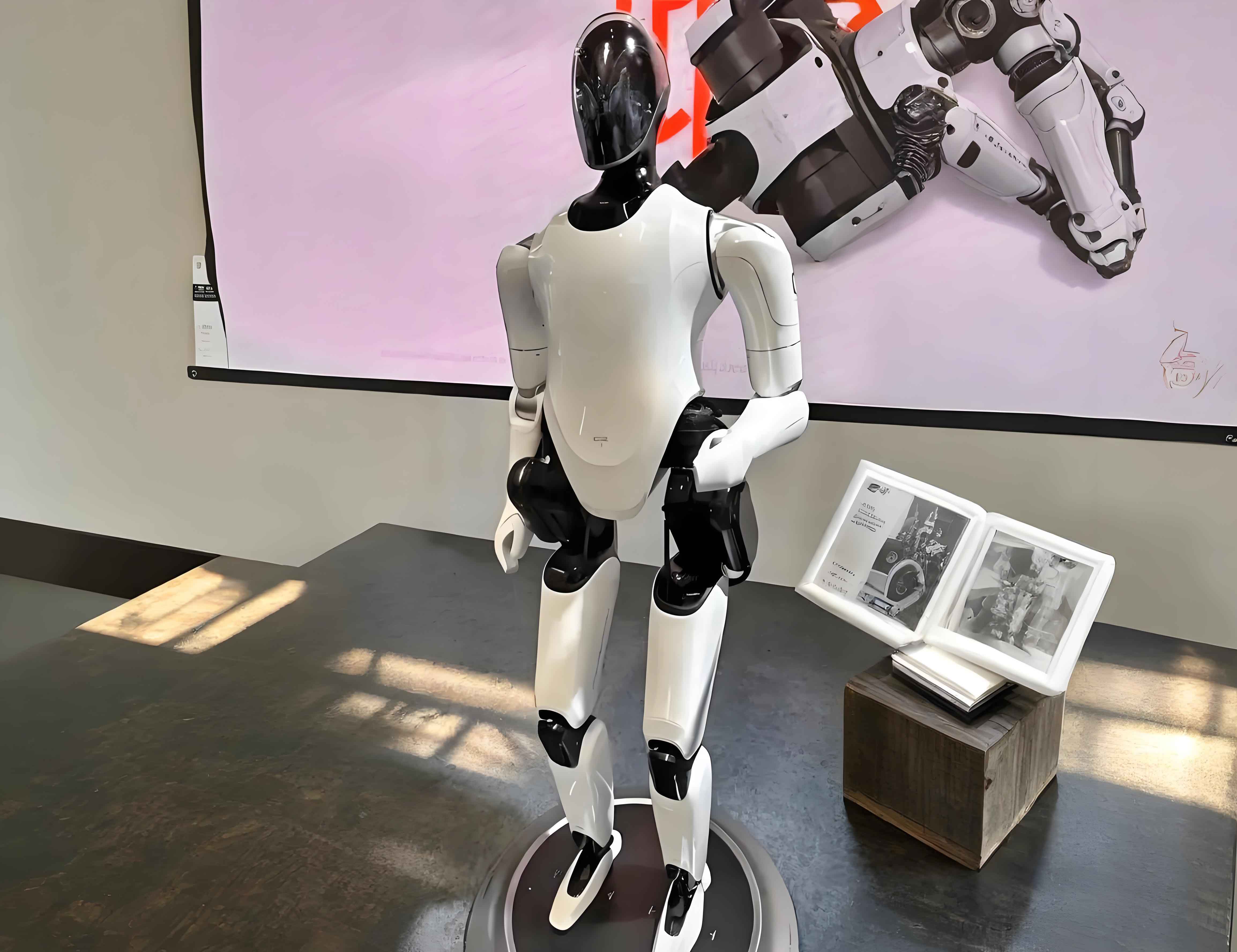
1. The Embodied AI Industrial Robot: Concept and Architecture
An Embodied AI Industrial Robot (EAI-IR) is an end-to-end closed-loop intelligent robotic system that deeply integrates multimodal perceptual information (e.g., vision, force, touch). It constructs an autonomous operational loop of “perception-decision-action-feedback” through continuous, dynamic embodied interaction with the physical environment. This enables environment perception, task comprehension, autonomous decision-making, and task planning, driving high-precision actuators to efficiently execute complex manipulation tasks. The EAI-IR continuously optimizes behavioral policies and adapts to novel scenarios based on interactive data, achieving capability iteration and performance evolution, thereby propelling industrial robots from program-driven automation to cognition-driven intelligent paradigms.
The EAI-IR is a complex system comprising three core, synergistically evolving elements: the Embodiment, the Intelligence, and the Environment, ultimately enabling autonomous decision-making.
- Embodiment (Hardware): This is the physical foundation, consisting of the execution system (robot manipulator, end-effector, controller) and the sensory system (vision, force, tactile sensors). It enables the robot to perceive the world and act upon it.
- Intelligence (Algorithms & Cognition): This is the “brain” of the system. It processes multimodal sensor data through algorithms like multimodal fusion and scene understanding. It leverages next-generation AI technologies—including multimodal large models, deep learning, reinforcement learning, and imitation learning—to make decisions, generate control instructions (e.g., end-effector trajectory sequences), and facilitate natural human-robot interaction.
- Environment (Context & Interaction): This encompasses the operational context, including workpieces, fixtures, related equipment (AGVs, CNC machines), and human operators. The EAI-IR interacts with this environment through industrial IoT protocols and intuitive interfaces, enabling collaborative task execution.
These three elements are highly coupled through dynamic interaction. The embodiment’s sensors feed environmental data to the intelligence layer, which processes it and sends command signals back to the embodiment’s actuators. The resulting changes in the environment are again perceived, forming a continuous “perception-decision-action-feedback” loop that drives autonomous learning and system optimization.
1.1 Typical Characteristics of an EAI-IR
The EAI-IR paradigm is characterized by five key “self-” attributes that distinguish it from traditional programmable robots:
| Characteristic | Description |
|---|---|
| Self-Perception | Real-time acquisition of dynamic data from the environment, its own state (joint angles, torque), and collaborative equipment via multimodal sensors. |
| Self-Learning | Continuous extraction of patterns from operational data using ML algorithms (e.g., RL, IL) to optimize control logic, build a process knowledge base, and enable experience transfer across tasks. |
| Self-Decision | Autonomous task planning and generation of optimal execution schemes based on simulation, prediction models, and real-time status, with dynamic priority adjustment for disruptions. |
| Self-Adaptation | Dynamic adjustment of motion paths and control strategies in response to environmental changes (e.g., obstacle avoidance, workpiece shift), and adaptive behavior in human-robot collaboration. |
| Self-Optimization | Continuous iterative optimization of model parameters, behavioral logic, and control algorithms through interaction feedback, often facilitated by a digital twin for virtual-physical synchronization. |
1.2 Proposed System Architecture for EAI-IR
We propose a six-layer system architecture to provide a structured framework for designing and implementing EAI-IR systems, integrating physical entities, intelligent algorithms, and environmental interaction capabilities.
| Layer | Core Function & Components |
|---|---|
| Application Layer | The top layer addressing specific industrial scenarios (e.g., automotive welding, electronics assembly, logistics) by integrating services from lower layers. |
| Intelligence Layer | The core “brain,” encompassing hardware (GPU clusters, edge nodes) and software algorithms for multimodal perception, understanding, decision & planning, learning & adaptation, and human-robot interaction. |
| Computation Layer | Provides infrastructure for algorithm deployment and compute scheduling, including central cloud platforms for heavy model training and edge nodes for low-latency, real-time inference. |
| Physical Layer | The hardware foundation: robot manipulator, sensory system (vision, force/torque, tactile), control unit, and actuators. Enables perception, execution, and physical interaction. |
| Interaction Layer | Manages and optimizes interaction with the external world through communication interfaces, data acquisition modules, human-robot interaction interfaces, and digital twin integration for simulation and virtual-physical synchronization. |
| Environment Layer | Defines the operational context and constraints: the physical workspace, device interaction protocols (for AGVs, machines), and human-robot collaboration rules with safety frameworks. |
2. Key Technologies for the “Perception-Decision-Action-Feedback” Loop
The autonomous operation of an embodied AI robot is driven by a tightly coupled “perception-decision-action-feedback” closed loop. Below, we dissect the key technologies within each phase.
2.1 Perception: Multimodal Sensing and Understanding
Perception is the prerequisite for intelligent decision-making, enabling the embodied AI robot to acquire and understand environmental information.
- Multimodal Sensor Technology: Advanced sensors form the bridge to the physical world. This includes high-dynamic-range vision sensors and vision chips for object recognition and 6D pose estimation; force/torque sensors for compliant control and collision detection; and flexible tactile sensors providing “skin-like” perception for material classification and delicate grip control. MEMS-based sensors enable compact, low-power multi-functional sensing.
- Multimodal Information Fusion: Fusing data from vision, force, touch, etc., is crucial for robust perception. Fusion can occur at the data level (early), feature level (mid), or decision level (late). Techniques like cross-modal attention or graph neural networks dynamically weigh information from different modalities to create a coherent environmental understanding.
- Scene Semantic Understanding: This involves deep parsing of the scene—detecting objects (using models like YOLO, Faster R-CNN), performing semantic segmentation (with U-Net, DeepLab), understanding object relationships (via Graph Neural Networks), and reasoning about events (using LSTMs, Transformers). This high-level understanding guides task-relevant decision-making.
- Human-Robot Interaction (HRI): EAI-IRs leverage natural language processing for voice commands, computer vision for gesture recognition, and tactile feedback to enable intuitive and direct communication with human operators, forming a collaborative perception-action loop.
2.2 Decision: The “Brain-Cerebellum” Collaborative Architecture
The decision-making architecture of an advanced embodied AI robot often follows a “Brain-Cerebellum”协同 model, moving beyond linear “sense-plan-act”.
The “Brain” (Planning Layer): This high-level layer, often powered by Large Language Models (LLMs) or Vision-Language Models (VLMs), acts as a semantic-driven dynamic decision engine. It interprets human instructions and environmental states, decomposes complex goals into logical task sequences, and performs reasoning. For example, given the command “Assemble the planetary gear system,” the brain might generate an XML-formatted plan: <command>Pick_gear → Align_to_hub → Insert_and_secure</command>. It utilizes constrained prompting with domain knowledge (e.g., assembly rules, API specs) to ensure feasible, executable output and can engage in clarification dialogues with humans if instructions are ambiguous.
The “Cerebellum” (Skill Layer): This layer houses the concrete, executable skills or policies. It is responsible for generating and optimizing low-level control strategies and can be built using various methodologies:
| Method | Role in Skill Layer |
|---|---|
| Supervised / Imitation Learning (IL) | Learns policy networks directly from expert demonstration data (e.g., from kinesthetic teaching). Behavior Cloning (BC) mimics demonstrated trajectories. Diffusion Policy formulates policy as a conditional denoising process, excelling in handling multi-modal action distributions. Recent Vision-Language-Action (VLA) models like RT-2 or π0 map instructions and perception directly to actions. |
| Reinforcement Learning (RL) | Enables online learning and skill optimization through trial-and-error interaction with the environment. Algorithms like SAC (Soft Actor-Critic) or PPO (Proximal Policy Optimization) are used to refine policies for tasks such as precision assembly, maximizing a reward function $$R(s_t, a_t)$$. |
| Transfer Learning | Accelerates learning of new tasks by transferring knowledge from previously learned skills, enhancing the robot’s adaptability and reducing data requirements. |
| Traditional Control | Provides reliable, deterministic “primitive skills” for safety-critical or highly structured tasks (e.g., PID for trajectory tracking, impedance control for safe contact). These are stored in the skill library as callable modules. |
Data & Simulation: Acquiring diverse, high-quality demonstration data is fundamental for training robust skill policies. Simulation platforms (CoppeliaSim, Isaac Sim) and Digital Twins provide safe, efficient environments for data augmentation, policy training, and Sim2Real transfer, drastically reducing physical trial-and-error costs. A continuous learning mechanism is essential for the long-term adaptation of both the planning brain (e.g., continual pre-training on new industrial data) and the skill cerebellum (e.g., using regularization or replay-based methods to avoid catastrophic forgetting of old skills while learning new ones).
2.3 Action: From Decision to Physical Motion
This phase translates high-level strategies and skill outputs into precise physical motion.
- Path Planning: Finds an optimal, collision-free path from start to goal pose, considering dynamic obstacles. Algorithms range from traditional (A*, RRT) to RL-based methods (DQN, PPO for dynamic environments). For multi-robot systems, Multi-Agent Path Finding (MAPF) algorithms coordinate paths to avoid inter-robot collisions.
- Motion Control: Executes the planned path with accuracy and stability. It involves:
- Drivers & Actuators: Electric servo motors, pneumatic/hydraulic systems, or novel materials like electroactive polymers for soft robotics.
- Controllers: Centralized or distributed control units processing sensor feedback.
- End-Effectors: Adaptive grippers, suction cups, or multi-fingered dexterous hands for versatile manipulation.
- Control Methods: From point-to-point and continuous path control to advanced force control and intelligent control (e.g., neural network control, fuzzy logic control). Model Predictive Control (MPC) is powerful for dynamic systems: it solves an optimization problem over a receding horizon:
$$ \min_{u_{t},…, u_{t+H}} \sum_{k=0}^{H} ( \| x_{t+k} – x_{ref} \|_Q^2 + \| u_{t+k} \|_R^2 ) $$
subject to system dynamics $$x_{k+1} = f(x_k, u_k)$$ and constraints.
- Sim-to-Real Transfer: Techniques like domain randomization and dynamics adaptation are used to bridge the “reality gap,” allowing policies trained or validated in high-fidelity simulations (e.g., within a digital twin) to be deployed successfully on the physical embodied AI robot.
2.4 Feedback: Closing the Loop for Adaptation and Optimization
Feedback is the connective tissue that enables closed-loop control, dynamic adaptation, and system optimization.
| Technology Category | Key Methods & Purpose |
|---|---|
| Model-Based Feedback Control | Relies on mathematical models of the robot and environment. Impedance/Admittance Control regulates interaction stiffness/damping. Model Predictive Control (MPC) uses the model for predictive optimization, as shown above. |
| Model-Free Adaptive Control | Used when accurate modeling is difficult. Includes Reinforcement Learning (learning optimal policy π(a|s)), Fuzzy Control (using rule-based inference), and Neural Network Control (approximating complex control laws). |
| Virtual-Physical Fusion Adjustment | Leverages Digital Twins and AR to fuse real-time physical data with virtual simulations, enabling dynamic optimization, predictive maintenance, and operational guidance. |
| Safety & Fault Tolerance | Incorporates redundancy design, real-time fault diagnosis algorithms, predefined emergency procedures, and self-recovery mechanisms to ensure safe and reliable operation. |
| Multi-Dimensional Performance Evaluation | Establishes comprehensive metrics (task success rate, cycle time, energy consumption, force smoothness) to monitor, analyze, and guide the continuous improvement of the embodied AI robot’s performance. |
3. Case Study: Embodied AI for Planetary Reducer Assembly
To validate the proposed concepts, we implemented an EAI-IR system for assembling a planetary gear reducer, demonstrating the “voice instruction-task planning-skill execution-feedback” closed loop.
3.1 System Setup: Embodiment and Environment
- Embodiment: A UR5 collaborative robot arm equipped with an OnRobot RG2 adaptive gripper, an OnRobot HEX-E six-axis force/torque sensor, and an Intel RealSense D435i RGB-D camera.
- Environment & Interfaces: The physical workcell with reducer components. A digital twin was built in CoppeliaSim for strategy testing. All devices were connected via a central compute box, with communication managed over TCP/IP and UDP protocols. Python APIs and the Robotiq RTDE interface were used for control.
3.2 Intelligence Implementation: Brain and Cerebellum
Planning “Brain”: We used the Qwen-Plus LLM as the central planner. The operator provides a natural language command (e.g., “Assemble the planetary reducer”). The LLM, guided by a structured prompt containing assembly knowledge and available skill APIs, decomposes the task into a sequence of executable skill calls (e.g., assemble_flange_shaft(), assemble_sun_gear(), assemble_planet_gear()).
Skill “Cerebellum”: Three distinct assembly skills (flange shaft, sun gear, planet gear) were trained using a Diffusion Policy approach. For each skill, demonstration data (100 trajectories) was collected via kinesthetic teaching. The policy network takes as input a history of stereo images $$I_{t}, I_{t-1},…$$ and force/torque readings $$F_t$$, and learns to predict a sequence of robot end-effector actions (delta poses) $$\{a_t, a_{t+1}, …, a_{t+H}\}$$ through a denoising diffusion process. The training minimizes the loss:
$$ L = \mathbb{E}_{t, a_0, \epsilon} \left[ \| \epsilon – \epsilon_\theta( \sqrt{\bar{\alpha}_t} a_0 + \sqrt{1-\bar{\alpha}_t} \epsilon, t | I, F ) \|^2 \right] $$
where $$\epsilon$$ is noise, $$\epsilon_\theta$$ is the learned noise predictor, and $$\bar{\alpha}_t$$ is a noise schedule. During execution, the trained model iteratively denoises a random action sequence conditioned on current observations to produce smooth, compliant assembly motions.
3.3 Results and Analysis
We conducted 100 full assembly runs. The LLM successfully parsed commands and invoked the correct skill sequence every time. The performance of the Diffusion Policy (DP) skills was compared against two baselines: 1) another imitation learning method, ACT (Action Chunking with Transformers), and 2) a traditional search-based method (spiral search with admittance force control).
| Assembly Task | Success Rate (%) | Avg. Reasoning Steps | ||||
|---|---|---|---|---|---|---|
| DP | ACT | Search | DP | ACT | Search | |
| Flange Shaft | 99 | 100 | 94 | 4.38 | 3.82 | 5.57 |
| Sun Gear | 96 | 91 | 95 | 6.69 | 8.17 | 7.22 |
| Planet Gear | 76 | 71 | 48 | 8.35 | 10.24 | 13.13 |
The EAI-IR system, integrating the LLM planner with DP skills, demonstrated a functional end-to-end closed loop from voice command to physical completion. The results show that the DP-based skill layer achieved a superior balance between success rate, action efficiency (fewer steps), and force compliance compared to the baselines, especially in the most complex planet gear task. This validates the effectiveness of the embodied AI robot architecture in handling unstructured assembly operations with high autonomy.
4. Conclusion and Future Trends
This article has presented a comprehensive framework for the Embodied AI Industrial Robot (EAI-IR), detailing its constitutive elements, characteristic features, and a proposed six-layer system architecture. We systematically summarized the key technologies underpinning the “perception-decision-action-feedback” autonomous loop. A practical case study on planetary reducer assembly demonstrated the viability of this architecture, showing how an LLM-based “brain” and a diffusion policy-based “cerebellum” can collaborate to execute complex tasks from natural language instructions.
The future development of embodied AI robots will focus on three core trajectories:
- Theoretical Foundations: Deeper integration of insights from cognitive science and neuroscience to develop more robust frameworks for autonomous perception, causal reasoning, and lifelong learning in physical systems.
- Technological Breakthroughs: The convergence of “Large Models + Robotics” will be pivotal. This includes developing vertical-domain foundation models (e.g., for mechanical reasoning) and enhancing their real-world grounding. Advancements in high-performance, low-latency edge computing and neuromorphic hardware will be crucial for deployment. Research into more sample-efficient and safer reinforcement learning, advanced Sim2Real transfer, and truly lifelong continuous learning algorithms will be essential.
- Application Ecosystem & Standardization: Widespread adoption requires the creation of standardized, modular, and open-source software stacks to lower development barriers. Establishing shared simulation platforms, benchmarking datasets, and interoperability standards will foster a collaborative ecosystem, accelerating the integration of embodied AI robots into flexible, intelligent manufacturing systems of the future.
By deepening the fusion of physical embodiment with environmental intelligence, EAI-IRs are poised to transition industrial robotics from programmed automation to adaptive, cognitive partnership, fundamentally driving the next wave of manufacturing innovation.