
In recent years, the field of embodied intelligence has gained significant traction, emphasizing that intelligence arises from the synergistic interaction between the brain, body, and environment. This paradigm shift highlights the importance of embodied AI robots, which integrate physical form, perception, action, and learning to interact dynamically with their surroundings. Unlike disembodied intelligence, which focuses on logic and reasoning, embodied AI robots leverage morphological computation, active perception, and embodied learning to achieve adaptive behaviors. As both academia and industry increasingly recognize the potential of embodied AI robots, there is a pressing need to develop comprehensive educational curricula that can equip students with the necessary skills and knowledge. In this article, I explore the preliminary efforts in curriculum development for embodied AI robots, adopting a dual-drive model that combines historical evolution with cutting-edge exploration. This approach aims to provide a holistic understanding while fostering innovation in this rapidly evolving field.
The dual-drive model serves as the cornerstone of our curriculum design, where one wheel represents the historical evolution of embodied intelligence, and the other symbolizes the frontier of contemporary research. This framework ensures that students not only grasp the foundational concepts but also engage with the latest advancements. The historical perspective traces the philosophical, psychological, and cognitive science roots of embodied AI robots, illustrating how ideas from morphology, behaviorism, and cybernetics have shaped current theories. For instance, the concept of morphological computation—where the physical body offloads computational tasks—can be traced back to early robotics and biological studies. By examining milestones such as the Moravec paradox, which highlights the difficulty of replicating human-like perception and action in machines, students gain a nuanced appreciation of the challenges and breakthroughs in embodied AI robot development.
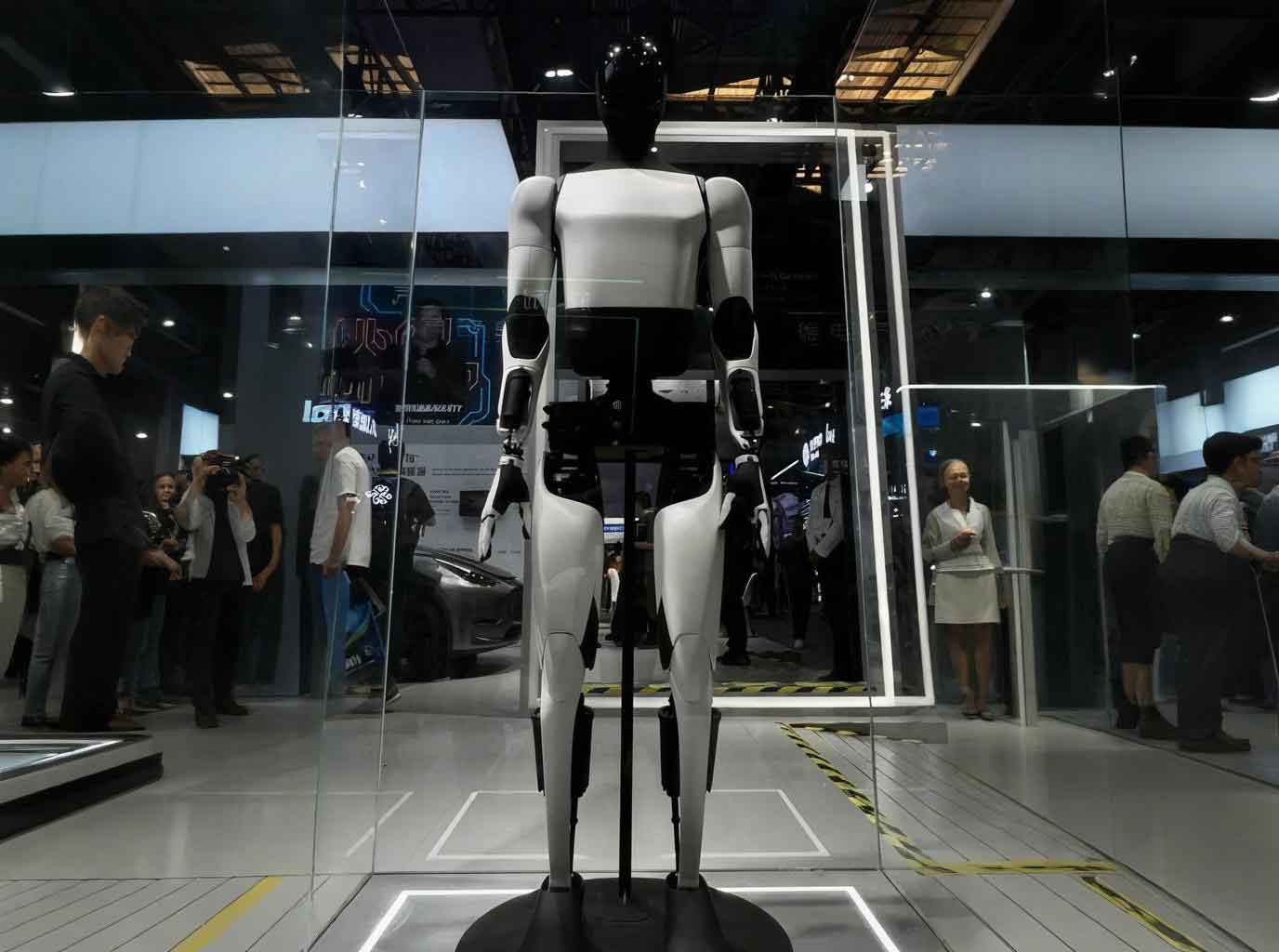
On the other hand, the frontier exploration wheel immerses students in state-of-the-art research, including recent publications on embodied learning, active perception, and multi-robot collaboration. For example, work published in Nature Communications on embodied intelligence via learning and evolution demonstrates how embodied AI robots can autonomously develop skills through interaction with their environment. This dual-drive approach encourages a dialectical mindset: students learn to contextualize new findings within historical frameworks while critically evaluating their implications. To operationalize this model, our curriculum is structured around four core pillars: morphology, behavior, perception, and learning, each interconnected to reflect the holistic nature of embodied AI robots. The synergy among these pillars is encapsulated in the following relation:
$$ \text{Embodied Intelligence} = f(\text{Morphology}, \text{Behavior}, \text{Perception}, \text{Learning}) $$
where each component influences and enhances the others. For instance, morphology can simplify control through structural properties, while behavior can improve perception via active exploration. This interdependence is central to designing effective curricula for embodied AI robots.
To systematically outline the curriculum, I have developed a detailed framework consisting of ten modules, each addressing key aspects of embodied AI robots. The table below summarizes these modules, their learning objectives, and reference hours, providing a clear roadmap for course implementation.
| Module | Key Topics | Learning Objectives | Reference Hours |
|---|---|---|---|
| 1: Introduction to Embodied Intelligence | Historical evolution, embodied AI robot tasks, system architecture | Understand philosophical foundations and differentiate embodied vs. disembodied intelligence | 3 |
| 2: Machine Learning Foundations | Multilayer perceptrons, convolutional neural networks, reinforcement learning | Master core ML techniques applicable to embodied AI robots | 9 |
| 3: Simulation Platforms | Gym, AI2-THOR, environment setup | Gain hands-on experience with tools for embodied AI robot simulation | 3 |
| 4: Morphological Computation | Principles, physical implementations, reservoir computing | Learn how morphology reduces computational load in embodied AI robots | 3 |
| 5: Morphological Control | Structure representation, graph neural networks, transfer learning | Develop control strategies leveraging morphological constraints | 3 |
| 6: Morphological Optimization | Parameter and structure optimization, co-evolution with control | Design adaptive morphologies for embodied AI robots | 3 |
| 7: Visual Navigation | Visual-language navigation, feature extraction, model training | Implement navigation systems for embodied AI robots | 3 |
| 8: Active Perception | Visual-semantic navigation, embodied scene description | Enable embodied AI robots to actively explore and interpret environments | 6 |
| 9: Embodied Learning | Exploration models, self-supervised learning | Foster autonomous skill acquisition in embodied AI robots | 3 |
| 10: Multi-Robot Collaboration | Task allocation, coordinated behavior | Orchestrate teamwork among embodied AI robots | 3 |
Each module integrates theoretical concepts with practical applications, ensuring that students can directly apply knowledge to embodied AI robot projects. For example, in the machine learning module, we delve into reinforcement learning algorithms, which are pivotal for training embodied AI robots. The Q-learning update rule is presented as:
$$ Q(s, a) \leftarrow Q(s, a) + \alpha \left[ r + \gamma \max_{a’} Q(s’, a’) – Q(s, a) \right] $$
where \( s \) represents the state of the embodied AI robot, \( a \) is the action, \( r \) is the reward, and \( \alpha \) and \( \gamma \) are learning and discount factors, respectively. Such formulas are complemented by hands-on exercises using simulation platforms like Gym, where students train virtual embodied AI robots to perform tasks such as navigation or manipulation.
The curriculum emphasizes the interplay between morphology and control, a key aspect of embodied AI robots. Morphological computation posits that the physical design of an embodied AI robot can inherently perform computations, thereby simplifying control algorithms. This is exemplified by passive walking robots, where mechanical design alone enables stable locomotion without complex controllers. Mathematically, this can be modeled using reservoir computing frameworks, where the morphology acts as a dynamical system. The state evolution of an embodied AI robot with morphological computation can be expressed as:
$$ \mathbf{h}(t+1) = f(\mathbf{W}_{in} \mathbf{u}(t) + \mathbf{W} \mathbf{h}(t)) $$
where \( \mathbf{h} \) is the hidden state representing the morphological dynamics, \( \mathbf{u} \) is the input, and \( \mathbf{W} \) matrices are weights that capture physical properties. By incorporating such models, students learn to design embodied AI robots that leverage their bodies for efficient task execution.
Active perception is another critical area covered in the curriculum, focusing on how embodied AI robots can enhance sensory information through movement and interaction. For instance, visual-semantic navigation requires embodied AI robots to explore environments based on linguistic instructions, blending perception with action. The objective function for training such systems often involves maximizing the probability of successful navigation:
$$ \max_{\theta} \mathbb{E}_{(s, a, g) \sim \mathcal{D}} \left[ \log P(a | s, g; \theta) \right] $$
where \( \theta \) represents model parameters, \( s \) is the visual scene, \( a \) is the action, and \( g \) is the goal description. Through case studies and assignments, students implement these algorithms, enabling embodied AI robots to perform complex tasks like object retrieval in cluttered spaces.
Embodied learning modules address how embodied AI robots can acquire knowledge through interaction, mimicking human developmental processes. This involves exploration strategies where the robot actively seeks informative experiences. The information gain from an action can be quantified using mutual information:
$$ I(S; A) = H(S) – H(S | A) $$
where \( S \) is the state space and \( A \) is the action set of the embodied AI robot. By optimizing for information gain, embodied AI robots can learn more efficiently, a concept reinforced through projects where students design learning agents for novel environments.
To complement theoretical instruction, the curriculum includes robust coursework assignments that challenge students to apply concepts to embodied AI robot scenarios. These assignments span topics such as motion learning, morphological evolution, and multi-robot coordination. For example, one assignment tasks students with optimizing the morphology of a simulated embodied AI robot for speed or stability using genetic algorithms. The fitness function might be defined as:
$$ F(\mathbf{m}) = \frac{1}{T} \sum_{t=1}^{T} v(t) – \lambda \cdot \text{energy}(t) $$
where \( \mathbf{m} \) is the morphological parameters, \( v(t) \) is velocity, and \( \lambda \) penalizes energy consumption. Such assignments not only deepen understanding but also foster creativity, with some student projects leading to research publications. The coursework is structured in phases: team formation, milestone workshops, and final presentations, ensuring continuous feedback and collaboration.
In parallel with course development, I have contributed to textbook creation to address the scarcity of comprehensive resources on embodied AI robots. The textbook, titled “Introduction to Embodied Intelligence,” aligns with the dual-drive model by covering historical context while highlighting前沿 techniques. It emphasizes problem-method separation, presenting clear definitions of embodied AI robot challenges alongside diverse algorithmic solutions. For instance, it details morphological optimization methods using reinforcement learning, with pseudo-code and case studies. The textbook also includes practical guides for simulation tools, enabling readers to experiment with embodied AI robot designs. This resource has been well-received, as noted in academic reviews, and serves as a foundational reference for both students and practitioners.
The implementation of this curriculum in educational settings has yielded positive outcomes. Student engagement has increased markedly, with high-quality project submissions demonstrating proficiency in embodied AI robot concepts. Feedback via course evaluations indicates that the historical perspective helps contextualize rapid advancements, while the前沿 focus keeps the material relevant. For instance, students appreciate discussions on recent breakthroughs in embodied AI robot learning, such as large-scale multi-modal models. Moreover, the coursework has inspired many participants to pursue research or careers in embodied AI robotics, contributing to the growing community. Workshops and seminars based on this curriculum have attracted hundreds of attendees from academia and industry, further validating the dual-drive approach’s effectiveness.
Looking ahead, the field of embodied AI robots continues to evolve, driven by advances in materials science, artificial intelligence, and robotics. Future curriculum iterations will incorporate emerging topics such as neuromorphic computing for embodied AI robots, human-robot collaboration, and ethical considerations. The dual-drive model will remain essential, as historical insights can guide responsible innovation while前沿 explorations push boundaries. For example, as embodied AI robots become more integrated into society, courses may address societal impacts through case studies on automation and autonomy. Additionally, international collaborations could enrich the curriculum with diverse perspectives on embodied AI robot development.
In conclusion, developing a curriculum for embodied AI robots requires a balanced approach that honors historical roots while embracing innovation. The dual-drive model of historical evolution and cutting-edge exploration provides a robust framework for educating the next generation of researchers and engineers. Through structured modules, hands-on assignments, and comprehensive textbooks, students gain a deep understanding of how morphology, behavior, perception, and learning synergize in embodied AI robots. As this field expands, continued refinement of educational practices will be crucial to unlocking the full potential of embodied intelligence, ultimately enabling embodied AI robots to transform industries and improve lives. The journey of curriculum development is ongoing, and I am committed to fostering an inclusive, dynamic learning environment that prepares learners for the challenges and opportunities ahead.