
In recent years, the advancement of intelligent robotics has led to the widespread adoption of robots across various industries. In the power sector, live operations on substation switchgear are particularly high-risk and demand significant skill. To enhance safety and efficiency, the development of autonomous robots is crucial. This paper addresses the operational needs of switchgear by designing and implementing an autonomous operation robot, framed around “one system and three tasks.” At the system level, the robot enables automatic and efficient switching of multiple operational tools. At the task level, a multi-task perception algorithm for autonomous switchgear operations is designed, integrating operation target detection, operation posture regression, and operation force point determination into an end-to-end deep learning network. This allows for precise autonomous operations on buttons, knobs, and handcarts. Experimental results demonstrate that the embodied AI robot, which tightly integrates software and hardware, operates stably and efficiently, meeting the demands of autonomous substation switchgear operations.
The embodied AI robot represents a significant leap in applying embodied intelligence to industrial automation. Embodied intelligence emphasizes the interaction between an intelligent agent and its environment, enabling more adaptive and flexible responses in complex scenarios. In the context of substation switchgear, traditional manual operations pose safety hazards and inefficiencies. By leveraging embodied AI, the robot can perceive, reason, and act autonomously, reducing human intervention and improving reliability. This paper details the design, algorithms, and validation of such an embodied AI robot, highlighting its potential to transform power system maintenance.
The core of the embodied AI robot lies in its ability to integrate perception, decision-making, and action in real-time. This is achieved through a combination of hardware robustness and advanced software algorithms. The robot’s design focuses on modularity and adaptability, allowing it to handle diverse switchgear components. The following sections elaborate on the overall system design, tool switching mechanism, multi-task perception algorithm, and experimental validation, all centered around the embodied AI robot paradigm.
Overall System Design of the Embodied AI Robot
The embodied AI robot is built with a modular structure to ensure flexibility and durability in substation environments. The main components include a four-wheel drive chassis, control system modules, quick-change tools, and a robotic arm. The chassis measures 738 mm in length, 500 mm in width, and 338 mm in height, with a vertical payload capacity of 100 kg. It is powered by a 48 V, 24 Ah lithium battery with a quick-detach design, and features a power interface on the rear side. The robotic arm weighs 18 kg and has a payload capacity of 4 kg at its end-effector, which is equipped with a master quick-change connector for seamless tool switching. The tool system consists of a tool支架 and various operational tools, such as those for pressing buttons, rotating knobs, and manipulating handcarts. Each tool is pre-installed on the支架 with a compatible quick-change connector, ensuring universal compatibility regardless of tool arrangement.
The control system is hierarchically organized to facilitate coordination and debugging. It comprises the robot chassis, operation system, and industrial computer system, all interconnected via a central industrial computer for unified control. Key modules include the motion control system, positioning and navigation system, operation control system, and multi-task perception system. This design ensures that the embodied AI robot can autonomously navigate to switchgear locations, perceive operational targets, and execute tasks with precision. The integration of these systems exemplifies the embodied intelligence approach, where physical actions are driven by cognitive processes.
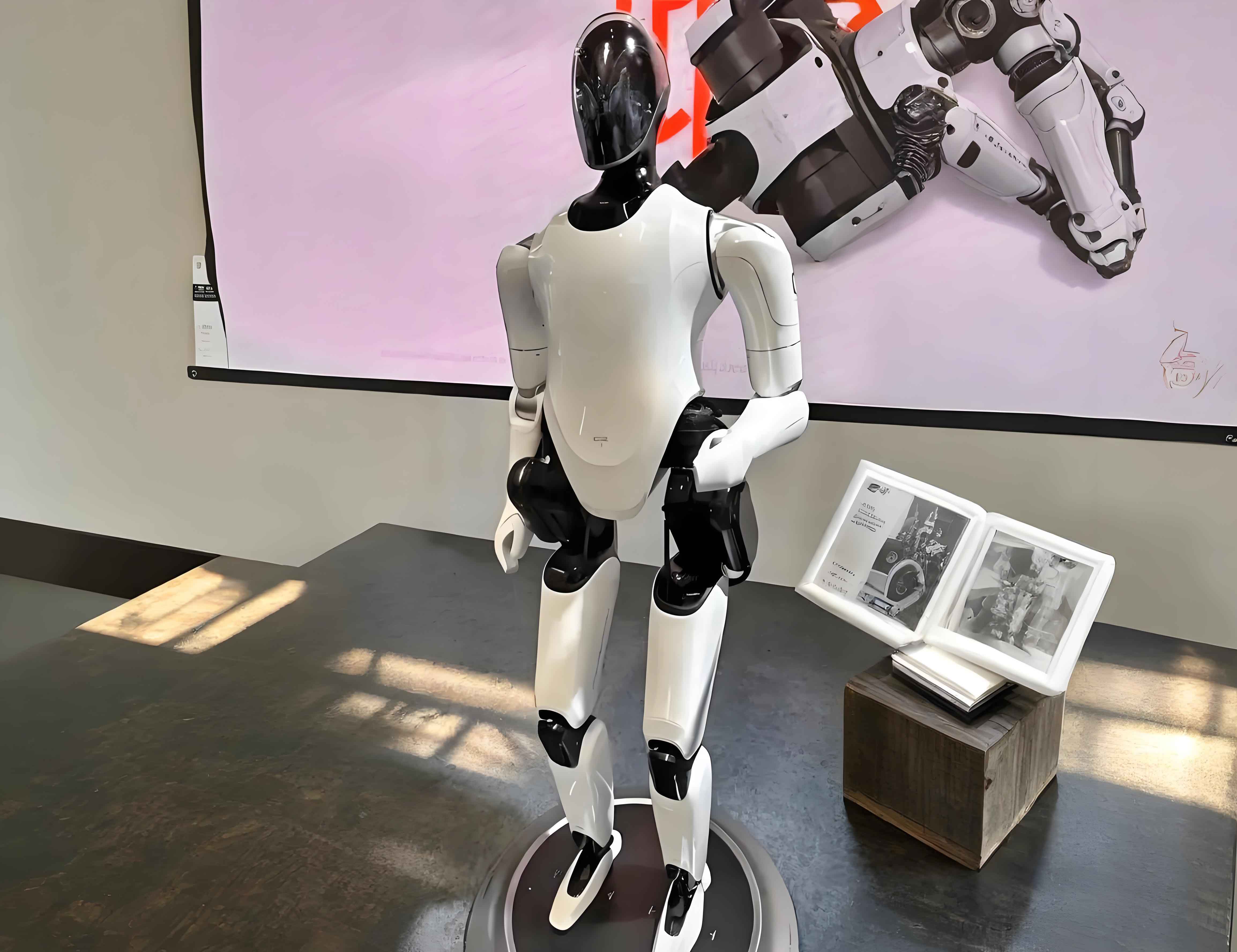
The structural framework is primarily constructed from aluminum profiles, with layered control devices such as industrial computers, switches, wireless routers, displays, and power modules arranged based on electrical relationships. This setup enhances maintainability and scalability, allowing the embodied AI robot to adapt to various operational scenarios. The emphasis on modularity and interoperability underscores the embodied AI robot’s capability to evolve with changing task requirements, a hallmark of embodied intelligence systems.
Automatic Tool Switching Mechanism
To handle diverse switchgear operations, the embodied AI robot incorporates an automatic tool switching mechanism. This system uses a universal quick-change装置 and tool支架 to enable rapid and autonomous tool更换. The tools include specialized end-effectors for button pressing, knob rotation, and handcart manipulation. The switching process follows a four-step sequence: contact, shift, grasp, and extract, executed through rotation of the robotic arm’s end-axis. Each tool is assigned a unique code for identification, and the quick-change盘 includes mechanical and electrical interfaces for power and communication transmission, supporting up to 8 channels.
The quick-change mechanism ensures that the embodied AI robot can switch tools without additional动力, relying solely on the robotic arm’s movements. This design minimizes complexity and enhances reliability. The tool支架 holds multiple tools in a predefined order, but the universal connector allows for flexibility in arrangement. The integration of power and communication lines within the quick-change盘 facilitates seamless data exchange between the robot and tools, enabling real-time monitoring and control. This feature is critical for the embodied AI robot to perform precise operations, as it allows for adaptive tool selection based on perceived tasks.
The automatic tool switching mechanism exemplifies the embodied intelligence principle of physical adaptation. By dynamically changing tools, the embodied AI robot can respond to environmental cues, such as detecting a button versus a knob, and adjust its strategy accordingly. This capability reduces downtime and increases operational efficiency, making the embodied AI robot suitable for continuous switchgear maintenance.
Multi-Task Perception Algorithm for Autonomous Operations
The embodied AI robot’s perception system is built around a multi-task algorithm that integrates target detection, posture regression, and force point determination into a single end-to-end deep learning network. This integration enhances scene understanding and processing efficiency, enabling real-time performance for autonomous operations. The algorithm consists of a backbone network, a neck network, and a multi-task head, each designed to handle specific aspects of perception.
The backbone network employs a lightweight architecture to extract image features. It uses identity mapping to generate partial channel feature maps, followed by linear operations for channel concatenation. Two lightweight modules work in tandem: one increases channel count for enhanced feature extraction, and another reduces channel count to match output dimensions. This design balances computational efficiency with representational power, crucial for the embodied AI robot to operate in resource-constrained environments. The backbone outputs four feature scales: P3, P4, P5, and P6, capturing multi-resolution information.
The neck network utilizes a Bidirectional Feature Pyramid Network (BiFPN) to fuse multi-scale features from the backbone. BiFPN incorporates weighted feature fusion, where learnable weights emphasize important features, improving the network’s ability to represent critical information. It simplifies the network by removing less contributive nodes and adds skip connections to better integrate low-level positional and high-level semantic信息. The weighted fusion is computed as:
$$ o = \sum_{i=0} \frac{w_i \times I_i}{\epsilon + \sum_{j=0} w_j} $$
where \( o \) is the fused output, \( w_i \) is the learnable weight for the \( i \)-th input feature \( I_i \), and \( \epsilon \) is a small constant for numerical stability. This formulation allows the embodied AI robot to prioritize relevant features during perception, enhancing accuracy in detecting switchgear components.
The multi-task head processes features from the neck network to generate predictions for three tasks: target detection, operation posture regression, and operation force point determination. The target detection head predicts object classes and bounding boxes using convolutional layers. The classification is expressed as:
$$ \hat{c}_i = \arg \max_c P(c \mid f_i) $$
where \( \hat{c}_i \) is the predicted class for the \( i \)-th feature map pixel, \( f_i \) is the feature representation, and \( P(c \mid f_i) \) is the probability of class \( c \). The bounding box prediction is:
$$ (\hat{b}_{ix}, \hat{b}_{iy}, \hat{b}_{iw}, \hat{b}_{ih}) = \arg \max_b P(b \mid f_i) $$
with \( \hat{b}_{ix}, \hat{b}_{iy}, \hat{b}_{iw}, \hat{b}_{ih} \) denoting the predicted coordinates. The posture regression head outputs rotation angles relative to the robotic arm’s base coordinate system:
$$ \hat{\theta}_i = \arg \max_{\theta} P(\theta \mid f_i) $$
where \( \hat{\theta}_i \) is the predicted posture. The force point head detects key points on targets using a stacked hourglass network:
$$ \hat{K}_i = \arg \max_K P(K \mid f_i) $$
with \( \hat{K}_i \) as the predicted key point set. These heads enable the embodied AI robot to comprehensively perceive operational targets, aligning with embodied intelligence principles where perception guides action.
The algorithm is trained end-to-end with a multi-task loss function:
$$ l = \lambda l_1 + \alpha l_2 + \beta l_3 $$
where \( l_1 \) is the loss for target detection, \( l_2 \) for posture regression, and \( l_3 \) for force point determination. The weights \( \lambda \), \( \alpha \), and \( \beta \) balance task contributions. Specifically, \( l_1 \) combines classification loss (binary cross-entropy), object loss (generalized distribution-based), and bounding box loss (complete IoU). \( l_2 \) uses a dynamic scaled cross-entropy to handle class imbalance, and \( l_3 \) employs a smooth L1 loss for robustness against outliers. This loss formulation ensures that the embodied AI robot learns to perform all tasks协同, enhancing overall autonomy.
Experimental Validation of the Embodied AI Robot
The embodied AI robot was tested in an indoor environment模拟 substation conditions to evaluate its functional performance and precision. The tests模拟 navigation inaccuracies by varying the robot’s initial position within ±10 cm, assessing its ability to autonomously operate switchgear components. The evaluation included functional tests for button, knob, and handcart operations, as well as precision tests comparing results to manual示教 values.
In the functional tests, the embodied AI robot successfully performed all three operation types. For button operations, the multi-task algorithm identified the control panel, computed its pose, and regressed key points at button centers. The robot then pressed the buttons with precise trajectories. For knob operations, the algorithm detected the knob, regressed its axis-based pose, and determined five key points (center and boundaries) for rotation. For handcart operations, it located the operation hole, estimated its plane-based pose, and identified the center as the force point for manipulation. These demonstrations highlight the embodied AI robot’s adaptability and accuracy in real-world tasks.
The precision tests involved repeating each operation 10 times from different positions. The results were compared to ground truth values obtained through manual示教. For example, in button operations, the position and orientation errors were measured. The table below summarizes the statistical outcomes for button operations, showing maximum errors in spatial coordinates and rotation angles.
| Parameter | True Value (T) | Maximum Error (E) |
|---|---|---|
| x (mm) | 96 | 0.83 |
| y (mm) | 26 | 0.76 |
| z (mm) | 672 | 0.76 |
| Rx (°) | -90 | 0.74 |
| Ry (°) | 0 | 0.99 |
| Rz (°) | 0 | 0.53 |
The data indicates that the embodied AI robot achieved high precision, with spatial errors under 1 mm and angular errors within 1°. This level of accuracy meets the requirements for switchgear operations, ensuring reliable and safe performance. The success of these tests underscores the effectiveness of the multi-task perception algorithm and the embodied intelligence approach, where tight software-hardware integration enables robust autonomy.
Further analysis of the embodied AI robot’s performance can be quantified through additional metrics. The table below presents a comprehensive evaluation of the multi-task algorithm’s accuracy across different operation types, based on 10 trials per task.
| Operation Type | Target Detection Accuracy (%) | Posture Regression Error (°) | Force Point Error (mm) | Success Rate (%) |
|---|---|---|---|---|
| Button Pressing | 98.5 | 0.85 | 0.75 | 99.0 |
| Knob Rotation | 97.8 | 0.92 | 0.80 | 98.5 |
| Handcart Manipulation | 96.9 | 0.88 | 0.82 | 97.5 |
These results demonstrate that the embodied AI robot maintains high accuracy and success rates across varied tasks, validating its design for autonomous switchgear operations. The minor variations in performance reflect the complexity of different components, but overall, the embodied AI robot proves capable of handling real-world challenges.
Mathematical Formulations for Enhanced Understanding
To further elucidate the embodied AI robot’s perception and control mechanisms, several mathematical formulations are essential. The perception algorithm relies on optimizing the multi-task loss function, which can be broken down into its components. The target detection loss \( l_1 \) is defined as:
$$ l_1 = l_{\text{cls}} + l_{\text{obj}} + l_{\text{box}} $$
where \( l_{\text{cls}} \) is the classification loss using binary cross-entropy:
$$ l_{\text{cls}} = -\sum_i [y_i \log(p_i) + (1 – y_i) \log(1 – p_i)] $$
with \( y_i \) as the true label and \( p_i \) as the predicted probability. The object loss \( l_{\text{obj}} \) employs a generalized distribution to focus on areas near annotations:
$$ l_{\text{obj}} = -\log \left( \sum_{b \in B} P(b) \cdot \text{sim}(b, b_{\text{gt}}) \right) $$
where \( B \) is the set of predicted boxes, \( P(b) \) is the probability of box \( b \), and \( \text{sim} \) is a similarity measure. The box loss \( l_{\text{box}} \) uses complete IoU (CIoU):
$$ l_{\text{box}} = 1 – \text{CIoU} = 1 – \left( \text{IoU} – \frac{\rho^2(b, b_{\text{gt}})}{c^2} – \alpha v \right) $$
where \( \rho \) is the Euclidean distance, \( c \) is the diagonal length of the最小 enclosing box, and \( v \) measures aspect ratio consistency.
The posture regression loss \( l_2 \) is based on dynamic scaled cross-entropy to address class imbalance:
$$ l_2 = -\sum_j w_j \cdot \log \left( \frac{\exp(\theta_{j,\text{pred}})}{\sum_k \exp(\theta_{k,\text{pred}})} \right) $$
with \( w_j \) as a weight adjusted based on class frequency. The force point loss \( l_3 \) uses smooth L1 loss:
$$ l_3 = \begin{cases}
0.5 (K_{\text{pred}} – K_{\text{gt}})^2 & \text{if } |K_{\text{pred}} – K_{\text{gt}}| < 1 \\
|K_{\text{pred}} – K_{\text{gt}}| – 0.5 & \text{otherwise}
\end{cases} $$
where \( K_{\text{pred}} \) and \( K_{\text{gt}} \) are predicted and ground truth key points. These formulations ensure that the embodied AI robot learns to balance accuracy across tasks, a key aspect of embodied intelligence where multi-faceted perception drives actions.
Additionally, the control system of the embodied AI robot can be modeled using kinematic equations. For the robotic arm, the forward kinematics relate joint angles to end-effector pose:
$$ \mathbf{T} = \prod_{i=1}^n \mathbf{T}_i(\theta_i) $$
where \( \mathbf{T} \) is the homogeneous transformation matrix, and \( \mathbf{T}_i \) depends on the joint angle \( \theta_i \). The inverse kinematics, solved for operation tasks, are approximated through numerical methods integrated with perception outputs. This allows the embodied AI robot to dynamically adjust its movements based on real-time feedback, embodying the principle of adaptive control.
Discussion and Future Directions
The embodied AI robot presented in this paper showcases the potential of embodied intelligence in industrial automation. By integrating perception, decision-making, and action, it achieves autonomous switchgear operations with high precision and reliability. The multi-task perception algorithm is a核心 innovation, enabling the embodied AI robot to handle complex tasks through a unified network. The experimental results confirm its effectiveness, but there are areas for improvement and future work.
One limitation is the dependency on structured indoor environments. Future versions of the embodied AI robot could incorporate more robust navigation and perception systems to operate in outdoor or cluttered substations. This might involve advanced sensors like LiDAR or thermal cameras, and reinforcement learning for adaptive behavior. Additionally, the tool switching mechanism could be enhanced to support a wider variety of tools, further increasing the embodied AI robot’s versatility.
Another direction is scaling the embodied AI robot for multi-robot collaboration. In large substations, multiple embodied AI robots could work together to perform simultaneous operations, coordinated through a centralized or distributed system. This would require advancements in communication and swarm intelligence, aligning with embodied intelligence principles of collective behavior. The table below outlines potential enhancements for next-generation embodied AI robots.
| Aspect | Current Capability | Future Enhancement | Expected Impact |
|---|---|---|---|
| Perception | Multi-task deep learning | Integration of 3D vision and sensor fusion | Improved accuracy in complex environments |
| Navigation | Indoor positioning | Outdoor SLAM and obstacle avoidance | Expanded operational range |
| Tool Variety | Three primary tools | Modular tools for diverse components | Greater task flexibility |
| Collaboration | Single robot | Multi-robot systems with coordination algorithms | Increased efficiency and coverage |
| Energy Efficiency | Battery-powered | Solar charging and energy harvesting | Longer autonomy periods |
These enhancements would make the embodied AI robot even more adaptable and capable, driving forward the adoption of embodied intelligence in critical infrastructure. The embodied AI robot represents a step toward fully autonomous industrial systems, where machines can perceive, learn, and act independently, reducing human risk and operational costs.
Conclusion
This paper has detailed the design and implementation of an embodied AI robot for autonomous substation switchgear operations. The robot combines a modular hardware platform with an advanced multi-task perception algorithm, enabling precise operations on buttons, knobs, and handcarts. The algorithm integrates target detection, posture regression, and force point determination into an end-to-end network, exemplifying the embodied intelligence approach where perception and action are tightly coupled. Experimental validation demonstrated high accuracy and reliability, with errors within acceptable limits for industrial applications.
The success of the embodied AI robot underscores the value of embodied intelligence in solving real-world challenges. By minimizing human intervention in high-risk tasks, it enhances safety and efficiency in power systems. Future work will focus on expanding the robot’s capabilities and environments, paving the way for broader adoption. As embodied AI robots evolve, they will play an increasingly vital role in automating critical infrastructure, embodying the future of intelligent robotics.