
As I delve into the challenges faced by elderly users in the automotive domain, it becomes evident that the digital divide significantly hampers their interaction with human-machine interfaces (HMI). Traditional car interfaces, often designed for younger, tech-savvy demographics, fail to account for the physiological and cognitive changes associated with aging. This results in frustrating experiences marked by complex navigation, poor information clarity, and heightened safety risks. In this research, I explore how the paradigm of embodied AI robot can be harnessed to redefine automotive HMI design, creating systems that are intrinsically aligned with the natural interaction patterns and needs of older adults. The core premise is that an embodied AI robot—viewing the vehicle as an intelligent agent with a physical presence and the ability to perceive, reason, and act within its environment—provides a foundational framework for building more intuitive, adaptive, and compassionate interfaces.
The concept of an embodied AI robot is central to this transformation. Unlike conventional AI that processes abstract data, an embodied AI robot learns and operates through direct sensorimotor interaction with the physical world. In an automotive context, the car itself becomes a sophisticated embodied AI robot, integrated with a network of cameras, LiDAR, radar, torque sensors, and microphones. This sensor suite allows the system to form a rich, real-time understanding of the interior cabin, the driver’s state, and the external road environment. The intelligence of this embodied AI robot is not merely about processing power; it is about situated cognition—the ability to use bodily experiences and environmental context to inform decision-making. This aligns perfectly with the need for automotive interfaces that can dynamically adapt to the user rather than forcing the user to adapt to a static, complex menu system. The equation governing this adaptive capability can be conceptualized as a continuous loop: $$S_{t+1} = f(S_t, A_t, O_t)$$ where \(S_t\) represents the system’s state (including user state and environmental context) at time \(t\), \(A_t\) is the action taken by the embodied AI robot (e.g., modifying the interface), and \(O_t\) is the observed outcome, which feeds back into the next state. This closed-loop interaction is what enables truly personalized and context-aware experiences.
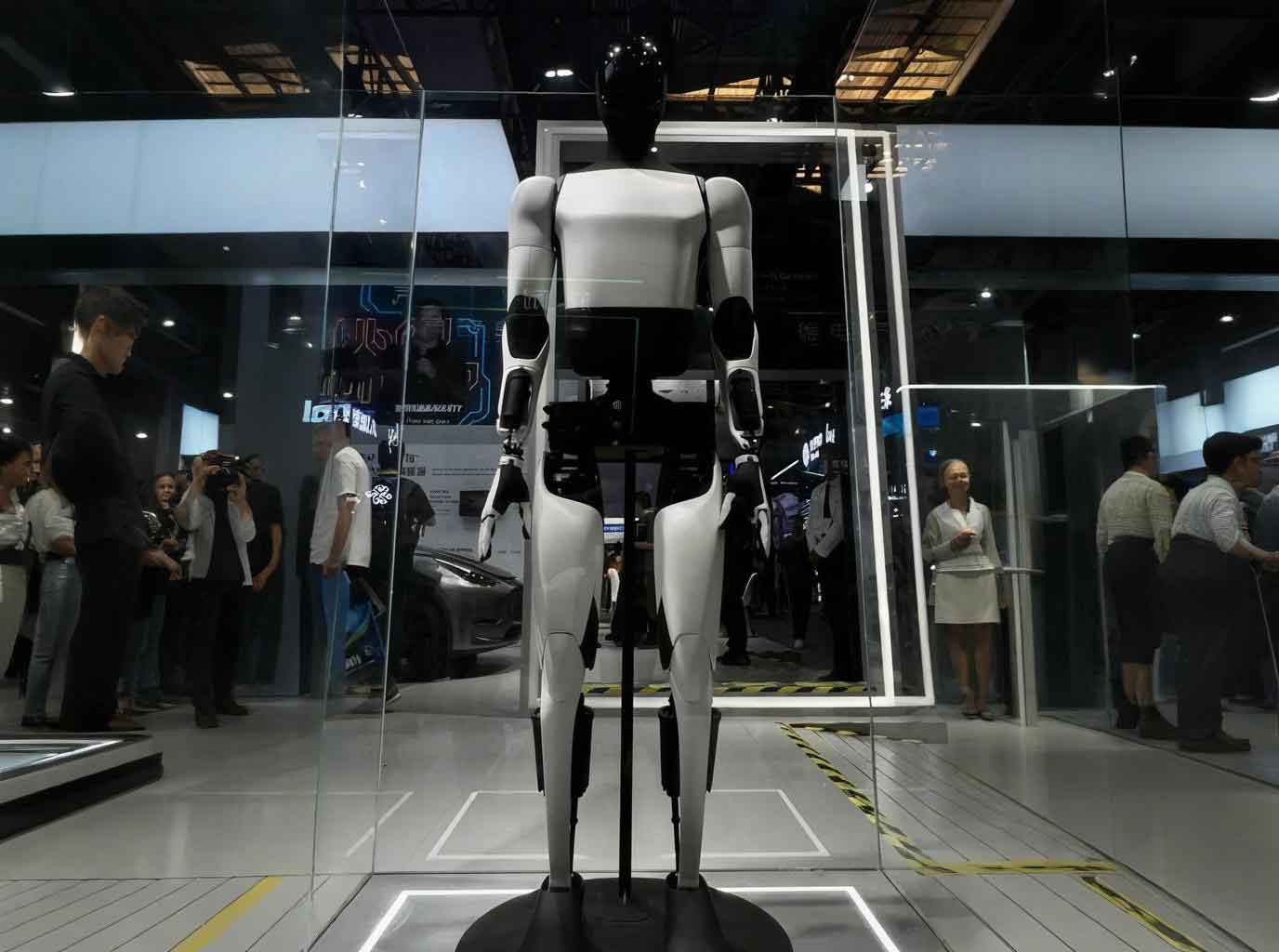
To ground the design of an embodied AI robot interface in real user needs, I conducted extensive research focusing on the elderly demographic. The first phase employed the KANO model to categorize and prioritize functional requirements. By surveying over 100 elderly users with recent independent driving experience, I gathered data on their reactions to various potential HMI features. The KANO model classifies features into five categories: Must-be (M), One-dimensional (O), Attractive (A), Indifferent (I), and Reverse (R). The analysis involves calculating the Better and Worse coefficients to quantify the impact of fulfilling or not fulfilling a feature on user satisfaction. The formulas for these coefficients are: $$Better = \frac{A + O}{A + O + M + I}$$ $$Worse = – \left( \frac{O + M}{A + O + M + I} \right)$$ A high Better value indicates that providing the feature greatly increases satisfaction, while a high absolute Worse value indicates that its absence greatly decreases satisfaction. The results, summarized in the table below, reveal clear priorities for an age-friendly embodied AI robot system.
| HMI Feature for Embodied AI Robot | Better Coefficient | Worse Coefficient | KANO Category | Design Implication |
|---|---|---|---|---|
| Proactive Voice Assistance & Conversation | 0.88 | -0.12 | Attractive | High priority for delight; core feature of the embodied AI robot. |
| Automatic Adjustment of Display Contrast/Font | 0.92 | -0.08 | One-dimensional | Linear increase in satisfaction; essential for perception compensation. |
| Simplified, Context-Aware Main Menu | 0.75 | -0.25 | Must-be | Basic expectation; its absence causes severe dissatisfaction. |
| Haptic Steering Wheel Feedback for Navigation | 0.80 | -0.05 | Attractive | Enhances multimodal interaction of the embodied AI robot. |
| Personalized Climate Control Automation | 0.70 | -0.15 | One-dimensional | Expected feature that should work seamlessly. |
| Gesture Control for Basic Functions | 0.60 | -0.02 | Indifferent | Lower priority; some users are indifferent to it. |
Complementing this functional analysis, I constructed detailed user experience maps to visualize the holistic journey of an elderly driver. This process involved breaking down the entire interaction timeline into stages such as Pre-Driving Setup, In-Transit Navigation, Climate Adjustment, Infotainment Use, and Post-Driving Feedback. At each stage, I mapped out user actions, thoughts, emotional states, and pain points. A critical insight was that frustration often peaked during secondary task interactions (e.g., changing radio station while driving), where divided attention and complex menu hierarchies posed significant cognitive and safety risks. The emotional trajectory frequently showed anxiety during initial learning and setup phases, shifting to either satisfaction when tasks were completed effortlessly or irritation when systems failed. This journey mapping underscored the necessity for an embodied AI robot to be not just functionally capable but also emotionally intelligent, capable of sensing user stress and simplifying interactions proactively.
Synthesizing the findings from the KANO model and experience maps, I formalized a comprehensive model of user experience influencing factors specifically for elderly interaction with an embodied AI robot. This model posits that the overall experience (UX) is a multidimensional construct. For analytical purposes, we can represent it as a function of six primary vectors: $$UX = \Phi(\mathbf{P}, \mathbf{C}, \mathbf{E}, \mathbf{F}, \mathbf{O}, \mathbf{S})$$ where \(\mathbf{P}\) is the Perception vector, \(\mathbf{C}\) is the Cognition vector, \(\mathbf{E}\) is the Emotion vector, \(\mathbf{F}\) is the Function vector, \(\mathbf{O}\) is the Operation vector, and \(\mathbf{S}\) is the Situation vector. Each vector comprises several measurable elements. The table below delineates these vectors and their key constituents, providing a blueprint for where the embodied AI robot must focus its adaptive intelligence.
| Experience Dimension (Vector) | Key Elements (Vector Components) | Description & Relevance to Embodied AI Robot |
|---|---|---|
| Perception (P) | Visual Acuity (p1), Auditory Sensitivity (p2), Haptic Perception (p3), Contrast Sensitivity (p4), Motion Perception (p5) | The embodied AI robot must sense user-specific perceptual thresholds and adapt output modalities (e.g., amplify audio if p2 is low, increase contrast if p4 is low). |
| Cognition (C) | Working Memory Load (c1), Information Processing Speed (c2), Spatial Reasoning (c3), Attention Capacity (c4), Learning Curve (c5) | The interface managed by the embodied AI robot should minimize c1 and c2 demands through chunking, predictability, and familiarity. |
| Emotion (E) | Anxiety Level (e1), Trust in Automation (e2), Sense of Control (e3), Frustration Tolerance (e4), Enjoyment (e5) | The embodied AI robot should use affective computing to monitor e1 and e4, and design interactions to boost e2, e3, and e5. |
| Function (F) | Task Success Rate (f1), Information Relevance (f2), Personalization Depth (f3), System Reliability (f4), Utility Comprehensiveness (f5) | Core performance metrics that the embodied AI robot optimizes through continuous learning and contextual awareness. |
| Operation (O) | Input Effort (o1), Gesture Accuracy (o2), Voice Recognition Rate (o3), Feedback Latency (o4), Physical Reachability (o5) | The embodied AI robot must enable naturalistic input (gesture, voice) and ensure o4 is minimal and o5 is ergonomically sound. |
| Situation (S) | Driving Task Criticality (s1), Environmental Complexity (s2), Social Context (s3), Time Pressure (s4), User Physiological State (s5) | The embodied AI robot’s supreme advantage: integrating s1-s5 to suppress non-critical functions during high s1 or s2, and adapting to s5 (e.g., fatigue). |
With this model as a guide, the application of embodied AI robot principles to age-friendly HMI design becomes a systematic engineering challenge. The goal is to instantiate an intelligent system that actively manipulates the vectors \(\mathbf{P}, \mathbf{C}, \mathbf{E}, \mathbf{F}, \mathbf{O}, \mathbf{S}\) to maximize UX for elderly users. This translates into several concrete design and technological strategies, which can be summarized by the following integrative framework. The effectiveness of an embodied AI robot in this domain, \(E_{EI}\), can be modeled as a weighted product of its competencies across these strategies: $$E_{EI} = \prod_{i=1}^{N} (C_i)^{w_i}$$ where \(C_i\) represents competency in strategy \(i\) (e.g., multimodal fusion, affective reasoning), and \(w_i\) is its relative importance weight derived from the user model.
| Strategic Application Area of Embodied AI Robot | Technical Implementation | Mathematical/Logic Representation | Expected Impact on UX Vectors |
|---|---|---|---|
| Adaptive Perceptual Compensation | Dynamic adjustment of UI brightness, font size, color contrast based on real-time ambient light and user eye-gaze tracking; spatial audio that directs sound based on head position. | \(FontSize_t = BaseSize \times \alpha(1/Lux_t) \times \beta(1/VisualAcuity_{user})\) where \(\alpha, \beta\) are adaptive functions. | ↑ \(\mathbf{P}\) (p1, p4), ↓ \(\mathbf{C}\) (c1), ↑ \(\mathbf{E}\) (e3). |
| Cognitive Offloading & Predictive Assistance | The embodied AI robot learns routine sequences (e.g., “go to grocery store every Tuesday”) and pre-configures navigation, suggests departure time, and pre-sets climate control. | \(Action_{suggest} = \underset{a}{\mathrm{argmax}} \, P(Route_a | Day, Time, History_{user})\) | ↓ \(\mathbf{C}\) (c1, c2, c4), ↑ \(\mathbf{F}\) (f1, f2, f3), ↑ \(\mathbf{E}\) (e1, e5). |
| Affective Computing & Emotional Resonance | Using in-cabin cameras and voice stress analysis to detect confusion, anxiety, or frustration. The embodied AI robot responds by simplifying the UI, using a calmer tone, or offering step-by-step verbal guidance. | \(EmotionState_t = ML\_Model(FacialExpr_t, VoicePitch_t, InteractionSpeed_t)\) If \(Anxiety(EmotionState_t) > \theta\), then \(InterfaceComplexity \leftarrow min\). | ↑ \(\mathbf{E}\) (e1, e2, e4), ↓ \(\mathbf{C}\) (c1), ↑ \(\mathbf{S}\) (s5 integration). |
| Embodied Natural Interaction Modalities | Replacing precise touch inputs with robust gesture recognition (e.g., hand wave for accept, push away for reject), natural language dialogue, and gaze-based selection. | \(Input_{recognized} = Fuse(Gesture\_CNN(hand\_skeleton), NLP\_Intent(speech\_text), Gaze\_Point)\) | ↓ \(\mathbf{O}\) (o1, o2, o3, o5), ↑ \(\mathbf{E}\) (e3, e5), ↑ \(\mathbf{C}\) (c5 – easier learning). |
| Holistic Situational Awareness & Context Adaptation | The embodied AI robot fuses vehicle dynamics (speed, steering torque), external object detection, and calendar data to infer primary task criticality. In complex traffic (high s2), it suppresses non-essential notifications. | \(UI\_Mode_t = \begin{cases} Minimal, & \text{if } TaskCriticality(s1, s2) > \tau \\ Full, & \text{otherwise} \end{cases}\) | ↑ \(\mathbf{S}\) (s1, s2, s4 management), ↑ \(\mathbf{F}\) (f2), ↑ \(\mathbf{E}\) (e1, e2 via increased safety). |
| Seamless Environmental & Social Integration | The embodied AI robot acts as a bridge, projecting navigational cues onto a Head-Up Display (HUD) aligned with the real road, or reading out relevant text messages from family in a social context (s3). | \(HUD\_Content = Project(Nav\_Path, World\_Coordinates_{ego})\) \(Social\_Alert = Filter(Message, Sender \in Family, DrivingMode)\) | ↑ \(\mathbf{P}\) (p5 – situating info in world), ↑ \(\mathbf{S}\) (s3), ↓ \(\mathbf{C}\) (c3 – less mental mapping). |
The realization of such an embodied AI robot system hinges on sophisticated sensor fusion algorithms and machine learning models that operate in real-time. For instance, the process of interpreting a user’s need can be formalized as a hierarchical Bayesian inference problem. Let \(G\) represent the user’s latent goal (e.g., “I am cold,” “I want to go home”). The embodied AI robot observes multimodal evidence \(E = \{e_{speech}, e_{gesture}, e_{physio}, e_{context}\}\). The posterior probability of the goal given the evidence is: $$P(G | E) = \frac{P(E | G) P(G)}{P(E)}$$ where \(P(G)\) is the prior probability of goals, informed by user history and context, and \(P(E|G)\) is the likelihood of observing the evidence given the goal. The embodied AI robot continuously updates this belief and takes the action corresponding to the most probable goal. This probabilistic reasoning allows the system to handle ambiguity and partial commands common among elderly users who may not use precise technical language.
Furthermore, the personalization aspect of the embodied AI robot is not static but evolves through continuous interaction. This can be modeled as a reinforcement learning (RL) problem where the embodied AI robot is the agent. The state \(s\) is the combined vector of UX dimensions \((\mathbf{P}, \mathbf{C}, \mathbf{E}, \mathbf{F}, \mathbf{O}, \mathbf{S})\). The action \(a\) is a specific interface adaptation (e.g., increase font size, activate voice prompt). The reward \(r\) is a composite signal derived from implicit feedback (e.g., task completion time, reduction in user error corrections, positive affective cues) and explicit feedback. The embodied AI robot learns a policy \(\pi(a|s)\) that maximizes the cumulative expected reward: $$J(\pi) = \mathbb{E}_{\pi} \left[ \sum_{t=0}^{T} \gamma^t r_t \right]$$ where \(\gamma\) is a discount factor. Through this RL framework, the embodied AI robot autonomously discovers the optimal adaptation strategies for individual elderly users, making the interface progressively more intuitive and supportive over time.
In conclusion, the journey towards truly age-inclusive automotive interfaces necessitates a fundamental shift from screen-centric design to experience-centric design facilitated by an embodied AI robot. This intelligent agent, perceiving through the car’s senses and acting through its interactive capabilities, can dynamically align the HMI with the evolving perceptual, cognitive, emotional, and situational realities of elderly drivers. By implementing the strategies of adaptive perception, cognitive offloading, emotional resonance, natural interaction, contextual awareness, and environmental integration, the embodied AI robot transcends being a mere tool and becomes a proactive partner. It holds the promise of not only bridging the digital divide but also enhancing safety, fostering independence, and restoring the joy of driving for the aging population. The future of automotive HMI lies in this symbiotic relationship between human and machine, where technology is embodied, context-aware, and deeply empathetic—a future where every car is an intelligent, caring embodied AI robot.