
As a researcher deeply immersed in the field of industrial automation, I have witnessed firsthand the transformative power of embodied AI robots. These intelligent systems, which perceive and interact with the physical world, are no longer confined to laboratories but are driving real-world revolutions on factory floors. The recent launch of a national challenge focused on application scenarios underscores the burgeoning interest and rapid advancement in this domain. This competition, bringing together hundreds of students and faculty, highlights the critical shift from theoretical concepts to practical, embodied intelligence solving complex industrial tasks. In this article, I will elaborate on the design and implementation of a sophisticated, customizable production system for manufacturing transformer components, a project that exemplifies the core principles and capabilities of modern embodied AI robots.
The cornerstone of this intelligent manufacturing paradigm is the seamless integration of perception, decision-making, and physical action. An embodied AI robot is not merely a passive executor of pre-programmed paths; it is an active agent that understands context through sensors, processes information using AI models, and adapts its actions in real-time. This capability is paramount for achieving true customization and flexibility in production. The system I designed centers on the batch production of transformer fin-tube connectors, a process traditionally reliant on skilled labor and prone to inconsistencies. By deploying an embodied AI robot at its core, the system achieves unprecedented levels of quality, efficiency, and adaptability.
The overall control framework for this intelligent, customized, and batch production system is built on a multi-layered architecture. This architecture ensures that every embodied AI robot within the ecosystem operates in a coordinated, data-driven manner. The physical layer consists of the robots, actuators, and sensors; the control layer involves programmable logic controllers (PLCs) and robot controllers; and the supervisory layer comprises human-machine interfaces (HMIs) and manufacturing execution systems (MES). Data flows bidirectionally, enabling the embodied AI robot to receive high-level production orders and report back status, quality metrics, and environmental data.
The material handling and preparation stage is the first point of interaction for the embodied AI robot. Supply bins store raw materials like flanges, tubes, and triangular brackets. The presence of material in each bin is detected by photoelectric sensors, a simple yet crucial form of environmental perception for the system. The actuation for presenting materials, such as the extension and retraction of pushers, is managed by pneumatic cylinders. The control logic for this, often handled by a PLC, can be summarized by a state-based formula. Let the sensor state for bin \(i\) be \(S_i\) (1 for material present, 0 for empty) and the cylinder command be \(C_i\) (1 for extend, 0 for retract). A simple control rule for a feeding sequence is:
$$ C_i(t) = \begin{cases} 1 & \text{if } S_i(t)=1 \text{ and } R(t)=1 \\ 0 & \text{otherwise} \end{cases} $$
Here, \(R(t)\) is a global readiness signal from the embodied AI robot or the central PLC, indicating that the workstation is ready to receive a new part. This integration of sensing and actuation is a fundamental behavior of any embodied AI robot operating in a structured environment.
The core of the production process is the robotic welding and processing system, which is a prime example of an embodied AI robot tasked with complex manipulation. The system primarily utilizes one welding robot and two positioners. The welding robot is equipped with a teach pendant and supports network protocols like FTP for program management. Crucially, its programs are modular with parameters, allowing external control systems to adjust welding parameters on the fly. This adaptability is key to custom production. The positioners, each controlled by two servo motors, orient the workpiece (the assembly of flange and tube) to present optimal angles to the welding torch held by the embodied AI robot. The kinematic coordination between the robot and the positioner can be described. If the robot’s tool center point (TCP) position is \(\mathbf{P}_r\) and the desired weld seam location on the workpiece is \(\mathbf{P}_w\), the positioner must rotate to align \(\mathbf{P}_w\) into a reachable and optimal orientation. This often involves solving inverse kinematics for both systems. A simplified relationship for a two-axis positioner (rotation \(\theta\), tilt \(\phi\)) might be:
$$ \mathbf{P}_w = \mathbf{T}(\theta, \phi) \cdot \mathbf{P}_w^{local} $$
$$ \text{Objective: Minimize } ||\mathbf{P}_r – \mathbf{P}_w|| \text{ subject to robot joint limits and weld quality constraints.} $$
All devices in this cell are integrated with a collision emergency stop system, a critical safety feature for any workspace shared by embodied AI robots and potentially human operators.
| Component | Quantity | Primary Function | Key Feature for Embodied AI |
|---|---|---|---|
| Welding Robot | 1 | Performs welding, grinding, deburring | Modular, parameterized programs; FTP communication |
| Servo-Controlled Positioner | 2 | Holds and reorients workpiece | Precise coordination with robot path |
| Tool Rack | 1 | Stores various end-effectors (grippers, grinders) | Enables multi-task capability for the robot |
| Collision Sensor System | Network | Monitors for unexpected contact | Ensures safe physical interaction |
The nervous system of the entire production line is the PLC control system. In this setup, multiple PLCs and remote I/O modules are deployed to orchestrate all devices. The primary PLC handles the central logic, while remote I/Os interface with sensors and actuators on the shop floor. An industrial router and gateway facilitate network communication, allowing the embodied AI robot controllers, PLCs, and higher-level systems to exchange data seamlessly. The control logic implemented here is what translates a high-level production order into the precise, timed sequence of actions for every cylinder, conveyor, sensor, and most importantly, the embodied AI robot. A typical state machine for a workstation controlled by a PLC can be modeled. Let the system state \(X\) belong to a set \(\{Idle, Loading, Processing, Unloading, Error\}\). Transitions between states are triggered by events \(E\) (e.g., “part detected,” “embodied AI robot task complete”) and guarded by conditions \(C\) (e.g., “safety gate closed”). The transition function \(\delta\) is:
$$ X_{t+1} = \delta(X_t, E_t, C_t) $$
This deterministic yet flexible logic is programmed into the PLCs, making the embodied interaction of all hardware components possible.
| Device Type | Count | Role in System Integration |
|---|---|---|
| Central PLC (e.g., S7-1200) | 4 | Execute main control program, manage data exchange |
| Remote I/O Module | 7 | Interface with field devices (sensors, actuators) |
| Industrial Router/Gateway | 2 | Provide network connectivity for robot controllers & MES |
Supervision and customization are empowered by the HMI and MES layer. The HMI provides a real-time visual dashboard displaying the welding process status, parameters, raw material levels in supply bins, finished product counts, and equipment positions. It includes virtual buttons for start, stop, reset, and emergency stop. For safety, the entire line is protected by light curtains; if an intrusion is detected, all embodied AI robots and machines halt immediately—a non-negotiable requirement for shared human-robot spaces. The MES is the brain for customized production. When an order for a specific fin-tube connector variant is placed via a tablet interface, the MES schedules the job, selects the appropriate welding parameters and robot subroutines from the library, and dispatches instructions to the PLCs and embodied AI robots. The MES also records a complete digital trace for every product, enabling full quality追溯. This traceability is vital for continuous improvement. If a defect rate \(D\) is observed for a batch, root cause analysis can be performed by correlating \(D\) with production data \(M\) (e.g., welding current \(I\), speed \(v\), ambient temperature \(T\)). A statistical model can be employed:
$$ D = f(I, v, T, …) + \epsilon $$
By analyzing this relationship, process parameters for the embodied AI robot can be optimized to minimize \(D\).
The application of machine vision represents another layer of embodied intelligence for quality assurance. After the embodied AI robot completes the welding, a vision system can inspect the weld seam for imperfections like cracks, porosity, or undercut. The vision algorithm typically involves acquiring an image \(I(x,y)\), preprocessing it (e.g., filtering, contrast enhancement), segmenting the region of interest (the weld seam), and extracting features \(\mathbf{F}\) (e.g., bead width, continuity, texture). A classification or regression model \(g\) then assesses quality:
$$ \text{Quality Score } Q = g(\mathbf{F}) $$
If \(Q\) falls below a threshold \(\tau\), the part is flagged for rework or scrap. This closed-loop inspection, potentially even guiding a repair action by the same embodied AI robot, embodies the principle of perception-action cycles.
The benefits of deploying such an integrated system with embodied AI robots are quantifiable. Let’s define a few key performance indicators (KPIs) and their theoretical improvement factors. Let \(P_0\) be the baseline manual production rate (parts per hour), \(Q_0\) the baseline first-pass yield, and \(L_0\) the labor hours per shift. After implementing the embodied AI robot system, the new metrics can be modeled as:
$$ P_{new} = \alpha P_0, \quad \alpha > 1 \text{ (due to 24/7 operation and faster cycle times)} $$
$$ Q_{new} = \beta Q_0, \quad \beta > 1 \text{ (due to robotic consistency and vision inspection)} $$
$$ L_{new} = \gamma L_0, \quad 0 < \gamma \ll 1 \text{ (due to high automation)} $$
The overall equipment effectiveness (OEE) improvement can be significant. OEE is the product of Availability \(A\), Performance \(P\), and Quality \(Q\) rates. The embodied AI robot system directly enhances all three.
| Key Performance Indicator (KPI) | Traditional Manual System | System with Embodied AI Robots | Primary Contributing Technology |
|---|---|---|---|
| Production Rate (Units/Hour) | Base Rate \(P_0\) | \(\alpha P_0\) (Est. \(\alpha \approx 2.5-3\)) | Robotic welding speed, no fatigue, parallel processing |
| First-Pass Yield (%) | Base Yield \(Q_0\) | \(\beta Q_0\) (Est. \(\beta \approx 1.2-1.3\)) | Precise robotic path repeatability, in-line vision inspection |
| Labor Intensity (Hours/Unit) | Base Labor \(L_0\) | \(\gamma L_0\) (Est. \(\gamma \approx 0.1-0.2\)) | Full automation of welding, handling, and inspection |
| System Availability (%) | Limited by shifts | High (potential for 24/7 operation) | Robust automation, predictive maintenance data from MES |
| Customization Changeover Time | Long (hours) | Short (minutes) | Parameterized robot programs, digital work orders from MES |
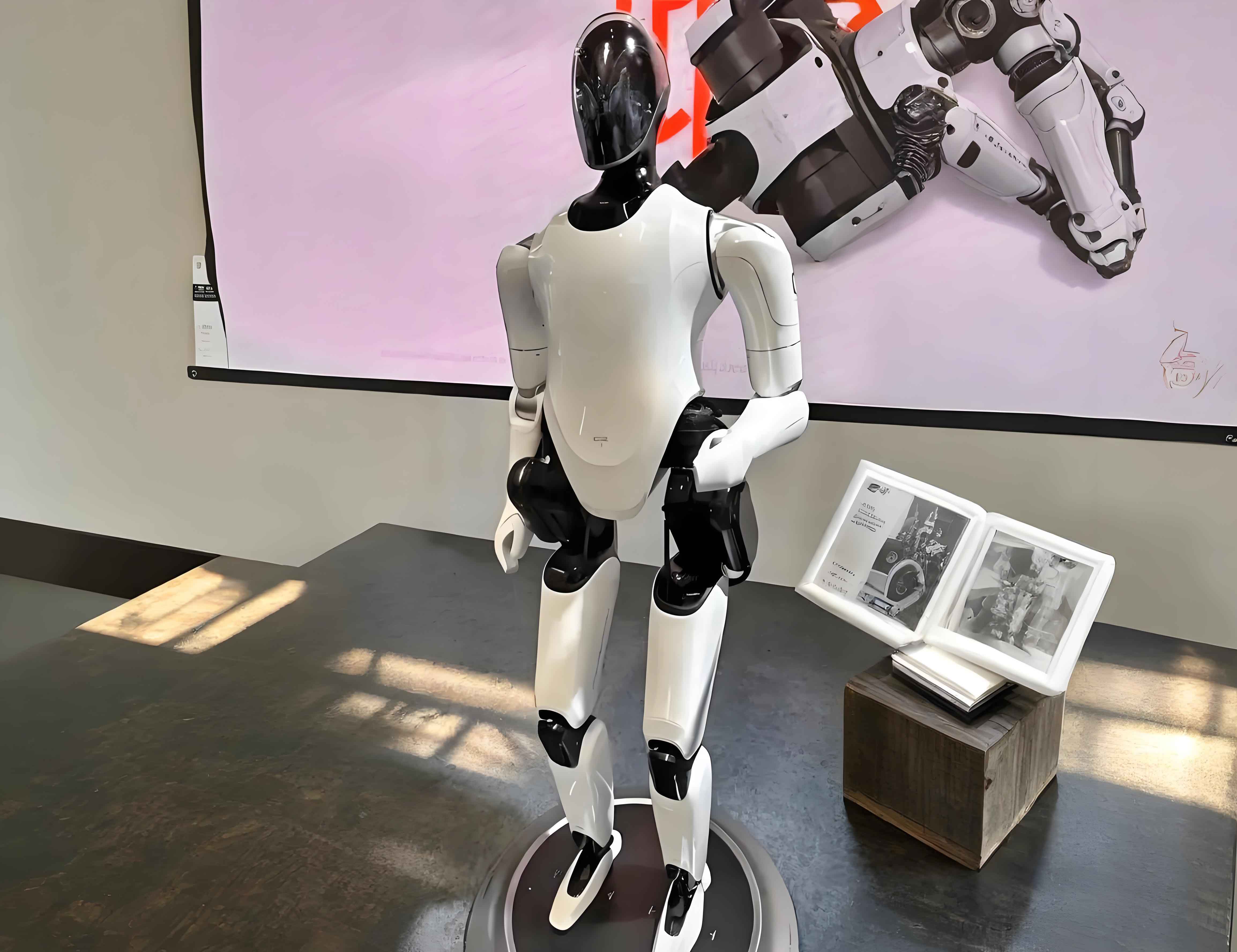
The paradigm of embodied AI robots extends beyond fixed automation. The challenge tracks mentioned earlier, focusing on humanoid and mobile manipulators (复合机器人), point to the next frontier: highly flexible, mobile embodied AI robots that can navigate unstructured environments and perform a vast array of tasks. The control architecture for such a robot is more complex. It must integrate simultaneous localization and mapping (SLAM) for navigation, real-time motion planning around dynamic obstacles, and dexterous manipulation. The cost function for a task and motion planning (TAMP) algorithm in such an embodied AI robot might look like:
$$ J(\mathbf{\pi}, \mathbf{\tau}) = w_1 \cdot \text{TaskCompletion}(\mathbf{\pi}) + w_2 \cdot \text{PathLength}(\mathbf{\tau}) + w_3 \cdot \text{EnergyUsed}(\mathbf{\tau}) + w_4 \cdot \text{CollisionRisk}(\mathbf{\tau}) $$
where \(\mathbf{\pi}\) is the high-level action sequence and \(\mathbf{\tau}\) is the detailed trajectory. The robot must solve for \(\mathbf{\pi}\) and \(\mathbf{\tau}\) that minimize \(J\).
In conclusion, the design and implementation of intelligent manufacturing systems are fundamentally being redefined by the advent of embodied AI robots. The system for producing transformer fin-tube connectors serves as a concrete testament to this shift. By integrating robotic manipulation, machine vision, modular PLC control, and MES-level data management, we achieve a production paradigm that is not only efficient and high-quality but also agile and customizable. The embodied AI robot acts as the versatile physical agent that executes complex tasks with precision and adapts to variations through sensory feedback and digital instructions. The future of manufacturing lies in scaling these principles—developing embodied AI robots that are more perceptive, more dexterous, more collaborative, and more seamlessly integrated into the digital thread of product lifecycle management. The ongoing research and competitions in this field are essential to catalyzing innovation, training the next generation of engineers, and ultimately realizing the full potential of intelligent, embodied systems in driving industrial progress.