
For decades, the dominant path in artificial intelligence has been the “disembodied” route. We have poured immense resources into models that process language, recognize images, and generate content, all from a passive, third-person perspective detached from physical reality. This approach, heavily reliant on massive datasets scraped from the internet, has culminated in the era of foundation models. These Transformer-based behemoths, trained via self-supervision on colossal corpora, exhibit remarkable generalization and sparks of reasoning, leading many to proclaim the dawn of artificial general intelligence (AGI).
Yet, a critical gap remains. Despite their prowess, these disembodied foundation models falter at tasks requiring an intuitive understanding of physics, causal relationships, and commonsense knowledge about how the world works. They can describe an apple in poetic detail but cannot predict how it will roll off a table, nor can they plan the sequence of actions needed to pick it up without crushing it. This limitation is not merely a scaling problem; it is a fundamental issue of grounding. True understanding, as argued by philosophers and cognitive scientists, emerges from interaction. Intelligence is not just computed; it is experienced through a body acting in an environment. This is the path of embodied AI robots.
The convergence of foundation model paradigms with advancements in robotics hardware and simulation presents a historic opportunity. We are now transitioning from building narrow, task-specific robotic controllers to developing embodied AI robot foundation agents—generalist systems that learn through multimodal interaction and can adapt their skills across diverse tasks, environments, and even physical morphologies. This essay, from my perspective as a researcher immersed in this transition, explores the technical landscape, current achievements, and profound challenges of building embodied AI robots in the age of foundation models.
From Internet Scale to Physical Grounding: Core Paradigms
The journey begins by understanding the two converging lineages: the scaling laws of disembodied AI and the principles of embodied cognition.
The Foundation Model Engine: Scalability and Self-Supervision
The breakthrough of models like BERT and GPT was not just architectural but methodological. The Transformer’s self-attention mechanism, coupled with self-supervised learning objectives, unlocked unprecedented scalability. The core formula is learning powerful, general representations by defining a pretext task on unlabeled data. For language, this is predicting the next token (autoregressive modeling) or a masked token (masked autoencoding). This paradigm scaled spectacularly, as shown by models with hundreds of billions of parameters trained on trillions of text tokens.
The key was the scaling law: performance predictably improves with more data and more parameters. This philosophy successfully migrated to vision (e.g., Masked Autoencoders, contrastive learning with CLIP) and then to vision-language models (VLMs) like PaLI-X, creating a unified framework where text, images, and eventually other modalities could be processed by the same Transformer backbone. These models serve as the “brain” candidates for embodied AI robots, offering pre-trained, world-aware representations.
The Embodied Cognition Imperative: Intelligence from Interaction
Parallel to this computational evolution runs a cognitive thesis. Embodied cognition posits that intelligence is not a disembodied algorithm but is shaped by, and exists for, sensorimotor interaction with the world. Key arguments inform our design of embodied AI robots:
- The Symbol Grounding Problem: A system manipulating symbols (like words) cannot truly understand them without connecting them to sensory-motor experiences. A large language model trained only on text may statistically associate “apple” with “red” and “fruit,” but it lacks the rich, multisensory grounding of weight, texture, smell, and the motor program to bite into one.
- Developmental Psychology: Landmark experiments, like Held and Hein’s kitten carousel, showed that active, self-generated movement is crucial for developing normal visual perception. Passive exposure to sensory data is insufficient.
- Physical Commonsense: Intuitive physics—knowing that objects fall, that they are persistent, that forces apply—is learned early in life through interaction. This is precisely the knowledge gap in internet-scale models.
Therefore, an embodied AI robot is not merely a foundation model attached to actuators. It is a system where learning, representation, and decision-making are fundamentally rooted in the closed-loop of perception and action.
Technical Blueprint for an Embodied Foundation Agent
Formally, we frame the problem as a general sequential decision-making process. At time step \(t\), the embodied AI robot has a history. Its goal is to produce the next action and perhaps update its internal state. We can express this as a function \(P\):
$$a_{t+1}, s_{t+1} = P (a_{t-T \to t}, s_{t-T \to t}, o_{t-T \to t}, x_{t-T \to t})$$
Here, \(a\) denotes actions, \(s\) the robot’s proprioceptive state (joint angles, etc.), \(o\) observations (e.g., camera images), and \(x\) optional auxiliary information (rewards, language instructions, goals). The sequence length \(T\) defines the agent’s memory horizon. This general form subsumes specific settings:
- Reinforcement Learning (RL): \(x\) is a reward \(r\). $$a_{t+1}, s_{t+1} = P (a_{t-T \to t}, s_{t-T \to t}, o_{t-T \to t}, r_{t-T \to t})$$
- Vision-Language Navigation: \(o\) is visual \(v\) and \(x\) is language instruction \(l\). $$a_{t+1}, s_{t+1} = P (a_{t-T \to t}, s_{t-T \to t}, v_{t-T \to t}, l_{t-T \to t})$$
The challenge is to learn the function \(P\) that generalizes across tasks, environments, and embodiments.
The Unifying Architecture: Transformers for Decision Sequences
The Transformer is the architectural keystone. Its ability to handle long-range dependencies and its modality-agnostic nature make it ideal. The seminal insight was to treat robot experience—the trajectory of \((s, o, a, x)\)—as just another sequence to be modeled, akin to a sentence. This led to frameworks like Decision Transformer and Trajectory Transformer, which reframe RL as a conditional sequence modeling problem. An autoregressive embodied AI robot model would predict the next token in its action-state-observation stream.
This sequence modeling view elegantly unifies learning paradigms. The model can be trained via:
1. Supervised Behavioral Cloning: Mimicking expert action sequences.
2. Offline RL: Learning to achieve high returns from a static dataset.
3. Self-Supervised Pre-training: Learning general representations by predicting masked parts of the trajectory.
Self-Supervised Pre-training: Building Foundational World Models
Following the success of LLMs, a primary approach is to pre-train the embodied AI robot model on vast, diverse datasets of robot experience (real or simulated) using self-supervised objectives. Two main paradigms exist:
1. Autoregressive Prediction (Next-Token Modeling): Models like Gato and RT-2 exemplify this. They tokenize all inputs—images (via VQ-VAE or patches), proprioception, actions (discretized or continuous)—into a unified token stream. The model is then trained to predict the next token in this stream across a myriad of tasks (e.g., playing Atari, stacking blocks, following instructions). Gato demonstrated a single model with 1.2B parameters could handle over 600 distinct tasks. RT-2 showed that a large vision-language model (VLM), fine-tuned with robot data where actions are expressed as text tokens (“rotate gripper 10 degrees”), could perform novel manipulation tasks via semantic reasoning.
2. Masked Modeling (Masked Autoencoding): Here, random spans of the trajectory—parts of an image, proprioceptive readings, or actions—are masked, and the model is trained to reconstruct them. This forces the model to learn robust, contextual representations of the world dynamics. MVP and its successor Real MVP pre-trained visual encoders with masked image modeling, significantly improving sample efficiency in downstream robotic control. RPT (Robotic Pre-Training) advanced this by jointly masking images, states, and actions, learning a rich sensorimotor representation crucial for an embodied AI robot.
$$ \text{Pre-training Objective: } \mathcal{L} = \mathbb{E}_{(o,s,a) \sim \mathcal{D}} \left[ \| \text{Mask}_{\theta}(o_{\text{masked}}, s_{\text{masked}}, a_{\text{masked}}) – (o, s, a) \|^2 \right] $$
Multimodal Learning: Fusing Sensation and Instruction
An embodied AI robot is inherently multimodal. It must fuse visual streams, proprioceptive feedback, language instructions, and haptic signals (future). Modern foundation models provide the blueprint. Large VLMs like CLIP and PaLI are trained on internet-scale image-text pairs, aligning visual and linguistic concepts. For embodiment, we extend this alignment to include action and state modalities. Models like R3M and Voltron use time-contrastive learning and language alignment to create visual representations that are informative for control and semantically grounded.
| Model | Modalities | Key Idea | Scale (Params) |
|---|---|---|---|
| Gato | Text, Image, Proprio, Act. | Unified token stream, multi-task. | 1.2B |
| RT-2 | Image, Text, Act. (as text) | Co-fine-tuning a large VLM. | 55B (PaLI-X) |
| RPT | Image, Proprio, Act. | Masked sensorimotor pre-training. | ~300M |
| PaLM-E | Text, Image, Proprio, Act. | Embodied reasoning in a LLM. | 562B |
Learning from Demonstration at Scale: The Rise of Imitation Learning
Reinforcement learning, while powerful, is sample-inefficient and often unsafe for real-world embodied AI robot training. The paradigm is shifting towards large-scale imitation learning (IL) or behavior cloning. The recipe: collect massive datasets of expert demonstrations for many tasks, then train a sequence model (like a Decision Transformer) to predict actions given past states and observations. RT-1, trained on 130k demonstrations across 700 tasks, showed strong real-world performance and robustness. The key enabler is the creation of large, diverse robot datasets, moving from single-task (e.g., grasping) to multi-task, multi-robot corpora like Open X-Embodiment.
Model-as-a-Service (MaaS): Leveraging External Brains
A pragmatic and rapidly evolving approach is to use existing, massive foundation models (LLMs, VLMs) as immutable “reasoning engines” for the embodied AI robot. Here, the robot’s perception system (e.g., object detection, scene description) converts the world state into a text prompt for an LLM like GPT-4. The LLM, possessing vast commonsense and planning knowledge, then outputs a high-level plan or low-level action codes, which are executed by the robot. LM-Nav and SayCan are early examples. This MaaS approach enables zero-shot planning and reasoning but faces challenges in reliability, latency, and grounding the model’s abstract plans in precise motor control.
The Ecosystem: Data, Simulation, and Benchmarking
The development of embodied AI robot foundation agents is critically dependent on their ecosystem—the data they learn from and the environments they are tested in.
From Narrow Datasets to Massive Cross-Embodiment Corpora
The history of robot learning is marked by small, task-specific datasets (e.g., for grasping, pushing). The foundation agent paradigm demands a qualitative shift towards large-scale, multi-task, and crucially, cross-embodiment datasets. The goal is to learn representations and policies that transfer across different robot morphologies (e.g., a 7-DoF arm vs. a mobile manipulator). Recent efforts are building this infrastructure:
| Dataset | Scope | # Skills | # Trajectories | # Robot Platforms |
|---|---|---|---|---|
| Open X-Embodiment | Aggregation of 22 datasets | 527 | >100k | 22 |
| Bridge Data V2 | Diverse manipulation | ~100 | >10k | Multiple |
| RH20T | Dexterous manipulation | 150 | >100k | 7 |
| GNM | Navigation | N/A | >60 hrs | 6 |
Training on such diverse data is what allows models like RT-X and RoboCat to exhibit positive transfer and adaptation to new robots, a cornerstone for a general embodied AI robot.
Simulation: The Scalable Playground
Real-world data collection is expensive and slow. High-fidelity simulators are indispensable for rapid prototyping, training, and evaluation. Modern simulators like Isaac Sim, SAPIEN, and AI2-Thor’s ProcTHOR provide physically realistic environments with photo-realistic rendering and programmable scenes. Habitat and iGibson focus on scalable embodied AI simulation for navigation and manipulation tasks. These platforms allow for the generation of massive, labeled datasets (e.g., for vision-language navigation) and stress-testing algorithms under controlled conditions before real-world deployment.
The central, unsolved challenge is the sim-to-real gap. A model perfect in simulation often fails on a real embodied AI robot due to differences in dynamics, visuals, and sensor noise. Research focuses on domain randomization, realistic rendering, and system identification to bridge this gap. The ultimate test for any embodied AI robot foundation model is its performance in the messy, unstructured physical world.
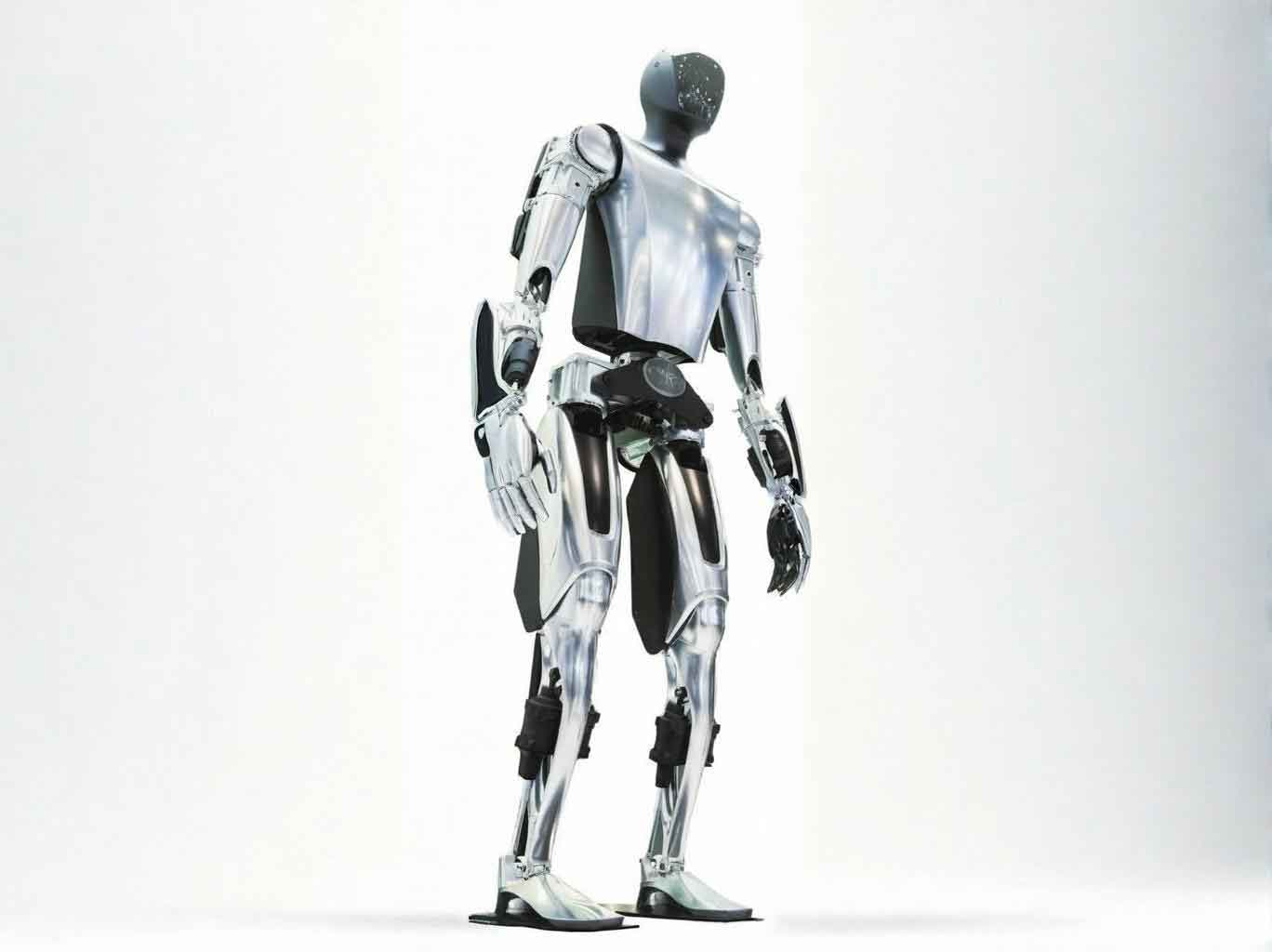
Application Domains: Navigation and Manipulation
The capabilities of embodied AI robot foundation agents are most concretely demonstrated in two grand challenge domains: moving through space (navigation) and interacting with objects (manipulation).
Embodied Visual Navigation: Towards General-Purpose Mobility
The goal is to autonomously move to a target specified by an image, object category, or language instruction in a novel environment. Foundation models have revolutionized this field.
- Zero-Shot Transfer with VLMs: Models like EmbCLIP and CLIP on Wheels use the semantic embedding space of CLIP to recognize target objects never seen during training, enabling open-vocabulary navigation.
- LLMs as Planners: Systems such as LM-Nav and NavGPT use large language models as zero-shot planners. They convert the navigation problem into a textual reasoning task (e.g., “You see a kitchen. To find a cup, go to the counter.”), leveraging the LLM’s commonsense about room layouts and object locations.
- Unified Navigation Models: Projects like ViNT (Visual Navigation Transformer) and Vienna aim to create a single foundation model for all navigation tasks. Trained on heterogeneous data from different robots and tasks, they learn a general “go to goal” skill that can be specialized via fine-tuning, demonstrating positive transfer across domains.
The trajectory is clear: from task-specific controllers to a general navigation “brain” for any mobile embodied AI robot.
Robotic Manipulation: The Quest for General-Purpose Hands
Manipulation is harder—it requires finer perception, precise control, and complex multi-step reasoning. Foundation models are making inroads here too, primarily through two avenues:
1. Vision-Language-Action (VLA) Models: These models, like RT-2 and PaLM-E, directly integrate manipulation into a VLM’s reasoning loop. Actions are expressed in the model’s output vocabulary (e.g., as normalized coordinates or discretized codes). When given an instruction (“put the banana in the bowl”), the model leverages its web-scale visual-language knowledge to identify the objects and its robot-action training to generate the correct motor commands. This enables emergent semantic reasoning, such as selecting a drink tool from a set of unseen objects.
2. Large-Scale Imitation Learning: This approach, exemplified by RT-1 and RoboCat, focuses on training a single, large Transformer model via behavior cloning on millions of demonstration trajectories. RoboCat introduced a self-improving loop: a base model is trained on diverse data; it then collects new data on a novel task or robot; this new data is used to fine-tune the model, creating a more capable successor. This demonstrates how an embodied AI robot foundation agent can continuously expand its own capabilities.
The most promising trend is cross-embodiment generalization. Models trained on data from various robot arms (different sizes, shapes, grippers) learn latent representations of tasks that are decoupled from the specific embodiment, allowing them to adapt more quickly to a new robot.
| Agent | Core Method | Key Feature | Real-World Test |
|---|---|---|---|
| RT-2 | VLA Fine-tuning | Semantic reasoning from web knowledge. | Yes |
| RoboCat | Large-scale IL + Self-Improvement | Cross-embodiment, learns new tasks quickly. | Yes (Sim & Real) |
| PaLM-E | LLM-based Planning | Largest embodied model (562B), multimodal reasoning. | Yes |
| Real MVP | Masked Visual Pre-training | Improves RL sample efficiency significantly. | Yes |
Future Trends and Formidable Challenges
As we push the boundaries of what an embodied AI robot foundation agent can be, several critical trends and challenges come into focus.
1. The Data Bottleneck: While we have Open X-Embodiment, it is still minuscule compared to internet-scale text or image datasets. Collecting high-quality, diverse, real-world robot data is the paramount challenge. We need more efficient data collection methods (e.g., teleoperation at scale, better simulation) and algorithms that are incredibly data-efficient.
2. The Sim-to-Real Chasm for Foundation Agents: The problem is magnified when the agent is trained across thousands of simulated scenes and tasks. The generalization we seek multiplies the potential for subtle simulation biases to cause catastrophic failures in reality. Developing robust, adaptive models that can self-calibrate or learn from minimal real-world interaction is essential.
3. The Pursuit of True Generality: The goal is an agent that can, with minimal prompting, perform a completely novel task in a novel environment with a novel body. This requires advances in compositional reasoning, few-shot adaptation, and learning from abstract instructions. Current models show glimpses, but robust, reliable generality is far off.
4. The Deployment Paradox: Size vs. Practicality: The scaling law suggests bigger is better. However, a 500-billion-parameter model cannot run on a robot’s onboard computer. We face a tension between capability and practicality. Research into model distillation, efficient architectures (e.g., mixture-of-experts), and edge-optimized deployment for embodied AI robots is crucial. We must find the “sweet spot” where emergent abilities appear without requiring data-center-scale compute at inference time.
5. Safety and Alignment in the Physical World: The stakes for an embodied AI robot are infinitely higher than for a chatbot. A misaligned or erroneously planning foundation agent can cause physical harm. Developing rigorous safety frameworks, verification methods, and interpretable decision-making processes for these powerful physical agents is a non-negotiable research frontier.
Conclusion
The fusion of foundation model techniques with the principles of embodied intelligence represents the most promising path toward machines that understand and act in our world with the fluidity and adaptability of living beings. We are moving beyond narrow, fragile robotic scripts towards the dawn of general-purpose embodied AI robot foundation agents. These systems, trained on vast, multimodal corpora of interaction, promise to learn the commonsense physics and grounded semantics that elude their disembodied cousins.
The journey is fraught with technical hurdles—from data scarcity and the sim-to-real gap to the challenges of safe, efficient deployment. Yet, the trajectory is clear. By building agents that learn from doing, that ground language and vision in action, and that can generalize their experience across tasks and forms, we are not just making better robots. We are taking a fundamental step toward artificial intelligence that is truly integrated with, and shaped by, the rich, complex physical reality we inhabit. The era of the embodied AI robot, powered by the scaling principles of foundation models, has begun.