
In the rapidly evolving landscape of low-altitude economy, the promise of aerial vehicles transforming industries is immense. From urban logistics and power inspection to emergency response, the vision of drones seamlessly integrating into our daily operations is captivating. However, beneath this excitement lies a critical bottleneck: the inability of these systems to perform precise, contact-based tasks in complex, high-altitude environments. As an innovator in this field, I have dedicated efforts to overcoming this challenge through the development of embodied AI robots, which combine柔韧(flexible)designs with advanced artificial intelligence. These robots are not just tools; they are intelligent entities capable of adapting, interacting, and operating safely in unstructured spaces, thereby unlocking the true potential of low-altitude applications.
The core issue in low-altitude operations is the “contact and interaction” dilemma. Traditional drones excel at reaching and hovering, but when it comes to executing physical tasks—such as inspecting power lines, cleaning skyscraper facades, or repairing wind turbine blades—they often fall short. Rigid robotic arms mounted on drones are prone to failure due to collisions, overloads, or environmental disturbances like wind and vibrations. This gap hinders the commercialization of many high-value scenarios, where safety, efficiency, and reliability are paramount. In response, our focus has been on creating embodied AI robots that emulate human-like dexterity and adaptability. These robots leverage柔韧(pliable)structures and embodied intelligence to navigate unpredictable conditions, making them ideal for high-risk, high-reward tasks. The term “embodied AI robot” encapsulates this synergy, where the robot’s physical form and cognitive abilities are intertwined, enabling it to perceive, reason, and act autonomously in real-world settings.
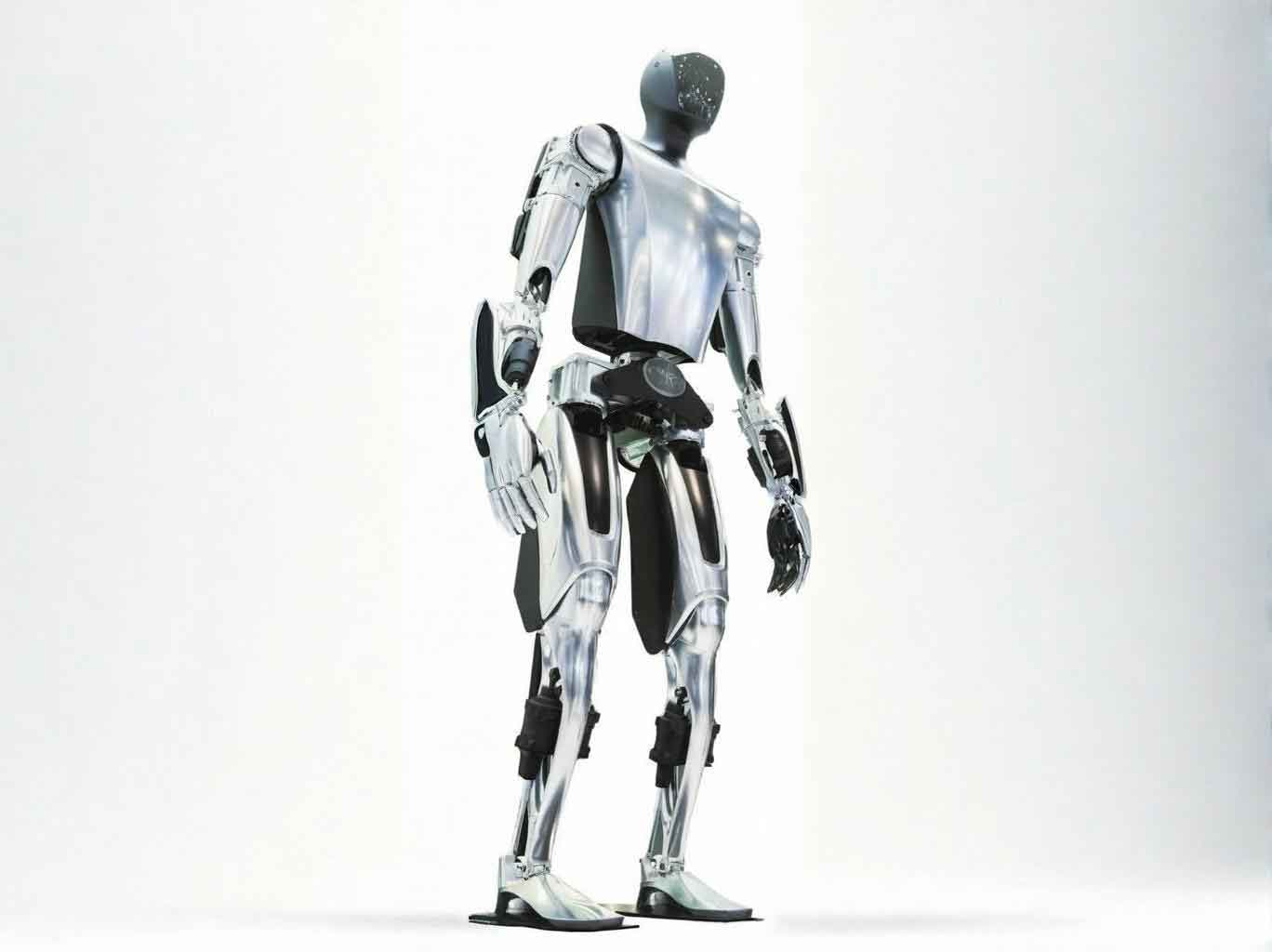
To address these challenges, our technological framework rests on three foundational pillars: biomimetic compliant motion control and adaptive interaction, lightweight high-load structures with smart materials, and sophisticated environmental perception with intelligent decision-making. Each pillar contributes to the overall efficacy of the embodied AI robot, ensuring it can handle the demands of low-altitude contact operations. Let’s delve into these aspects, using formulas and tables to elucidate key concepts.
First, the biomimetic compliant motion control system enables our embodied AI robots to interact softly yet precisely with their surroundings. Unlike conventional robots that rely on rigid positioning, our approach uses force and torque sensing to adjust joint stiffness and trajectories in real-time. This mimics the human ability to “feel” and adapt, preventing damage and enhancing safety. The control law can be expressed as:
$$ \tau = J^T(F_d + K_p e + K_d \dot{e}) + D(\theta, \dot{\theta}) $$
where \(\tau\) is the torque vector applied to the joints, \(J\) is the Jacobian matrix mapping joint space to task space, \(F_d\) is the desired force vector for interaction, \(e\) is the position error, \(K_p\) and \(K_d\) are proportional and derivative gain matrices, and \(D(\theta, \dot{\theta})\) represents damping terms that account for柔韧 dynamics. This formula allows the embodied AI robot to maintain stability while exerting controlled forces, crucial for tasks like wiping surfaces or tightening screws at heights. The adaptive interaction is further enhanced by neural-inspired algorithms that process sensory data, enabling the robot to learn from each encounter. For instance, when contacting a swaying cable, the embodied AI robot can modulate its impedance to absorb shocks, much like a human arm cushioning an impact. This capability is validated across multiple applications, as summarized in Table 1.
| Application Scenario | Traditional Method | Embodied AI Robot Solution | Efficiency Improvement | Cost Reduction | Safety Enhancement |
|---|---|---|---|---|---|
| Wind Turbine Blade Inspection | Manual work with ropes/baskets, 4 hours | Autonomous contact-based detection, 2 hours | 50% faster | 30% lower | Eliminates fall risks |
| Skyscraper Facade Cleaning | Human “spider-men”, 8 hours for a section | 柔韧 cleaning system, 2 hours | 4-6x faster | 30-50% lower | Zero高空 hazards |
| Power Line Maintenance | Full line shutdowns with scaffolding, days | Drone-mounted柔韧 robot, hours | 70% faster | 40% lower | Reduces electrical risks |
| Navigation Buoy Replacement | Manual boat-based, 2 hours per buoy | Aerial柔韧 platform, 15 minutes | 8x faster | 60% lower | Minimizes maritime dangers |
Second, the lightweight high-load structure is pivotal for extending operational endurance and ensuring durability. Our embodied AI robots utilize advanced composites, engineering plastics, and custom柔韧 actuators to achieve a high strength-to-weight ratio. The design principle balances “softness” for impact absorption and “toughness” for task precision. The mechanical behavior can be modeled using viscoelastic theory, where stress \(\sigma\) and strain \(\epsilon\) relate through:
$$ \sigma(t) = E \epsilon(t) + \eta \frac{d\epsilon}{dt} $$
Here, \(E\) represents the elastic modulus, and \(\eta\) is the viscosity coefficient, capturing the material’s ability to dissipate energy under dynamic loads. This ensures that the embodied AI robot can withstand accidental collisions or wind gusts without compromising performance. Moreover, the lightweight nature allows for longer flight times when integrated with drones, a critical factor in low-altitude missions. We have developed modular platforms where柔韧 joints and limbs can be reconfigured for various tasks, enhancing versatility. For example, a柔韧 arm for inspection can be swapped with a cleaning module, all based on the same embodied AI core. This modularity reduces costs and accelerates deployment, as shown in Table 2, which outlines key material properties and their benefits.
| Material Type | Elastic Modulus (E) | Density (ρ) | Impact Resistance | Application in Embodied AI Robot |
|---|---|---|---|---|
| High-Performance Composites | 10-50 GPa | 1.5-2.0 g/cm³ | High | Structural框架 for load-bearing |
| 特种 Engineering Plastics | 2-10 GPa | 1.0-1.4 g/cm³ | Medium-High | 柔韧 joints and actuators |
| Custom Flexible Drivers | Variable, 0.1-5 GPa | 0.8-1.2 g/cm³ | Very High | Adaptive motion control |
| Polymer-based Coatings | 0.5-3 GPa | 1.0-1.5 g/cm³ | Medium | Surface protection and grip |
Third, the complex environment perception and intelligent decision-making system empower our embodied AI robots with autonomous capabilities. Integrating multi-modal sensors—such as depth cameras, LiDAR, and tactile arrays—the robot constructs a 3D map of its surroundings in real-time. This感知 is fused with embodied AI algorithms to plan optimal paths and execute tasks with minimal human intervention. The perception model can be described as:
$$ P(s_{t+1} | s_t, a_t) = \int_{o_t} P(s_{t+1} | s_t, a_t, o_t) P(o_t | s_t) \, do_t $$
where \(s_t\) is the state at time \(t\), \(a_t\) is the action taken, and \(o_t\) is the observation from sensors. This Bayesian framework allows the embodied AI robot to handle uncertainties in高空 environments, like changing lighting or reflective surfaces. The decision-making module uses reinforcement learning to optimize actions, with the objective function:
$$ J(\pi) = \mathbb{E}_{\pi} \left[ \sum_{t=0}^{T} \gamma^t R(s_t, a_t) \right] $$
where \(\pi\) is the policy, \(R\) is the reward for successful contact operations, and \(\gamma\) is the discount factor. This enables the embodied AI robot to learn from experience, improving its performance over time. In practice, when inspecting a wind turbine blade, the robot can autonomously detect defects, adjust its posture to maintain stable contact, and even perform minor repairs—all while compensating for wind disturbances. This level of intelligence is what sets embodied AI robots apart, making them reliable partners in hazardous settings.
The applications of embodied AI robots in low-altitude economy are vast and transformative. Beyond the examples in Table 1, these systems are revolutionizing fields like emergency response, where they can deliver supplies or assess damage in disaster zones, and urban management, where they monitor infrastructure health. The synergy between drones and embodied AI robots is particularly powerful: drones provide mobility, while embodied AI robots add manipulation skills. This combination is not merely additive; it creates a new paradigm of aerial automation. For instance, in power grid maintenance, a drone can carry an embodied AI robot to a transmission line, where the robot uses its柔韧 arms to clean insulators or tighten connections, all without human presence. This reduces downtime and enhances grid resilience. Similarly, in building maintenance, embodied AI robots can perform window washing or painting at heights, drastically improving worker safety and operational efficiency.
Moreover, the versatility of embodied AI robots extends beyond low-altitude scenarios. In the automotive sector, for example, our柔韧 charging solutions for electric vehicles demonstrate how embodied AI can adapt to diverse interfaces. The robot uses柔韧 limbs with embodied AI to locate charging ports, insert plugs, and handle variations in vehicle models, ensuring reliable service. This highlights the generalizability of the technology: the same core principles of柔韧 design and adaptive intelligence apply across domains. The embodied AI robot becomes a universal tool for physical interaction, capable of tackling tasks that were once deemed too delicate or dangerous for machines.
Looking ahead, the future of low-altitude economy hinges on the widespread adoption of embodied AI robots. As regulations evolve and technology matures, we anticipate a surge in automated aerial services, from agricultural monitoring to construction support. The key will be continuous innovation in柔韧 materials, sensor fusion, and AI algorithms to enhance the capabilities of embodied AI robots. We are exploring swarm robotics, where multiple embodied AI robots collaborate on complex missions, and edge computing to reduce latency in decision-making. The potential economic impact is staggering, with projections suggesting that embodied AI robots could unlock billions in value by enabling new low-altitude applications.
In conclusion, embodied AI robots represent a breakthrough in overcoming the “last mile” challenge of low-altitude operations. By integrating柔韧 physical structures with advanced artificial intelligence, these robots offer unmatched adaptability, safety, and efficiency. They are not just replacing human labor in dangerous tasks; they are creating possibilities that were previously unimaginable. From inspecting critical infrastructure to maintaining urban aesthetics, embodied AI robots are poised to become indispensable assets in our aerial future. As we continue to refine this technology, I am confident that embodied AI robots will redefine what is possible in the skies, turning高空 challenges into opportunities for growth and innovation. The journey has just begun, and with each advancement, we move closer to a world where machines work seamlessly alongside humans, empowered by the柔韧 and intelligence of embodied AI.