
In my perspective, the evolution of artificial intelligence has reached a pivotal juncture where the focus is shifting from purely cognitive tasks to interactive physical embodiments. Embodied AI robots, which integrate intelligence with a physical form, are poised to revolutionize how we interact with and manipulate our environment. This concept, often referred to as embodied intelligence, combines “body” and “intelligence” to enable artificial agents to perceive, learn, and act in real-world settings. As someone deeply engaged in this field, I see embodied AI robots not merely as machines but as versatile platforms that can adapt to diverse scenarios, from industrial operations to everyday household chores.
The broader definition of artificial intelligence encompasses both linguistic models, which handle language-based tasks, and robotics-related embodied intelligence. While language models have advanced rapidly, solving problems of “thinking” and “speaking,” the next frontier lies in enabling AI to “move hands and feet” for physical interaction. This is where embodied AI robots come into play, serving as the bridge between digital intelligence and the tangible world. In this article, I will explore why embodied AI robots, particularly humanoid forms, are considered the optimal载体 for this technology, the challenges they face, and the innovative solutions driving their development.
From historical observation, tools that endure and gain widespread use typically enhance productivity or provide emotional value—or both. For embodied AI robots to achieve high出货量 and versatility, they must embody these attributes. I argue that the通用形态 of robots should be designed with this duality in mind. Biologically inspired forms, such as quadrupedal and bipedal structures, are outcomes of evolution and represent efficient adaptations to our environments. Among these, humanoid robots are often hailed as the终极形态 because approximately 90% of human workspaces are ergonomically designed for bipedal beings. This design compatibility reduces migration costs when switching between different scenarios, making embodied AI robots based on humanoid forms more通用 and cost-effective in the long run.
However, the journey of embodied AI robots has not been without obstacles. Reflecting on robotics development, I note that robots have often been perceived as problems rather than solutions due to issues like limited functionality per scenario, inadequate reliability, and poor applicability. These stem from a tendency toward specialized designs, which restrict出货量 and hinder economies of scale. Low出货量, in turn, limits investments in capital, R&D, and talent, creating a vicious cycle of customization over通用平台 development. To break this cycle, defining a通用形态 for embodied AI robots is crucial not only for the industry’s growth but also for addressing practical needs in sectors like energy, where labor shortages and safety concerns are pressing.
In hardware terms, humanoid robots stand out as the best载体 for embodied AI. Their recent surge in popularity around 2023 and 2024 correlates with breakthroughs in AI, which have enabled a分工 in the robotics ecosystem. Previously, companies had to manage hardware, software, applications, services, and交付 holistically, stifling scalability. Now, with AI models industrializing, a分工 structure is emerging: hardware firms focus on机器人本体, software companies on algorithms, platform providers on integration, and service entities on deployment. This industrial-era-style分工 is accelerating the advancement of embodied AI robots, allowing for more specialized and efficient development.
From a technical standpoint, the分工 in embodied AI robots can be categorized into本体,大脑,小脑, and applications/交付. The本体 includes physical架构, energy systems, batteries, motors, and platforms—the tangible hardware of embodied AI robots. The小脑 handles control and interaction with the physical world, such as locomotion and manipulation, while the大脑 enables perception, decision-making, and adaptation to environmental changes. Embodied AI itself acts as the “brain” of these robots, using sensors for认知 and interaction. As embodied AI robots achieve泛化能力, they will become ubiquitous, entering homes and industries alike. This technology transforms general AI from the digital realm into实体世界, with载体 ranging from service robots to industrial arms and autonomous vehicles.
The development of embodied AI robots has historical roots in military applications since the 1950s, but recent milestones include the 2020语言大模型突破 and the 2023 shift toward embodied intelligence as a tech trend. Key elements involve算力,算法, and数据. While算力 has become通用 and算法 are advancing academically, data scarcity remains a major hurdle for embodied AI robots. Unlike language models, embodied AI requires physical sampling through机器人实体, which is resource-intensive. Two primary methods exist: real-world sampling via remote control, as seen with systems where operators use VR to guide robots, and simulation-based training in virtual environments. The former is intuitive but slow and limited in precision, while the latter lacks accurate物理属性 like gravity and friction, necessitating sophisticated models for real-world迁移.
I have explored various approaches in my work, emphasizing the importance of仿真 for training embodied AI robots. For instance, platforms like Cosmos, introduced in early 2025, aim to create detailed虚拟世界基础模型 for模拟训练. If successful, this could enable modular assembly of production environments in computers, combining robot hardware with industry-specific models for plug-and-play deployment—a potential “ChatGPT moment” for embodied AI robots. To illustrate the technical aspects, consider the control dynamics of embodied AI robots, which can be modeled using equations of motion. For a humanoid robot, the balance and movement can be described by:
$$ \sum \vec{F} = m \vec{a} $$
where $\vec{F}$ represents forces acting on the embodied AI robot, $m$ is its mass, and $\vec{a}$ is acceleration. In more complex scenarios, the torque $\tau$ applied to joints can be expressed as:
$$ \tau = I \alpha + b \omega $$
with $I$ as moment of inertia, $\alpha$ as angular acceleration, $b$ as damping coefficient, and $\omega$ as angular velocity. These formulas underscore the precision required in designing embodied AI robots for stable interaction.
To summarize the advantages of humanoid embodied AI robots over other forms, I present the following table comparing key attributes:
| Robot Type | 通用性 | Migration Cost | Efficiency in Specialized Tasks | Best Suited For |
|---|---|---|---|---|
| Wheeled Robots | Low | High | High | Flat terrains, logistics |
| Quadruped Robots | Medium | Medium | Medium | Rough terrain, inspection |
| Humanoid Robots | High | Low | Variable (lower in some tasks) | Human environments, versatile tasks |
| Aerial Drones | Medium | Medium | High | Surveillance, delivery |
This table highlights that embodied AI robots with humanoid designs excel in通用性, making them ideal for diverse applications. Another critical aspect is the cost-benefit analysis of embodied AI robots. The total cost $C$ can be modeled as:
$$ C = C_h + C_s + C_d + C_m $$
where $C_h$ is hardware cost, $C_s$ is software development cost, $C_d$ is data acquisition cost, and $C_m$ is maintenance cost. For embodied AI robots, economies of scale can reduce $C_h$ and $C_s$ as出货量 increases, emphasizing the need for通用平台. Moreover, the reliability $R$ of an embodied AI robot can be expressed as a function of failure rate $\lambda$ over time $t$:
$$ R(t) = e^{-\lambda t} $$
Improving $\lambda$ through better design and testing is essential for the adoption of embodied AI robots in critical sectors like energy.
In energy applications, embodied AI robots hold immense promise. They can perform tasks such as live-line work, photovoltaic cleaning, and various inspections in power grids and oil-gas facilities. My experience indicates that embodied AI robots enhance safety by replacing humans in hazardous environments and boost efficiency through autonomous operations. For example, in变电站, embodied AI robots can conduct automated semantic segmentation for inspections, integrating with digital孪生 platforms for real-time analysis. These platforms allow quick deployment—within a day for enclosed spaces—enabling robots to plan paths and actions in simulation before physical implementation, achieving所见即所得 functionality.
The integration of large models into embodied AI robots further augments their capabilities. By incorporating推理方式, these robots can perform deep analysis on巡检 data, identify equipment defects, and provide决策 support, including cause assessment, hazard evaluation, and maintenance recommendations. To facilitate this, open-source仿真 platforms have been developed, allowing for动作模拟 and optimization before transferring models to physical embodied AI robots. This synergy between virtual and real worlds accelerates the maturation of embodied AI robots.
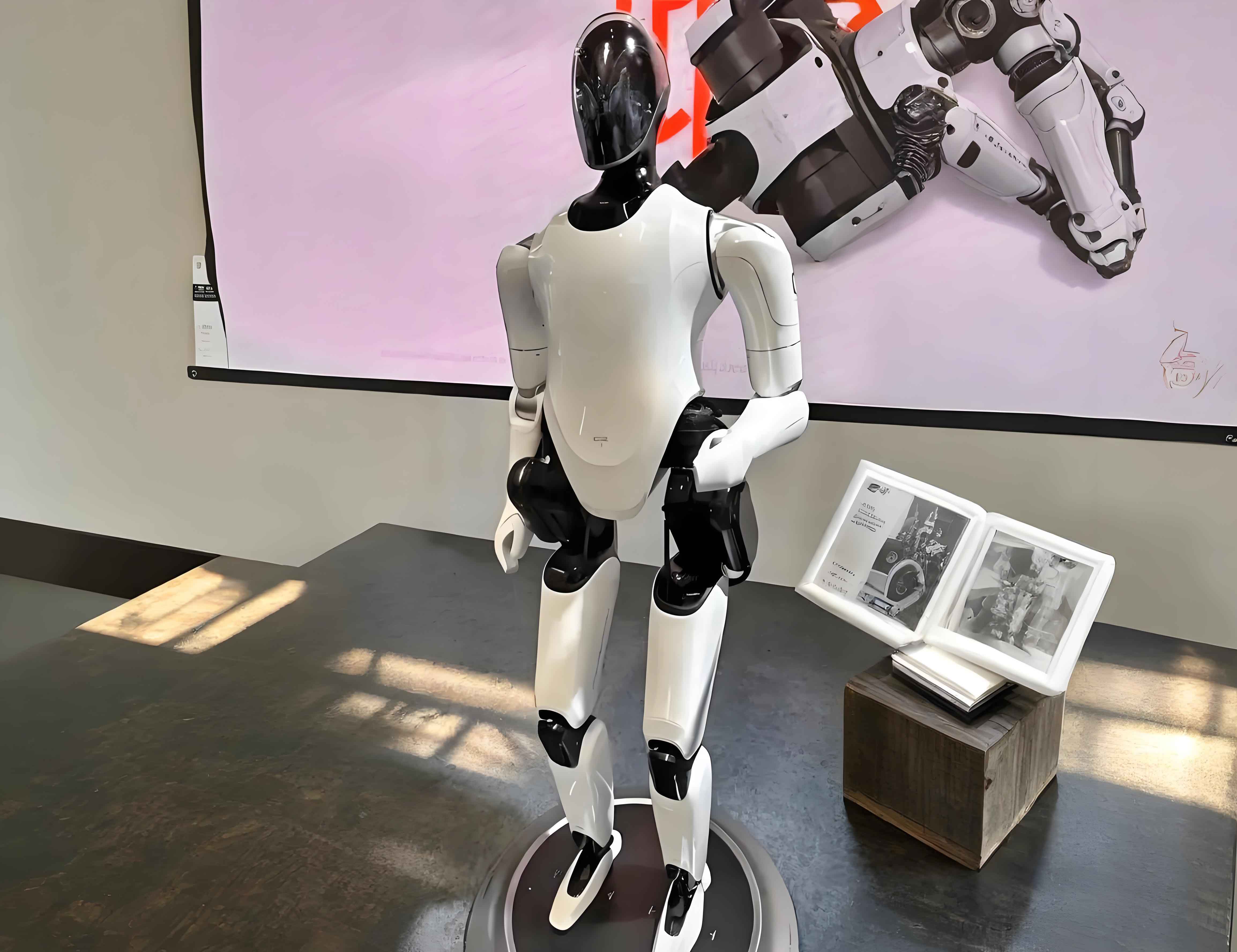
Looking ahead, the future of embodied AI robots is bright. As仿真 technologies advance, we may witness seamless integration of virtual training with real-world deployment, reducing the data gap. The分工 trend in the robotics industry will continue to foster innovation, with specialized entities collaborating to produce more robust and affordable embodied AI robots. In energy and beyond, these robots will not only solve labor shortages but also enhance安全生产 through precise, reliable operations. The ultimate goal is to have embodied AI robots that can learn and adapt dynamically, much like humans, making them indispensable partners in our daily lives.
To delve deeper into the technicalities, consider the learning process for embodied AI robots. In reinforcement learning, a common approach for training embodied AI robots, the objective is to maximize cumulative reward $R$ over time steps $t$:
$$ R = \sum_{t=0}^{T} \gamma^t r_t $$
where $\gamma$ is a discount factor and $r_t$ is the reward at time $t$. For embodied AI robots operating in physical spaces, this involves complex state-action spaces defined by sensor inputs and motor outputs. The policy $\pi(a|s)$ that dictates actions $a$ given states $s$ can be optimized using algorithms like Proximal Policy Optimization (PPO):
$$ L^{CLIP}(\theta) = \hat{\mathbb{E}}_t \left[ \min\left( r_t(\theta) \hat{A}_t, \text{clip}(r_t(\theta), 1-\epsilon, 1+\epsilon) \hat{A}_t \right) \right] $$
where $\theta$ represents policy parameters, $r_t(\theta)$ is the probability ratio, $\hat{A}_t$ is the advantage estimate, and $\epsilon$ is a clipping parameter. Such mathematical frameworks are vital for developing intelligent behaviors in embodied AI robots.
Another key area is the能源 efficiency of embodied AI robots. The power consumption $P$ can be broken down into computational $P_c$, actuation $P_a$, and sensory $P_s$ components:
$$ P = P_c + P_a + P_s $$
For humanoid embodied AI robots, $P_a$ often dominates due to bipedal locomotion, which can be optimized using dynamic walking algorithms. The specific resistance $\zeta$, a measure of energy cost per unit weight and distance, is given by:
$$ \zeta = \frac{P}{mgv} $$
where $m$ is mass, $g$ is gravitational acceleration, and $v$ is velocity. Lowering $\zeta$ through lightweight materials and efficient control is crucial for the longevity and sustainability of embodied AI robots.
In terms of market adoption, the growth of embodied AI robots can be projected using logistic models. The number of units $N(t)$ over time $t$ might follow:
$$ N(t) = \frac{K}{1 + e^{-r(t-t_0)}} $$
where $K$ is the carrying capacity (maximum market size), $r$ is the growth rate, and $t_0$ is the inflection point. As embodied AI robots become more通用, $K$ is expected to rise, driven by demand across industries. To summarize the technological分工, here is a table outlining the roles in the embodied AI robot ecosystem:
| Role | Focus Area | Examples for Embodied AI Robots |
|---|---|---|
| Hardware Companies | 机器人本体, actuators, sensors | Developing durable platforms for embodied AI robots |
| Software Firms | Algorithms, brain models | Creating perception and decision systems for embodied AI robots |
| Platform Providers | Integration, simulation | Offering tools for training and deploying embodied AI robots |
| Service Entities | Deployment, maintenance | Ensuring embodied AI robots operate smoothly in field |
This structured approach accelerates innovation, as each entity specializes, reducing time-to-market for embodied AI robots. In my view, the emphasis on仿真 will be a game-changer. By building accurate物理模型 in virtual environments, we can generate vast datasets for training embodied AI robots without the costs and risks of real-world sampling. For instance, the success rate $S$ of model migration from simulation to reality can be modeled as:
$$ S = f(A, P, D) $$
where $A$ is algorithm sophistication, $P$ is物理 model精度, and $D$ is data diversity. Investing in $P$ through platforms like Cosmos can boost $S$, making embodied AI robots more reliable.
Moreover, the emotional value of embodied AI robots should not be underestimated. As they become more human-like in interaction, they can provide companionship or assist in elderly care, expanding their utility beyond productivity. This dual appeal—practical and emotional—will drive consumer adoption, further increasing出货量 for embodied AI robots. In industrial settings, the return on investment (ROI) for deploying embodied AI robots can be calculated as:
$$ \text{ROI} = \frac{\text{Net Benefits} – \text{Cost}}{\text{Cost}} \times 100\% $$
where net benefits include labor savings, safety improvements, and efficiency gains. As costs decline with scale, ROI for embodied AI robots is poised to rise, incentivizing widespread use.
In conclusion, embodied AI robots represent a convergence of intelligence and physicality that will redefine our relationship with technology. Humanoid forms, as the best载体, offer unmatched通用性 for navigating human-centric environments. Through分工, advanced仿真, and continuous innovation in algorithms and hardware, the challenges of reliability and applicability are being addressed. I am optimistic that embodied AI robots will soon become integral to sectors like energy, manufacturing, and domestic life, ushering in an era where intelligent machines work alongside humans seamlessly. The journey toward this future requires collaboration across disciplines, but the potential of embodied AI robots to enhance productivity, safety, and quality of life makes it a pursuit worth championing.