
As I observe the rapid evolution of artificial intelligence, I am struck by the gap between human capabilities and those of embodied AI robots. While humans perform tasks like walking, running, or grasping objects with ease, these actions remain formidable challenges for robots, demanding precise environmental perception, decision-making, and motion control. In this analysis, I will delve into the key technological breakthroughs still needed for embodied AI robots to achieve true generality and adaptability in real-world scenarios. From my perspective, the journey toward sophisticated embodied AI robots is fraught with hurdles that span across intelligence, control, and physical embodiment.
The concept of an embodied AI robot revolves around an intelligent agent that interacts with the physical world in a human-like manner. Historically, robots have evolved from mechanical automation to environmental perception and cognitive decision-making. Today, the integration of large models and robotics has enhanced autonomous decision-making and environmental interaction, yet embodied AI robots are far from reaching their “iPhone moment.” I believe that the core of this delay lies in several intertwined technological domains that require deeper innovation.
To structure my discussion, I consider the technical framework of embodied AI robots as comprising four modules: perception, decision, action, and feedback. These align with three core elements: the body (hardware), the environment, and the intelligence. Often, embodied AI robots are described as having a “brain” (intelligence), a “cerebellum” (embodied operation and control), and a “hardware body.” The progress in these areas is uneven, with significant advances in the “brain” due to large language models, while the “cerebellum” and “body” lag behind. Below, I outline the current state and pending breakthroughs using tables and formulas to summarize key points.
Current Technological Progress in Embodied AI Robots
In recent years, embodied AI robots have seen notable advancements, particularly in intelligence driven by AI models. However, as I analyze the landscape, the integration of these components remains fragmented. The following table summarizes the progress across the four modules:
| Module | Description | Current Status | Examples in Embodied AI Robots |
|---|---|---|---|
| Perception | Ability to sense and interpret the environment through sensors (e.g., vision, touch). | Advanced with multi-modal fusion, but lacks real-world robustness. | Use of cameras, LiDAR, and tactile sensors for object recognition. |
| Decision | Cognitive processes that plan actions based on perception and goals. | Enhanced by large models, yet limited in physical reasoning. | Task planning using reinforcement learning or language models. |
| Action | Execution of movements through actuators and controllers. | Improved with learning-based control, but inflexible in dynamic settings. | Locomotion in humanoid or quadruped robots like “Tiangong.” |
| Feedback | Real-time adjustment based on action outcomes and environmental changes. | Basic in closed-loop systems, but needs better adaptation. | Error correction in grasping or walking via sensor feedback. |
From my viewpoint, the “brain” of embodied AI robots has benefited immensely from models like ChatGPT and DeepSeek, which enable better instruction understanding and task planning. However, this intelligence is primarily linguistic, not fully aligned with the “language of the world” that requires spatial awareness and physical interaction. For instance, the decision-making process in an embodied AI robot can be modeled as a Markov Decision Process (MDP), where the agent seeks to maximize cumulative reward. The value function $$V^{\pi}(s) = \mathbb{E}_{\pi} \left[ \sum_{t=0}^{\infty} \gamma^t R(s_t, a_t) \mid s_0 = s \right]$$ represents the expected return under policy $$\pi$$, but in practice, embodied AI robots struggle with the complexity of state $$s$$ and action $$a$$ spaces in physical environments.
Moreover, the “cerebellum” or motion control system has evolved through machine learning, allowing real-time parameter adjustment. Yet, as I see it, the non-standardized structures of embodied AI robots—such as bipedal, quadrupedal, or wheeled forms—pose unique challenges. The dynamics of a robot can be described by equations like the Lagrangian formulation: $$L = T – U$$, where $$T$$ is kinetic energy and $$U$$ is potential energy. For an embodied AI robot with multiple joints, the equations of motion become complex: $$M(q)\ddot{q} + C(q, \dot{q})\dot{q} + G(q) = \tau$$, where $$q$$ are joint angles, $$M$$ is the inertia matrix, $$C$$ accounts for Coriolis forces, $$G$$ is gravity, and $$\tau$$ is the torque. Current controllers often lack the generalization to handle diverse body morphologies efficiently.
Key Technological Bottlenecks for Embodied AI Robots
In my assessment, the primary bottlenecks for embodied AI robots revolve around the insufficient intelligence of the “brain” and “cerebellum,” hardware limitations, and data scarcity. I will break these down into specific areas.
1. Intelligence and World Models
The “brain” of an embodied AI robot currently relies on large language models that excel in textual tasks but fall short in physical world understanding. As I emphasize, embodied AI robots need a “world model” that integrates linguistic knowledge with spatial perception, interaction capabilities, and reasoning in complex environments. This gap can be expressed through the discrepancy between a language model’s probability distribution $$P(w_n | w_{1:n-1})$$ for words and a world model’s distribution over states and actions: $$P(s_{t+1} | s_t, a_t)$$. For embodied AI robots, the latter must be learned from multimodal data, which is scarce.
Furthermore, decision-making in embodied AI robots requires advanced reasoning that combines perception and action. A table comparing traditional robots versus embodied AI robots highlights this:
| Aspect | Traditional Industrial Robots | Embodied AI Robots |
|---|---|---|
| Control | Fixed pre-programmed paths | Adaptive, real-time planning |
| Perception | Limited or absent | Multi-modal and continuous |
| Decision | Rule-based | Learning-based with generalization |
| Flexibility | Low; fails if environment changes | High; adjusts to variations |
From my perspective, the bottleneck here is that even the smartest models cannot immediately solve real-world problems due to the lack of embodied experience. For example, an embodied AI robot tasked with sorting fruits into colored bowls must perceive changes and re-plan, which involves solving a optimization problem: $$\min_{a_{1:T}} \sum_{t=1}^{T} c(s_t, a_t)$$ subject to $$s_{t+1} = f(s_t, a_t)$$, where $$c$$ is a cost function and $$f$$ is the dynamics. Current systems often fail in such tasks due to imperfect models.
2. Motion Control and the “Cerebellum”
The “cerebellum” of an embodied AI robot refers to the embodied operation and control system. I observe that while learning techniques have improved control, the diversity of robot morphologies makes standardization difficult. For instance, a bipedal embodied AI robot must maintain balance using control laws like the Zero Moment Point (ZMP) criterion: $$x_{ZMP} = \frac{\sum_i m_i (g z_i – \ddot{z}_i x_i) – \sum_i m_i \ddot{x}_i z_i}{\sum_i m_i (g – \ddot{z}_i)}$$, where $$m_i$$ are masses and $$(x_i, z_i)$$ are coordinates. However, tuning such controllers for various terrains requires extensive data, which is lacking.
Moreover, the agility and flexibility of human motion are hard to replicate. As I see it, embodied AI robots often exhibit rigidity and low energy efficiency. The power consumption during locomotion can be modeled as $$P = \tau \cdot \dot{q}$$, where $$\tau$$ is torque and $$\dot{q}$$ is joint velocity. Compared to humans, embodied AI robots have higher $$P$$ due to inefficient actuators and materials. This highlights the need for breakthroughs in mechanical design and control algorithms.
3. Hardware Body and Standardization
The hardware body of an embodied AI robot encompasses sensors, actuators, and structural components. I believe that a major bottleneck is the absence of standardized modules, leading to fragmentation in the industry. Unlike smartphones or PCs, embodied AI robots lack a unified ecosystem where parts are interchangeable. This increases costs and hinders innovation. For example, reducers like RV reducers, which act as “joints,” have seen localization efforts, but overall hardware architectures are still evolving.
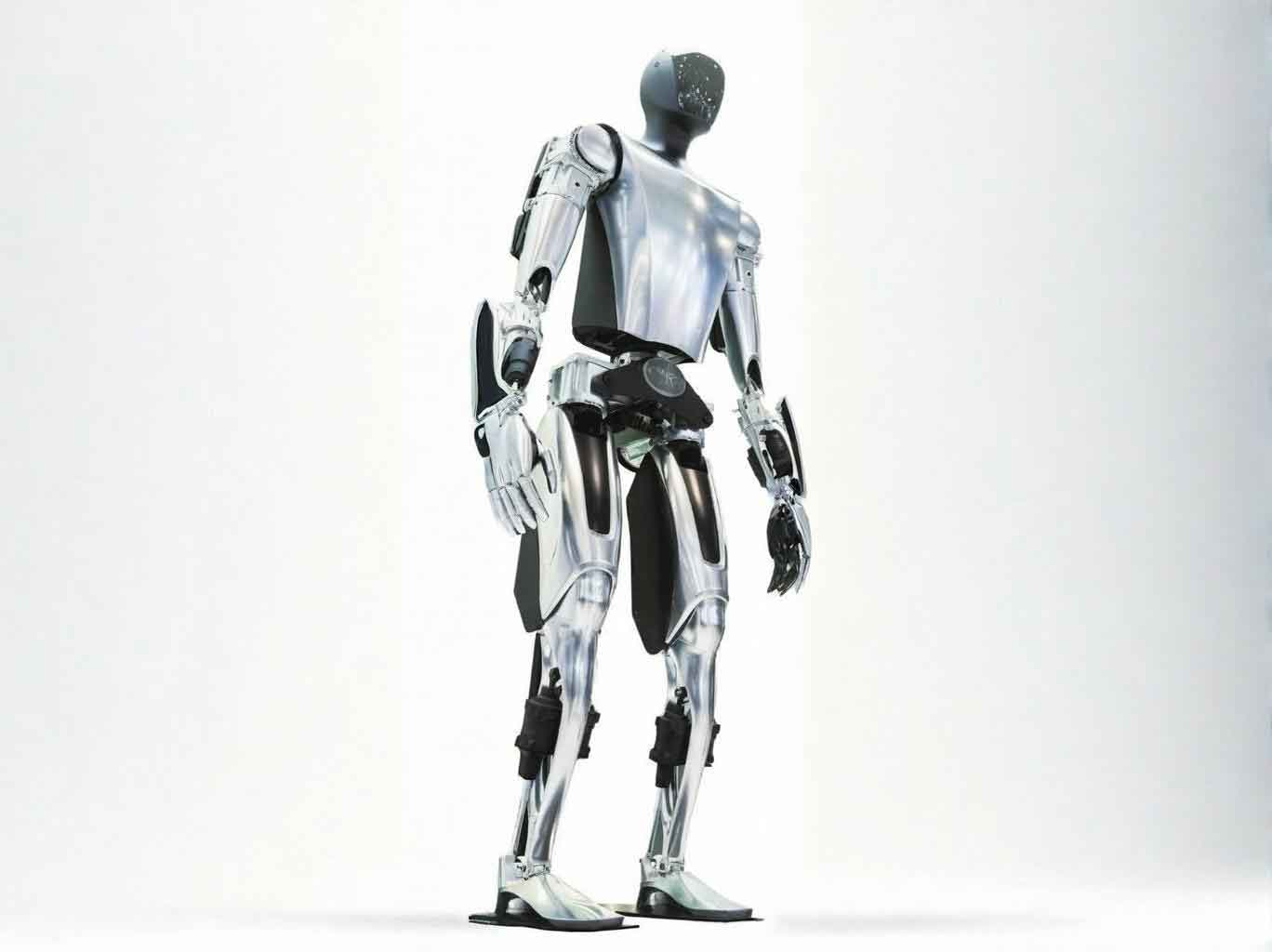
As shown in the image, manufacturing embodied AI robots involves complex assembly, but without standardization, each model may have unique components. From my analysis, key issues include excessive rigidity, poor energy utilization, and limited structural innovation. The stiffness $$k$$ of a joint in an embodied AI robot affects its compliance, with human-like motion requiring low $$k$$ for shock absorption. Current materials often result in high $$k$$, leading to clumsy movements.
Additionally, sensor technology needs improvement. Tactile sensors, for instance, should provide high-resolution feedback. The sensitivity can be represented by $$S = \frac{\Delta V}{\Delta F}$$, where $$V$$ is output voltage and $$F$$ is force. For embodied AI robots, enhancing $$S$$ across varied conditions is crucial for delicate tasks like grasping ants or lifting buckets, as seen in soft robotics inspired by octopus tentacles.
4. Data Scarcity and Quality
In my view, the development of embodied AI robots is heavily constrained by the lack of high-quality, diverse datasets from real physical interactions. Just as autonomous driving benefited from massive road data, embodied AI robots need extensive training in varied scenarios. The learning process for an embodied AI robot can be framed as maximizing the expected reward over trajectories: $$J(\theta) = \mathbb{E}_{\tau \sim p_{\theta}(\tau)} [R(\tau)]$$, where $$\tau$$ is a sequence of states and actions, and $$\theta$$ are policy parameters. Without rich data, $$p_{\theta}(\tau)$$ fails to cover real-world complexities.
Data collection for embodied AI robots should span multiple scenarios—industrial, domestic, hazardous inspection, office, and retail—with tasks like cleaning or sorting. A table illustrating data requirements can summarize this:
| Data Type | Importance for Embodied AI Robots | Current Challenges |
|---|---|---|
| Real-world interaction data | Enables generalization and adaptation | Costly to collect; safety risks |
| Simulated data | Scalable for training | Sim-to-real gap limits effectiveness |
| Multi-modal data (vision, touch, etc.) | Enhances perception and control | Integration difficulties; sensor noise |
| Task-specific datasets | Improves performance in niches | Fragmented; lacks standardization |
I argue that initiatives like open-source datasets for embodied AI robots are vital, but they must ensure quality and relevance. For instance, a dataset might include trajectories with state-action pairs $$(s_t, a_t, s_{t+1})$$, but if the data is noisy or biased, the embodied AI robot’s policy will underperform. The loss function in training, such as mean squared error for dynamics learning: $$\mathcal{L} = \frac{1}{N} \sum_{i=1}^{N} || s_{t+1}^{(i)} – \hat{f}(s_t^{(i)}, a_t^{(i)}) ||^2$$, requires large $$N$$ for accuracy, which is currently insufficient.
Future Directions and Breakthroughs Needed
Based on my analysis, I propose several key technological breakthroughs for embodied AI robots to advance. These involve synergistic improvements across intelligence, control, hardware, and data.
1. Developing World Models for Embodied AI Robots
Embodied AI robots must transition from language models to comprehensive world models that encode physical laws and interaction dynamics. I envision a model that predicts next states from actions: $$s_{t+1} = g_{\phi}(s_t, a_t)$$, where $$g_{\phi}$$ is a neural network with parameters $$\phi$$ trained on multimodal data. This should incorporate uncertainty estimation, perhaps using Bayesian neural networks: $$p(s_{t+1} | s_t, a_t) = \int p(s_{t+1} | s_t, a_t, \phi) p(\phi | \mathcal{D}) d\phi$$, where $$\mathcal{D}$$ is the dataset. Such models would enhance reasoning for embodied AI robots in unseen environments.
Moreover, integrating reinforcement learning with world models can accelerate training. The Dreamer algorithm, for example, learns a latent world model and policies jointly. For embodied AI robots, this could be extended to continuous control with hierarchical policies: $$\pi(a_t | s_t) = \pi_{high}(z_t | s_t) \pi_{low}(a_t | s_t, z_t)$$, where $$z_t$$ are high-level skills. This decomposition might address the complexity of long-horizon tasks.
2. Advancing Motion Control through Learning
The “cerebellum” of embodied AI robots needs more adaptive control algorithms that generalize across morphologies. I suggest leveraging meta-learning, where a controller quickly adapts to new robots. The objective is to minimize the expected cost across tasks: $$\min_{\theta} \mathbb{E}_{\mathcal{T}_i} [ \mathcal{L}_{\mathcal{T}_i}(f_{\theta}) ]$$, where $$\mathcal{T}_i$$ represents different embodied AI robot configurations, and $$f_{\theta}$$ is the control policy. This could be implemented using model-agnostic meta-learning (MAML), which updates parameters with few examples.
Additionally, imitation learning from human demonstrations can refine control. Given demonstration trajectories $$\mathcal{D}_{demo} = \{(s_0, a_0), \dots, (s_T, a_T)\}$$, an embodied AI robot can learn a policy $$\pi_{\psi}(a | s)$$ by minimizing behavior cloning loss: $$\mathcal{L}_{BC} = \mathbb{E}_{(s,a) \sim \mathcal{D}_{demo}} [ || a – \pi_{\psi}(s) ||^2 ]$$. However, to handle distributional shift, algorithms like adversarial imitation learning (GAIL) can be used, where a discriminator $$D(s,a)$$ distinguishes robot actions from human ones, and the policy aims to fool it.
3. Hardware Innovation and Standardization
For the hardware body of embodied AI robots, breakthroughs in materials science and modular design are essential. I believe that soft robotics, like spiral soft robots inspired by octopus tentacles, offer promising directions. The mechanics of such systems can be modeled using continuum mechanics equations, such as the strain energy density: $$W = \frac{E}{2(1+\nu)} \left( \epsilon_{ij} \epsilon_{ij} + \frac{\nu}{1-2\nu} \epsilon_{kk}^2 \right)$$, where $$E$$ is Young’s modulus and $$\nu$$ is Poisson’s ratio. By reducing $$E$$, embodied AI robots can achieve better flexibility and safety.
Standardization efforts should focus on creating interchangeable modules for sensors, actuators, and joints. A potential framework could involve defining interfaces, similar to USB for computers. For instance, a joint module for an embodied AI robot might specify torque range $$\tau_{max}$$, speed $$\dot{q}_{max}$$, and communication protocol. This would lower barriers for innovation and scalability. The table below outlines proposed standards for embodied AI robot hardware:
| Module Type | Standard Parameters | Benefits for Embodied AI Robots |
|---|---|---|
| Actuator | Torque-density ratio, efficiency, weight | Improved performance and energy use |
| Sensor | Resolution, range, latency, accuracy | Enhanced perception and feedback |
| Structural frame | Material stiffness, weight, durability | Better agility and cost-effectiveness |
| Power system | Energy density, recharge time, output | Longer operation and reliability |
From my perspective, collaborative initiatives across industry and academia could drive these standards, ensuring that embodied AI robots evolve in a cohesive manner.
4. Scaling High-Quality Data Collection
To overcome data scarcity, embodied AI robots must be deployed in diverse real-world settings for continuous learning. I propose the establishment of large-scale testing environments—akin to “schools” for robots—where embodied AI robots can practice tasks and collect data. The data generation rate can be quantified as $$\frac{dD}{dt} = \lambda N_r N_s$$, where $$\lambda$$ is the data per robot-scenario pair, $$N_r$$ is the number of robots, and $$N_s$$ is the number of scenarios. Increasing $$N_r$$ and $$N_s$$ through shared facilities would accelerate progress.
Moreover, simulation-to-real transfer techniques can supplement real data. Using domain randomization, where simulation parameters vary widely, an embodied AI robot can learn robust policies. The simulation parameters $$\xi$$ might include friction coefficients or lighting conditions, sampled from a distribution $$p(\xi)$$. The policy $$\pi_{\theta}$$ is trained to maximize reward across these variations: $$\max_{\theta} \mathbb{E}_{\xi \sim p(\xi)} [ \mathbb{E}_{\pi_{\theta}} [ \sum_t R(s_t, a_t) ] ]$$. This approach can reduce the need for costly real-world trials.
Open-source datasets, like those involving millions of real-robot interactions, are crucial. For embodied AI robots, data should include multi-modal streams: visual images $$I_t$$, tactile readings $$T_t$$, and proprioceptive states $$q_t$$. A dataset entry might be $$(I_t, T_t, q_t, a_t, I_{t+1}, T_{t+1}, q_{t+1})$$. By sharing such data, the community can benchmark algorithms and foster innovation.
5. Integrating Soft and Hardware for Co-Evolution
Finally, I emphasize that breakthroughs in embodied AI robots will come from the co-evolution of software and hardware. This means designing AI algorithms in tandem with physical embodiments. For example, morphological computation—where the body itself contributes to control—can simplify intelligence requirements. The dynamics of an embodied AI robot with passive elasticity might be described by $$M(q)\ddot{q} + C(q, \dot{q})\dot{q} + G(q) + K q = \tau$$, where $$K$$ is a stiffness matrix from soft materials. By optimizing $$K$$ through design, the control burden on the “brain” is reduced.
Furthermore, neuromorphic hardware that mimics biological neural networks could enhance efficiency for embodied AI robots. Spiking neural networks (SNNs) operate with sparse events, reducing power consumption. The neuron model might follow the leaky integrate-and-fire equation: $$\tau_m \frac{dV}{dt} = -V + I$$, where $$V$$ is membrane potential and $$I$$ is input current. Implementing such hardware in embodied AI robots could lead to more adaptive and energy-efficient systems.
Conclusion
In conclusion, as I reflect on the journey of embodied AI robots, it is clear that significant technological breakthroughs are still needed. The intelligence of embodied AI robots must evolve from language-centric models to holistic world models that encompass physical reasoning. The control systems, or “cerebellum,” require greater generalization across diverse morphologies through advanced learning techniques. The hardware body of embodied AI robots demands innovation in materials and standardization to achieve flexibility and efficiency. Moreover, high-quality data from real interactions is the lifeblood for training these systems, necessitating large-scale collection efforts and open collaboration.
The path forward for embodied AI robots lies in addressing these challenges in an integrated manner. By fostering synergy between AI algorithms, control strategies, and hardware design, we can unlock the full potential of embodied AI robots to perform complex tasks in unstructured environments. I am optimistic that with continued research and industry collaboration, embodied AI robots will eventually bridge the gap with human capabilities, revolutionizing fields from manufacturing to domestic service. The key is to persist in tackling these technological frontiers with creativity and rigor.
Throughout this analysis, I have underscored the importance of embodied AI robots as a transformative technology. By repeatedly focusing on the needs of embodied AI robots, I hope to highlight the urgency of these breakthroughs. The future of embodied AI robots depends on our ability to innovate across multiple domains, and I believe that concerted efforts will yield remarkable advancements in the years to come.