
The convergence of intelligent computation and embodied intelligence represents a fundamental paradigm shift in the pursuit of artificial general intelligence (AGI). This fusion marks the transition from “virtual intelligence”—confined to the manipulation of symbols and data within digital realms—to “physical-world interactive intelligence,” where intelligent agents perceive, reason, and act within complex, unstructured environments. As an essential component of this shift, the embodied AI robot emerges as the physical instantiation of this cognitive architecture, demanding a radical rethinking of computational paradigms. This article, from my perspective as a researcher engaged at this intersection, aims to dissect the intrinsic logic of this convergence through the lenses of systemic drivers, technological evolution, and architectural innovation. I will construct a comprehensive framework for understanding how embodied AI robots are poised for autonomous evolution, supported by principled analyses, comparative tables, and formal models.
Foundations of Embodiment: Beyond the Disembodied Mind
The historical trajectory of AI has been largely dominated by a Cartesian separation of mind and body. Success was measured by performance in closed-world games, pattern recognition in curated datasets, and textual generation. The embodied AI robot challenges this dogma by asserting that intelligence is not a purely computational property but arises from the dynamic interaction between an agent’s perceptual apparatus, its physical actuatorium, and its environment. This “embodiment hypothesis” posits that cognition is for action. The mathematical formulation of an embodied agent can be conceptualized as a Partially Observable Markov Decision Process (POMDP), but one where the state space $S$ is grounded in physical reality, the observation space $O$ is provided by noisy, multi-modal sensors, and the action space $A$ has direct kinetic consequences.
$$E = (S, O, A, T, \Omega, R)$$
where an embodied AI robot must learn a policy $\pi_\theta(o_t)$ to maximize the expected cumulative reward $\mathbb{E}[\sum_{t=0}^{T} \gamma^t R(s_t, a_t)]$, while simultaneously learning or refining the models for the transition dynamics $T(s_{t+1} | s_t, a_t)$ and observation function $\Omega(o_t | s_t)$. The core challenge is the grounding problem: creating a shared representational substrate that connects high-level semantic concepts from large-scale pre-training with low-level sensorimotor streams.
The Convergence Engine: Policy, Industry, and Technology Stack
The rapid acceleration of embodied AI robot development is not serendipitous; it is propelled by a powerful, three-dimensional convergence engine. Understanding this engine is key to forecasting its trajectory.
1. Strategic Policy as a Catalyst
Global competition has crystallized into a race for technological sovereignty, with embodied intelligence as a central arena. Policy frameworks are no longer passive regulators but active architects of the innovation ecosystem. The European Union’s AI Act (2024) establishes a risk-based regulatory pyramid, explicitly categorizing certain embodied AI robot applications in critical infrastructure as “high-risk,” mandating rigorous conformity assessments, fundamental rights impact evaluations, and human oversight. This creates a compliance-driven design philosophy from the outset.
Conversely, the U.S. CHIPS and Science Act (2022) employs a supply-chain resilience strategy. By incentivizing domestic semiconductor manufacturing, it aims to secure the hardware substrate—the advanced GPUs, NPUs, and specialized chips for robotic control—necessary for autonomous embodied AI robot development. China’s approach, as observed, integrates spatial industrial policy, exemplified by coupling “East Data, West Computing” mega-projects with regional robotics cluster development. This creates a synergistic loop where abundant, centralized compute trains the brain (the AI models), while co-located manufacturing hubs refine the body (the robotic platforms). Policies are also extending data governance into the physical domain, creating rules for ownership, privacy, and security of the vast streams of data generated by embodied AI robots operating in the wild.
2. Industrial Evolution: From Stacking to Value Loops
The industry is undergoing a metamorphosis from a focus on isolated technology stacking to the orchestration of closed-loop value creation. The previous era was defined by scaling AI models *up*: more parameters, more data, more FLOPS. We are now in an era of multidimensional scaling, as summarized in Table 1.
| Dimension | Scaling Up (Capacity) | Scaling Down (Efficiency) | Scaling Out (Integration) |
|---|---|---|---|
| Core Objective | Maximize capability & generality of foundational models. | Optimize for deployment under resource (power, latency, memory) constraints. | Create interconnected ecosystems of specialized models/agents. |
| Key Challenge | Diminishing returns on scale; exhaustion of high-quality data; exorbitant training costs. | Maintaining performance post-compression (pruning, quantization); real-time inference on edge hardware. | Standardized interfacing & communication; orchestration of multi-agent plans; managing systemic complexity. |
| Enabling Tech. | Synthetic data generation; Mixture-of-Experts (MoE) architectures; distributed, optimized training pipelines. | Neural architecture search for edge; speculative decoding; efficient transformer variants (e.g., Mamba, RWKV). | Agent frameworks (e.g., LangChain, AutoGPT); tool & plugin ecosystems; federated learning for collective embodied experience. |
| Impact on Embodied AI Robot | Provides the “brain”: large vision-language-action (VLA) models like RT-2, PaLM-E for common-sense reasoning and task planning. | Enables the “on-board nervous system”: allows high-frequency perception-control loops to run locally on the robot, ensuring safety and responsiveness. | Forms the “social layer”: allows a embodied AI robot to call upon external tools, consult specialist models, or collaborate with other robots. |
This evolution signifies a move from building monolithic intelligence to engineering an intelligence that is *distributed* (across cloud, edge, and robot), *adaptive* (via efficient scaling down), and *collaborative* (via scaling out). The value is no longer in the model alone, but in the seamless, reliable, and economically viable operation of the embodied AI robot within a specific workflow—from perceiving a messy shelf, to planning a grasp, to executing it without collision, to updating the inventory system.
3. The Reconstructed Cognitive Architecture
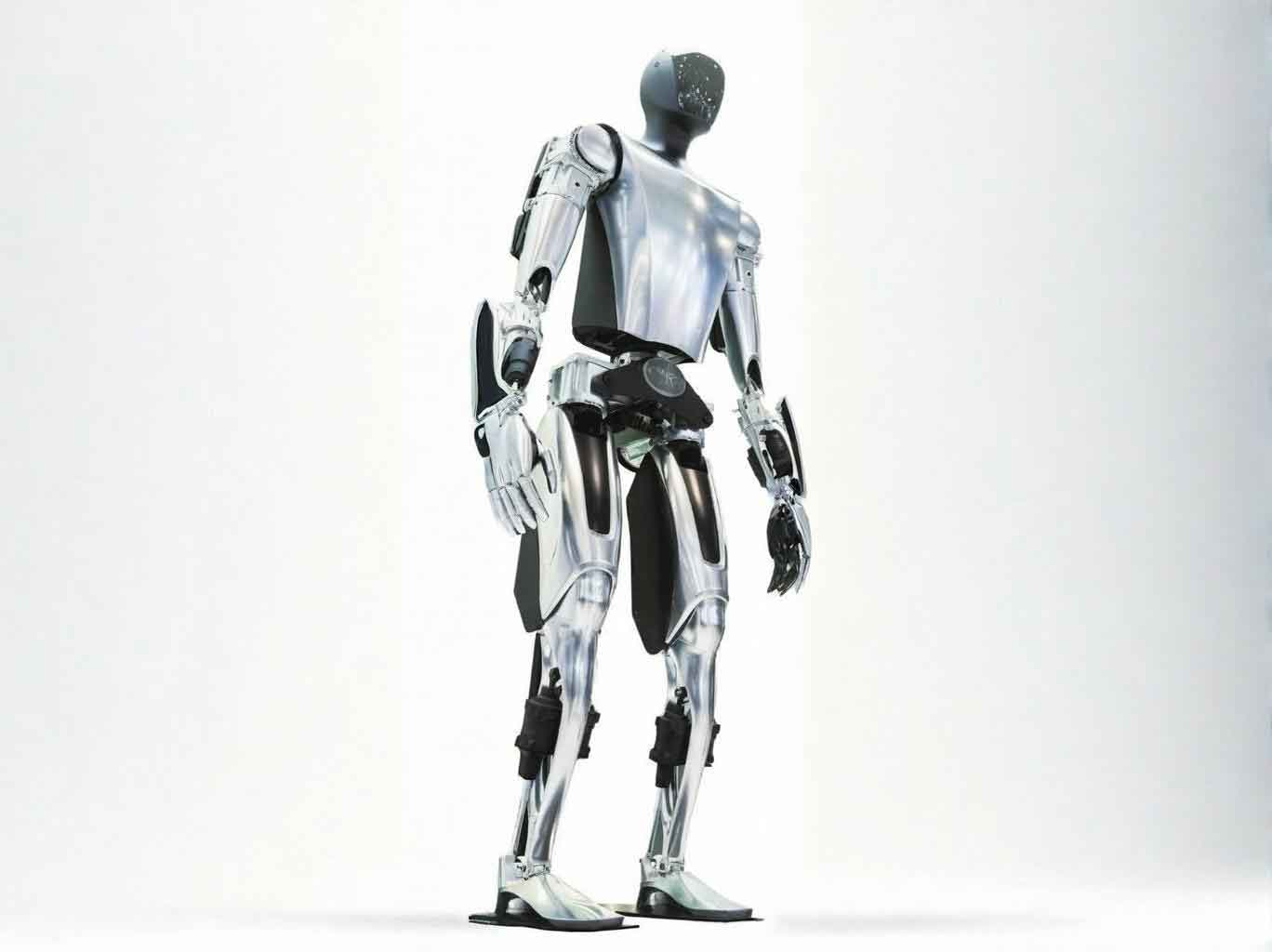
The classic “sense-plan-act” pipeline is obsolete for dynamic environments. The modern embodied AI robot relies on a tightly integrated, cognitive architecture reconstructed around three pillars, heavily dependent on advances in intelligent computation. This architecture can be modeled as a hierarchical, recurrent process, as shown in the following layered technology stack.
| Layer | Function | Key Computational Technologies | Formal Representation / Challenge |
|---|---|---|---|
| Perception | Ground raw sensor data into a persistent, actionable world state. | Spiking Neural Networks (SNNs) for temporal coding; Neural Radiance Fields (NeRFs) for 3D scene reconstruction; Multi-modal sensor fusion (LiDAR, vision, touch). | $$o_t = \Omega(s_t) + \epsilon_t$$ where $\Omega$ must learn to fuse $[I_{rgb}, I_{depth}, L_{pointcloud}, \tau_{torque}…]$ into a unified latent state $z_t$. The challenge is continuous, ego-centric map updating: $M_t = f(M_{t-1}, z_t, a_{t-1})$. |
| Cognition & World Modeling | Predict future states, simulate action outcomes, and perform long-horizon reasoning. | Transformer-based World Models; Diffusion models for planning; Retrieval-Augmented Generation (RAG) from embodied experience databases. | Learning a latent dynamics model: $$\hat{s}_{t+1}, \hat{r}_t = g_\phi(z_t, a_t)$$ The agent uses this model for “mental simulation”: $\pi_\theta = \arg\max_\pi \mathbb{E}_{g_\phi}[\sum \hat{r}]$, enabling planning without exhaustive real-world trial-and-error. |
| Action & Control | Translate high-level plans into smooth, stable, and energy-efficient physical movements. | Model Predictive Control (MPC) with learned dynamics; Reinforcement Learning for dexterous manipulation; Impedance & force control algorithms. | Solving a constrained optimization at high frequency: $$a_t^* = \arg\min_{a_t} \sum_{k=t}^{t+N} ||\hat{s}_k – s_{k}^{desired}||_Q^2 + ||a_k||_R^2$$ subject to kinematic/dynamic limits $a_{min} \le a_k \le a_{max}$. The challenge is blending learned policies with robust, model-based control for safety. |
The integration of these layers is non-linear. Perception is informed by expectations from the world model (e.g., where to look next), and the control layer provides proprioceptive feedback that refines the agent’s sense of self. This creates a virtuous cycle of embodied learning.
Applications and Economic Imperatives
The theoretical framework materializes in transformative applications. In advanced manufacturing, the embodied AI robot transitions from a blind, pre-programmed arm to an adaptive assembly worker. It can handle “kitted” parts with random pose, detect subtle defects via tactile inspection, and collaborate with human workers, dynamically adjusting its force and trajectory for safety. The economic model shifts from capital expenditure on fixed automation to operational expenditure on flexible, cognitive automation.
In logistics and warehousing, the value proposition is total cost of ownership (TCO) in complex, changing environments. An embodied AI robot equipped with the aforementioned stack can navigate a warehouse during both day and night shifts, adapt to constantly changing pallet layouts, handle a vast SKU variety without reconfiguration, and even perform simple depalletization or item picking, tasks that have long eluded traditional automation.
| Application Domain | Traditional Automation | Embodied AI Robot Solution | Key Value Driver |
|---|---|---|---|
| Electronics Assembly | Dedicated machines for specific tasks (e.g., soldering, screw-driving). High changeover cost. | General-purpose robotic arm with fine manipulators and vision. Can be rapidly re-tasked via natural language instruction. | Flexibility for high-mix, low-volume production; reduced downtime for line reconfiguration. |
| Hospital Patient Support | Fixed delivery robots on pre-mapped routes; tele-operated devices. | Mobile manipulator that can navigate crowded halls, fetch items from a cluttered supply room, and gently hand them to a patient or nurse. | Labor augmentation in high-stress environments; 24/7 operational support; reducing physical strain on healthcare workers. |
| Agricultural Harvesting | Large, destructive harvesting machines for monocultures. | Agile mobile robot with specialized end-effector for selective picking of fruits (e.g., strawberries, apples) based on ripeness perception. | Reduction of food waste; enabling sustainable, high-value polyculture farming; addressing labor shortages. |
Frontier Challenges and Future Vectors
The path forward is illuminated by profound challenges that define the research agenda. First is the **Sim2Real Gap and the Data Famine**. Training a robust embodied AI robot purely in the real world is prohibitively slow and dangerous. While simulation (Sim) provides a vast training ground, policies trained in Sim often fail in Real due to unmodeled physics, perception discrepancies, and emergent complexity. The solution lies in developing *adaptive simulators* that can be calibrated from small amounts of real-world data and in creating foundational models for physics and material interaction that generalize. The formal challenge is minimizing the *domain discrepancy* $\delta$ between the simulation dynamics $T_{sim}$ and real-world dynamics $T_{real}$.
$$ \delta = D_{KL}(P_{sim}(s_{t+1} | s_t, a_t) || P_{real}(s_{t+1} | s_t, a_t)) $$
Advanced techniques involve domain randomization, meta-learning, and building simulators on neural differential equations that can be fine-tuned.
Second is **Energy Efficiency and Computational Morphology**. The power consumption of running large models on-board a mobile embodied AI robot is a critical bottleneck. The future lies in *computational morphology*—designing hardware and algorithms co-adapted for efficiency. This includes neuromorphic chips that mimic the brain’s event-driven, sparse activity for perception, and the use of Spiking Neural Networks (SNNs) whose energy use is proportional to the number of “spikes” or events processed, rather than constant high-rate operation.
$$ E_{comp} \propto \sum_{i}^{Neurons} \sum_{t}^{T} \mathbb{I}(V_i(t) > V_{thresh}) $$
where $\mathbb{I}$ is the indicator function for a spike event. Combining such hardware with “algorithmic efficiency” from the Scaling Down paradigm is essential for autonomy.
Third is **Ethical Grounding and Value Alignment**. An embodied AI robot operating in human spaces must make implicit value judgments: how close to approach a person, how to prioritize tasks during an emergency, how to handle unexpected social cues. Encoding human values, ethics, and norms into the control loop of a physical agent is an unsolved problem. It requires moving beyond simple constraint-based safety to learning normative models of human behavior and intention. This intersects directly with policy-driven safety frameworks and necessitates transparent, interpretable decision-making processes in the robot’s cognitive architecture.
| Challenge | Nature of the Problem | Convergent Solution Pathways |
|---|---|---|
| Cross-Modal Common Sense | Lacking intuitive physics (e.g., stability, containment) and affordances (what actions an object permits) that are innate to humans. | Training world models on massive, multi-modal video data of everyday interaction; leveraging physics-inspired neural network priors; curriculum learning in simulation from simple to complex physical concepts. |
| Long-Tail Adaptation | Performing reliably in rare, unforeseen “edge-case” scenarios not covered in training data. | Lifelong learning architectures that assimilate new experiences without catastrophic forgetting; scaling out to query expert models or human guidance when uncertainty is high; building episodic memory for past similar situations. |
| Human-Robot Co-Evolution | Designing interaction paradigms where humans and embodied AI robots collaborate seamlessly, each adapting to the other. | Natural, multi-modal communication (gesture, gaze, language); learning human intent models from demonstration (inverse reinforcement learning); developing robot behaviors that are predictable and legible to humans. |
Conclusion: Towards a Self-Evolving Ecosystem
The fusion of intelligent computation and embodied intelligence is not merely another step in AI progress; it is the opening of a new volume. The central protagonist of this volume is the embodied AI robot, an entity whose intelligence is inextricably linked to its physical form and its history of sensorimotor experience. This convergence is dismantling the artificial walls between the virtual and the physical, between the brain and the body, and between isolated agents and collaborative societies of machines.
The future I foresee is one of a **self-evolving ecosystem**. In this ecosystem, populations of embodied AI robots will share their learned experiences—their successes and failures in manipulating the world—contributing to a continually growing, collective “embodied knowledge graph.” This graph will in turn refine the simulators used to train the next generation of robots, creating a virtuous cycle of improvement. The computational substrate will become increasingly heterogeneous, blending quantum-inspired optimization for planning, neuromorphic chips for perception, and traditional silicon for high-level reasoning. This path leads us toward a future where artificial intelligence is not just a tool we use, but a partner we collaborate with in the shared task of navigating and shaping the physical world. The journey has just begun, and its trajectory will be defined by our continued commitment to interdisciplinary, principled, and ethically grounded innovation at this most fascinating intersection.