
The global manufacturing landscape is undergoing a profound shift from mere automation towards true intelligence. At the heart of this transformation lies the integration of embodied AI into industrial robotics. This paradigm moves machines from being simple executors of pre-programmed paths to becoming adaptive, cognitive entities capable of understanding and interacting with the physical world. The convergence of advanced robotics and artificial intelligence promises to unlock new levels of flexibility and autonomy on the factory floor.
Traditional industrial robots, predominantly serial-link manipulators, excel in repetitive, structured tasks such as welding, painting, and material handling within controlled environments. However, they face significant limitations when confronted with dynamic, unstructured, or contact-rich operations. Tasks like precision assembly, adaptive grinding, or complex inspection often involve vibrations, part tolerances, and unpredictable forces that defy simple coordinate-based programming. The existing control architectures, reliant on fixed algorithms and external sensing with inherent latency, struggle to form a real-time “perception-action” closed loop. This gap highlights the need for a fundamental重构 of both the physical form and the cognitive core of next-generation robots.
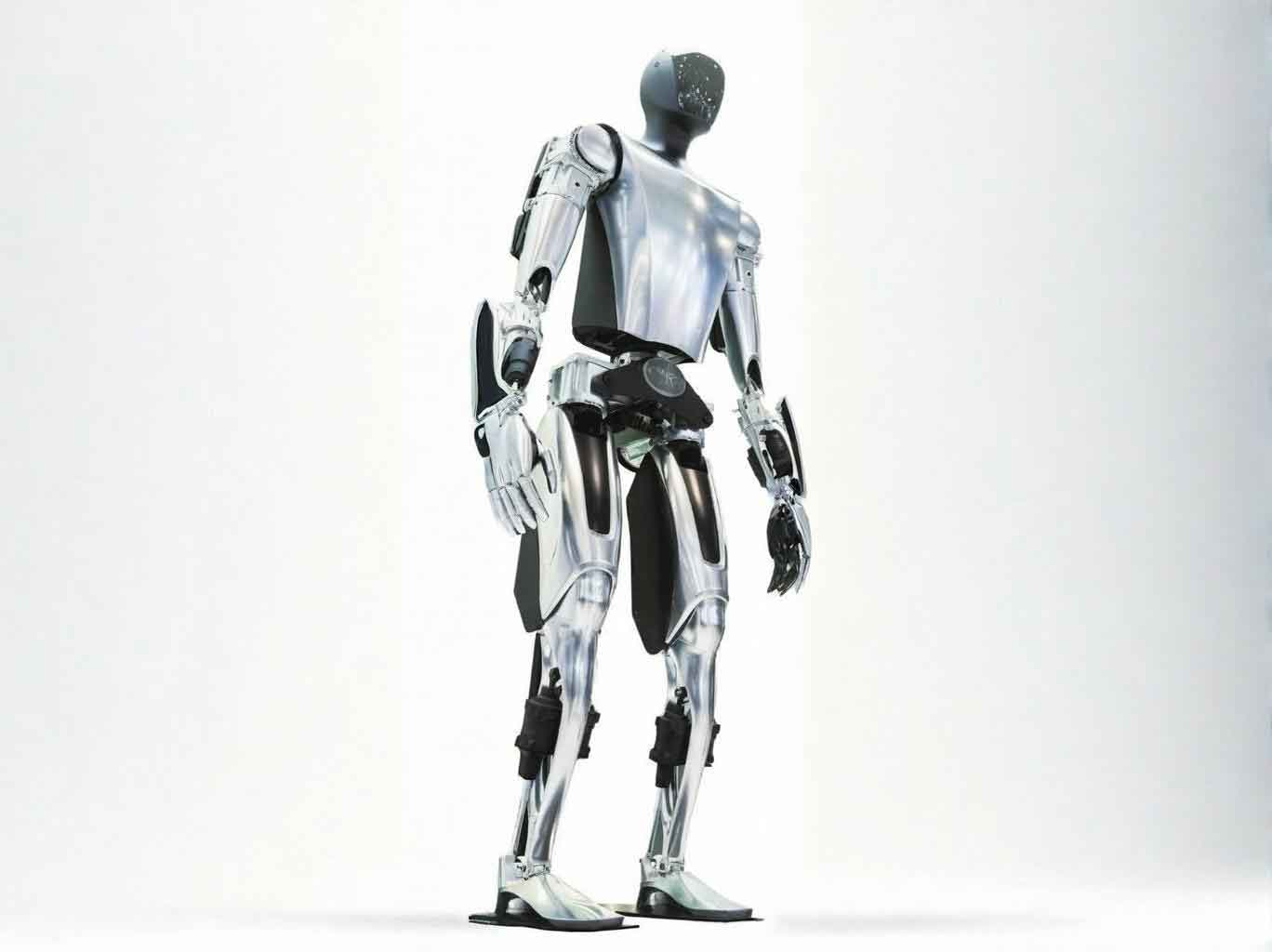
The physical embodiment is the first frontier. The future industrial embodied AI robot will not be limited to a single arm bolted to the floor. New morphologies are emerging as critical carriers for embodied intelligence:
- Collaborative Parallel Robots: Systems where two or more low-degree-of-freedom parallel robots work in tandem to achieve high-speed, compliant operations.
- Mobile Hybrid Platforms: Combining parallel manipulators with legged or wheeled mobile bases to operate in complex, changing workspaces.
- Humanoid Robots: Leveraging bimanual coordination and human-like spatial reasoning to perform high-complexity tasks like assembly in environments designed for people.
These diverse forms provide the necessary physical foundation for the three-layer evolution of an embodied AI robot: Perception, Cognition, and Informed Action (“Knowing-through-Acting”).
I. Perception: Enabling the Robot to “See” and “Feel”
Perception is the bedrock of embodied intelligence. An embodied AI robot must fuse multi-modal sensory data—visual, force, tactile, and sometimes auditory—to build a real-time, holistic understanding of its environment and its interaction state. The key challenge is the synchronous, high-frequency integration of these data streams to provide reliable input for decision-making.
For instance, in a peg-in-hole assembly task, vision can provide coarse initial positioning, while force/torque sensing at the wrist and tactile sensing on the fingers deliver fine-grained contact feedback. The control law for such compliant insertion can be modeled using impedance or admittance control. A simplified impedance control equation is:
$$
\boldsymbol{\tau} = \boldsymbol{J}^T(\boldsymbol{q}) \left( \boldsymbol{K}_p (\boldsymbol{x}_d – \boldsymbol{x}) + \boldsymbol{D}_p (\dot{\boldsymbol{x}}_d – \dot{\boldsymbol{x}}) \right)
$$
Where \(\boldsymbol{\tau}\) is the joint torque vector, \(\boldsymbol{J}\) is the Jacobian matrix, \(\boldsymbol{q}\) are joint angles, \(\boldsymbol{x}_d\) and \(\boldsymbol{x}\) are desired and actual end-effector poses, and \(\boldsymbol{K}_p\) and \(\boldsymbol{D}_p\) are stiffness and damping matrices. An embodied AI robot dynamically adjusts \(\boldsymbol{K}_p\) and \(\boldsymbol{D}_p\) based on real-time sensory feedback (e.g., sensed contact force \(\boldsymbol{F}_s\)) to achieve柔顺 behavior:
$$
\boldsymbol{K}_p = f_{adapt}(\boldsymbol{F}_s, \boldsymbol{x}, t), \quad \boldsymbol{D}_p = g_{adapt}(\boldsymbol{F}_s, \dot{\boldsymbol{x}}, t)
$$
The table below summarizes key sensory modalities and their roles in embodied perception for an industrial embodied AI robot.
| Sensory Modality | Typical Sensors | Primary Role in Embodied AI Robot | Key Challenge |
|---|---|---|---|
| Vision | 2D/3D Cameras, RGB-D | Object recognition, coarse pose estimation, scene understanding. | Lighting variance, occlusion, real-time processing. |
| Force/Torque | 6-Axis F/T Sensor | Measuring interaction forces and moments at the end-effector. | Sensor calibration, dynamic coupling with robot inertia. |
| Tactile | Skin-like arrays, MEMS | Measuring pressure distribution, slip detection, texture recognition. | High-density wiring, robustness, spatial calibration. |
| Proprioception | Encoders, Current Sensors | Internal state measurement (joint position, velocity, torque). | Modeling friction and backlash accurately. |
II. Cognition: Enabling Understanding and Judgment
Cognitive intelligence elevates the embodied AI robot from following explicit commands to understanding task intent and context. This layer integrates neural network-based learning with physical world models to form task logic and planning strategies. Deep Reinforcement Learning (DRL) is a powerful framework for this, where the robot learns optimal policies through interaction, often first in a simulated environment.
The core DRL objective is to learn a policy \(\pi_{\theta}(\boldsymbol{a}_t | \boldsymbol{s}_t)\) parameterized by \(\theta\) that maximizes the expected cumulative reward \(R_t = \sum_{k=t}^{T} \gamma^{k-t} r(\boldsymbol{s}_k, \boldsymbol{a}_k)\), where \(\boldsymbol{s}_t\) is the state (from perception), \(\boldsymbol{a}_t\) is the action, \(r\) is the reward function, and \(\gamma\) is a discount factor. For an assembly task, the state might include part poses and contact forces, actions are joint motions or torques, and the reward function penalizes misalignment and excessive force while rewarding successful insertion.
A policy gradient update rule, such as in REINFORCE, can be expressed as:
$$
\nabla_{\theta} J(\theta) \approx \frac{1}{N} \sum_{i=1}^{N} \sum_{t=0}^{T} \nabla_{\theta} \log \pi_{\theta}(\boldsymbol{a}_t^i | \boldsymbol{s}_t^i) \hat{A}_t^i
$$
where \(J(\theta)\) is the expected return, \(N\) is the number of trajectories, and \(\hat{A}_t^i\) is an estimator of the advantage function. The cognitive module of an embodied AI robot uses such learned policies, combined with symbolic reasoning for task decomposition, to make judgments like “the part is jammed, I need to perform a wiggling motion to recover.”
| Cognitive Function | Enabling Technologies | Benefit for Embodied AI Robot |
|---|---|---|
| Task Planning & Reasoning | Symbolic AI, Hierarchical RL | Breaks down high-level goals (e.g., “assemble engine”) into sequential actionable steps. |
| Interactive Policy Learning | Deep Reinforcement Learning (DRL), Imitation Learning | Enables adaptation to new tasks and variations without explicit reprogramming. |
| World Modeling | Physics-informed Neural Networks, Neural Radiance Fields (NeRF) | Provides an internal simulation for prediction, planning, and safe exploration. |
| Skill Memory & Retrieval | Embedding Networks, Skill Libraries | Allows rapid adaptation by recalling and modifying previously learned successful strategies. |
III. Informed Action (“Knowing-through-Acting”): The Unification of Mind and Body
This is the apex of embodied intelligence, where perception and cognition are fully internalized into seamless, autonomous behavior. The embodied AI robot demonstrates “知行合一” – it acts based on an integrated understanding, constantly refining its strategy through real-time feedback. This is not merely reactive control; it is anticipatory and self-correcting.
Consider the task of grinding an unknown, irregular surface. A traditional robot follows a pre-scanned path. An embodied AI robot, however, employs a dynamic action policy that fuses a predicted material removal model with in-situ force/tactile feedback. The control objective can be formulated as optimizing a cost function \(C\) over a horizon \(H\):
$$
\min_{\boldsymbol{a}_{t:t+H}} \sum_{k=t}^{t+H} \left( \| \boldsymbol{F}_{d} – \boldsymbol{F}_{pred}(\boldsymbol{s}_k, \boldsymbol{a}_k) \|^2_{W_F} + \| \boldsymbol{z}_{d} – \boldsymbol{z}_{pred}(\boldsymbol{s}_k, \boldsymbol{a}_k) \|^2_{W_z} \right)
$$
Subject to: \(\boldsymbol{s}_{k+1} = f_{physics}(\boldsymbol{s}_k, \boldsymbol{a}_k)\)
Here, \(\boldsymbol{F}_{d}\) is the desired contact force profile, \(\boldsymbol{z}_{d}\) is the desired surface profile, \(\boldsymbol{F}_{pred}\) and \(\boldsymbol{z}_{pred}\) are neural network predictors of force and surface outcome, \(W\) are weighting matrices, and \(f_{physics}\) represents the robot and environment dynamics. The embodied AI robot solves this optimization in a receding horizon fashion, constantly adjusting its grinding path \(\boldsymbol{a}_t\) based on the latest perceptual state \(\boldsymbol{s}_t\) to achieve uniform quality.
The transition across these three layers represents the core evolution of the embodied AI robot. The following table contrasts the traditional paradigm with the embodied intelligence paradigm across key dimensions.
| Dimension | Traditional Industrial Robot | Embodied AI Robot |
|---|---|---|
| Core Objective | Precise repetition of pre-defined trajectories. | Adaptive achievement of task goals in dynamic environments. |
| Information Flow | Open-loop or slow, segregated perception-action cycles. | Tightly closed “Perception-Cognition-Action” loop with high-frequency integration. |
| Control Basis | Geometric and kinematic models, fixed logic. | Hybrid models combining physics, neural networks, and real-time sensory fusion. |
| Adaptability | Low. Requires reprogramming for new tasks or variations. | High. Can generalize and adapt through simulation and few-shot real-world learning. |
| Typical Task Suitability | Structured, non-contact, large-batch operations. | Unstructured, contact-rich, small-batch, high-mix operations. |
IV. Future Outlook and Systemic Impact
The proliferation of the embodied AI robot will fundamentally reshape manufacturing systems. Production lines will evolve into intelligent networks of collaborative embodied AI robot agents, orchestrated by digital twin systems. These agents will autonomously plan and negotiate tasks based on real-time workstation status, seamlessly collaborating with each other and human workers. This enables a shift towards mass customization and self-optimizing production.
Key application domains ready for transformation include:
- Compliant Assembly: Autonomous micro-scale insertion, screw driving with torque-angle monitoring, and wiring harness installation.
- Adaptive Finishing: Consistent grinding, polishing, and deburring of complex castings or composite parts with variable material properties.
- Intelligent Inspection: Go beyond pass/fail checks to diagnose root causes of defects by correlating tactile feedback with visual anomalies.
- Logistics and Kitting: Autonomous picking and packing of diverse, unstructured items in warehouses.
The mathematical foundation for such a multi-agent system can be described as a decentralized partially observable Markov decision process (Dec-POMDP). Each embodied AI robot \(i\) has a local observation \(o_t^i\), takes an action \(a_t^i\), and the team shares a joint reward. The goal is to find a set of policies \(\{\pi^i\}\) that maximize the expected sum of joint rewards. The complexity of this problem underscores the advanced cognition required at the system level.
The journey from a rigid, blind executor to a flexible, cognitive embodied AI robot is the defining trajectory for the next era of industrial automation. It is a transition from machines that simply act on the world to machines that understand and intelligently interact with it. This evolution, powered by embodied AI, will be crucial in building more resilient, efficient, and adaptable manufacturing ecosystems, solidifying the foundation of the real economy for the future.