
As I reflect on the rapid evolution of artificial intelligence, it becomes increasingly clear that the dawn of embodied AI robots marks a pivotal shift in how we perceive and interact with technology. In my years of working in industrial automation, I have witnessed firsthand the limitations of traditional AI—confined to virtual realms, processing data without a tangible presence. Embodied AI breaks these boundaries, endowing intelligent agents with the ability to perceive, decide, and act within real physical environments. This transformative capability is not merely an incremental improvement but a fundamental reimagining of industrial processes. The term “embodied AI robot” encapsulates this fusion of cognition and physicality, where machines become active participants in the world around them. In this article, I will delve into the journey of embodied AI robots, exploring their current state, developmental stages, technical underpinnings, and future potential, all while emphasizing the need for cautious optimism as we navigate this exciting frontier.
The essence of an embodied AI robot lies in its integration of sensory perception, cognitive processing, and mechanical action. Unlike conventional AI systems that operate in isolation, an embodied AI robot interacts directly with its surroundings, learning from feedback loops that bridge the digital and physical. In industrial settings, this means that an embodied AI robot can adapt to dynamic conditions—whether it’s a robotic arm assembling components on a production line or an autonomous vehicle navigating a warehouse. The core principle can be expressed through a simple formula representing the perception-decision-action cycle: $$ a_t = \pi(s_t, \theta) $$ where \( a_t \) is the action taken at time \( t \), \( s_t \) is the state of the environment perceived by the embodied AI robot, and \( \pi \) is the policy function parameterized by \( \theta \), learned through experience. This continuous loop enables embodied AI robots to optimize tasks in real-time, reducing errors and enhancing efficiency.
Currently, the development of embodied AI robots is in its nascent stages, characterized by experimental deployments and cautious integration. Many industries are grappling with the challenges of implementing these systems, from high initial costs to technical complexities. However, the promise is undeniable. An embodied AI robot can take various forms, such as industrial robots, CNC machines, or mobile manipulators, each designed to perform specific functions. When multiple embodied AI robots collaborate, they form intelligent entities at higher levels—think of a production line where robots coordinate seamlessly or a factory where entire workflows are automated. This hierarchical scalability is a key advantage, paving the way for smart manufacturing ecosystems. To illustrate the progression, consider the following table summarizing the evolution of embodied AI robots in industry:
| Era | Dominant Technology | Role of Embodied AI Robot | Key Limitations |
|---|---|---|---|
| Pre-2020 | Traditional Automation | Limited to repetitive tasks with fixed programming | Lacked adaptability and cognitive functions |
| 2020-2025 | Early Embodied AI | Basic perception and decision-making in controlled environments | High dependency on human supervision |
| Post-2025 | Advanced Embodied AI | Autonomous operation in complex, dynamic settings | Integration challenges with legacy systems |
Looking ahead, 2025 stands out as a critical inflection point where embodied AI robots transition from laboratory prototypes to factory floor staples. This journey unfolds in three distinct phases, each building on the last to achieve greater autonomy. In the initial phase, embodied AI robots coexist with humans in shared production spaces. Here, the focus is on solving human-robot collaboration issues, such as safety protocols and intuitive interfaces. I recall a project where we deployed an embodied AI robot alongside workers on an assembly line; using sensors and machine learning, the robot learned to anticipate human movements, minimizing collisions and boosting productivity. The dynamics of such interaction can be modeled using equations like: $$ F_{safe} = k \cdot \frac{1}{d^2} $$ where \( F_{safe} \) represents the safety force exerted by the embodied AI robot, \( k \) is a constant based on system parameters, and \( d \) is the distance to the human operator. This phase lays the groundwork for trust and integration.
The mid-term phase sees embodied AI robots achieving more efficient and intelligent collaboration, though they remain subordinate to human oversight. In this stage, robots take on complex tasks like quality inspection or adaptive machining, leveraging real-time data from IoT sensors. For instance, an embodied AI robot equipped with vision systems can detect defects using convolutional neural networks, expressed as: $$ y = \sigma(W * x + b) $$ where \( y \) is the output classification (e.g., defect or no defect), \( \sigma \) is the activation function, \( W \) represents the weights, \( * \) denotes convolution, \( x \) is the input image from the embodied AI robot’s camera, and \( b \) is the bias. This enhances precision and reduces waste. However, humans still guide high-level decisions, ensuring that the embodied AI robot aligns with operational goals. The synergy here is akin to a dance, where each partner complements the other’s strengths.
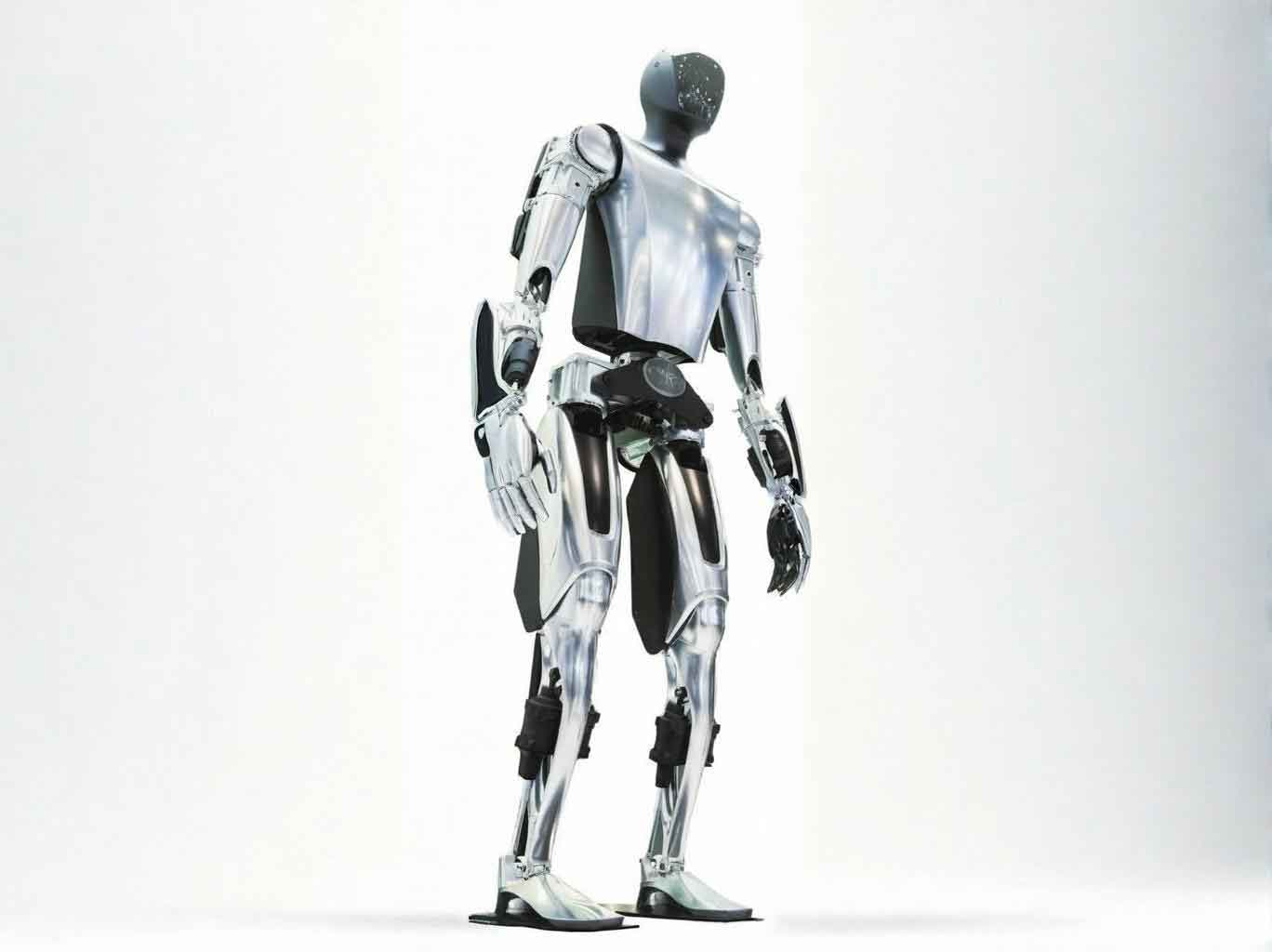
Ultimately, the final phase envisions embodied AI robots operating independently, with humans gradually receding from the production frontline. This leads to the realization of “unmanned factories,” where networks of embodied AI robots manage end-to-end processes. Imagine a supply chain where autonomous vehicles, robotic arms, and smart warehouses coordinate without human intervention. The economic impact can be quantified through formulas like: $$ C_{total} = C_{fixed} + \frac{C_{variable}}{n} $$ where \( C_{total} \) is the total production cost, \( C_{fixed} \) includes initial investments in embodied AI robots, \( C_{variable} \) covers operational expenses, and \( n \) is the number of units produced, showcasing economies of scale. In this phase, embodied AI robots not only execute tasks but also self-optimize using reinforcement learning algorithms, such as: $$ Q(s,a) \leftarrow Q(s,a) + \alpha [r + \gamma \max_{a’} Q(s’,a’) – Q(s,a)] $$ where \( Q \) is the action-value function for the embodied AI robot, \( \alpha \) is the learning rate, \( r \) is the reward, and \( \gamma \) is the discount factor. This autonomy drives unprecedented levels of efficiency and innovation.
Throughout these stages, the integration of embodied AI robots with emerging technologies amplifies their capabilities. Fusion with 5G enables low-latency communication, while edge computing allows for real-time processing at the source. Additionally, advancements in materials science and energy systems enhance the durability and sustainability of embodied AI robots. The table below highlights key synergies:
| Technology | Integration with Embodied AI Robot | Benefit | Example Application |
|---|---|---|---|
| Internet of Things (IoT) | Sensors provide real-time environmental data to the embodied AI robot | Improved situational awareness and predictive maintenance | Smart factories with connected devices |
| Digital Twins | Virtual models simulate and optimize embodied AI robot performance | Reduced downtime and enhanced planning | Testing robot workflows in a digital replica |
| Blockchain | Secures data exchanges between embodied AI robots in a supply chain | Increased transparency and trust in autonomous transactions | Tracking parts from manufacturer to assembly |
| Quantum Computing | Accelerates complex calculations for embodied AI robot decision-making | Faster optimization of large-scale systems | Solving logistics problems in real-time |
Despite the optimism, embracing embodied AI robots requires a prudent assessment of risks. In my experience, companies often underestimate the complexities of deployment, leading to costly setbacks. Key challenges include cybersecurity vulnerabilities, ethical concerns around job displacement, and the need for robust fail-safes. For example, an embodied AI robot malfunctioning in a high-stakes environment could cascade into systemic failures. To mitigate this, we can employ control theories like PID (Proportional-Integral-Derivative) expressed as: $$ u(t) = K_p e(t) + K_i \int_0^t e(\tau) d\tau + K_d \frac{de(t)}{dt} $$ where \( u(t) \) is the control output for the embodied AI robot, \( e(t) \) is the error signal, and \( K_p, K_i, K_d \) are tuning parameters. This ensures stable and responsive operations. Moreover, interdisciplinary collaboration—combining expertise in robotics, AI, and human factors—is essential to navigate these hurdles.
From a technical perspective, the mathematics behind embodied AI robots is both elegant and complex. Consider the kinematics of a robotic manipulator, which governs its movement. The forward kinematics can be described using the Denavit-Hartenberg parameters, with transformations like: $$ T_i^{i-1} = \begin{bmatrix} \cos\theta_i & -\sin\theta_i \cos\alpha_i & \sin\theta_i \sin\alpha_i & a_i \cos\theta_i \\ \sin\theta_i & \cos\theta_i \cos\alpha_i & -\cos\theta_i \sin\alpha_i & a_i \sin\theta_i \\ 0 & \sin\alpha_i & \cos\alpha_i & d_i \\ 0 & 0 & 0 & 1 \end{bmatrix} $$ where \( T_i^{i-1} \) represents the transformation from link \( i-1 \) to link \( i \) for an embodied AI robot, with \( \theta_i, d_i, a_i, \alpha_i \) as joint and link parameters. This formalism enables precise control, allowing the embodied AI robot to perform delicate tasks such as welding or assembly. Similarly, for navigation, we might use probabilistic models like the Kalman filter: $$ \hat{x}_{k|k-1} = F_k \hat{x}_{k-1|k-1} + B_k u_k $$ $$ P_{k|k-1} = F_k P_{k-1|k-1} F_k^T + Q_k $$ where \( \hat{x} \) is the state estimate of the embodied AI robot’s position, \( F_k \) is the state transition model, and \( P \) is the error covariance. These formulas underscore the sophistication required to bring embodied AI robots to life.
In practice, the deployment of embodied AI robots often involves iterative testing and refinement. I remember a case where we implemented a swarm of embodied AI robots for inventory management. Each robot used distributed algorithms to avoid collisions and optimize paths, modeled by potential fields: $$ F_{rep} = \eta \frac{1}{d^2} \hat{d} $$ where \( F_{rep} \) is the repulsive force between embodied AI robots, \( \eta \) is a scaling factor, and \( d \) is the distance vector. This collective intelligence led to a 30% reduction in retrieval times, demonstrating the power of embodied AI robots in collaborative settings. However, scalability remains a concern; as systems grow, coordination becomes more challenging, necessitating advanced orchestration layers.
The future of embodied AI robots in industry is brimming with innovation opportunities. As computing power increases and algorithms mature, we can expect these robots to become more affordable and accessible. They will likely evolve from task-specific tools to general-purpose assistants, capable of learning new skills on the fly. For instance, an embodied AI robot in a manufacturing plant might switch from assembling electronics to packaging goods with minimal reprogramming, using meta-learning techniques: $$ \theta^* = \arg\min_{\theta} \sum_{i=1}^{N} \mathcal{L}(f_{\theta}, D_i) $$ where \( \theta^* \) are the optimized parameters for the embodied AI robot’s model, \( \mathcal{L} \) is the loss function, and \( D_i \) represents different task datasets. This flexibility will drive customization and responsiveness in production, aligning with trends like mass personalization.
Moreover, the environmental impact of embodied AI robots cannot be overlooked. By optimizing resource usage and reducing waste, they contribute to sustainable manufacturing. Energy consumption models, such as: $$ E_{total} = \sum_{t=1}^{T} P_t \cdot \Delta t $$ where \( E_{total} \) is the total energy used by an embodied AI robot over time \( T \), \( P_t \) is the power at time \( t \), and \( \Delta t \) is the time interval, help in designing eco-efficient systems. Coupled with renewable energy sources, embodied AI robots could pave the way for greener industries.
In conclusion, the rise of embodied AI robots heralds a new era in industrial intelligence. From enhancing human-robot collaboration to enabling fully autonomous factories, these systems are set to redefine productivity and innovation. Yet, as I have emphasized, this journey demands careful planning and risk management. By leveraging formulas for control, learning, and optimization, and by integrating with cutting-edge technologies, embodied AI robots will overcome current limitations. The vision of a world where embodied AI robots seamlessly interact with the physical environment is no longer science fiction—it is an imminent reality. As we stand at this crossroads, I urge stakeholders to embrace the potential while anchoring decisions in rigorous analysis, ensuring that the evolution of embodied AI robots benefits humanity as a whole.