
The evolution of artificial intelligence presents a fascinating narrative of increasing environmental complexity and agent capability. For decades, the field was largely dominated by what I would term “disembodied” intelligence. This paradigm focused on processing static, curated datasets—whether text corpora, image collections, or game state representations—within closed, virtual environments. Landmark achievements like Deep Blue in chess and AlphaGo in Go exemplified powerful computational intelligence, mastering complex rule-based systems. The subsequent wave of perceptive intelligence, powered by deep learning, brought breakthroughs in recognizing patterns in sensory data: identifying faces, transcribing speech, and classifying objects. While transformative, these systems operated at a remove from the messy, unpredictable, and interactive nature of the physical world we inhabit.
The recent advent of large foundation models, particularly multimodal systems, has triggered another leap. Models like ChatGPT demonstrate astonishing generative and reasoning capabilities with abstract symbols, while video generation models like Sora hint at an emerging capacity to simulate physical dynamics. These advances are crucial, yet they still primarily operate in the realm of information processing. They lack a fundamental attribute of human and animal intelligence: embodiment. For an intelligent system to truly understand and act in our world, it must be situated within it, learning through sensory-motor interaction. This is the core premise of embodied AI. An embodied AI robot is not merely a passive processor of data but an active agent whose intelligence is shaped by and expressed through its physical form and its continuous dialogue with the environment.
This article, from my perspective as a researcher in this burgeoning field, delves into the research landscape of embodied intelligence. I will explore its foundational pillars—perception, cognition, and action optimization—examine the profound opportunities and challenges presented by modern AI, and discuss its most compelling application: the humanoid embodied AI robot. The journey from disembodied algorithms to physically intelligent agents represents one of the most exciting frontiers in the quest for artificial general intelligence (AGI).
Defining the Embodied Paradigm
The philosophical roots of embodiment argue that cognition is not an abstract computational process independent of its physical substrate. Instead, it is deeply dependent on, and shaped by, the characteristics of the body and its sensorimotor experiences in the world. Translating this to artificial systems, we can define an embodied AI robot as a physically instantiated system that acquires and demonstrates intelligent behavior through active, goal-directed interaction with a surrounding environment, which it can perceive and affect. The key differentiator from traditional AI is the closed interaction loop: action influences perception, which in turn informs future action. This stands in stark contrast to non-embodied or “pure” AI, which deals with predefined, often static, data distributions. The following table crystallizes the core distinctions:
| Aspect | Non-Embodied / Traditional AI | Embodied AI |
|---|---|---|
| Primary Domain | Virtual, closed-world environments (datasets, simulators with fixed rules). | Physical or high-fidelity simulated open-world environments. |
| Learning Signal | Supervision from labeled data, reward/score in a game, pattern matching. | Physical consequences of actions, task success/failure, environmental feedback. |
| Perception | Passive observation of complete, often curated, data (e.g., an entire image). | Active, sequential, and often partial sensing (e.g., moving to see around an object). |
| Goal | Optimize a statistical or symbolic function (classification accuracy, game score). | Accomplish a physical task in the world (manipulate, navigate, interact). |
| Intelligence Test | Performance on benchmark datasets (ImageNet, GLUE). | Competency in real-world tasks requiring perception, planning, and motor control. |
The research agenda for embodied AI is consequently structured around enabling an agent to successfully operate within this interactive loop. This can be decomposed into three interconnected pillars: embodied perception, embodied cognition, and embodied action optimization.
Pillar I: Embodied Perception
Perception for an embodied AI robot is not a one-time, passive capture of scene information. It is an active, dynamic process where the agent’s movements are deliberately chosen to reduce uncertainty and gather task-relevant information. The agent must answer not just “what is where?” but “what will I see if I move there?” and “what properties can I discover by interacting?”.
1. Active Object Understanding: This goes far beyond basic recognition. An embodied AI robot must infer properties critical for interaction.
- 3D Geometry & Shape: From a single viewpoint, an object’s full shape is ambiguous. An embodied agent must plan a view trajectory to reconstruct a complete 3D model, often dealing with occlusion. The information gain from a potential viewpoint \( V_t \) can be modeled as the reduction in entropy of the scene belief state \( S \):
$$ I(V_t; S) = H(S) – H(S | V_t) $$
where \( H \) is entropy. The agent seeks viewpoints that maximize \( I \). - Physical Properties: Is an object heavy, soft, fragile, or slippery? These attributes cannot be reliably determined from vision alone. An embodied AI robot must employ tactile sensing or perform exploratory “poking” or “grasping” actions. For instance, stiffness \( k \) might be inferred from the force-deformation relationship \( F = k \cdot \Delta x \) measured during a poke.
- Articulation & Affordance: How does an object move? A door has a hinge, a drawer slides, a shirt is deformable. Discovering these kinematic or dynamic models through interaction—pushing, pulling, rotating—is a key embodied perception task. This involves estimating parameters like joint axes and limits from observation sequences during manipulation.
2. Interactive & Exploratory Perception: Sometimes, the object of interest is not directly perceivable.
- Mobile Exploration: The agent must navigate an environment to find a target object (“find my keys”). This combines navigation with active visual search, requiring spatial memory and search strategies.
- Interaction for Perception: To see a book’s title, you may need to move other objects obscuring it. To assess if a cup is full, you might need to pick it up to gauge its weight. The perception-action cycle is tightly coupled: action \( a_t \) (e.g., push aside a box) is taken explicitly to enable a better perceptual observation \( o_{t+1} \) (see the book).
3. Social Perception: In human-centric environments, an embodied AI robot must perceive and interpret human activity, intent, and emotion. This involves understanding not just poses and gestures, but the semantic context: is a person struggling to open a jar (needs help) or exercising (does not need intervention)? This requires integrating visual cues with commonsense reasoning about human goals and social norms.
Pillar II: Embodied Cognition
If perception tells the agent about the current state of the world, cognition is about deciding what to do. Embodied cognition translates high-level, often abstract instructions into sequences of physically executable actions, leveraging the agent’s learned skills and understanding of the world.
The canonical problem is instruction following: a human gives a command like “Make me a cup of coffee.” The embodied AI robot must:
- Task Planning: Decompose the abstract goal into a feasible sequence of sub-tasks. This requires world knowledge and causal reasoning.
$$ \text{Goal: “Make coffee”} \Rightarrow \text{Plan: } [ \text{Find kettle}, \text{Fill kettle}, \text{Heat water}, \text{Find cup}, \text{Add instant coffee}, \text{Pour water} ] $$ - Skill Learning & Policy Learning: Each sub-task (e.g., “Fill kettle”) must be mapped to a low-level control policy \( \pi(a_t | s_t, g_{\text{subtask}}) \) that generates actions (joint torques, gripper commands) based on the current state \( s_t \) (sensor readings) and the sub-goal \( g \).
- Tool Use & API Grounding: The agent must know how to use its body and any tools. In robotic systems, this often means grounding natural language instructions to calls in a Robot Operating System (ROS) API, such as `move_base` for navigation or `MoveIt!` for arm motion planning.
The development of embodied cognition methodologies has progressed through distinct paradigms, increasingly empowered by large AI models:
| Paradigm | Mechanism | Role of Large Models | Limitations |
|---|---|---|---|
| Rule-Driven | Hand-coded state machines and scripts for specific tasks. | None. | Brittle, no adaptability, requires reprogramming for every new task. |
| Imitation-Driven | Learning policy \( \pi \) from demonstrations (human or robotic teleoperation). | Limited; can process demonstration videos or state sequences. | Limited generalization beyond demonstration distribution; requires costly expert data. |
| Large Model-Driven | Using LLMs/VLMs for task planning, reward shaping, and skill grounding. | Central. Provides commonsense knowledge, zero-shot planning, and natural language grounding. | Can generate implausible plans; lacks physical grounding; requires careful integration with low-level controllers. |
The large model-driven approach is revolutionary. A model like GPT-4 can act as a “high-level cognitive engine” for an embodied AI robot. It can parse “I’m thirsty,” infer the goal is to get a drink, plan the steps, and even generate code for low-level skill APIs. Furthermore, models can be used to automatically design reward functions \( R(s, a) \) for reinforcement learning, a process exemplified by frameworks like Eureka, where the LLM iteratively writes and improves reward code based on training outcomes. The cognition loop can be formalized as:
$$ \text{Instruction } L \xrightarrow{\text{LLM Planner}} \text{Plan } P = [g_1, g_2, …, g_n] $$
$$ \text{Sub-goal } g_k \xrightarrow{\text{Skill Policy } \pi_\theta} \text{Actions } a_t $$
where \( \pi_\theta \) is a neural network policy whose parameters \( \theta \) are trained via reinforcement learning with a reward \( R \) potentially shaped by the large model.
Pillar III: Embodied Action Optimization (The Sim-to-Real Gap)
Training a sophisticated embodied AI robot directly in the real world is often impractical: it is slow, unsafe, and can damage the hardware. Therefore, training is predominantly conducted in simulation. This gives rise to the fundamental challenge of embodied action optimization: how do we optimize policies in simulation such that they transfer effectively and robustly to the physical embodied AI robot? The discrepancy between simulation and reality is known as the sim-to-real gap.
The gap arises from multiple sources:
- Dynamics Discrepancy: Simulated physics (e.g., in MuJoCo, Bullet, NVIDIA Isaac Sim) is an approximation. Friction, contact forces, material deformation, and actuator dynamics are imperfectly modeled. A policy \( \pi_{\text{sim}} \) that expertly balances a simulated robot may fail catastrophically on the real hardware because the modeled inertia or friction coefficients are off by a few percent.
- Perceptual Discrepancy: The simulated visual renderer generates synthetic images that lack the noise, lighting variations, and texture complexities of real cameras. A vision-based policy trained on perfect synthetic images may not recognize real-world objects.
- State Estimation Discrepancy: The simulator provides perfect, noise-free ground truth state (e.g., exact joint angles, object positions). In reality, the agent must estimate its state from noisy sensors (encoders, IMUs, cameras), introducing uncertainty.
We can formulate the core optimization problem. Let \( \pi_\theta \) be a policy parameterized by \( \theta \). In simulation, we optimize for expected return:
$$ \theta^*_{\text{sim}} = \arg\max_\theta \mathbb{E}_{\tau \sim p_{\text{sim}}(\tau|\theta)}[R(\tau)] $$
where \( \tau \) is a trajectory and \( p_{\text{sim}} \) is the trajectory distribution under the simulator’s dynamics \( \mathcal{D}_{\text{sim}} \). The real-world performance, however, is:
$$ J_{\text{real}}(\theta) = \mathbb{E}_{\tau \sim p_{\text{real}}(\tau|\theta)}[R(\tau)] $$
with dynamics \( \mathcal{D}_{\text{real}} \). The sim-to-real gap is the performance drop:
$$ \text{Gap}(\theta) = J_{\text{real}}(\theta) – J_{\text{sim}}(\theta) $$
The goal of embodied action optimization is to develop methods that minimize this gap, making \( J_{\text{real}}(\theta^*_{\text{sim}}) \) as high as possible.
Key technical approaches to bridge this gap include:
- Domain Randomization: Instead of training on one fixed simulated world, train on thousands with randomized parameters (lighting, textures, friction, masses). This forces the policy \( \pi_\theta \) to be robust to a wide distribution of environments, hoping the real world falls within this distribution. The optimization becomes:
$$ \theta^* = \arg\max_\theta \mathbb{E}_{d \sim \mathcal{D}_{\text{rand}}} \mathbb{E}_{\tau \sim p_d(\tau|\theta)}[R(\tau)] $$
where \( d \) is a randomized domain instance. - Domain Adaptation: Use techniques to align the feature representations between simulated and real data. For perception, this might involve training a vision network with adversarial losses so that features from synthetic and real images are indistinguishable.
- System Identification & Dynamics Matching: Carefully calibrate the simulator’s physical parameters to match the real robot’s behavior as closely as possible, minimizing \( || \mathcal{D}_{\text{sim}} – \mathcal{D}_{\text{real}} || \).
- Meta-Learning & Fast Online Adaptation: Train a policy that can quickly adapt its parameters with a small amount of real-world interaction data, effectively learning to bridge the gap at deployment time.
The Convergence: Humanoid Robots as the Ultimate Embodied AI Platform
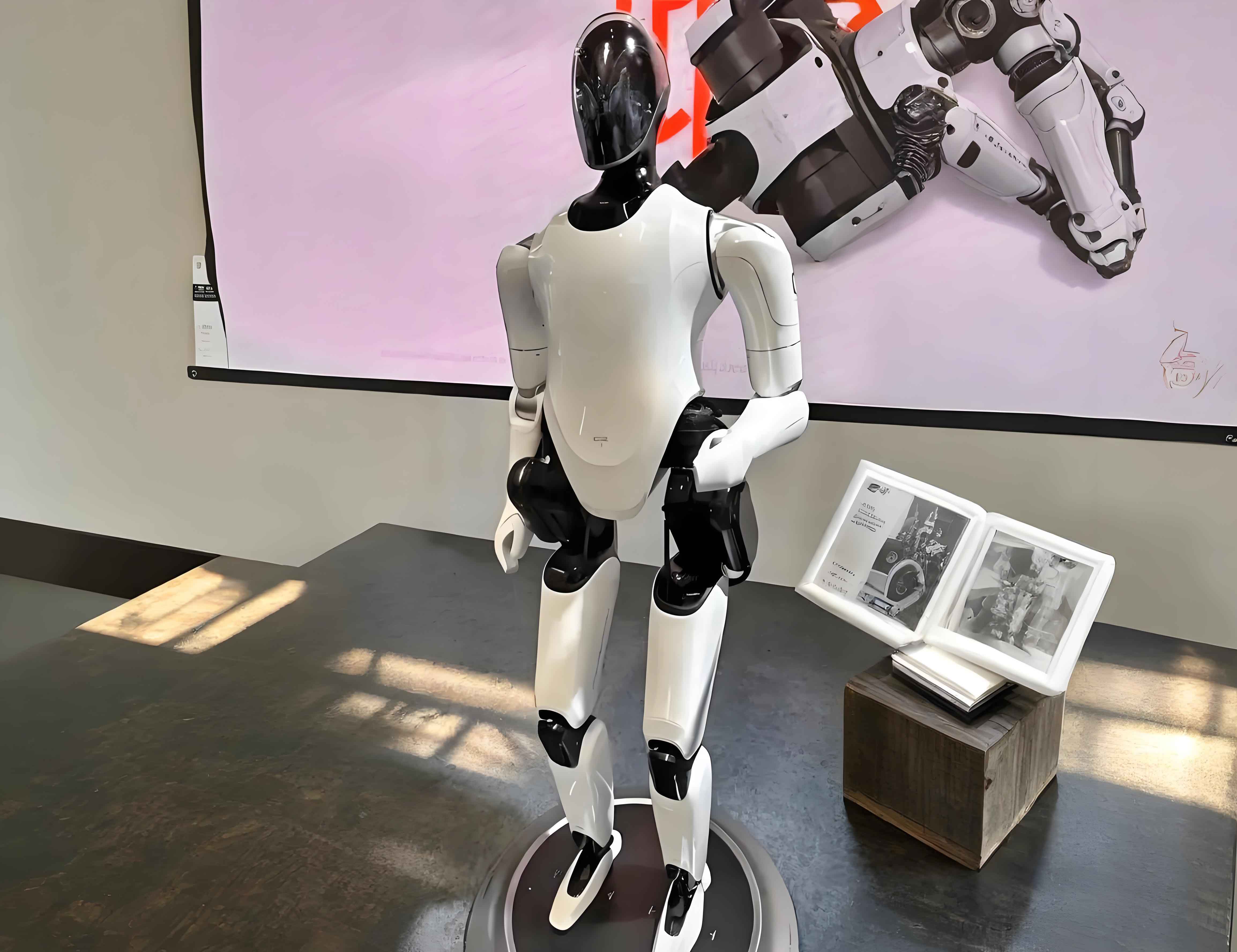
While embodied AI principles apply to any robotic form (wheeled, legged, manipulator arms), the humanoid embodied AI robot represents a unique and compelling pinnacle. Its anthropomorphic form is designed to natively operate in environments built for humans—using stairs, tools, vehicles, and furniture. The resurgence of interest in humanoids, led by companies like Tesla (Optimus), Figure (in partnership with OpenAI), Boston Dynamics (Atlas), and others, is directly fueled by advances in the three pillars discussed.
The modern humanoid robot architecture mirrors the “brain-brainstem-body” hierarchy:
- The “Cerebrum” (High-Level Cognition): Powered by large multimodal models. This layer handles natural language interaction, task understanding, long-horizon planning, and social intelligence. It outputs abstract sub-goals.
- The “Cerebellum” (Low-Level Control): Comprises advanced model-based and learning-based controllers. This layer is responsible for dynamic balance, whole-body motion coordination, compliant force control, and real-time adaptation to disturbances. It translates sub-goals into dynamically feasible joint trajectories and torque commands.
- The “Body” (Hardware): Requires robust, high-performance actuators (often with series elastic elements for force control), lightweight structures, rich sensor suites (cameras, LiDAR, tactile skins, joint torque sensors), and efficient power systems.
The integration is key. The large model “brain” might decide to “pick up the box,” but the “cerebellum” must compute a stable grasping trajectory, account for the box’s estimated weight, and adjust leg posture to counteract the arm’s movement—all in real-time. Projects like Stanford’s Mobile ALOHA demonstrate how low-cost hardware combined with imitation learning from human teleoperation can rapidly teach bimanual mobile manipulation skills, creating valuable data for training these integrated systems.
Opportunities and Challenges on the Path Forward
The synergy between large AI models and advanced robotics creates unprecedented opportunities. An embodied AI robot can leverage the internet-scale knowledge of an LLM for task understanding, while its physical interaction provides a grounding mechanism—a way for the model to learn what “heavy,” “fragile,” or “tight” truly mean through experience. This two-way street—knowledge informing action, and action refining knowledge—is the essence of embodied learning.
However, the path is strewn with significant challenges:
| Challenge Category | Specific Issues |
|---|---|
| Technological Maturity | Ensuring safety and reliability of complex policies in unstructured environments; achieving human-level dexterity and failure recovery; seamless fusion of symbolic planning with continuous control. |
| Data Scarcity | Lack of large-scale datasets of robotic interactions in the real world. While simulation helps, it cannot capture all real-world phenomena. Collecting “robotic experience” at scale is expensive and slow. |
| Computation & Cost | Running large models requires significant onboard or networked compute. Making humanoid robots mechanically reliable and affordable for widespread deployment remains a major hurdle. |
| Generalization & Lifelong Learning | An embodied AI robot must adapt to new objects, environments, and tasks without forgetting previous skills. Developing systems that learn continuously from a few interactions is an open problem. |
| Evaluation &> Benchmarking | Creating standardized physical testbeds and benchmarks to measure progress in embodied intelligence is more difficult than creating software benchmarks. |
Conclusion and Outlook
The field of embodied AI represents a necessary and profound shift in artificial intelligence research. It moves us away from static pattern recognition in curated datasets toward the development of agents that learn, reason, and act in the dynamic, complex physical world we inhabit. The integration of powerful large models for cognition with sophisticated control and perception systems in platforms like humanoid robots is creating a new generation of general-purpose embodied AI robot prototypes.
The vision is clear: machines that can understand a verbal request, perceive their surroundings, formulate and execute a plan using physical action, and learn from the outcomes. Realizing this vision requires continued breakthroughs not in AI alone, but at the intersection of machine learning, robotics, control theory, mechanical engineering, and cognitive science. The focus will be on creating more sample-efficient and robust learning algorithms, building vastly more realistic and scalable simulators (perhaps powered by world models like Sora), developing hardware that is both capable and affordable, and establishing frameworks for safe and ethical deployment.
The journey from a disembodied language model to an embodied AI robot that can genuinely assist in a home, factory, or disaster site is long and arduous. Yet, the foundational pillars are being built, and the pace of progress is accelerating. As we advance, we are not just building better machines; we are deepening our own understanding of what it means to be intelligent, grounded in a physical reality. The era of embodied intelligence is dawning, and it promises to redefine the relationship between humans and machines.