
In this article, I explore the transformative potential of embodied intelligence in reshaping our understanding of cognitive development and its applications in educational innovation. As a researcher deeply engaged in the intersections of cognitive science, developmental psychology, and artificial intelligence, I argue that traditional approaches to intelligence, which often emphasize abstract computation and static data processing, fall short in capturing the dynamic, interactive nature of human cognition. Instead, I propose a cognitive growth path rooted in embodied intelligence, where cognition emerges through continuous sensorimotor interactions between the body, environment, and actions. This perspective not only challenges conventional machine learning paradigms but also offers novel insights for designing adaptive educational systems. Throughout this discussion, I will incorporate tables and mathematical formulations to summarize key concepts, and I will emphasize the role of embodied robots as central agents in simulating and realizing this cognitive growth.
The foundation of my argument lies in the theory of embodied cognition, which posits that cognitive abilities are not merely products of internal computations but are fundamentally shaped by bodily experiences and environmental engagements. For instance, the concept of affordances, as introduced by ecological psychology, highlights how objects gain meaning through an embodied robot’s interactions—such as a chair being perceived as “sittable” based on the robot’s physical structure and prior experiences. This aligns with Piaget’s stages of cognitive development, where infants progress from sensorimotor explorations to symbolic reasoning. I draw on these theories to construct a cognitive growth path comprising stages like bodily regulation, object construction, intention simulation, and inferential reasoning. To illustrate, consider the following table summarizing these stages and their corresponding mechanisms in an embodied robot context:
| Cognitive Stage | Description | Key Mechanisms | Example in Embodied Robot |
|---|---|---|---|
| Bodily Regulation | Initial sensorimotor coordination and self-awareness | Sensorimotor contingencies, reflex-based learning | An embodied robot learning to stabilize its grip through trial and error |
| Object Construction | Formation of object permanence and basic causal understanding | Perception-action mapping, memory integration | An embodied robot tracking occluded objects and inferring their continued existence |
| Intention Simulation | Development of goal-directed behaviors and causal reasoning | Reinforcement learning, intrinsic motivation | An embodied robot experimenting with tools to achieve tasks, like pushing a ball to a target |
| Inferential Reasoning | Abstract symbol manipulation and generalization | Representational reorganization, meta-learning | An embodied robot categorizing objects into abstract concepts (e.g., “furniture”) based on limited experiences |
To model these stages computationally, I rely on frameworks such as Markov Decision Processes (MDPs), which formalize the perception-action loop in embodied robots. For example, the value function in an MDP can be expressed as: $$ V(s) = \max_a \left[ R(s,a) + \gamma \sum_{s’} P(s’|s,a) V(s’) \right] $$ where \( s \) represents the state (e.g., sensory input), \( a \) the action, \( R \) the reward, \( \gamma \) the discount factor, and \( P \) the transition probability. This equation captures how an embodied robot optimizes its behavior through iterative interactions, mirroring the exploratory learning seen in human infants. Furthermore, self-supervised learning (SSL) algorithms enable embodied robots to discover patterns without explicit labels, akin to a child learning causality through play. For instance, the loss function in SSL might be defined as: $$ \mathcal{L} = -\mathbb{E}_{x \sim \mathcal{D}} \left[ \log p(x | f(x)) \right] $$ where \( x \) is the input data, \( f \) is a transformation function, and \( p \) represents the probability distribution learned by the embodied robot. This approach reduces reliance on massive datasets and fosters autonomous knowledge construction.
The mechanisms supporting cognitive growth in embodied robots involve dynamic processes like embodied regulation, situated construction, and representational reorganization. Embodied regulation refers to the way an embodied robot adjusts its actions based on real-time feedback from the environment. For example, in developmental robotics, researchers have implemented models where an embodied robot uses sensorimotor contingencies to distinguish between self and non-self, leading to emergent self-awareness. This can be mathematically represented using differential equations that model the robot’s state transitions: $$ \frac{ds}{dt} = f(s, a, e) $$ where \( s \) is the internal state, \( a \) the action, and \( e \) the environmental input. Situated construction emphasizes how knowledge is built incrementally through interactions; tables can help summarize the progression:
| Learning Phase | Characteristics | Computational Model |
|---|---|---|
| Early Exploration | Random actions, basic reflexes | Stochastic policies in reinforcement learning |
| Intermediate Skill Acquisition | Goal-oriented behaviors, causal inference | Q-learning with reward shaping |
| Advanced Generalization | Symbolic representation, abstract reasoning | Neural-symbolic integration models |
Representational reorganization involves the restructuring of internal models to accommodate new knowledge while maintaining stability. In embodied robots, this is addressed through techniques like elastic weight consolidation to prevent catastrophic forgetting, which can be formulated as: $$ \mathcal{L}_{\text{total}} = \mathcal{L}_{\text{new}} + \lambda \sum_i \Omega_i (\theta_i – \theta_i^*)^2 $$ where \( \mathcal{L}_{\text{new}} \) is the loss for new tasks, \( \lambda \) is a regularization parameter, \( \Omega_i \) represents the importance of parameters \( \theta_i \), and \( \theta_i^* \) are the parameters from previous tasks. This ensures that the embodied robot retains old skills while learning new ones, mimicking the plasticity-stability balance in human cognition.
The computability of cognitive growth paths is a cornerstone of my research. I employ reinforcement learning (RL) and SSL as algorithmic backbones for embodied robots to simulate developmental stages. For instance, in the object construction stage, an embodied robot might use attention mechanisms to focus on relevant perceptual cues, enhancing its ability to learn object permanence. The attention weights can be computed as: $$ \alpha_i = \frac{\exp(\text{score}(q, k_i))}{\sum_j \exp(\text{score}(q, k_j))} $$ where \( q \) is a query vector, \( k_i \) are key vectors from sensory inputs, and \( \alpha_i \) represents the attention allocation. This allows the embodied robot to filter redundant information and build compact representations, reducing cognitive load. Moreover, I have explored hybrid models that combine RL with symbolic reasoning, enabling embodied robots to perform abstract inferences. For example, a probabilistic graphical model can represent causal relationships: $$ P(Y | X) = \sum_Z P(Y | Z) P(Z | X) $$ where \( X \) denotes actions, \( Y \) outcomes, and \( Z \) latent variables. Such models help embodied robots generalize from limited experiences, a key aspect of cognitive growth.
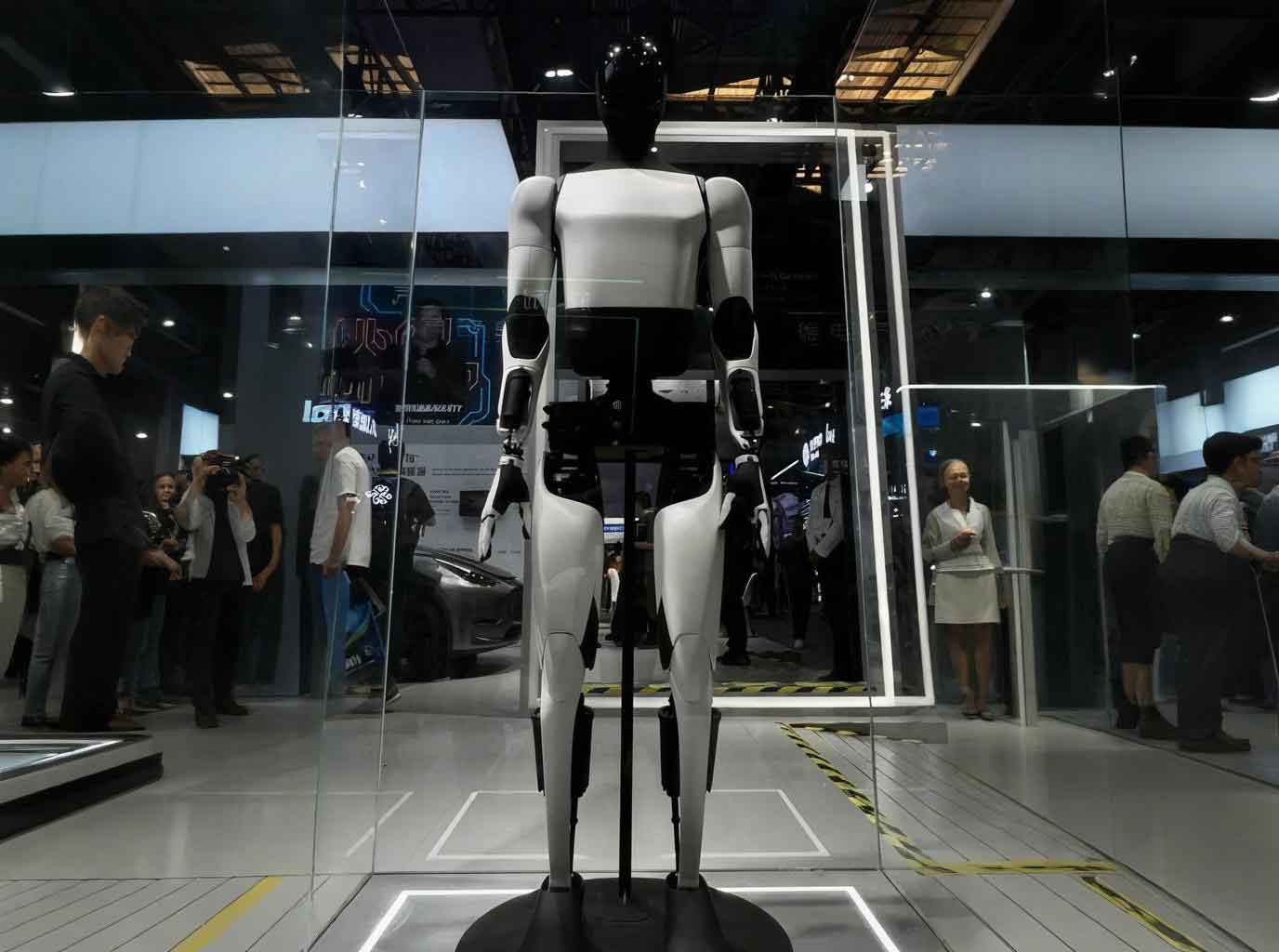
In educational contexts, the cognitive growth path of embodied robots offers profound implications. As an educator and technologist, I see immense potential in using embodied robots as simulated learners to study developmental processes. For instance, in a classroom setting, an embodied robot can model how children acquire language through multimodal interactions, providing insights into personalized learning strategies. The following table outlines applications in education:
| Educational Domain | Role of Embodied Robot | Benefit |
|---|---|---|
| Personalized Learning | Adaptive tutor that adjusts to student’s cognitive stage | Enhances engagement and knowledge retention |
| Cognitive Assessment | Tool for evaluating developmental milestones | Provides objective metrics for interventions |
| Teacher Training | Simulated student for practicing instructional strategies | Improves pedagogical skills through feedback |
Furthermore, the intrinsic motivation mechanisms in embodied robots, such as curiosity-driven exploration, align with educational theories that emphasize self-directed learning. Mathematically, intrinsic reward can be modeled as: $$ r_{\text{intrinsic}} = \eta \cdot \text{KL}(p(s’ | s, a) || p(s’)) $$ where \( \eta \) is a scaling factor, and the Kullback-Leibler divergence measures the novelty of state transitions. This encourages embodied robots to explore unfamiliar environments, similar to how children learn through play. In practice, embodied robots have been deployed in special education to support children with cognitive disabilities, demonstrating improved social and motor skills through interactive sessions.
Comparing this embodied approach to traditional machine learning reveals significant advantages. While conventional deep learning relies on vast datasets and static models, embodied robots engage in active, situated learning that fosters robustness and generalization. For example, in object manipulation tasks, an embodied robot trained through RL outperforms batch-trained models in adaptability, as shown by higher success rates in novel scenarios. The trade-offs can be summarized as:
| Aspect | Traditional Machine Learning | Embodied Robot Approach |
|---|---|---|
| Data Dependency | High; requires large labeled datasets | Low; learns from interactions |
| Adaptability | Limited; struggles with new environments | High; continuously updates through feedback |
| Explainability | Low; “black box” models | Moderate; traceable through action sequences |
| Cognitive Fidelity | Weak; lacks developmental progression | Strong; mirrors human growth stages |
However, I acknowledge limitations in the current implementation of embodied robots. Computational demands are substantial, as real-time interactions require efficient resource management. Additionally, while embodied robots simulate cognitive functions, they do not fully replicate biological processes like emotional regulation. Future work should focus on scaling these systems and integrating neuroscientific insights to enhance fidelity.
In conclusion, my exploration of embodied intelligence and cognitive growth underscores a paradigm shift in artificial intelligence and education. By embracing a multidisciplinary framework that prioritizes embodied interactions, we can develop embodied robots that not only mimic human learning but also serve as powerful tools for educational innovation. The integration of computational models, such as MDPs and SSL, with developmental theories provides a robust foundation for creating adaptive, explainable systems. As I continue this research, I aim to refine these pathways and expand their applications, ultimately fostering a deeper understanding of intelligence itself.