
The rapid advancement of Artificial Intelligence (AI) is fundamentally reshaping scientific discovery and engineering practice. The paradigm is evolving from “AI for Science” (AI4S), which focuses on data-driven exploration of natural laws, toward “AI for Engineering” (AI4E), which aims to create highly reliable, trustworthy, and economically viable new paradigms for solving complex engineering problems. Within this transformative landscape, embodied intelligence has emerged as a critical frontier. It posits that true intelligence is not merely an abstract algorithm but is fundamentally grounded in a physical or virtual “body” that interacts continuously with its environment to form a closed loop of perception, cognition, decision-making, and action.
This paradigm shift is particularly consequential for the field of hydraulic engineering construction. Projects such as high earth-rock dams, large concrete dams, and complex underground cavern groups are characterized by massive scale, intricate processes, stringent quality and safety requirements, and highly uncertain, dynamic field environments. Traditional approaches, reliant on mechanization, digitization, and localized automation, are increasingly challenged to meet the demands for holistic optimization of progress, quality, safety, and sustainability. Embodied intelligence offers a groundbreaking framework by proposing the deep fusion of AI models with physical/virtual “embodied” carriers—such as intelligent construction robots—within a cyber-physical environment, enabling autonomous, adaptive, and continuously evolving construction processes.
This article analyzes the current state of intelligent construction in hydraulic engineering through the lens of embodied intelligence. It first examines the macro-trend from AI4S to AI4E and the evolving paradigms within hydraulic engineering itself. It then systematically constructs a research framework, defining the connotation, core elements, architecture, and key characteristics of embodied intelligence-enabled intelligent construction. Subsequently, it re-interprets and synthesizes existing research in key application scenarios—intelligent filling, intelligent vibration, and intelligent simulation—demonstrating their prototypical alignment with the embodied paradigm. Finally, the article outlines fundamental scientific questions, key technological bottlenecks, and future prospects, providing a new theoretical and practical roadmap for the field.
1. The Evolutionary Context: From AI4S to Embodied AI4E
1.1 The Trajectory from AI4S to AI4E
The history of science and engineering reveals a pattern of paradigm shifts driven by new methodologies. The advent of powerful computing, vast datasets, and sophisticated algorithms has ushered in the “AI for Science” (AI4S) paradigm, exemplified by breakthroughs like AlphaFold2. This paradigm leverages AI to discover patterns, formulate hypotheses, and accelerate scientific discovery in ways that transcend traditional human-driven experimentation and simulation.
Engineering, as the application of scientific principles to create solutions, inevitably undergoes a parallel transformation. The “AI for Engineering” (AI4E) paradigm emerges from the application of AI4S principles to the core challenges of engineering: design, optimization, control, and innovation within complex, constrained, and real-world systems. While AI4S seeks to understand nature, AI4E seeks to create and control reliable, high-performance artifacts and processes. The focus shifts from pure discovery to the synthesis of functionality, safety, economy, and trustworthiness.
Bibliometric analysis clearly shows this convergence. Research in AI4E, while initially following the growth trajectory of AI4S, has exhibited explosive growth in recent years, indicating a rapid absorption and transformation of AI capabilities to address engineering-specific challenges.
1.2 From Traditional to Intelligent Construction Paradigms
Hydraulic engineering construction has progressed through distinct stages: manual labor, mechanization, digitization (with tools like BIM), and informatization (with IoT and monitoring systems). The current stage is “intelligent construction,” which integrates data, models, and algorithms to achieve a higher degree of automation and decision support.
| Paradigm Stage | Core Driver | Key Technologies | Limitation |
|---|---|---|---|
| Mechanization | Mechanical Power | Excavators, Dozers, Rollers | Human-operated, experience-dependent |
| Digitization | Geometric Models | CAD, BIM, 3D Modeling | Static representation, lacks real-time link |
| Informatization | Data Collection | Sensors, IoT, Monitoring Systems | Data-rich but information-poor; reactive control |
| Localized Intelligence | Automation & Analytics | Single-task robots, data analytics, digital twins | Isolated systems, limited adaptation and learning |
| Embodied Intelligence (Emerging) | AI-Embodied Interaction | Embodied AI robots, world models, continuous learning | Seeks to achieve autonomous, adaptive, and systemic intelligence |
While current intelligent construction systems have made strides in perception, monitoring, and automated control, they often rely on pre-defined models and rules. Their “intelligence” is typically reactive, lacking the ability for deep environmental understanding, autonomous decision-making in novel situations, and continuous self-improvement through interaction. This gap highlights the need for the next paradigm shift.
1.3 The Rise of Embodied Intelligence as the Next Frontier
Unlike traditional AI, which processes static data, embodied intelligence emphasizes that intelligence is generated and evolves through the sustained sensorimotor interaction of an agent (the “body”) with its environment. The agent’s physical or virtual embodiment constrains and shapes its perception and possible actions, while the environment provides the context and feedback for learning. This creates a foundational “perception-cognition-decision-action” loop.
In engineering, this translates to embodied AI robots—construction equipment embedded with AI models that can perceive the jobsite, understand tasks, make decisions, and execute actions, while continuously learning from the outcomes. The evolution of such systems in hydraulic engineering is evident in the development of lineage-based intelligent equipment. For example, intelligent unmanned rollers have progressed from first-generation remote-controlled or simple automated machines (“kinetic” stage), to second-generation systems with multi-sensor perception and real-time decision-making (“perceptive/adaptive” stage), and now to third-generation systems exploring multi-robot collaboration and lifelong learning (“cognitive/collaborative” stage). This progression mirrors the core tenets of embodied intelligence.
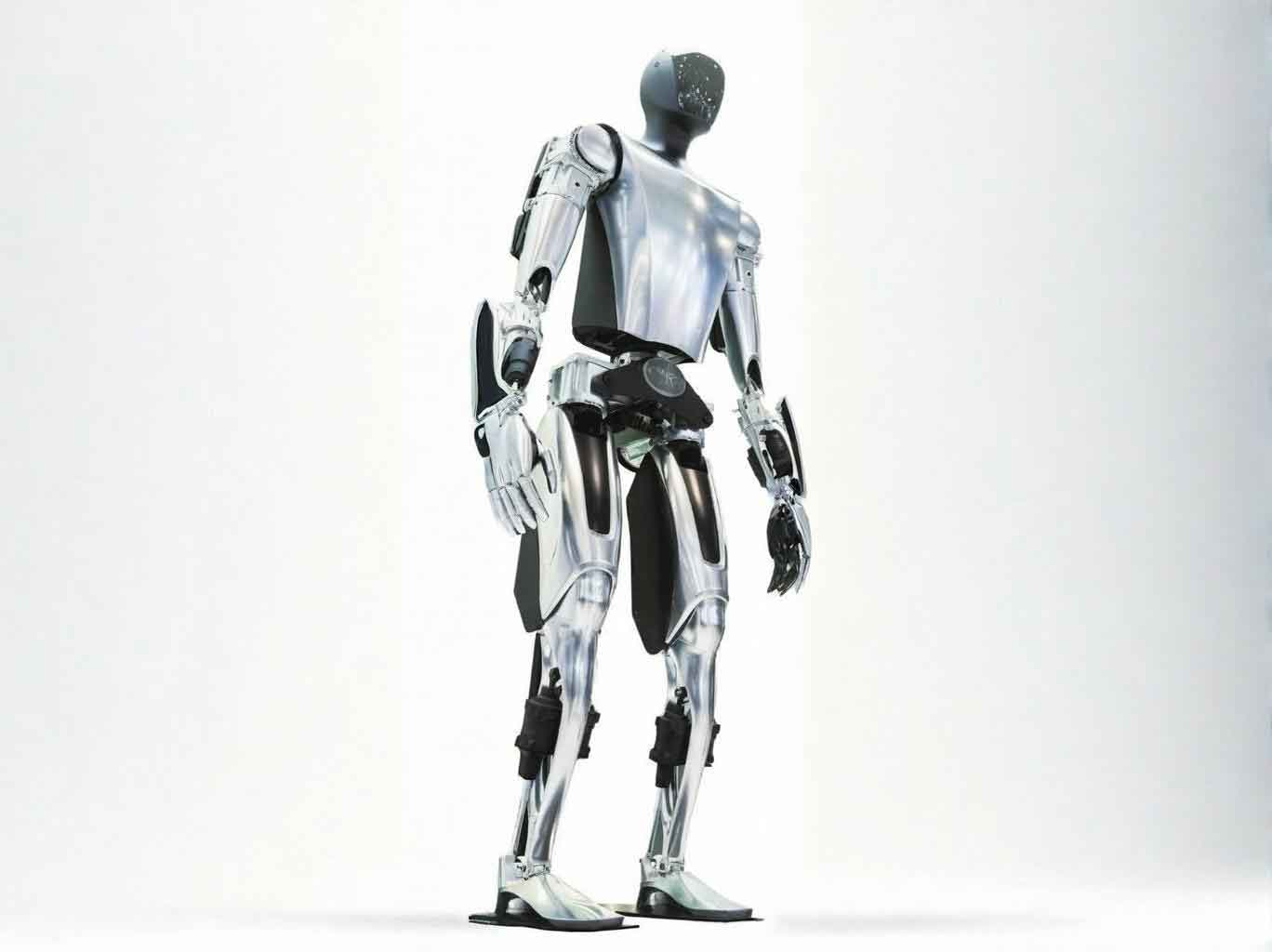
The figure above illustrates the concept of an embodied AI robot in a manufacturing/construction context, representing the physical instantiation of intelligence that interacts with its surroundings. In our context, this could be an intelligent roller or vibrator on a dam construction site.
2. A Framework for Embodied Intelligence in Hydraulic Engineering Construction
2.1 Core Connotation
Embodied intelligence-enabled intelligent construction for hydraulic engineering is defined as a new paradigm where domain-specific AI models (e.g., construction specialized LLMs, physics-informed neural networks, control models) are deeply embedded into physical or virtual “carriers.” These carriers, such as embodied AI robots, then engage in sustained “perception-cognition-interaction” closed loops within a fused virtual-real environment that includes the physical jobsite, digital twins, simulation platforms, and human actors.
Through embodied perception, the agent actively seeks critical information. Through embodied cognition, it integrates this sensory data with engineering knowledge to understand context and task intent. It then generates and executes decisions, updating its internal world model. Crucially, through continuous interactive learning, both the AI models and the carrier’s behavior co-evolve and adapt. This enables self-organization, self-optimization, and self-correction across different working conditions, project phases, and spatial zones, ultimately achieving the multi-objective协同 optimization of schedule, quality, safety, and green objectives.
2.2 The Five Core Elements
The realization of this paradigm rests on five interconnected core elements, forming the essential “body-brain-environment” nexus.
| Core Element | Description | Key Function in Hydraulic Engineering |
|---|---|---|
| 1. Embodied Agent Carrier | The physical or virtual entity that houses and executes the intelligent agent. | Intelligent unmanned rollers, dozers, vibratory robots, drilling jumbos, transport vehicle fleets. |
| 2. Embodied Perception | Active, interactive information acquisition and state estimation via the carrier’s sensors. | Using LiDAR, cameras, mmWave radar, acoustics, and proprioceptive sensors to perceive terrain, material state, equipment pose, and obstacles in real-time. |
| 3. Embodied Cognition | Deep understanding and dynamic reasoning formed by integrating perception with action experience. | Using multimodal AI to unify language (specifications), vision (site state), and physics (material behavior). Building world models for predicting outcomes (e.g., compaction quality evolution) and enabling causal reasoning for explainable decisions. |
| 4. Decision Generation | Translating cognitive understanding into actionable plans under physical and safety constraints. | Generating optimal rolling paths, vibration parameters, or fleet dispatch schedules. Embedding engineering codes and safety rules into the decision process via constrained AI workflows. |
| 5. Execution Control | Precise conversion of decisions into physical actions with real-time feedback and adjustment. | Low-level control of actuator forces and motions. In multi-agent settings, managing synchronization, collision avoidance, and cooperative task execution. |
The interaction between these elements can be conceptually modeled. For instance, the decision-generation process for an embodied AI robot like an unmanned roller can be framed as an optimization problem:
$$ \pi^* = \arg\max_{\pi \in \Pi} \mathbb{E}_{\tau \sim p(\tau|\pi)} \left[ \sum_{t=0}^{T} \gamma^t R(s_t, a_t) \right] $$
$$ \text{subject to: } g(s_t, a_t) \leq 0 \quad \text{(safety/quality constraints)}, $$
where $\pi$ is the policy of the embodied AI robot, $\tau$ is a trajectory of states $s_t$ and actions $a_t$, $R$ is a reward function encoding objectives (e.g., compaction uniformity, efficiency), and $g$ represents engineering constraints. The policy $\pi$ is conditioned on the agent’s embodied cognition $C_t = f_{\text{cogn}}(P_t, H_{t-1}, K)$, where $P_t$ is the current perceptual input, $H_{t-1}$ is history, and $K$ is background knowledge.
2.3 System Architecture: A Multi-Agent, Cyber-Physical System
The overall architecture is best understood as a Distributed AI (DAI) system composed of multiple embodied AI robots operating within a cyber-physical environment, supported by robust communication and computing infrastructure.
a) Knowledge & Cognitive Support Layer: This is the “engineering brain.” It provides shared services, containing structured domain knowledge (e.g.,水利工程知识图谱), physics-based simulation models, and global optimization algorithms. It supports the distributed agents by offering common understanding, facilitating complex reasoning that exceeds a single agent’s capability, and ensuring decisions align with project-wide objectives. It evolves through continuous learning from project data.
b) Embodied Agent Carrier Layer: This is the “physical body” layer, consisting of the fleet of embodied AI robots and associated field sensors. Each robot runs local perception-cognition-decision-execution loops for specific tasks (rolling, vibrating, hauling). They interact with each other and the environment, forming the executable edge of the intelligent system.
c) Computing & Communication Support Layer: This is the “nervous system.” It comprises 5G/6G networks, edge computing nodes, and cloud resources that enable high-reliability, low-latency data exchange between agents, the knowledge layer, and human supervisors. It ensures the real-time feasibility of the closed-loop interactions.
2.4 Key Characteristics of the Embodied Intelligence Paradigm
This new paradigm introduces several transformative characteristics compared to previous intelligent construction systems:
- Robustness via Distributed Multi-Agent Systems: The system is inherently robust. Individual embodied AI robots have local autonomy, allowing them to function even with limited communication. Multi-agent collaboration provides redundancy; the failure or underperformance of one agent can be compensated by others, maintaining overall system stability.
- Scalability: The architecture is naturally scalable. New embodied AI robots can be added to the network by adhering to standard interaction interfaces. The system’s performance scales with the number of agents without requiring a fundamental architectural redesign, supporting expansion from a single dam section to an entire river basin project.
- Compatibility with Existing Systems: The paradigm does not mandate a “greenfield” approach. It is designed for compatibility with established systems like BIM, GIS, IoT platforms, and digital twins. These systems provide the initial virtual environment and data models which the embodied AI robots can interact with and enrich.
- Self-Evolution and Self-Organization: This is a hallmark feature. Through lifelong learning in both real and simulated environments, each embodied AI robot continuously refines its world model and control policies. At the group level, through local interactions and shared learning, the multi-agent system can self-organize to solve complex tasks (like dynamic fleet scheduling) and improve its collective performance over time across multiple projects.
- Trustworthy Evolution with Embedded World Models: For safety-critical projects like high dams, the evolution of intelligence must be traceable, explainable, and verifiable. The paradigm incorporates mechanisms for recording decision logs, using explainable AI (XAI) techniques to make reasoning processes interpretable to engineers, and embedding safety constraints and ethical guidelines directly into the learning process. This ensures that the system’s autonomous evolution remains within a bound of human understanding and control.
3. Case Analysis Through the Embodied Intelligence Lens
Existing research and pilot projects in hydraulic engineering already exhibit nascent forms of embodied intelligence. Re-examining them through this framework clarifies their position on the evolutionary path and highlights future research directions.
3.1 Case: Intelligent Embodied Filling of Earth-Rock Dams
Dam filling involves a tightly coupled sequence of hauling, spreading, and compacting, managed amidst dynamic terrain and changing material properties. This is an ideal scenario for a multi-embodied AI robot system.
Embodied Agent Carriers: Intelligent Unmanned Rollers, Autonomous Bulldozers, and optionally, autonomous haul trucks form the physical embodiment.
Embodied Perception & Cognition: Rollers use GNSS, IMU, and onboard compaction meters for state perception. Advanced systems fuse millimeter-wave radar and cameras for obstacle detection and terrain mapping. The cognition system integrates this real-time data with compaction theory to assess if a location has reached target density, creating a dynamic “quality field” model of the fill area.
Decision & Execution: The roller’s decision module uses this model to plan non-uniform compaction paths, spending more time/passes on softer spots. The control module executes precise tracking of these paths. At the fleet level, a supervisory agent (which could itself be a virtual embodied AI robot) makes dispatch decisions, coordinating dozers and rollers to optimize overall workflow. The interaction can be modeled as a multi-agent reinforcement learning problem:
$$ \text{Joint Policy Optimization: } \max_{\pi_1, \pi_2, …} \mathbb{E} \left[ R_{\text{global}}(s, \mathbf{a}) \right], \quad \mathbf{a} = (\pi_1(\tau_1), \pi_2(\tau_2), …) $$
where different agents (roller $\pi_1$, dozer $\pi_2$) have different observation histories $\tau_i$ but collaborate to maximize a global reward $R_{\text{global}}$ (e.g., fill volume per day meeting quality specs).
Evolution: The system learns from historical compaction data to improve its quality prediction model and from traffic patterns to enhance multi-agent coordination strategies, demonstrating a simple form of continuous evolution.
3.2 Case: Intelligent Embodied Vibration for Concrete Dams
Concrete vibration is critical for eliminating voids and ensuring structural integrity. An embodied AI robot for vibration must intimately interact with the complex, changing material state of fresh concrete.
Embodied Agent Carrier: A robotic vibrator platform with a manipulator and an insertion vibrator head.
Embodied Perception: This goes beyond simple positioning. It involves multi-modal sensing: vision to identify vibration insertion points and avoid reinforcements; current/power sensors on the vibrator motor to infer concrete resistance (a proxy for rheology); and potentially acoustic sensors to listen for the characteristic sound of well-vibrated concrete.
Embodied Cognition: The core challenge is building a “concrete state cognition model.” The robot must fuse the sensory stream (current draw, sound frequency) to distinguish between under-vibrated, optimally vibrated, and over-vibrated (segregation risk) states. This is a dynamic classification/regression task:
$$ \text{State}_t = f_{\text{cogn}}(\text{Current}_t, \text{AudioSpectrum}_t, \text{Pose}_t; \theta) $$
where $\theta$ are the parameters of a learned model (e.g., a neural network) that maps raw sensor data to a semantic concrete state.
Decision & Execution: Based on the cognized state, the robot decides its next action: continue vibrating, move to the next insertion point, or adjust vibration frequency/power. The execution control involves precise robotic arm movement and vibrator actuation. The current state of the art often uses pre-set rules (e.g., vibrate for X seconds if current > Y). The embodied intelligence vision pushes towards a policy that adapts X and Y in real-time based on the cognized state model and learning from past outcomes.
3.3 Case: Embodied Intelligent Simulation
Construction simulation has evolved from static 4D CAD animations to dynamic, discrete-event models. Embodied intelligence pushes it further towards a “living simulation” that actively interacts with and learns from the real world.
The Simulation as a Virtual Embodied Agent: The simulation model itself can be viewed as a virtual embodied AI robot. Its “body” is the digital twin of the project. Its “sensors” are data interfaces pulling real-time information from the jobsite (weather, equipment GPS, RFID tags).
Embodied Perception & Cognition for Simulation: The simulation actively perceives real-world progress and disruptions. Its cognition involves diagnosing discrepancies between simulated and actual progress, identifying causes (e.g., a truck breakdown, slower-than-expected cycle time), and updating its internal world model parameters accordingly. This can use Bayesian updating:
$$ P(\theta | D_{\text{new}}) \propto P(D_{\text{new}} | \theta) \cdot P(\theta | D_{\text{old}}) $$
where $\theta$ are simulation parameters (e.g., activity duration distributions), and $D$ is observed data.
Decision & Execution: The updated, more accurate simulation can now run “what-if” analyses to generate robust recovery schedules or optimal resource re-allocation plans. These decisions are “executed” by being fed back to the real-world control system—recommending new dispatch orders to the fleet of physical embodied AI robots or alerting human managers. This closes the loop, making simulation an active, interactive, and decision-informing agent within the construction process, rather than a passive planning tool.
4. Fundamental Challenges and Future Prospects
The transition from prototypical applications to a fully realized embodied intelligence paradigm faces significant scientific and technical hurdles.
4.1 Key Scientific Questions
- Unified Representation and World Modeling: How to create a unified, multi-scale semantic representation that seamlessly integrates geometric (BIM), physical (material properties), dynamic (equipment state), and procedural (construction method) information for heterogeneous embodied AI robots to share a common understanding?
- Autonomous Embodied Intelligence Mechanisms: How do embodied AI robots achieve robust attention and active perception in chaotic environments? How is stable cognition maintained under frequent, unforeseen disturbances? How can natural language instructions from engineers be reliably mapped to and from the robot’s internal action representations?
- Collective Cognition and Synergistic Behavior: What are the theoretical foundations for a group of embodied AI robots to develop a shared situational awareness with limited communication? How can we formally model the interplay between individual agent learning and emergent group intelligence for complex tasks like coordinated filling or tunnel excavation?
- Explainability, Trustworthiness, and Ethical Constraints: How can we design embodied AI robots whose decision-making processes are inherently explainable and auditable? How can safety codes, engineering standards, and ethical principles (e.g., “do not compromise long-term dam safety for short-term speed”) be formally embedded into the learning and evolution process to guarantee trustworthy behavior?
4.2 Critical Technological Bottlenecks
- Hardware-Software Co-Design for Harsh Environments: Developing embodied AI robots that are rugged, power-efficient, and capable of real-time, complex AI inference (like transformer-based world models) in conditions of dust, vibration, humidity, and electromagnetic interference remains a major engineering challenge.
- Scalable Multi-Agent Coordination & Control: Lacking are robust, real-time frameworks for dynamic task decomposition, allocation, and conflict resolution among dozens of heterogeneous embodied AI robots. The “simulation-planning-scheduling-execution” loop for such fleets is not yet solved at scale.
- Integration with Engineering Governance: There is a lack of standardized testing protocols, safety certification processes, and liability frameworks for autonomous embodied AI robots on construction sites. Intuitive human-machine interfaces for supervision, intervention, and understanding robot intent are also underdeveloped.
4.3 Future Prospects
The future of hydraulic engineering construction lies in the systematic development of:
- Hydraulic Engineering Embodied World Models: Creating high-fidelity, interactive digital twins that serve as the unified “digital substrate” for training, testing, and co-evolving with embodied AI robots. These models will integrate geotechnical, structural, hydraulic, and construction process physics.
- Autonomous and Collective Embodied Intelligence: Progressing from single-task robots to truly collaborative multi-embodied AI robot systems that exhibit emergent intelligent behavior—self-organizing fleets for earthmoving, adaptive teams for concreting, and autonomous inspector robots for quality assurance.
- The Trustworthy Evolution Ecosystem: Establishing the full stack—from verifiable AI algorithms and secure edge computing to regulatory sandboxes and operator training programs—that allows embodied intelligence to be deployed not just as a tool, but as a responsible and resilient partner in building the critical water infrastructure of the future.
In conclusion, embodied intelligence provides a powerful and coherent framework to unify the physical, digital, and cognitive dimensions of hydraulic engineering construction. By transitioning from automated tools to interactive, learning, and collaborative embodied AI robots, the field can achieve a fundamental leap in capability, moving towards a future where construction systems are not just built smart but are intrinsically intelligent.