
In recent years, the rapid advancement of artificial intelligence has ushered in transformative changes across various sectors, including education. However, many AI-driven learning systems exhibit a significant lack of embodiment and contextual embedding, leading to a disconnection between cognitive processes and bodily experiences, as well as a detachment of knowledge construction from real-world situations. This technological alienation deepens the gap between cognition and practice in education. As an educator and researcher, I have observed that embodied intelligence, as a crucial direction in AI evolution, offers a new paradigm for reshaping the embodied characteristics of education and fostering personalized development. It serves as a key driver in cultivating new productive forces in education. In this article, I explore the theoretical foundations, application hierarchies, implementation frameworks, and future research directions of embodied intelligence in education, aiming to provide insights for its practical integration. Throughout this discussion, I will emphasize the role of the embodied robot as a central element in bridging theory and practice.
Embodied intelligence represents a shift from disembodied AI models to systems that interact physically with the environment. Historically, the concept dates back to early AI discussions, such as Turing’s 1950 inquiry into machine thinking, which sparked debates on the relationship between machines and intelligence. In the 1980s, researchers like Brooks introduced the idea of behavior-based robotics, stressing that intelligence is inherently embodied and situated, guiding a move from computational power to body-environment interactions. Today, embodied intelligence is seen as a pathway to general AI, with humanoid robots and biomimetic systems enabling practical applications. From my perspective, embodied intelligence is not merely the combination of large language models (LLMs) with robotics; it involves a closed-loop process of perception, cognition, decision-making, and action, allowing for autonomous learning and adaptation. The core components include the embodied robot as the physical entity, intelligent models like LLMs and vision-language-action (VLA) models as the “brain,” and the environment as a dynamic space for interaction. These elements form a synergistic system where the environment acts as a testing ground, the embodied robot serves as the sensory and motor interface, and the intelligent models process information to guide actions, enabling continuous evolution through feedback loops.
The application of embodied intelligence in education can be structured into three hierarchical levels based on embodied cognition theory, which posits that cognition arises from the interaction of brain, body, and environment. This theory highlights that learning is an embedded activity, where bodily experiences and environmental contexts shape understanding. For instance, basic concepts often stem from perceptual-motor experiences, and full-body engagement enhances knowledge internalization. In the following table, I summarize these levels, emphasizing how each stage integrates the embodied robot to foster deeper learning experiences.
| Level | Description | Role of Embodied Robot |
|---|---|---|
| Primary Embodiment | Focuses on situational embedding through mixed-reality environments, providing immersive experiences that stimulate interest and multi-sensory engagement. | The embodied robot acts as a facilitator in virtual or physical settings, enhancing environmental perception and initial interaction. |
| Intermediate Embodiment | Involves embodied interaction, where learners use the embodied robot for hands-on activities like experiments or simulations, promoting knowledge internalization through active participation. | The embodied robot serves as an interactive tool, enabling operations, feedback, and real-time adjustments based on learner actions. |
| Advanced Embodiment | Centers on cognitive creativity and personalization, leveraging the embodied robot to transform abstract concepts into tangible experiences, fostering knowledge reconstruction and innovation. | The embodied robot functions as a collaborative partner, supporting adaptive learning and creative tasks in blended environments. |
These levels are not isolated but form a dynamic continuum, where situational embedding provides the context, embodied participation enables interaction, and cognitive creation drives innovation. For example, in primary embodiment, mixed-reality environments allow learners to engage with virtual elements superimposed on physical spaces, reducing the gap between abstract ideas and real-world applications. In intermediate embodiment, studies have shown that virtual experiments with varying degrees of embodiment significantly improve learning outcomes, particularly in subjects requiring practical skills. Advanced embodiment, meanwhile, leverages the embodied robot to enable gestures or full-body movements that reconceptualize knowledge, such as manipulating virtual objects to understand geometric principles. This hierarchical approach underscores the importance of the embodied robot in creating a seamless learning journey from basic engagement to sophisticated cognitive development.
To operationalize these concepts, I propose a framework for implementing embodied intelligence in education, which comprises three main components: the virtual-physical environment, embodied interaction, and the intelligent brain. This framework aligns with the three application levels, facilitating a structured integration of embodied robots into educational practices. The environment component involves constructing blended learning scenes, such as physical spaces, virtual simulations, and mixed-reality setups, where the embodied robot can operate. For instance, in a mixed-reality environment, projections overlay virtual elements onto real-world settings, creating an immersive space for learners to interact with the embodied robot. The embodied interaction component focuses on multi-modal perception and action, where the embodied robot uses sensors to capture data, processes it through cognitive maps, and executes decisions. This can be modeled using equations that represent perception-action cycles, such as the reinforcement learning update rule: $$Q(s,a) = Q(s,a) + \alpha \left[ r + \gamma \max_{a’} Q(s’,a’) – Q(s,a) \right]$$ where \( Q(s,a) \) denotes the value of action \( a \) in state \( s \), \( \alpha \) is the learning rate, \( r \) is the reward, and \( \gamma \) is the discount factor. This equation illustrates how the embodied robot learns from environmental feedback to optimize its actions. The intelligent brain component relies on models like multimodal large language models (MLLMs) to enable knowledge generation and personalization, analyzing learner data to adapt teaching strategies. Below, I include a table that breaks down the framework components and their functions, highlighting the centrality of the embodied robot.
| Component | Function | Implementation with Embodied Robot |
|---|---|---|
| Virtual-Physical Environment | Provides contextual settings for learning, including real, virtual, and mixed-reality spaces. | The embodied robot navigates and interacts within these environments, using sensors to gather multi-modal data (e.g., visual, auditory) for immersive experiences. |
| Embodied Interaction | Enables perception, cognition, decision-making, and action through physical engagement. | The embodied robot performs tasks like object manipulation or navigation, employing algorithms for simultaneous localization and mapping (SLAM) to build environmental models. |
| Intelligent Brain | Processes information using AI models to support adaptive learning and innovation. | Integrated with the embodied robot, models like MLLMs analyze learner behavior and emotions, enabling personalized feedback and creative problem-solving. |
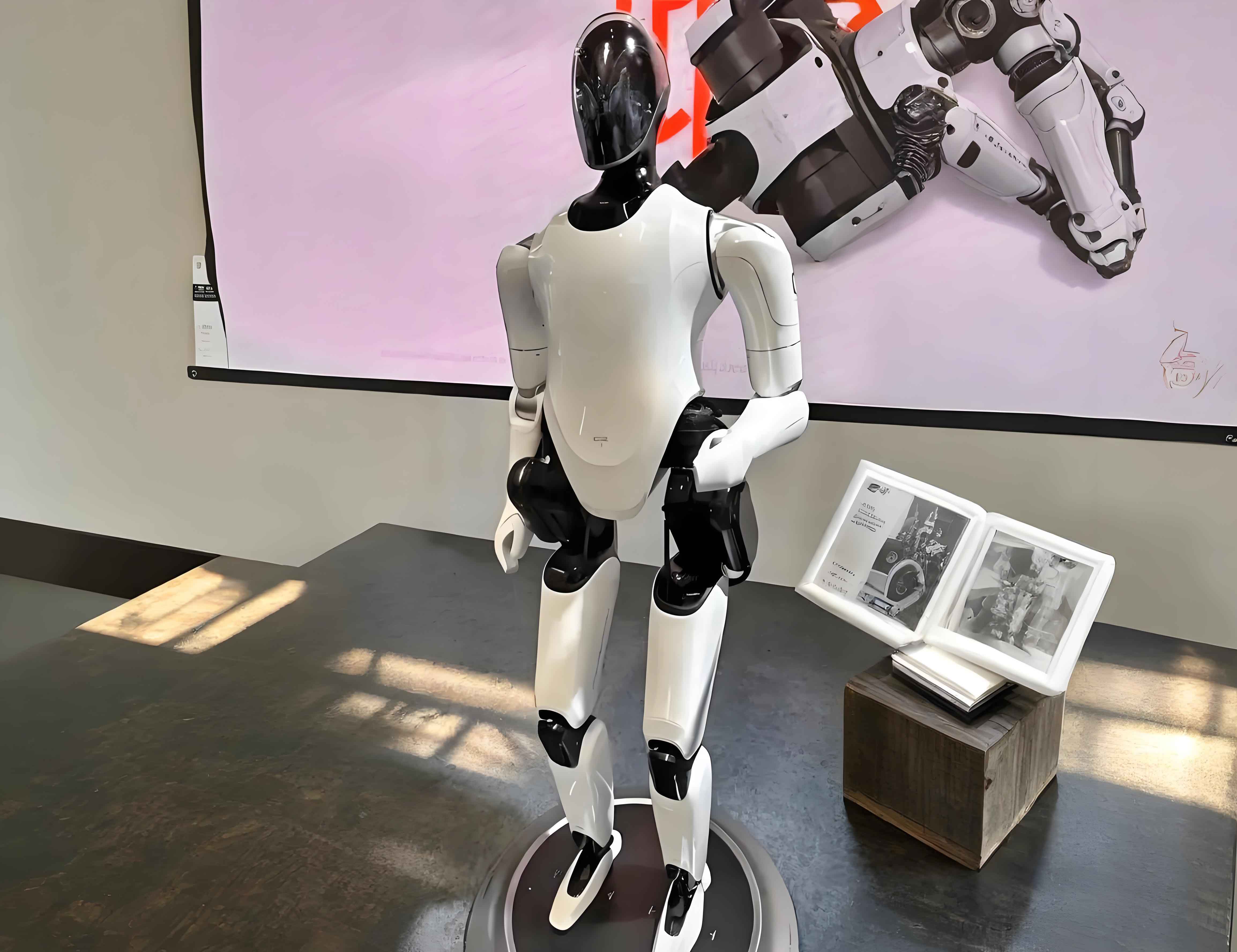
This framework emphasizes the embodied robot as a key enabler, bridging the physical and digital worlds. In the virtual-physical environment, the embodied robot can operate in real classrooms or VR simulations, collecting data to create dynamic learning scenarios. During embodied interaction, the robot’s perception-action loop—capturing inputs, refining cognitive maps, and executing decisions—mirrors human learning processes, fostering deeper understanding. For example, in a science lesson, an embodied robot might conduct experiments, with its actions guided by real-time analysis of student responses. The intelligent brain component leverages models like CLIP or PaLM-E to enhance cross-modal understanding, allowing the embodied robot to interpret commands and generate insights. A mathematical representation of this process can be given by the Bayesian update rule for belief states: $$P(H|E) = \frac{P(E|H) P(H)}{P(E)}$$ where \( P(H|E) \) is the posterior probability of hypothesis \( H \) given evidence \( E \), illustrating how the embodied robot updates its knowledge based on sensory inputs. By integrating these elements, the framework supports a holistic educational experience, where the embodied robot facilitates from situational embedding to cognitive creation, addressing the “disembodied” limitations of traditional education.
Looking ahead, several research directions emerge for leveraging embodied intelligence in education, particularly through the lens of the embodied robot. From the learner’s perspective, embodied personalized learning can tailor experiences to individual needs. For instance, in STEM education, students might program an embodied robot to simulate physical phenomena, using equations like Newton’s second law: $$F = ma$$ to explore force and motion concepts. The embodied robot can provide real-time feedback, transforming abstract theories into hands-on activities. Similarly, in special education, the embodied robot can act as a social partner for children with autism, replicating interactions in controlled environments to reduce anxiety. From the teacher’s viewpoint, the embodied robot can serve as a teaching proxy, assisting in classroom management and providing multimodal support. For example, an embodied robot like Furhat can use facial expressions and speech to enhance language learning, making lessons more engaging. In collaborative settings, multi-agent systems involving multiple embodied robots can simulate complex scenarios, such as project-based learning where each robot assumes a role. The coordination among embodied robots can be modeled using game theory equations, like the Nash equilibrium: $$\forall i, \quad u_i(s_i^*, s_{-i}^*) \geq u_i(s_i, s_{-i}^*) \quad \forall s_i$$ where \( u_i \) represents the utility of agent \( i \), ensuring optimal collaboration. Additionally, immersive learning environments powered by embodied robots in VR or MR setups can heighten engagement, as studies show that embodied experiences in virtual reality improve academic performance and interest. However, challenges such as data privacy, ethical considerations, and technical scalability must be addressed to ensure the responsible use of embodied robots in education.
In conclusion, embodied intelligence, with the embodied robot at its core, represents a pivotal innovation for advancing education beyond disembodied paradigms. It offers a pathway to reconcile the divide between knowledge and practice, enabling personalized, interactive, and creative learning experiences. As I reflect on this journey, it is clear that the integration of embodied robots requires overcoming hurdles in multi-modal data processing, multi-agent coordination, and ethical frameworks. Future efforts should focus on developing explainable and secure embodied intelligence systems that can adapt to diverse educational contexts. By embracing these advancements, we can harness the full potential of embodied robots to transform education into a more embodied, inclusive, and dynamic endeavor, ultimately fostering a generation of learners equipped for the complexities of the modern world.