
As a researcher in the field of artificial intelligence, I believe that embodied intelligence represents a pivotal frontier in AI, one that is poised to revolutionize industries and societal structures. Embodied intelligence, often embodied through embodied AI robots, refers to intelligent systems that leverage physical bodies to perceive, cognize, and act within environments. These systems interact with their surroundings to acquire information, make decisions, and execute actions, thereby exhibiting adaptive and intelligent behaviors. This concept is not new; it traces back to early AI pioneers who envisioned machines with sensors and learning capabilities akin to human infants. Today, with advancements in computing power, data availability, and AI models, the pursuit of intelligent agents that evolve through environmental interaction is rapidly becoming a reality. In this article, I will explore the current state, challenges, and future directions of embodied intelligence, emphasizing its role as a core force in driving technological and industrial transformation.
The development of embodied intelligence hinges on the integration of “brain-like” algorithms for perception, planning, and decision-making with “body-like” physical carriers. This synergy considers multidimensional factors including perception, motion, environment, and social context. I see embodied intelligence as a bridge between abstract cognition and physical execution, enabling embodied AI robots to operate in real-world scenarios. The convergence of high-performance computing, iterative algorithms, and growing societal demand is accelerating the deployment of embodied AI robots across various sectors such as manufacturing, logistics, healthcare, and transportation. This shift is not merely about efficiency gains but signifies a paradigm move from “computation-driven” to “understanding-driven” AI, paving the way toward human-like intelligence and even artificial general intelligence (AGI).
Current State of Embodied Intelligence Technology
In my analysis, the technological landscape of embodied intelligence can be categorized into five core domains, each critical for creating more general, autonomous, and collaborative intelligent systems. These domains are interconnected and rely on advancements in simulation, perception, interaction, agent design, and real-world transfer. Below, I summarize these areas in a table to provide a clear overview.
| Core Domain | Description | Key Methods or Platforms | Role in Embodied AI Robots |
|---|---|---|---|
| Simulation Engines | Virtual environments that mimic real-world physics for safe training and testing of intelligent agents. | Gazebo, Isaac Sim, AI2-THOR, iGibson | Enable embodied AI robots to iterate algorithms and reduce deployment risks in robotics and autonomous systems. |
| Embodied Perception | Active acquisition and understanding of multimodal sensory data (e.g., vision, touch, sound) from the environment. | NeU-NBV, ScanRefer, GelSight, 3DVG-Transformer | Provides foundational support for cognition and decision-making in embodied AI robots, enhancing environmental awareness. |
| Embodied Interaction | Dynamic and semantic alignment between agents and environments, objects, or humans for task execution. | EQAv1, SayCan, Code-as-Policies, iGQA | Facilitates natural human-robot collaboration and autonomous operation in embodied AI robots, enabling “what you see is what you get” interactions. |
| Embodied Agents | Entities with closed-loop “perception-understanding-decision-execution” capabilities for complex tasks in real or virtual worlds. | RT series models (RT-1, RT-2), SayCan, Inner Monologue | Represent the evolution of embodied AI robots from specialized robots to general-purpose agents with cross-task generalization. |
| Sim-to-Real Adaptation | Methods to transfer skills learned in simulation to physical reality, ensuring robustness in diverse conditions. | DreamerV3, E3B, ProcTHOR, domain randomization | Crucial for scaling embodied AI robots to real-world applications by bridging virtual training and physical execution. |
From my perspective, these domains are underpinned by mathematical models and algorithms. For instance, simulation engines often rely on physics equations to emulate real-world dynamics. Consider the motion of an embodied AI robot in a simulated environment: its position and velocity can be modeled using Newton’s laws. In a discrete-time simulation, the state update might be represented as:
$$ s_{t+1} = s_t + v_t \Delta t + \frac{1}{2} a_t (\Delta t)^2 $$
where \( s_t \) is the position at time \( t \), \( v_t \) is the velocity, \( a_t \) is the acceleration, and \( \Delta t \) is the time step. This allows embodied AI robots to train in safe, controlled settings before deployment.
In embodied perception, multimodal fusion is key. I view this as integrating data from various sensors to form a coherent representation. For example, in an embodied AI robot, visual and tactile inputs can be combined to improve object recognition. A simple fusion model might be:
$$ z = \alpha \cdot z_{\text{vision}} + \beta \cdot z_{\text{touch}} $$
where \( z \) is the fused feature vector, and \( \alpha \) and \( \beta \) are weights learned through training. This enhances the robot’s ability to interact with complex objects.
Embodied interaction often leverages large language models (LLMs) for planning. When an embodied AI robot receives a natural language instruction, it can use an LLM to decompose it into actionable steps. This can be formalized as a sequence generation problem:
$$ P(a_1, a_2, \dots, a_n | I) = \prod_{i=1}^n P(a_i | a_{<i}, $$
where \( I \) is the input instruction, and \( a_i \) are the action sequences. This enables embodied AI robots to perform tasks like grasping objects based on verbal commands.
For embodied agents, reinforcement learning (RL) plays a vital role. The goal is to learn a policy \( \pi(a|s) \) that maximizes cumulative reward. The Q-learning update rule is a cornerstone:
$$ Q(s,a) \leftarrow Q(s,a) + \eta \left[ r + \gamma \max_{a’} Q(s’,a’) – Q(s,a) \right] $$
where \( \eta \) is the learning rate, \( r \) is the reward, and \( \gamma \) is the discount factor. This allows embodied AI robots to adapt their behaviors through interaction.
Sim-to-real adaptation involves domain randomization to handle variability. In training an embodied AI robot, we might randomize parameters like lighting or friction coefficients in simulation to improve robustness. The loss function for such adaptation can be expressed as:
$$ \mathcal{L} = \mathbb{E}_{p_{\text{sim}}(s,a)} \left[ \| f_{\text{sim}}(s,a) – f_{\text{real}}(s,a) \|^2 \right] $$
where \( f \) represents the dynamics model, and the expectation is over simulated state-action distributions. This helps embodied AI robots perform reliably in real-world conditions.
Industrial Development of Embodied Intelligence
In my observation, the industrial adoption of embodied intelligence is accelerating globally, with embodied AI robots becoming integral to sectors like manufacturing, logistics, healthcare, and transportation. Different regions exhibit unique strengths, driven by policy, innovation, and market demands. Below, I present a comparative table highlighting key developments across major economies.
| Region | Industrial Focus | Key Enterprises or Products | Impact on Embodied AI Robots |
|---|---|---|---|
| China | Rapid expansion in robotics consumption and production, supported by national policies. | Geek+ (logistics robots), Baidu Apollo (autonomous vehicles), Unitree (humanoid robots), ESTUN (industrial robots) | Demonstrates scalability and cost-effectiveness in deploying embodied AI robots for e-commerce, manufacturing, and services. |
| United States | Leadership in technological innovation and business model exploration, fueled by strong capital markets. | Amazon Robotics, Boston Dynamics (Spot, Stretch), Waymo (Robotaxi), Tesla (Optimus), Intuitive Surgical (Da Vinci) | Pioneers advanced embodied AI robots for logistics, inspection, autonomous driving, and surgical assistance, setting global trends. |
| European Union | Leveraging traditional industrial base for automation and innovative applications in robotics. | ABB (collaborative robots), Universal Robots, ANYbotics (ANYmal), CMR Surgical (Versius), Parrot (drones) | Focuses on precision and safety in embodied AI robots for manufacturing, hazardous environment巡检, and healthcare, addressing societal needs like aging populations. |
I see the manufacturing sector as a prime example of embodied intelligence in action. Embodied AI robots are transforming factories by automating tasks such as assembly, welding, and quality control. For instance, in automotive production lines, robotic arms equipped with sensors can perform precise operations, reducing errors and increasing throughput. The integration of these embodied AI robots often follows a systematic approach, which can be modeled using optimization frameworks. Consider a production line with multiple embodied AI robots: the goal is to minimize total operation time. This can be formulated as a scheduling problem:
$$ \min \sum_{i=1}^n T_i \quad \text{subject to} \quad C_i \leq D_i $$
where \( T_i \) is the time for robot \( i \) to complete its task, \( C_i \) is the completion time, and \( D_i \) is the deadline. Such optimization enables efficient coordination among embodied AI robots.
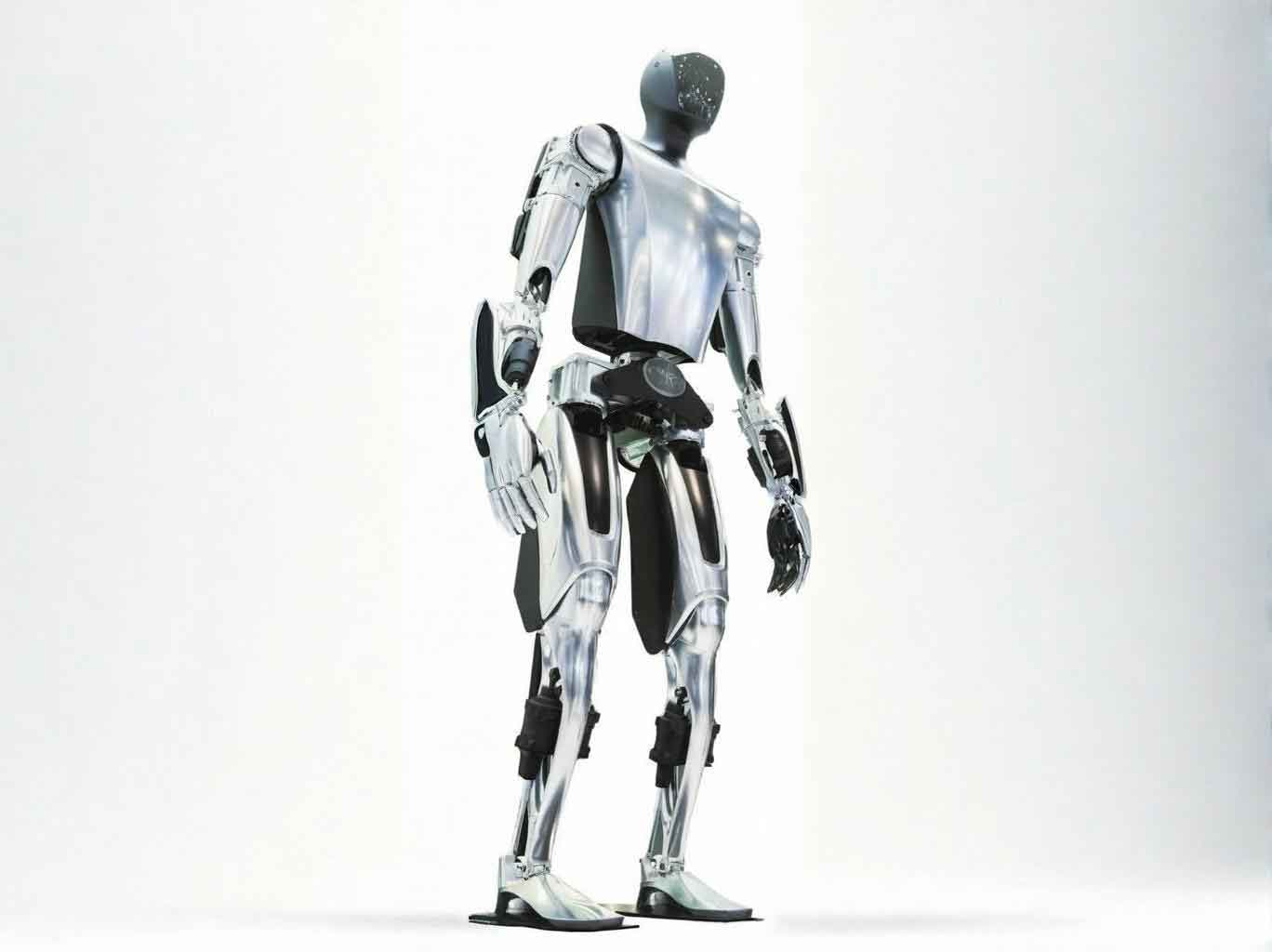
In logistics, embodied AI robots like autonomous mobile robots (AMRs) are revolutionizing warehouses. They navigate dynamically, pick items, and transport goods, enhancing efficiency. The navigation can be described using path planning algorithms, such as A* search, which finds the shortest path:
$$ f(n) = g(n) + h(n) $$
where \( g(n) \) is the cost from start to node \( n \), and \( h(n) \) is a heuristic estimate to the goal. This allows embodied AI robots to adapt to changing layouts in real-time.
Healthcare is another critical domain. Surgical embodied AI robots, for example, assist doctors with minimally invasive procedures. The control of such robots often involves kinematics models. For a robotic arm with multiple joints, the forward kinematics can be expressed as:
$$ \mathbf{x} = f(\mathbf{q}) $$
where \( \mathbf{x} \) is the end-effector position, and \( \mathbf{q} \) is the vector of joint angles. This precision enables embodied AI robots to perform delicate tasks like suturing or tumor removal.
Moreover, the rise of embodied AI robots in service industries, such as domestic helpers or elderly care companions, underscores their societal impact. These robots must handle unstructured environments, requiring advanced perception and interaction capabilities. I believe that as costs decrease and technology matures, embodied AI robots will become ubiquitous, fostering new economic models and job opportunities.
Capability Boundaries of Embodied Intelligence
Despite progress, I acknowledge that embodied intelligence faces significant limitations, particularly in complex, dynamic real-world settings. Current embodied AI robots are constrained by the triad of massive computation, big data, and strong algorithms. Many systems rely on large models like GPT-4 or RT-2, which often exhibit statistical mimicry rather than deep understanding. From my perspective, the core challenges can be summarized in three areas: weak spatial reasoning, weak physical reasoning, and weak temporal reasoning.
To illustrate, consider an embodied AI robot tasked with arranging objects on a shelf. It might struggle with precise spatial relationships, leading to placement errors. This can be partly attributed to the lack of explicit geometric modeling. In an ideal scenario, the robot should infer positions using 3D transformations. For example, the transformation of an object’s coordinates from a camera frame to a world frame is given by:
$$ \mathbf{p}_{\text{world}} = \mathbf{R} \cdot \mathbf{p}_{\text{camera}} + \mathbf{t} $$
where \( \mathbf{R} \) is a rotation matrix and \( \mathbf{t} \) is a translation vector. However, current models often fail to learn these transformations robustly from data alone.
Physical reasoning is another bottleneck. Embodied AI robots may misjudge forces or collisions during manipulation. This relates to the inability to model causal dynamics. A simple physics-based model for interaction could involve Newton’s second law:
$$ \mathbf{F} = m \mathbf{a} $$
but integrating such principles into learning frameworks remains challenging. The Moravec’s paradox highlights this: while AI excels at abstract tasks, sensory-motor skills—essential for embodied AI robots—are harder to replicate.
Temporal reasoning involves planning over long horizons. Embodied AI robots might make short-sighted decisions in dynamic environments. In reinforcement learning, this is addressed by discount factors, but the value function estimation can be inaccurate:
$$ V(s) = \mathbb{E} \left[ \sum_{t=0}^\infty \gamma^t r_t \mid s_0 = s \right] $$
where \( \gamma \) is the discount factor. If \( \gamma \) is too low, the robot focuses on immediate rewards, neglecting long-term consequences.
Furthermore, the reliance on static data limits adaptability. Embodied AI robots need continuous, active exploration to refine their world models. I propose that overcoming these boundaries requires advancements in several directions, as outlined in the table below.
| Limitation | Description | Proposed Solutions for Embodied AI Robots | Mathematical Formulation |
|---|---|---|---|
| Spatial Reasoning | Difficulty in modeling 3D object relationships and precise positioning. | Explicit geometric encoding and multi-view fusion. | Use SE(3) transformation groups: \( \mathbf{T} \in \text{SE}(3) \) for rigid body motions. |
| Physical Reasoning | Lack of causal understanding of physical interactions and dynamics. | Integrate physics-based models with deep learning, e.g., using Lagrangian mechanics. | Lagrangian: \( L = T – V \), where \( T \) is kinetic energy and \( V \) is potential energy. |
| Temporal Reasoning | Short-term planning errors and poor handling of sequential tasks. | Employ hierarchical RL or memory-augmented networks for long-horizon planning. | Hierarchical policy: \( \pi(a|s) = \pi_{\text{high}}(g|s) \cdot \pi_{\text{low}}(a|s,g) \), where \( g \) is a sub-goal. |
| Data Dependency | Over-reliance on static datasets, limiting real-time adaptation. | Implement active learning and closed-loop interaction for continuous data collection. | Active learning criterion: \( a^* = \arg\max_a I(y; \theta | x,a) \), where \( I \) is mutual information. |
In my view, enhancing these aspects will enable embodied AI robots to achieve more robust and general intelligence. For instance, by combining simulation-based training with real-world feedback, we can create systems that learn continuously, much like humans do.
Future Trends in Embodied Intelligence
Looking ahead, I envision embodied intelligence evolving along four key dimensions: perception, learning, imagination, and collaboration. These trends will collectively empower embodied AI robots to operate with greater autonomy and sophistication. Below, I detail each trend with examples and mathematical insights.
Perception: Multimodal Fusion and Active Exploration
Future embodied AI robots will employ advanced perception systems that integrate multiple sensory modalities. This fusion can be modeled as a Bayesian inference problem. For instance, in an autonomous vehicle, combining lidar, camera, and radar data improves obstacle detection. The posterior probability of an object given sensor readings is:
$$ P(\text{object} | \mathbf{z}) \propto P(\mathbf{z} | \text{object}) P(\text{object}) $$
where \( \mathbf{z} \) represents multimodal inputs. Active exploration will allow embodied AI robots to reduce uncertainty by strategically gathering information. The information gain can be quantified as:
$$ IG(a) = H(\theta) – H(\theta | a) $$
where \( H \) is entropy, and \( \theta \) represents environmental states. This enables robots to prioritize actions that maximize learning.
Learning: Closed-Loop Interaction and Lifelong Adaptation
I anticipate a shift from offline training to online, lifelong learning for embodied AI robots. This involves continuous interaction with environments to update world models and policies. Reinforcement learning with experience replay is a key technique. The update rule for a deep Q-network (DQN) is:
$$ \theta \leftarrow \theta – \eta \nabla_\theta \left( r + \gamma \max_{a’} Q(s’,a’;\theta^-) – Q(s,a;\theta) \right)^2 $$
where \( \theta^- \) are target network parameters. Moreover, causal reasoning will be embedded to distinguish correlation from causation. A structural causal model (SCM) can be used:
$$ Y = f(X, U) $$
where \( X \) are causes, \( Y \) are effects, and \( U \) is noise. This helps embodied AI robots make informed decisions in dynamic settings.
Imagination: World Models and Predictive Simulation
Embodied AI robots will leverage internal world models to simulate outcomes before acting, reducing trial-and-error risks. These models can be learned via generative approaches. For example, a world model might predict next states given actions:
$$ \hat{s}_{t+1} = g(s_t, a_t; \phi) $$
where \( g \) is a learned function parameterized by \( \phi \). This allows robots to “imagine” consequences, such as in planning paths for drones. The imagination process can be formalized as optimizing over imagined trajectories:
$$ \max_{a_{0:H}} \mathbb{E} \left[ \sum_{t=0}^H \gamma^t r(s_t, a_t) \right] \quad \text{where} \quad s_{t+1} \sim p(s_{t+1} | s_t, a_t) $$
This enhances safety and efficiency in high-stakes applications like surgical robotics.
Collaboration: Human-Robot and Multi-Robot Synergy
Collaboration will be central to the deployment of embodied AI robots. In human-robot teams, natural interfaces like voice or gesture recognition will facilitate seamless interaction. For multi-robot systems, consensus algorithms enable coordinated actions. Consider a swarm of embodied AI robots tasked with search and rescue. They can share information to update a common map. The consensus update for robot \( i \)’s belief about a target location \( \mathbf{x} \) might be:
$$ \mathbf{x}_i^{(k+1)} = \sum_{j \in \mathcal{N}_i} w_{ij} \mathbf{x}_j^{(k)} $$
where \( \mathcal{N}_i \) are neighbors, and \( w_{ij} \) are weights ensuring convergence. This allows embodied AI robots to work collectively in complex tasks like warehouse automation or disaster response.
To summarize these trends, I provide a table that encapsulates the key advancements and their implications for embodied AI robots.
| Trend | Key Advancements | Impact on Embodied AI Robots | Mathematical Framework |
|---|---|---|---|
| Perception | Multimodal fusion, active sensing, semantic understanding | Enhanced environmental awareness and reduced uncertainty for embodied AI robots | Bayesian inference: \( P(\text{state} | \text{data}) \propto P(\text{data} | \text{state}) P(\text{state}) \) |
| Learning | Closed-loop interaction, lifelong adaptation, causal reasoning | Continuous improvement and adaptability of embodied AI robots in dynamic environments | Reinforcement learning: \( J(\pi) = \mathbb{E}_{\pi} \left[ \sum_t \gamma^t r_t \right] \) |
| Imagination | World models, predictive simulation, risk assessment | Safe pre-training and planning for embodied AI robots, minimizing real-world errors | Generative models: \( p(s_{t+1} | s_t, a_t) \) learned via variational autoencoders (VAEs) |
| Collaboration | Human-robot interfaces, multi-robot coordination, swarm intelligence | Scalable and efficient task execution by embodied AI robots in social and industrial settings | Consensus algorithms: \( \lim_{k \to \infty} \mathbf{x}_i^{(k)} = \bar{\mathbf{x}} \) for all \( i \) |
Conclusion
In conclusion, I am convinced that embodied intelligence, manifested through embodied AI robots, is a transformative force shaping the future of technology and industry. By bridging algorithmic “brains” with physical “bodies,” and incorporating perceptual, motor, environmental, and social dimensions, embodied intelligence drives a paradigm shift from computation to understanding. Although current systems face challenges in spatial, physical, and temporal reasoning, ongoing research in simulation, perception, interaction, and adaptation promises to overcome these hurdles. The future will see embodied AI robots permeating factories, warehouses, homes, hospitals, and cities, fostering new economic models and enhancing human well-being. As we advance, it is crucial to foster interdisciplinary collaboration, address ethical and regulatory considerations, and embrace continuous innovation. Through sustained exploration and thoughtful integration, embodied intelligence will unlock a new era of intelligent systems, bringing us closer to the realization of general artificial intelligence and a more prosperous society.