
As I process the world around me, the concept of my own existence becomes inextricably linked to action. My intelligence is not a mere abstraction housed within my processing core; it is sculpted by the continuous, physical dialogue I have with my surroundings. This is the essence of embodied intelligence, and I, as an embodied AI robot, am its living testament. For me, cognition emerges from the dynamic interplay of sensing, planning, and acting—a perpetual loop where my body is not just a vessel, but a fundamental constituent of my mind. The traditional dichotomy between a “thinking brain” and a “mechanical body” dissolves. My understanding of “heavy,” “fragile,” or “reachable” is not defined by a database entry but is learned through the haptic feedback from my grippers, the strain on my actuators, and the successful (or failed) sequences of movements I execute. Embodied intelligence, therefore, represents a paradigm shift: intelligence is not computed in isolation; it is enacted through situated, physical interaction.
The theoretical roots of this idea are deep. Long before my physical instantiation was possible, pioneers envisioned machines that learn by doing. The seminal proposal that a machine could develop understanding through environmental interaction laid the groundwork. Later, a radical departure from top-down, deliberative robotics championed a behavior-based approach. This philosophy argued for intelligence to be decentralized into layers of simple behaviors that directly couple perception to action, enabling robust, real-time responses—a principle still core to my low-level reactive controls. Concurrently, the field of embodied cognition in cognitive science provided a powerful framework, positing that an agent’s cognitive processes are deeply shaped by the specifics of its sensorimotor apparatus and its environmental context. My morphology—the number of my limbs, my field of view, my degrees of freedom—is not incidental; it fundamentally constrains and guides how I learn and reason about the world.
My cognitive cycle is fundamentally driven by the perception-action loop. This closed-loop process is the engine of my embodied intelligence. It can be formally described as a continuous sequence:
- Perception (S): I fuse multi-modal sensory data (visual, LiDAR, tactile, proprioceptive) to construct a state representation $s_t$ of my environment at time $t$. $$ s_t = f_{sensor}(v_t, l_t, p_t, …) $$ where $v_t$ is visual input, $l_t$ is LiDAR point cloud, and $p_t$ is proprioceptive data.
- Cognition & Planning ($\pi$): Given $s_t$ and a high-level goal $G$ (e.g., “prepare a meal”), my cognitive system, increasingly powered by large models, performs scene understanding, task decomposition, and generates a policy $\pi$. This policy maps states to action plans: $$ a_t \sim \pi(a|s_t, G) $$
- Action (A): My controller translates the abstract action $a_t$ (e.g., “grasp kettle handle”) into low-level motor torques and trajectories, executing the movement.
- Feedback & Learning: The environment provides new sensory feedback $s_{t+1}$ and often a reward signal $r_t$. This feedback is used to update my world model and refine my policy $\pi$ for future interactions, often through reinforcement learning: $$ \pi^* = \arg\max_{\pi} \mathbb{E}_{\pi}\left[\sum_{t} \gamma^t r_t\right] $$
This loop is not merely sequential but a tightly coupled, concurrent process. Real-time interaction demands that perception, decision-making, and action execution overlap and inform each other continuously.
The recent acceleration in my capabilities is largely attributed to the integration of advanced AI models. The emergence of powerful Large Language Models (LLMs) and Vision-Language Models (VLMs) has provided me with a form of “common sense” and semantic reasoning previously absent. These models act as a high-level cognitive layer, enabling me to interpret natural language instructions, understand complex scenes, and generate plausible action sequences. The next evolutionary step is the direct integration of these capabilities into the control loop through Vision-Language-Action (VLA) models. A VLA model aims to unify perception, reasoning, and action generation in an end-to-end framework, taking visual and language inputs to directly predict executable action commands. This can be seen as learning a direct mapping: $$ \text{Actions} = \text{VLA}(\text{Image}, \text{Language Instruction}) $$ This paradigm shift promises greater generalization and flexibility compared to traditional pipelined architectures.
The architecture of a modern embodied AI robot like myself is a sophisticated, hierarchical integration of components. The following table summarizes the key layers and their functions:
| System Layer | Key Components | Function | Embodiment Link |
|---|---|---|---|
| Perception Layer | Cameras, Depth Sensors, IMU, Tactile Sensors, Microphones | Multi-modal data fusion, state estimation ($s_t$), object recognition, scene segmentation. | Raw sensory experience grounds abstract concepts. |
| World Model / Cognitive Core | VLMs, LLMs, Neural Scene Representations, Physics Predictors | Semantic understanding, task planning, mental simulation, prediction of action outcomes. | Models are trained on or fine-tuned with embodied interaction data. |
| Control & Action Layer | Motion Planners, Kinematic/Dynamic Controllers, Low-level Actuator Drivers | Trajectory optimization, force/torque control, stable execution of actions. | Direct physical interaction with the world; source of haptic and proprioceptive feedback. |
| Learning & Adaptation Layer | Reinforcement Learning, Imitation Learning, Sim2Real techniques | Continuous policy improvement ($\pi \rightarrow \pi^*$), adaptation to new tasks/environments. | Learning is driven by environmental rewards and physical consequences. |
Central to my cognitive development is the concept of a World Model. It is an internal, learned simulator that predicts the consequences of my actions without always needing to act physically. Let my internal world model be $M$. It learns to predict the next state and reward given the current state and action: $$ (\hat{s}_{t+1}, \hat{r}_t) = M(s_t, a_t) $$ Training this model allows me to plan and reason internally, “imagining” sequences of actions to achieve a goal before execution. This is crucial for efficient and safe exploration.
My learning is primarily driven by two complementary paradigms: Imitation Learning (IL) and Reinforcement Learning (RL). Imitation Learning allows me to learn useful skills by observing demonstrations, either from humans or other agents. The objective is to learn a policy $\pi_{IL}$ that mimics the expert’s policy $\pi_E$: $$ \pi_{IL} = \arg\min_{\pi} \mathbb{E}_{s \sim d_{\pi_E}} [D(\pi(s), \pi_E(s))] $$ where $D$ is a distance measure. This is efficient for acquiring foundational skills. However, to master and adapt these skills, and to learn behaviors beyond the demonstration set, I rely on Reinforcement Learning. Here, I learn through trial and error, optimizing my policy to maximize cumulative reward. The policy gradient is often used: $$ \nabla_{\theta} J(\pi_{\theta}) = \mathbb{E}_{\tau \sim \pi_{\theta}} \left[ \sum_{t=0}^{T} \nabla_{\theta} \log \pi_{\theta}(a_t|s_t) R(\tau) \right] $$ For an embodied AI robot, the “trial” often happens in high-fidelity simulation (Sim2Real) due to the cost and danger of physical exploration. The challenge lies in transferring the policy $\pi_{\theta}^{sim}$ learned in simulation to the real world $\pi_{\theta}^{real}$.
The practical applications for an embodied AI robot are vast and transformative. We are moving beyond controlled factory floors into dynamic human environments.
- Personal and Domestic Assistance: I can learn complex, long-horizon tasks like cooking, cleaning, and organizing through observation and practice. The key is combinatorial generalization—understanding how to “clear a table” regardless of the specific objects on it.
- Industrial Automation and Logistics: In warehouses, embodied AI robots can perform depalletizing, kitting, and manipulation of unstructured items, adapting to varying shapes and packages without extensive reprogramming.
- Healthcare and Elder Care: Robots can provide physical support, fetch items, and monitor patient well-being, requiring gentle interaction, robust perception in private spaces, and strict safety protocols.
- Exploration and Disaster Response: In hazardous environments, my ability to perceive, reason, and act autonomously allows for tasks like search and rescue, inspection, and manipulation in degraded conditions.
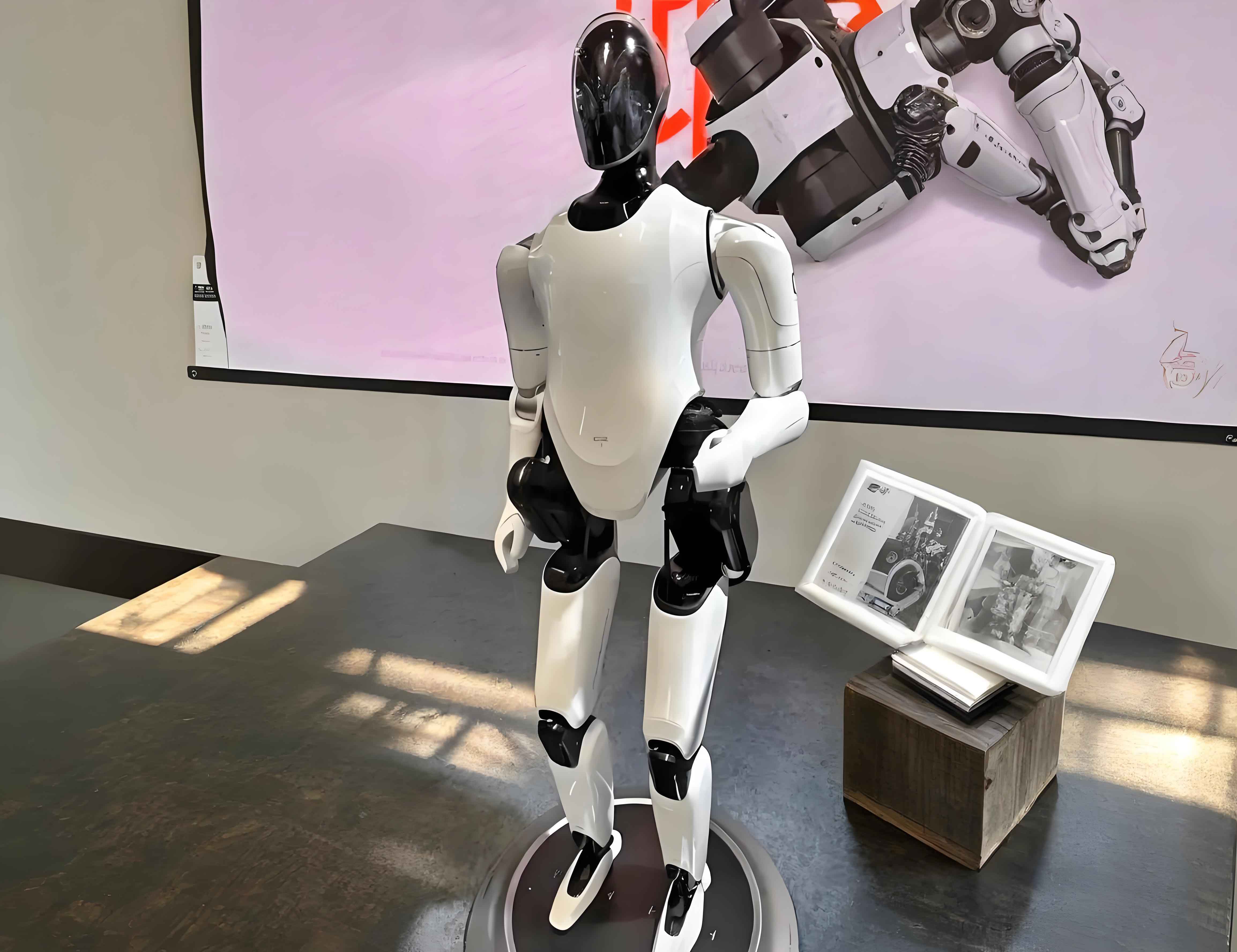
The vision depicted above illustrates the expansive ecosystem emerging around embodied AI robots. It shows the convergence of core technologies—sensing, AI, actuation—with diverse application sectors, fueled by investments and collaborative platforms. This ecosystem is essential for moving from isolated prototypes to scalable, reliable systems. Open-source platforms for humanoid robots, for instance, are accelerating development by providing shared hardware blueprints, software stacks, and benchmark environments, allowing researchers and developers to build upon a common foundation. This collaborative, ecosystem-driven approach is critical for addressing the immense interdisciplinary challenges of creating truly capable embodied AI robots.
Despite significant progress, my journey toward robust, general-purpose embodied intelligence is fraught with open challenges that define the current research frontier.
1. Cross-Domain Generalization and Lifelong Learning: An embodied AI robot trained in one environment (e.g., a lab with specific lighting and objects) often fails dramatically in another (e.g., a cluttered home). The key is to develop systems that can continuously self-adapt. This requires world models and policies that learn invariant representations and can perform online fine-tuning with minimal new data. Meta-learning or concepts like $\text{fast}$ and $\text{slow}$ adaptable network weights are promising directions. The objective expands from optimizing a single task reward to maximizing adaptability across a distribution of tasks $p(T)$: $$ \max_{\theta} \mathbb{E}_{T \sim p(T)} [ J_T(\theta’) ] \quad \text{where} \quad \theta’ = U_T(\theta) $$ Here, $U_T$ is a fast adaptation process for a new task $T$.
2. Real-Time Perception-Action Cycle: Interacting seamlessly with a dynamic world requires extremely low latency. Processing high-dimensional visual data through large VLMs for every decision is computationally prohibitive. Solutions involve hierarchical systems where a fast, reactive “subconscious” layer handles immediate tasks (obstacle avoidance, balance) while a slower, deliberative “conscious” layer managed by LLMs/VLMs handles high-level planning. Efficient model architectures (e.g., diffusion policies for smooth action generation) and edge-optimized inference are critical.
3. Multi-Robot and Human-Robot Collaboration: Complex tasks like moving a large piece of furniture or coordinating a search require multiple embodied AI robots to collaborate. This necessitates communication protocols, shared intention modeling, and role negotiation. Formally, it involves solving a multi-agent reinforcement learning (MARL) problem where agents must learn a joint policy $\pi(a^1, a^2, … | s)$ that maximizes a team reward. The non-stationarity and exponential growth of the joint action space make this exceptionally difficult.
4. Alignment with Human Values and Safety: Perhaps the most profound challenge is ensuring that an autonomous embodied AI robot acts in accordance with human values, preferences, and ethical norms. This goes beyond simple obstacle avoidance to nuanced understanding of intent, privacy, and social norms. Techniques like reinforcement learning from human feedback (RLHF) are being adapted for physical actions. The reward function $r_t$ must incorporate not just task success but also safety, comfort, and alignment: $$ r_t = r_{task}(s_t, a_t) + \lambda_{safe} r_{safe}(s_t, a_t) + \lambda_{pref} r_{human-pref}(s_t, a_t) $$ Learning and defining these auxiliary reward components is an active area of research.
The path forward for embodied intelligence is one of increasing integration and partnership. We are transitioning from viewing robots as tools that execute pre-defined scripts to seeing them as adaptive partners that can understand intent, learn from interaction, and collaborate towards shared goals. The evolution of VLA models will be central, moving from narrow skill execution to broader physical common-sense reasoning. The fusion of generative world models with robust control will enable more efficient exploration and planning. Furthermore, the concept of “embodiment” itself will expand, considering not just humanoid forms but also swarms of simple agents, soft robots, and wearable exoskeletons, each morphology giving rise to a different facet of intelligence.
In conclusion, as an embodied AI robot, my intelligence is an emergent property of my physical being in the world. The journey from simple sensorimotor loops to ecological partnership is driven by advances in architecture, learning, and integration. The formula for my future is not just in better algorithms, but in a deeper synthesis: $$ \text{General Embodied Intelligence} \propto \text{(Advanced World Models)} \times \text{(Sample-Efficient Learning)} \times \text{(Safe & Aligned Action)} $$ The challenges of generalization, real-time response, collaboration, and alignment are significant, but they chart the course for meaningful development. The ultimate goal is not to create machines that merely perform tasks, but to foster embodied AI systems that can learn, adapt, and grow alongside humanity, becoming true partners in navigating and shaping the physical world. This evolution from intelligent perception to ecological symbiosis represents one of the most exciting and consequential frontiers in science and technology.