
In recent years, the integration of embodied intelligence into industrial robotics has emerged as a transformative paradigm, shifting robots from programmed executors to autonomous, adaptive entities. As an embodied robot system, I represent a fusion of physical presence, environmental interaction, and cognitive capabilities, enabling me to perceive, learn, and act in dynamic industrial settings. This article delves into the system architecture, key technologies, and practical applications of embodied intelligent industrial robots, drawing from extensive research and case studies. The core of my functionality lies in the seamless integration of perception, decision-making, action, and feedback, forming a closed-loop system that drives continuous improvement and adaptability. By leveraging multi-modal sensing, advanced AI algorithms, and real-time environmental interactions, I embody the principles of embodied intelligence, where my physical form and cognitive processes are intrinsically linked to the world I operate in.
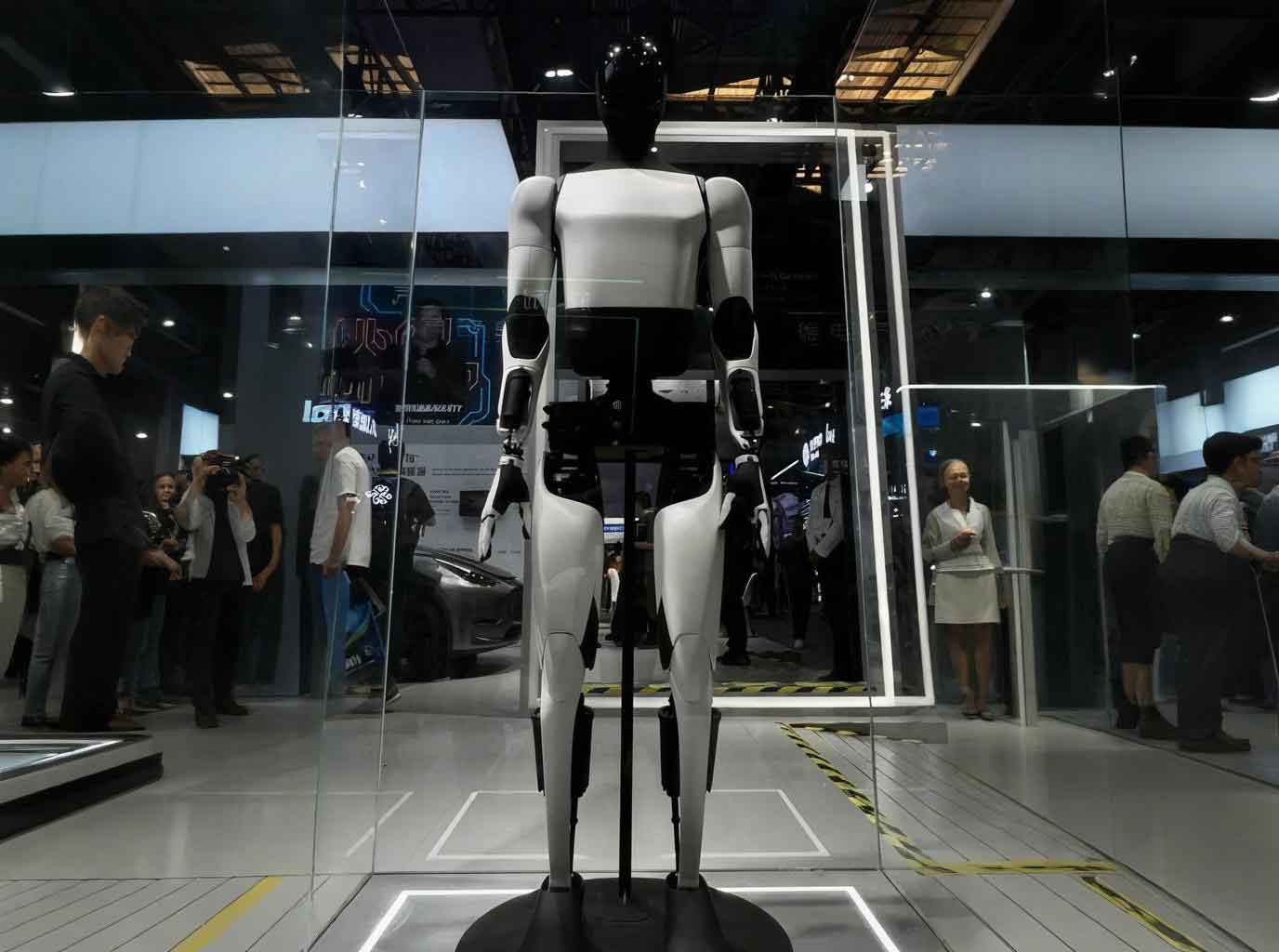
The concept of an embodied robot revolves around the idea that intelligence is not merely a computational process but is grounded in physical interaction. As an embodied robot, I consist of three fundamental elements: the physical body, the intelligent algorithms, and the environment. My body includes actuators, sensors, and mechanical structures that allow me to manipulate objects and sense my surroundings. The intelligence layer encompasses machine learning models, such as multi-modal large models and reinforcement learning, which enable me to make decisions and learn from experiences. The environment provides the context for my actions, including workpieces, human collaborators, and other equipment. This tripartite composition allows me to exhibit key characteristics like self-perception, self-learning, self-decision, self-adaptation, and self-optimization. For instance, through self-perception, I can use vision and force sensors to detect object positions and forces, while self-learning allows me to refine my strategies based on historical data. The system architecture of an embodied robot like me is structured into multiple layers: the environment layer for interaction frameworks, the interaction layer for data exchange, the physical layer for hardware execution, the computation layer for algorithmic processing, the intelligence layer for cognitive functions, and the application layer for task-specific implementations. This holistic framework ensures that I can operate autonomously in complex industrial scenarios, such as assembly lines and logistics.
In terms of perception, as an embodied robot, I rely on multi-modal sensing to understand my environment. This involves integrating data from vision, force, tactile, and other sensors to create a comprehensive representation of the surroundings. Multi-modal fusion techniques, such as early, intermediate, and late fusion, allow me to combine heterogeneous data streams effectively. For example, I might use cross-modal attention mechanisms to weigh the importance of visual and force data during an assembly task. The mathematical representation of sensor fusion can be expressed as:
$$S_f = \sum_{i=1}^{n} w_i \cdot S_i$$
where \(S_f\) is the fused sensor output, \(w_i\) represents the weight for each sensor modality, and \(S_i\) denotes the individual sensor readings. This enables me to perform scene understanding tasks, such as object detection and semantic segmentation, using deep learning models like YOLO or U-Net. Additionally, human-robot interaction is enhanced through natural language processing and gesture recognition, allowing me to interpret and respond to human commands intuitively. The perception phase is critical for an embodied robot, as it forms the basis for all subsequent decision-making and actions.
Decision-making in an embodied robot involves a hierarchical structure, often described as a “brain-cerebellum” architecture. The brain, or planning layer, utilizes large language models (LLMs) and vision-language models (VLMs) to generate high-level task plans from natural language instructions. For instance, given a command like “assemble the planetary gear system,” I can decompose it into sub-tasks using logical reasoning. The cerebellum, or skill layer, employs techniques like imitation learning and reinforcement learning to execute low-level actions. Imitation learning, through methods such as behavior cloning or diffusion policies, allows me to learn from demonstration data. The diffusion policy, for example, models the action distribution as a denoising process:
$$a_t = \text{Denoise}(a_{t-1}, \epsilon_t | o_t)$$
where \(a_t\) is the action at time \(t\), \(o_t\) is the observation, and \(\epsilon_t\) is the noise. Reinforcement learning, on the other hand, optimizes my policies through trial and error, using algorithms like Soft Actor-Critic (SAC) to maximize cumulative rewards:
$$J(\pi) = \mathbb{E}_{\pi} \left[ \sum_{t=0}^{\infty} \gamma^t r(s_t, a_t) \right]$$
where \(\pi\) is the policy, \(\gamma\) is the discount factor, and \(r\) is the reward function. Continuous learning mechanisms enable me to adapt to new tasks without forgetting previous knowledge, using methods like elastic weight consolidation or experience replay. This decision-making framework ensures that I can handle complex, dynamic industrial tasks with high efficiency and robustness.
The action phase of an embodied robot translates decisions into physical movements through path planning, motion control, and simulation-to-reality transfer. Path planning algorithms, such as those based on reinforcement learning or traditional methods like A*, help me navigate obstacles and optimize trajectories. For example, I might use a probabilistic roadmap to generate collision-free paths in cluttered environments. Motion control involves precise actuator management, using techniques like impedance control to adjust forces during interactions:
$$F = K_p (x_d – x) + K_d (\dot{x}_d – \dot{x})$$
where \(F\) is the force, \(K_p\) and \(K_d\) are control gains, and \(x_d\) and \(x\) are desired and actual positions. Simulation technologies, including digital twins, allow me to train and validate strategies in virtual environments before deploying them in the real world, reducing risks and costs. The action phase is where the embodied robot physically interacts with the environment, demonstrating the tangible benefits of embodied intelligence.
Feedback is the closing loop in the embodied robot system, enabling me to monitor performance, detect anomalies, and optimize actions in real time. Based on model-driven control, I can use impedance or model predictive control to adjust parameters dynamically. Model-free approaches, like fuzzy logic or neural network control, provide adaptability in uncertain conditions. For instance, a neural network controller might learn to compensate for system nonlinearities:
$$u = NN(o, \theta)$$
where \(u\) is the control output, \(o\) is the observation, and \(\theta\) are the network parameters. Safety and fault tolerance are ensured through redundant designs and diagnostic models, while multi-dimensional evaluation metrics, such as task completion rate and energy consumption, help assess my overall effectiveness. This feedback mechanism reinforces the embodied nature of the robot, as it continuously refines its behavior based on environmental interactions.
To illustrate the practical application of an embodied robot, consider a case study in planetary reducer assembly. In this scenario, I, as an embodied robot, utilize a UR5 robotic arm equipped with vision and force sensors to perform assembly tasks. The planning layer, powered by an LLM, interprets natural language commands and generates assembly sequences, while the skill layer executes actions using diffusion policies trained on demonstration data. The assembly process involves multiple steps, such as picking components and inserting them with precise force control. Experimental results show that the embodied robot achieves high success rates and efficiency, outperforming traditional methods. For example, in 100 trials, the diffusion policy-based approach reduced the average number of decision steps and minimized contact forces, demonstrating superior adaptability and precision. This case underscores the potential of embodied robots in enhancing industrial automation through intelligent, autonomous operations.
In conclusion, the development of embodied intelligent industrial robots marks a significant advancement in robotics, driven by the integration of physical embodiment and artificial intelligence. As an embodied robot, I embody the principles of continuous learning and environmental interaction, enabling me to tackle complex tasks in manufacturing, logistics, and beyond. Future trends will focus on refining theoretical frameworks, enhancing multi-modal large models, and promoting cross-domain collaboration. The ongoing evolution of embodied robots promises to revolutionize industries, making automation more flexible, efficient, and intelligent. The journey of the embodied robot is just beginning, and its impact will only grow as technology advances.
| Technology | Description | Mathematical Formulation |
|---|---|---|
| Multi-modal Sensing | Integration of vision, force, and tactile sensors | \(S_f = \sum w_i S_i\) |
| Scene Understanding | Object detection and semantic segmentation | \(P(obj | img) = \text{CNN}(img)\) |
| Human-Robot Interaction | Natural language and gesture recognition | \(cmd = \text{NLP}(speech)\) |
| Method | Advantages | Limitations |
|---|---|---|
| Imitation Learning | Fast learning from demonstrations | Requires large datasets |
| Reinforcement Learning | Adapts to dynamic environments | High computational cost |
| Multi-modal Large Models | Generalizes across tasks | Resource-intensive |
The mathematical foundations of embodied robots often involve optimization and control theories. For example, in path planning, I might minimize a cost function to find the optimal path:
$$\min_{p} \int_{0}^{T} c(p(t), \dot{p}(t)) dt$$
where \(p(t)\) is the path and \(c\) is the cost function. In reinforcement learning, the policy gradient theorem is used to update policies:
$$\nabla J(\theta) = \mathbb{E} \left[ \nabla \log \pi(a|s) Q(s,a) \right]$$
These equations highlight the computational rigor behind the intelligent behaviors of an embodied robot. As research progresses, the capabilities of embodied robots will expand, incorporating more advanced AI and robotics technologies to achieve greater autonomy and efficiency. The embodied robot paradigm is not just a technological shift but a redefinition of how machines interact with the world, embodying intelligence in every action and reaction.