
In the contemporary era of rapid technological advancement, the embodied robot industry represents a pivotal frontier in the global科技 revolution. As we observe the convergence of artificial intelligence, robotics, and sensory technologies, embodied robots—physical entities that interact with their environment through perception, decision-making, and action—are transforming industries and societies. We aim to delve into the mechanisms driving this industry’s growth and propose strategies for its sustained development. This analysis draws on a “technology-economy” paradigm, examining how innovation, demand, supply, and collaborative ecosystems intertwine to foster progress. Throughout this discussion, we will emphasize the role of embodied robots as key enablers of intelligent systems, highlighting their potential to redefine productivity and create new economic value.
The embodied robot industry encompasses a broad spectrum of activities, from hardware manufacturing to software integration and application deployment. We define it as an emerging industrial cluster focused on intelligent systems that deeply interact with the physical world through embedded AI in entities capable of environmental sensing, motion control, and autonomous decision-making. This industry facilitates a “perception-cognition-action” closed loop, enabling tasks ranging from industrial automation to personal assistance. For instance, embodied robots like humanoid machines and autonomous vehicles are not merely tools but adaptive agents that learn from interactions, much like humans. This evolution marks a shift from virtual intelligence to embodied intelligence, unlocking new dimensions of productivity.
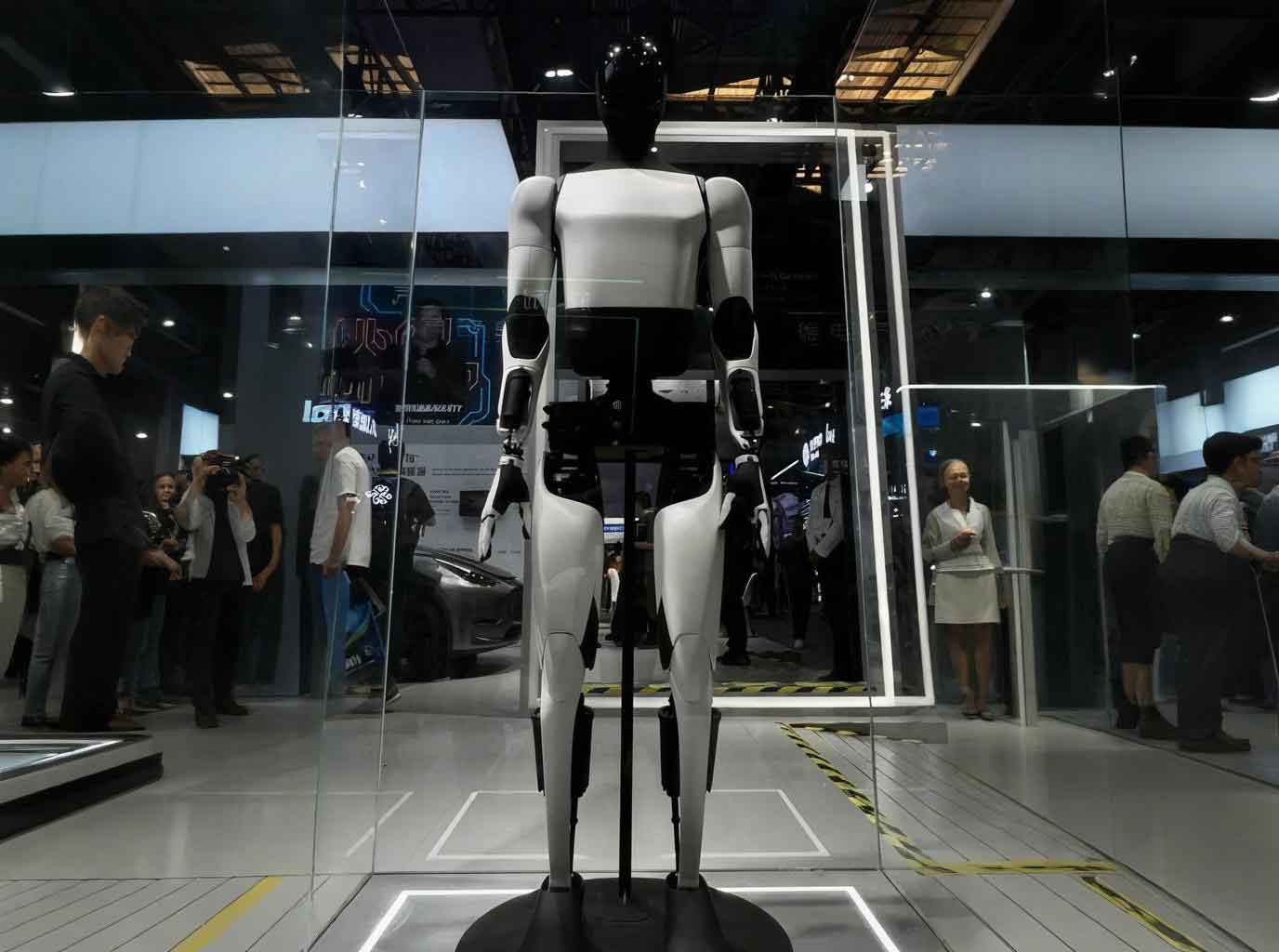
To understand the embodied robot industry’s trajectory, we must first recognize its typical characteristics, which we categorize into three dimensions:前沿先进性与颠覆不确定性 (frontier advancement and disruptive uncertainty), 技术融合性与产业协同性 (technological integration and industrial synergy), and 前瞻战略性与高成长潜力 (forward-looking strategy and high growth potential). These features underscore the industry’s dynamic nature, where cutting-edge innovations like multi-modal sensors and AI algorithms drive progress but also introduce uncertainties due to rapid iterations and market volatilities. For example, the integration of large language models into embodied robots has boosted task success rates, yet multiple technological paths—such as neural networks and reinforcement learning—remain in flux, leading to unpredictable outcomes. The following table summarizes these characteristics based on our analysis:
| Characteristic Dimension | Description | Example in Embodied Robot Industry |
|---|---|---|
| Frontier Advancement and Disruptive Uncertainty | Involves state-of-the-art technologies that can overturn existing paradigms, but with high risks of failure or obsolescence. | Use of GPT-4 in embodied robots for autonomous decision-making, which improves efficiency but faces ethical and technical uncertainties. |
| Technological Integration and Industrial Synergy | Combines diverse technologies like AI, robotics, and IoT, requiring coordination across supply chains and sectors. | Collaboration between chip manufacturers and software developers to create integrated systems for humanoid robots. |
| Forward-Looking Strategy and High Growth Potential | Emphasizes long-term strategic importance and rapid market expansion, driven by innovation and scalability. | Global market projections for humanoid robots showing a compound annual growth rate exceeding 50%, indicating vast economic opportunities. |
The development of the embodied robot industry follows a “technology-industry-society” theoretical logic, where internal and external forces interact to form a virtuous cycle. We identify four core mechanisms: innovation drive, demand pull, supply creation, and value co-creation. Each mechanism contributes to the industry’s evolution from technological inception to ecosystem maturity. For instance, innovation drive involves clusters of technologies converging to create new products, while demand pull leverages market needs to refine applications. To quantify these relationships, we can model the innovation process using a production function approach. Let us consider a simplified formula representing the output of embodied robot innovations:
$$ Y = A \cdot K^\alpha \cdot L^\beta \cdot T^\gamma $$
Here, \( Y \) denotes the output of embodied robot products, \( A \) is total factor productivity influenced by technological integration, \( K \) represents capital investment in R&D, \( L \) is labor input including skilled researchers, and \( T \) symbolizes technological clusters like AI and sensor fusion. The exponents \( \alpha \), \( \beta \), and \( \gamma \) capture the elasticities of these inputs, typically summing to 1 in Cobb-Douglas forms, reflecting how synergies among factors amplify growth. This equation illustrates how embodied robot advancements rely on balanced investments across knowledge domains.
In the innovation drive mechanism, we observe three sub-processes: technological cluster innovation, system integration, and cross-domain technology spillover. Technological cluster innovation refers to the transition from isolated breakthroughs to convergent, mainstream technologies that dominate the market. For example, early experiments in embodied robots involved disparate approaches to mobility and cognition, but over time, methods like deep learning and reinforcement learning have coalesced into standard practices. System integration involves combining hardware and software layers to form cohesive “perception-decision-action-feedback” loops. A prime example is the integration of high-precision actuators with multi-modal sensors in embodied robots, enabling real-time environmental interactions. Cross-domain technology spillover occurs when innovations in one field, such as autonomous driving, are adapted to others like healthcare robotics, fostering a cycle of knowledge transfer and refinement. We can express the spillover effect mathematically as:
$$ S = \delta \cdot \sum_{i=1}^{n} E_i \cdot C_i $$
Where \( S \) represents the spillover benefit, \( \delta \) is a diffusion coefficient, \( E_i \) denotes embodied robot technologies in domain \( i \), and \( C_i \) is the compatibility factor for cross-domain application. This formula highlights how modular designs in embodied robots reduce adaptation costs, accelerating industry-wide innovation.
Demand pull acts as a critical catalyst, driven by application scenarios, market scale, and industrial ecosystems. Application scenarios, such as industrial automation or home care, create specific needs that spur product iterations. For instance, embodied robots in warehouse logistics have evolved to handle complex tasks like sorting and packing, directly responding to efficiency demands. Market scale, particularly in regions with large populations, amplifies this effect through network externalities—where the value of embodied robots increases with user adoption. The network effect can be modeled as \( V = k \cdot N^2 \), where \( V \) is the value, \( k \) is a constant, and \( N \) is the number of users or connected devices. This underscores how massive markets provide diverse testing grounds, reducing innovation risks. Industrial ecosystems further magnify demand by fostering vertical and horizontal collaborations. Vertical synergy involves upstream-downstream coordination in supply chains, while horizontal synergy enables knowledge sharing across sectors, as seen in partnerships between automotive and robotics firms to develop autonomous embodied robots.
Supply creation complements demand by generating new markets through technological diversification, competitive quality, and efficiency gains. Under technology-driven diversification, embodied robot innovations lead to novel products like adaptive humanoid machines, which unlock latent demands—for example, in elderly care where robots assist with daily activities. Competitive-driven quality arises from market rivalries that push firms to enhance features and lower costs, thereby creating effective demand. Efficiency-driven supply optimizes resource allocation, such as using AI to personalize embodied robot services, which挖掘s hidden consumer needs. A useful framework to analyze this is the Solow-Swan growth model augmented for embodied robots:
$$ g = \frac{dY}{Y} = \theta + \alpha \frac{dK}{K} + \beta \frac{dL}{L} + \gamma \frac{dT}{T} $$
Here, \( g \) is the growth rate of embodied robot output, \( \theta \) represents exogenous technological progress, and the other terms denote contributions from capital, labor, and technology. This model emphasizes how efficiency improvements in embodied robot production can sustain long-term growth by aligning supply with evolving demands.
Value co-creation integrates governmental support, social capital, and产学研用 (industry-academia-research-application) collaborations to build a resilient industry ecosystem. Policy initiatives, such as funding programs and regulatory frameworks, provide stability, while private investments inject vitality into startups focused on embodied robots. For example, venture capital flows into embodied robot companies have enabled breakthroughs in AI-driven mobility.产学研用 synergies facilitate knowledge exchange, as universities contribute foundational research and industries apply it to commercial products. The overall ecosystem can be visualized as a network where nodes represent stakeholders—firms, researchers, users—and edges denote collaborations. The strength of these ties enhances innovation diffusion, which we can quantify using a network centrality measure:
$$ C = \sum_{i \neq j} \frac{\sigma_{ij}(v)}{\sigma_{ij}} $$
In this formula, \( C \) represents the closeness centrality of an embodied robot firm in the ecosystem, \( \sigma_{ij} \) is the number of shortest paths between nodes \( i \) and \( j \), and \( \sigma_{ij}(v) \) counts paths passing through node \( v \). Higher centrality indicates better access to resources and knowledge, accelerating value generation for embodied robots.
Comparing the embodied robot industries in major economies reveals distinct patterns. In terms of technological驱动, one region emphasizes algorithmic sophistication and basic research, leading to high-performance embodied robots, while another leverages cost-effective hardware and rapid iteration. For instance, differential technological paths have emerged: one focused on premium, algorithm-intensive embodied robots for specialized tasks, and another on affordable, electrically-driven models for mass adoption. The table below summarizes key comparisons based on our assessment:
| Aspect | Region A Approach | Region B Approach |
|---|---|---|
| Technological Innovation | Leads in core AI algorithms and system integration, with high R&D intensity. | Excels in hardware manufacturing and multi-modal model applications, with growing patent filings. |
| Development Direction | Focuses on high-value scenarios like aerospace and healthcare, driven by innovation premiums. | Prioritizes scalable applications in manufacturing and services, leveraging market size. |
| Capital Investment | Dominates in venture capital inflows, supporting foundational technology ventures. | Relies on policy-guided funds and industrial clusters, fostering grassroots innovation. |
| Talent Deployment | Attracts global top-tier researchers, though talent concentration faces challenges. | Cultivates domestic expertise through education reforms, with rising AI PhD graduations. |
From a directional perspective, the embodied robot industry in different regions adapts to local industrial structures. One area emphasizes规模化应用驱动 (scale-driven application), deploying embodied robots in sectors like manufacturing and agriculture to address labor shortages, while another pursues高端附加值驱动 (high-end value-driven) models, targeting niches such as surgical robotics and autonomous systems. Capital investment patterns also differ: one is characterized by risk capital dominance, fueling long-term R&D in embodied robots, while the other combines public and private funds to accelerate commercialization. Talent-wise, disparities in international mobility affect innovation pace, with one region drawing skilled professionals globally and another strengthening homegrown capabilities through institutional reforms.
To propel the embodied robot industry forward, we propose a multifaceted strategy. First, deepen the integration of前沿新兴技术 (frontier emerging technologies) with cost-effective solutions to expand application scenarios. This involves establishing cross-disciplinary research teams to tackle core challenges in embodied robot development, such as enhancing energy efficiency and adaptability. For example, investing in open-source platforms can reduce barriers to entry, fostering innovation. Second, build an enterprise-led产学研用协同创新体系 (industry-academia-research-application collaborative innovation system) to open new avenues. By aligning national strategies with market mechanisms, we can form innovation chains that connect upstream suppliers with downstream users of embodied robots. Third,梯度培育创新型具身智能企业 (gradient cultivation of innovative embodied robot enterprises) to stimulate micro-level vitality. This means tailoring support for startups, growth-stage firms, and leaders—for instance, through incubators that provide funding and mentorship for embodied robot prototypes. Lastly,畅通“科技—产业—金融”良性循环机制 (smooth the “technology-industry-finance” virtuous cycle mechanism) to optimize the ecosystem. Creating industrial clusters and enhancing information sharing between tech developers and investors will ensure sustained capital flow into embodied robot projects.
In conclusion, the embodied robot industry stands at the nexus of technological evolution and economic transformation. Through a concerted effort that blends innovation, demand-side incentives, supply-side creativity, and collaborative value creation, we can harness its full potential. As embodied robots become increasingly embedded in daily life—from smart homes to advanced healthcare—their role in shaping future societies will only grow. By adopting the strategies outlined, stakeholders can navigate uncertainties and capitalize on opportunities, ensuring that the embodied robot industry drives inclusive and sustainable progress worldwide.