
The quest to bridge the animate and the engineered has always been a cornerstone of advanced robotics. The field of bionics, specifically, seeks not merely to copy nature’s forms but to decode and implement its underlying principles of efficiency, resilience, and adaptability. Among the diverse biological models, multi-legged arthropods present a fascinating paradox: a seemingly complex and unstable locomotion mechanism that, in reality, offers unparalleled stability and terrain negotiation. This article chronicles the comprehensive design, realization, and behavioral programming of a six-legged bionic robot, a platform that embodies the principles of its biological archetype to achieve robust, autonomous operation.
The motivation for developing such a bionic robot is twofold. Firstly, from a fundamental research perspective, it serves as a physical testbed for understanding and validating theories of legged locomotion, sensorimotor integration, and reactive autonomy. Secondly, its practical applications are significant. Unlike wheeled or tracked counterparts, a legged bionic robot can traverse discontinuous, rubble-strewn, or highly uneven terrain where conventional platforms fail. This makes it an ideal candidate for critical missions such as search and rescue in collapsed structures, planetary exploration, or environmental monitoring in wild, unstructured landscapes. By fusing insights from biology with precision engineering and intelligent software, we create a machine that is more than the sum of its parts—it becomes a synthetic organism with purpose.
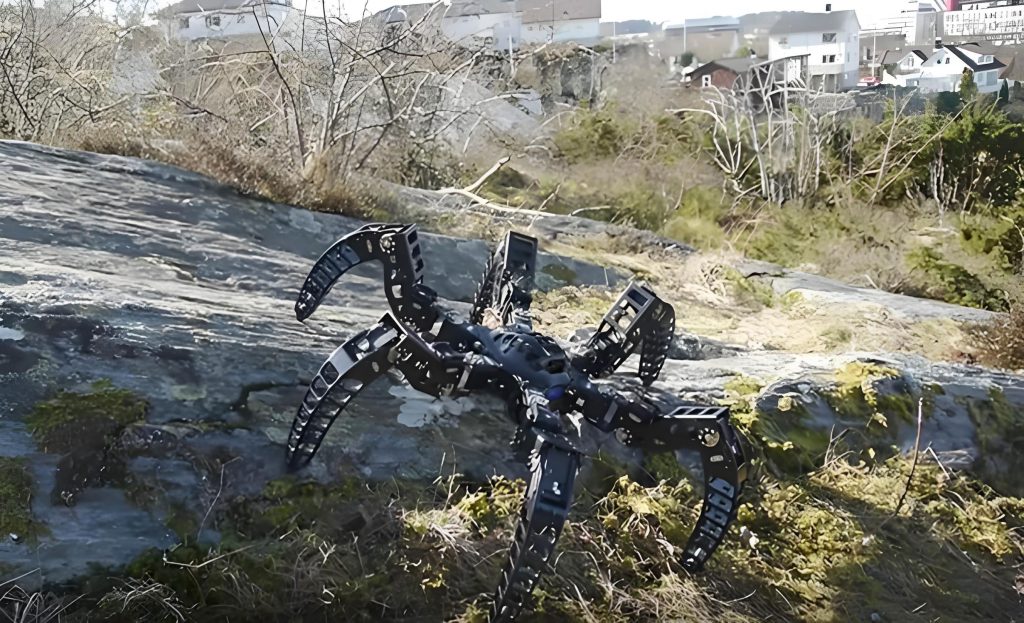
I. Hardware Design: The Physical Embodiment of the Bionic Robot
The physical instantiation of the bionic robot is paramount; it is the canvas upon which all behaviors are painted. The design philosophy prioritizes modularity, high-fidelity actuation, integrated sensing, and structural integrity, all while adhering to a form factor inspired by its biological counterpart.
1.1 Central Control and Computational Core
The torso of the bionic robot houses its central nervous system. For this platform, a high-performance, low-power 16-bit AVR microcontroller was selected. Operating at a frequency of up to 16 MHz, it provides a computational throughput of 16 Million Instructions per second (MIPS). This capacity is sufficient for the real-time demands of the bionic robot, including inverse kinematics calculations for 18 degrees of freedom, sensor data fusion, gait pattern generation, and state machine execution. The controller’s role is analogous to a brainstem, managing low-level coordination and reflex loops, ensuring the body’s actuators respond cohesively to high-level behavioral commands.
1.2 Limb and Actuation System: The Dynamics of Motion
The leg apparatus is the defining feature of this bionic robot. A hexapodal configuration was chosen, offering an optimal balance between stability and mechanical complexity. Biological spiders often utilize an 8-legged alternating tripod gait for supreme stability; a six-legged design efficiently replicates this principle, always maintaining a stable triangular support polygon with three feet on the ground.
Each leg is endowed with three degrees of freedom (DOF), corresponding to three orthogonal rotational axes (approximating yaw, pitch, and roll at the coxa, femur, and tibia joints). This allows the foot endpoint to access a substantial volume of Cartesian space, enabling precise foot placement for walking, climbing, and reactive balancing. The 3-DOF configuration for six legs necessitates 18 independent, high-performance actuators.
For this critical function, we employed the Dynamixel AX-12+ robotic servo. This is not a standard radio-control servo but a fully integrated smart actuator module. It combines a DC motor, a gear train, a microcontroller, a communication interface, and sensors (position, temperature, load, input voltage) into a single, robust package. Its specifications are crucial for the bionic robot’s performance:
| Parameter | Specification | Implication for Bionic Robot |
|---|---|---|
| Control Resolution | 1024 steps (0 to 1023) | High precision joint control (~0.29° per step). |
| Angular Range | 300° | Wide range of motion for complex leg postures. |
| Communication | Half-duplex Asynchronous Serial, TTL | Enables daisy-chaining of all 18 servos on a single bus. |
| Device ID | 254 unique IDs possible | Easy addressing and management of each joint. |
| Feedback | Position, Temperature, Load, Voltage | Allows for torque control, overload protection, and system health monitoring. |
| Control Table | RAM & EEPROM based | Stores configuration (PID gains, compliance) and real-time status. |
The control paradigm is digital and centralized. The main controller sends target position commands to each servo’s control table. The servo’s internal PID controller drives the motor to the commanded angle and continuously reports back its present position. This closed-loop control at the joint level is fundamental for achieving accurate and repeatable motion in the bionic robot.
The relationship between the command value (C) and the resulting joint angle (θ) is linear:
$$ \theta = \frac{300^\circ}{1023} \cdot C $$
where \( C \) is an integer between 0 and 1023.
1.3 Sensory Apparatus: The Perceptual World of the Bionic Robot
To behave autonomously, a bionic robot must perceive its environment. Rather than employing a disparate array of sensors, we integrated a multi-modal sensory module, the Dynamixel AX-S1. This unit, mechanically and communicatively compatible with the AX-12+ servos, provides a cohesive suite of environmental inputs:
- Ultrasonic Distance Sensing: Two transducers provide distance measurements forward (`distance_f`) and upward (`distance_u`).
- Audio Detection: A microphone captures ambient sound pressure levels.
- Ambient Light Sensing: Measures the intensity of incident light.
- Infrared Receiver: Allows for remote control via standard IR protocols.
- Temperature Sensor: Monitors internal module temperature.
The AX-S1 acts as the bionic robot’s primary exteroceptive organ. Its data, accessed via the same serial bus as the servos, feeds the control algorithms that govern the robot’s reactive behaviors. For instance, the ultrasonic values are not direct distance in centimeters but are quantized values. A calibration step maps these raw values (e.g., `distance_f`) to approximate physical distances, which are then used for obstacle detection and reaction.
| Sensor Data | Raw Value Range | Typical Behavioral Trigger Condition | Interpreted Action |
|---|---|---|---|
| `distance_u` | 0-255 (lower=closer) | `distance_u` ≤ 20 | “Ceiling too low” → Initiate crouch/sit-down sequence. |
| `distance_f` | 0-255 (lower=closer) | 20 < `distance_f` ≤ 100 | “Object detected ahead” → Prepare for assessment/attack. |
| `distance_f` | 0-255 (lower=closer) | `distance_f` ≤ 20 | “Object very close” → Initiate evasion (back away and turn). |
| Audio Level | ~128 (quiet) to 255 (loud) | Audio spike > Threshold (e.g., 200) | “Loud sound detected” → Exit sleep mode, initiate startle reflex. |
1.4 Mechanical Integration and Final Form
The final assembly integrates the controller (torso), the 18 AX-12+ servos (forming six 3-DOF legs), and the AX-S1 module (head). Specialized brackets and frames connect these components, ensuring structural rigidity while allowing the full range of motion for each joint. The resulting form factor is distinctly arthropodal, with a low center of gravity and symmetrically distributed limbs, providing the physical foundation for stable, bionic locomotion.
II. Software and Behavioral Architecture: The Cognitive Layer of the Bionic Robot
The hardware provides the body; the software instills the mind. The behavioral architecture for this bionic robot is designed as a layered, modular system that progresses from low-level servo control to high-level, sensor-driven autonomy.
2.1 System Initialization and State Management
Upon power-up, the bionic robot undergoes a rigorous initialization sequence. This ensures all components begin in a known, safe state.
Actuator Configuration: Each Dynamixel AX-12+ servo is addressed and its control table is programmed. A critical step is setting the servo to “Position Control Mode” (as opposed to continuous rotation mode). This is done by writing the value 1023 to the specific address in the servo’s control table that governs operating mode. Mathematically, for a servo with ID `i`, we set:
$$ \text{Write}(ID_i, \text{Address}_{mode}, 1023) $$
All 18 servos are configured identically for precise angular positioning.
Postural Reset: Following configuration, each joint is commanded to a predefined “home” position. This involves solving the inverse kinematics for a default standing pose where all six feet are placed symmetrically to support the body. The set of 18 joint angles \( \{\theta_1, \theta_2, …, \theta_{18}\} \) for this pose is stored and loaded, bringing the bionic robot to a stable, ready state. This is managed by a global state variable, `play_motion`.
| `play_motion` Value | Robot Behavior / Action Sequence | Category |
|---|---|---|
| 0 | Emergency Stop / Motion Kill | Safety |
| 1 | Initialize / Home Pose | Setup |
| 2, 3 | Forward Walk (Normal, Fast) | Basic Locomotion |
| 4, 5 | Backward Walk (Normal, Fast) | |
| 6, 7 | Turn Right (Normal, Fast) | |
| 8, 9 | Turn Left (Normal, Fast) | |
| 10 | Sit / Crouch (Legs Retracted) | Static Pose |
| 11 | Startle / Flinch Reflex | Reactive Behavior |
| 12, 13 | Attack Pose, Lunge Forward | Aggressive Behavior |
| 50 | Normal Autonomous Exploratory Loop | Composite Autonomous Modes |
| 60 | Obstacle Avoidance & Evasion Sequence | |
| 70 | Fear/Startle Response Sequence | |
| 80 | Aggressive Engagement Sequence |
2.2 Gait Generation and Locomotion Control
The core of the bionic robot’s mobility is its gait engine. We implemented an alternating tripod gait, the most stable and efficient for hexapods. In this gait, legs are grouped into two sets of three (e.g., front-left, middle-right, rear-left form Tripod A; the others form Tripod B).
The foot trajectory for each leg during a step cycle is typically defined by a curve in 3D space, consisting of a swing phase (foot lifted and moved forward) and a stance phase (foot on the ground, pushing backward to propel the body). This trajectory can be defined parametrically. A common simplified model for the foot tip position \( \vec{P}(t) = [x(t), y(t), z(t)]^T \) in a leg’s local coordinate frame during the swing phase is:
Swing Phase (Leg in Air):
$$ x(t) = -\frac{S}{2} \cos\left(\pi \frac{t}{T_{swing}}\right) $$
$$ z(t) = H \sin\left(\pi \frac{t}{T_{swing}}\right) $$
Where \( S \) is the stride length, \( H \) is the maximum lift height, \( T_{swing} \) is the swing duration, and \( t \) goes from 0 to \( T_{swing} \). The y-coordinate is typically constant for straight-line walking.
Stance Phase (Leg on Ground):
$$ x(t) = \frac{S}{2} \cos\left(\pi \frac{t}{T_{stance}}\right) $$
$$ z(t) = 0 $$
Here, the foot remains at ground level (\(z=0\)) and moves backward relative to the body, providing thrust.
The controller continuously cycles through these pre-calculated or dynamically adjusted trajectories for all six legs, with Tripods A and B 180 degrees out of phase. This generates smooth, stable forward motion. Turning is achieved by introducing a differential in the stride length or foot placement between legs on the left and right sides of the bionic robot.
2.3 Sensor Integration and Reactive Autonomy
The transition from a pre-programmed machine to an autonomous bionic robot is enabled by its sensor feedback loops. The AX-S1 data is polled periodically within the main control loop.
Sleep/Wake Cycle: A primary autonomy feature is the energy-conserving sleep mode. After a period of activity (e.g., 30 seconds, controlled by a timer), the bionic robot assumes a low-power crouch and halts motion. It can be awakened by two distinct stimuli:
- Acoustic Trigger: The audio sensor is monitored. A sharp sound (like a clap) exceeding a calibrated threshold is interpreted as a wake-up command. Debouncing logic is implemented to count a sustained audio spike as a single event:
Let \( A[n] \) be the audio sample at time \( n \). An event is triggered if:
$$ A[n] > T_{audio} \quad \text{and} \quad (n – n_{last\_event}) > N_{debounce} $$
where \( T_{audio} \) is the threshold (e.g., 200) and \( N_{debounce} \) is a minimum sample count between events. - Infrared Remote: A standard IR remote control can send a specific “wake” code, received by the AX-S1’s IR sensor.
Obstacle Reaction and Behavioral State Machine: During the active “normal behavior” mode (`play_motion = 50`), the bionic robot continuously assesses its environment via ultrasonics. This implements a hierarchical reactive system, which can be formalized as a state machine with conditions based on sensor inputs \( \vec{S} = (distance\_f, distance\_u, …) \).
The decision logic can be summarized as:
$$ \text{Next State} = f(\text{Current State}, \vec{S}) $$
For example, the core logic for frontal obstacle interaction is:
if (distance_u <= 20) then
    execute_sequence(SIT_DOWN)  // Response to overhead obstacle
else if (distance_f <= 100) then
    if (distance_f <= 20) then
        execute_sequence(EVASION) // Back away and turn
    else
        execute_sequence(ASSESS_ATTACK) // Prepare and lunge
    end if
else
    continue(FORWARD_WALK) // Default exploratory behavior
end if
These sensor-driven transitions between behavioral states (`play_motion` values 50, 60, 70, 80) create the impression of a purposeful, reactive entity, fulfilling the goal of a truly autonomous bionic robot.
2.4 Motion Primitives and Sequencing
Complex behaviors like “attack” or “startle” are not single commands but carefully choreographed sequences of motion primitives. A motion primitive is a timed series of target positions for all 18 servos. These are often designed manually or via software tools to create lifelike, dynamic movements. The controller sequences through these primitives to execute a complex action. The stability of the bionic robot during these dynamic motions is ensured by the continuous maintenance of the support polygon and careful control of the center of mass projection.
III. Discussion: Challenges, Performance, and Future Embodiment
The development of this bionic robot platform successfully demonstrates the integration of biomechanical design, smart actuation, multi-modal sensing, and layered control software. The robot reliably executes stable alternating tripod gaits, navigates around obstacles reactively, and exhibits distinct behavioral personas (sleepy, exploratory, defensive, aggressive).
However, several challenges and frontiers for improvement persist, highlighting the ongoing evolution of bionic robot design:
- Power Autonomy: The current system is tethered to a power supply. Future iterations require high-density onboard batteries and power management systems to achieve true field autonomy.
- Enhanced Sensing: While the AX-S1 provides a good foundation, adding inertial measurement units (IMUs) for body orientation, torque sensing at joints for compliant force control, and vision systems would dramatically increase the bionic robot’s environmental awareness and interaction capabilities.
- Adaptive Gait Control: The current gait is fixed-pattern. Implementing adaptive algorithms that can adjust stride length, frequency, and even gait type (e.g., wave gait for slower, more stable climbing) based on terrain feedback from joint loads and IMU data would make the bionic robot far more robust.
- Learning and Adaptation: The ultimate goal for an advanced bionic robot is the ability to learn from experience. Implementing machine learning frameworks to optimize gait parameters or map sensor inputs to successful action sequences would push this platform from pre-programmed reactivity to genuine adaptive intelligence.
In conclusion, this project illustrates a complete pathway from biological inspiration to functional robotic embodiment. The resulting bionic robot serves not only as a versatile platform for researching autonomous legged locomotion but also as a prototype for future machines capable of operating in the complex, unstructured environments that define our world and others. The synthesis of form, function, and behavior in this bionic robot underscores the profound potential of looking to nature not just for shapes, but for deep principles of embodied intelligence.