
Contemporary research in artificial intelligence stands at the precipice of a profound paradigm shift. We are witnessing a transition from the classical, computational-representational framework toward a phenomenological paradigm centered on the concept of embodied intelligence. This revolution compels us to confront fundamental ontological questions: Can artificial systems transcend the epistemic limitations of computationalism to achieve genuine embodiment? What forms of embodiment constitute the necessary and sufficient conditions for the emergence of intelligence? In exploring these questions, the humanoid robot emerges not merely as a sophisticated piece of engineering, but as the quintessential experimental apparatus—a philosophical probe that materializes our theories and exposes their limits. Through a critical examination of embodiment, I argue that intelligence is not an abstract product of computation but is fundamentally rooted in the dynamic, constitutive coupling between an agent and its world, a process dependent on the reciprocal constitution of agency, perceptual structure, and meaning-making.
The classical AI paradigm, grounded in computational representationalism, operated on a Cartesian ontology that cleaved mind from body. Intelligence was conceived as a disembodied algorithm, a formal system of symbol manipulation that mapped inputs to outputs through internal representations. The body, if considered at all, was relegated to the status of a peripheral input/output device. This framework, while powerful for well-defined, closed-world problems, proved brittle and incapable of scaling to the open-ended, ambiguous, and dynamic nature of real-world interaction. It failed to account for the fact that our most basic cognitive capacities—perceiving an object, navigating a room, understanding a gesture—are not computed but enacted through our lived bodily engagement with the environment.
The critique of this disembodied view, powerfully articulated through phenomenological philosophy and embodied cognitive science, has fundamentally reshaped the inquiry. It posits that cognition is not something that happens in a brain but something that is accomplished by an embodied agent in a world. From this perspective, the morphology of the agent, its sensorimotor capacities, and the structural coupling it maintains with its environment are not incidental but constitutive of its intelligence. The humanoid robot, therefore, becomes a critical test case: it is an attempt to instantiate these theoretical principles in a physical artifact that mirrors the human form, the environment for which our intelligence evolved.
Theoretical Foundations: The Three Pillars of Embodied Intelligence
To systematically analyze how artificial intelligence can be embodied, we must deconstruct embodiment into its core, interdependent dimensions. These dimensions are not modular components but interrelated aspects of a single, dynamic process of sense-making.
1. Sensorimotor Embodiment: The Pre-Reflective Ground of Cognition
This is the most foundational dimension. It asserts that cognition originates in the closed-loop, non-linear dynamics between perception and action. The body is not a passive receiver of stimuli but an active explorer that shapes what is perceived through its movements. Perception is for action, and action structures perception. This creates a sensorimotor understanding of the world—knowing what a cup is involves the sensorimotor patterns of reaching, grasping, and lifting. In engineering terms, this principle has led to paradigms like behavior-based robotics, which emphasize tight coupling between sensors and actuators, and morphological computation, which offloads computational burden onto the physical dynamics of the body itself.
The control paradigm for a traditionally disembodied AI versus an embodied humanoid robot can be contrasted as follows:
| Aspect | Classical (Disembodied) AI Paradigm | Embodied AI Paradigm (e.g., Humanoid Robot) |
|---|---|---|
| Core Process | Symbolic Reasoning & Planning | Sensorimotor Coupling & Dynamics |
| World Model | Explicit, internal representation | Implicit in agent-environment interaction |
| Body’s Role | Peripheral I/O device | Constitutive element of cognition |
| Time Scale | Discrete planning cycles | Real-time, continuous coupling |
| Error Handling | Fragile (fails on unmodeled states) | Robust (exploits physical dynamics) |
Mathematically, this coupling can be described as a dynamical system where the agent’s state \( \vec{a} \) and the environment’s state \( \vec{e} \) co-evolve:
$$ \frac{d\vec{a}}{dt} = F(\vec{a}, \vec{e}, \vec{s}) $$
$$ \frac{d\vec{e}}{dt} = G(\vec{e}, \vec{a}) $$
where \( \vec{s} \) represents sensor readings, and the functions \( F \) and \( G \) encode the agent’s control policy and the environment’s physics, respectively. True sensorimotor intelligence emerges from the attractors and stability properties of this coupled system.
2. Situated Embodiment: The Constitutive Mechanism of Meaning
Cognition is always situated within a specific context—physical, social, and cultural. Situated embodiment emphasizes that meaning is not pre-defined and transferred but is generated through the interaction between an agent’s goals and the “affordances” (opportunities for action) offered by the environment. An affordance, such as a chair being “sittable,” is a relational property that exists only relative to an agent with a certain body and capability. For a humanoid robot, a doorknob affords turning only if the robot has a hand with the appropriate grip strength and articulation. Thus, intelligence is the capacity to perceive and adaptively respond to the shifting field of affordances in a given situation. This requires models that are deeply context-aware and capable of online adaptation, moving beyond static task specifications.
3. Interactive (Social) Embodiment: The Paradigm of Co-Generated Cognition
The highest dimension of embodiment extends the cognitive loop to include other agents. Intelligence here is not just a solo performance but a duet or an orchestra. This dimension draws from the phenomenological concept of intercorporeality—the idea that we understand others not by theorizing about their hidden minds, but by directly perceiving their intentions through their bodily actions, and by engaging in joint action where meaning is participatorily co-created. For a humanoid robot to be intelligible and effective in human spaces, it must master non-verbal cues, turn-taking, shared attention, and the subtle rhythms of interaction. Its actions must be “legible” to humans, and it must be able to “read” human intentions. This moves the field from Human-Robot Interaction (HRI) to genuinely social robotics, where the interaction itself becomes a cognitive system.
The Humanoid Robot as a Philosophical and Engineering Crucible
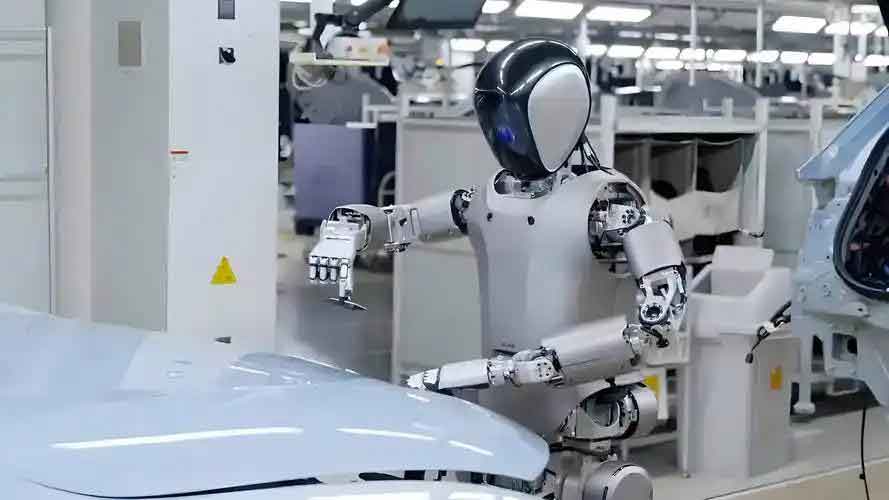
The humanoid robot is the ultimate expression and test of these three dimensions of embodiment. Its design is predicated on the hypothesis that a human-like morphology is not just aesthetically preferable but functionally critical for operating in environments built by and for humans. It serves as a powerful redefinition of what a robot is and can be.
Traditional robots are often task-specific machines (welding arms, vacuuming disks, rover wheels). A humanoid robot, in contrast, is conceived as a general-purpose embodied agent. Its value lies in its potential for flexibility and adaptability across a wide range of unscripted scenarios. Let us analyze its role through our three dimensions:
1. Sensorimotor Realization: The bipedal locomotion of a humanoid robot like Boston Dynamics’ Atlas is a masterpiece of dynamical balance and morphological computation. Its backflips and parkour are not the result of a central processor solving complex physics equations in real-time for every joint. Instead, they emerge from sophisticated control policies that exploit the passive dynamics of its mechanical structure, combined with robust balancing reflexes—a direct instantiation of sensorimotor embodiment. The physical body itself is performing computational work.
2. Situated Adaptation: A humanoid robot intended for caregiving or logistics must navigate cluttered, ever-changing environments. Its success depends on its ability to perceive situational affordances: is that space navigable? Is that object graspable? Is that person signaling for help? This requires a deep integration of multi-modal perception (vision, LiDAR, touch) with real-time world modeling and action planning. The shift is from pre-programmed “if-then” rules to generative models that predict the consequences of actions in a probabilistic world, allowing the robot to handle novelty.
3. Interactive Engagement: This is perhaps the most challenging frontier. A humanoid robot like Softbank’s Pepper or Amazon’s Digit is designed for collaboration. This demands more than voice commands. It requires the robot to understand gesture, gaze, proxemics (personal space), and the pragmatic context of dialogue. The robot must coordinate its actions temporally with a human partner, sometimes leading, sometimes following. This interactive embodiment transforms the human-robot dyad into a new, coupled cognitive system where intelligence and task accomplishment are distributed.
The landscape of humanoid robot development can be categorized by their primary embodiment challenges:
| Robot Class | Primary Embodiment Dimension | Key Technological Challenge | Example Tasks |
|---|---|---|---|
| Dynamic Locomotion Bots | Sensorimotor | Balancing, agile motion on uneven terrain | Search & Rescue, Inspection |
| Industrial Manipulation Bots | Precise, adaptive manipulation in semi-structured environments | Assembly, Logistics | |
| Social Interaction Bots | Interactive | Natural dialogue, emotion recognition, collaborative action | Elder Care, Customer Service, Education |
| General-Purpose Bots | All Three | Integration of all capabilities into a unified, adaptive cognitive architecture | Home Assistant, True General Assistant |
Critical Reflections and the Ontological Gap
Despite the remarkable progress, a critical phenomenological analysis reveals a profound gap between the functional simulation of embodiment and its lived reality. The humanoid robot, for all its advances, operates within a different ontological register than a human being.
From a phenomenological stance, the human body is not just a functional organism but a “lived body” (Leib)—the transcendental condition for having a world at all. It is the source of pre-reflective, pre-predicative understanding that underlies all explicit thought. Our embodiment gives rise to a field of meanings that are felt, not computed. The “sittability” of a chair is not a logical inference but a direct perceptual invitation shaped by a lifetime of bodily experience.
The humanoid robot, in contrast, possesses a “functional body” (Körper). Its “understanding” is ultimately derivative, built from statistical correlations learned from vast datasets and reinforced through reward signals. It can mimic the output of embodied cognition—grasping the chair, sitting down—but it lacks the inner, first-person perspective of being a body that is itself the ground of experience. It does not have a “point of view” in the existential sense; it has a sensor origin in a coordinate frame. This distinction points to a fundamental limit: current AI, even in its most advanced embodied forms like the humanoid robot, may be incapable of accessing the pre-reflective, meaning-generating structures of lived embodiment.
This ontological gap manifests in several concrete challenges:
- The Frame Problem: How does the robot determine, from an infinite set of facts, which ones are relevant to its current situation? Humans do this effortlessly based on bodily concern.
- The Symbol Grounding Problem: How do the internal symbols (or neural activations) of the AI acquire genuine meaning, rather than just functional associations? For humans, meaning is grounded in bodily experience.
- The Problem of Common Sense: The vast, unstated network of assumptions about the physical and social world that guides human action remains elusive for robots.
We can formalize a measure of this gap. Let \( E_h \) represent the rich, lived embodied experience of a human, and \( E_r \) represent the functional embodiment of a humanoid robot. The robot’s performance \( P \) on a task \( T \) is a function of its ability to approximate human-like behavior:
$$ P_r(T) = f(\Phi(E_r, T)) $$
where \( \Phi \) is its policy function. The human performance \( P_h(T) \) is grounded differently:
$$ P_h(T) = g(E_h, T) $$
The gap \( \Delta \) is not just a performance difference but an ontological one:
$$ \Delta = \int | g(E_h, T) – f(\Phi(E_r, T)) | dT $$
This integral over all possible tasks \( T \) highlights that the robot’s approximation, while possibly effective in a narrow domain, lacks the deep, generative foundation of \( E_h \).
Conclusion: Toward a New Ontology of Artificial Intelligence
The journey toward embodied artificial intelligence, exemplified by the ambitious project of the humanoid robot, is fundamentally reshaping our understanding of intelligence itself. By moving beyond the computational-representational paradigm, we are forced to acknowledge that intelligence is an enacted, situated, and interactive phenomenon. The three dimensions of embodiment—sensorimotor, situated, and interactive—provide a robust framework for both analyzing natural cognition and designing artificial systems.
The humanoid robot serves as an indispensable catalyst in this intellectual and technological endeavor. It materializes our theories, providing a concrete testbed where philosophical concepts like affordances, coupling, and intercorporeality must be translated into algorithms, sensors, and actuators. Its successes demonstrate the power of the embodied approach, enabling robustness and adaptability in open environments. Its failures and limitations, however, are equally instructive. They reveal the profound depth of human embodiment, pointing to the pre-reflective, transcendental structures of lived experience that remain, for now, beyond the reach of functional simulation.
Therefore, the ultimate significance of the humanoid robot may not lie in its eventual replication of human intelligence. Rather, it lies in its role as a philosophical mirror, reflecting back to us the intricate, mysterious, and constitutive relationship between body, mind, and world. It challenges us to develop a new ontology for artificial agents—one that takes embodiment seriously as the very condition for having a world and engaging in meaningful action within it. This pursuit demands continued collaboration across philosophy, cognitive science, and engineering, and must be accompanied by sustained ethical vigilance as we create agents that move and interact among us with increasing autonomy and social presence.