
The task of harvesting fruits and vegetables is characterized by its strong seasonality, high labor intensity, and significant cost. The imperative to ensure timely harvest while reducing expenses is a critical strategy for enhancing economic returns in agriculture. In this context, the development of cost-effective harvesting robots has become a major focus. The fundamental design objective of these robots is to alleviate the physical burden on human laborers, reduce production costs, enhance operational efficiency, and maintain the quality of the produce, ensuring it is collected at its optimal ripeness. At the heart of any harvesting robot lies its end effector. This component is the direct interface with the crop and is arguably the most critical subsystem, as it fundamentally dictates the robot’s work efficiency and the quality of the harvested target. Therefore, in-depth research and innovative design of the end effector hold profound significance for the advancement of agricultural automation.
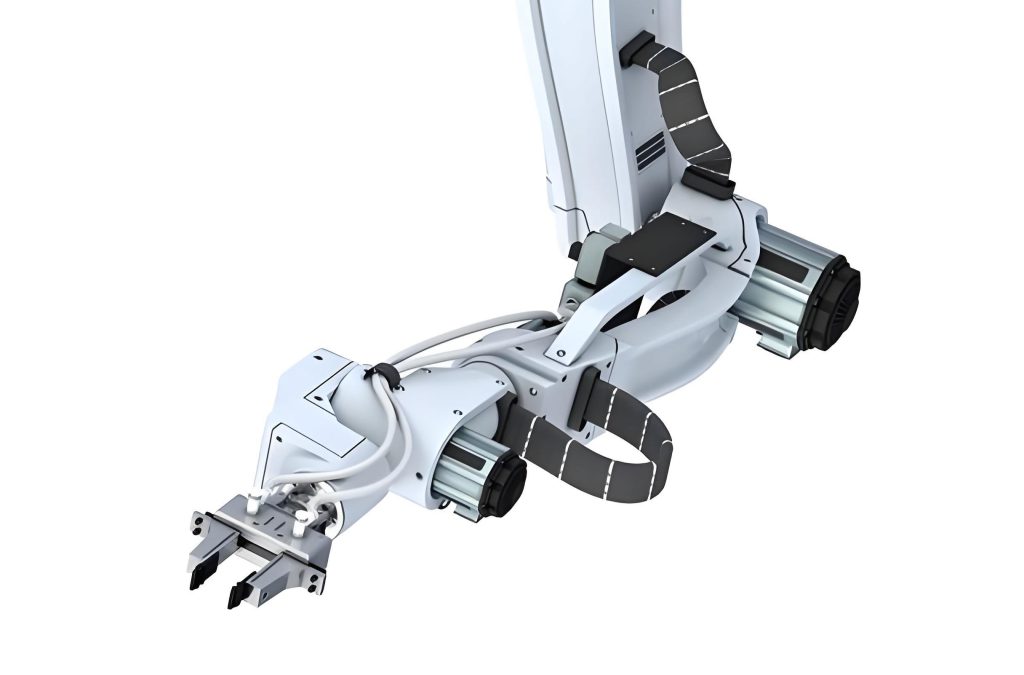
The operational environment for a harvesting end effector is defined by several key challenges. Firstly, there is immense diversity and uncertainty in the harvest targets. Crops vary widely in type, and their growth state is intimately connected to time and space, changing with environmental conditions. This demands that a harvesting robot’s end effector possesses a degree of versatility and intelligence to adapt to shifting natural environments and different crop types while maintaining normal functionality and efficiency.
Secondly, the physical vulnerability of fruits and vegetables is a paramount concern. Their delicate and easily bruised nature requires extremely careful handling during picking. Given the variety in shapes and differences in growth and ripening stages, the harvesting robot’s end effector must apply an appropriate and carefully controlled grasping force to avoid damaging the produce, which would compromise its market value and shelf life.
The design of the end effector is heavily influenced by the category of the target crop. We can classify common approaches based on the size and morphology of the fruit or vegetable, as summarized in the table below.
| Target Category | Example Crops | Common End Effector Strategies | Key Design Considerations | |
|---|---|---|---|---|
| Small Fruits | Strawberry, Lychee | Compact grippers, suction+cutter integration, cable-driven fingers. | Precision, low inertia, gentle grip to avoid crushing delicate skin. | |
| Medium-Soft Fruits | Kiwifruit, Tomato | Encompassing grippers, twisting mechanisms, suction-based detachment. | Compliant materials, force control for soft flesh, reliable stem separation. | |
| Medium-Hard Fruits | Apple, Citrus | Multi-finger grasping, cutting or snapping mechanisms. | Robust grip, precise cutter alignment, higher allowable gripping force. | |
| Large Fruits | Pineapple | Two-finger clamps with progressive engagement, rotating cutters, large surface area contact. | High payload capacity, stable grip on irregular shape, powerful cutting torque. | |
| Elongated Vegetables | Asparagus, Chili Peppers | Pinching grippers, specialized cutting blades aligned with the stem. | Precision alignment for slender targets, selective harvesting logic. |
The grasping force $F_g$ required by an end effector must be sufficient to hold the fruit against gravity and inertial forces during rapid motion, yet below the damage threshold $F_d$ of the crop. This can be expressed as a fundamental constraint:
$$ F_{min} \leq F_g \leq F_d $$
where $F_{min}$ is the minimum force needed to prevent slippage, often calculated considering the weight $mg$ of the fruit, the coefficient of friction $\mu$, and a safety factor $k_s$:
$$ F_{min} = k_s \cdot \frac{mg}{\mu} $$
The research and development of harvesting end effector technology has evolved significantly over decades, with pioneering work in Europe, Japan, and later, China. The advancement has been accelerated by progress in industrial robotics, computer vision, and artificial intelligence. Current mainstream end effector designs can be broadly categorized by their actuation and operational principles.
Actuation and Operational Paradigms
1. Electro-Pneumatic End Effectors
These end effector designs utilize pneumatic actuators (air cylinders, pneumatic muscles, suction cups) controlled by electric valves. They are favored for their relatively low cost, high power-to-weight ratio, and inherent compliance, which can be beneficial for handling delicate produce.
- Suction and Grip Integration: A common design uses a suction cup to initially attract and pull the fruit into a chamber or against a backing surface, followed by pneumatic fingers or an inflatable bladder to secure it. A final twisting or cutting action separates the stem. The suction force $F_s$ is given by:
$$ F_s = P \cdot A $$
where $P$ is the pressure difference and $A$ is the effective area of the suction cup. - Full-Pneumatic Systems: Some designs employ entirely pneumatic circuits for all actions—gripping, cutting, and releasing—simplifying the electrical control system but requiring a compressed air supply on the robot platform.
2. Electro-Mechanical End Effectors
These are driven by electric motors (DC, stepper, or servo) through gearboxes, linkages, or screw mechanisms. They offer precise position and speed control, which is crucial for complex manipulation sequences.
- Multi-Fruit Harvesting Strategy: Some end effector designs implement strategies like approaching multiple fruits from below and inducing a coordinated twisting motion to sever stems at the abscission layer simultaneously, improving efficiency.
- Specialized Mechanisms: Designs based on principles like a “shutter mechanism” or multi-bar linkages have been developed for specific fruits like pineapples, providing a combination of clamping and rotating actions to loosen and detach the fruit.
3. Bio-Inspired/Adaptive Gripping End Effectors
This is a growing area of research focused on mimicking the adaptive and gentle grasping found in nature. These end effector designs often use under-actuated linkage systems, soft robotics principles, or compliant materials.
- Under-Actuated Fingers: Using fewer motors than degrees of freedom, these grippers can conform to irregular fruit shapes passively, distributing grip force and reducing point stresses. The kinematics of an under-actuated finger can be complex, often requiring static equilibrium models to predict the contact forces $F_{c_i}$ at each phalanx:
$$ \sum_{i=1}^{n} J_i^T F_{c_i} = \tau $$
where $J_i$ is the Jacobian for the i-th contact point and $\tau$ is the applied joint torque. - Soft Robotic Grippers: Made from elastomers and actuated by pneumatic pressure (pneu-nets), these grippers offer extreme conformity and safety but can have challenges with precision and speed.
| End Effector Type | Advantages | Disadvantages | Typual Applications |
|---|---|---|---|
| Electro-Pneumatic | High force density, compliant, low cost for actuators, fast motion. | Requires air compressor, potential for leakage, less precise position control. | Tomatoes, apples, soft fruits where gentle, encompassing grip is needed. |
| Electro-Mechanical | High precision, excellent position/speed control, no need for air supply. | Can be heavier, more complex transmission, higher point contact stress risk. | Citrus, kiwifruit, pineapples where specific twisting or cutting trajectories are required. |
| Bio-Inspired/Adaptive | Excellent shape conformity, low risk of damage, simple control for grasping. | Slower cycle times, can be difficult to model and control precisely, durability concerns with soft materials. | Delicate berries, clustered fruits, irregularly shaped vegetables. |
Persistent Challenges and Technical Limitations
Despite rapid development, significant challenges hinder the widespread adoption of harvesting robots, many of which are intrinsically linked to the performance and design of the end effector.
1. Low Harvesting Efficiency: Overall cycle time remains a critical bottleneck. Inefficiencies stem from:
- Positioning Errors: Inaccurate guidance from the vision system leads to the end effector missing the target or approaching at a suboptimal angle, requiring time-consuming re-positioning.
- Complex Sequential Actions: The typical harvest cycle—move, identify, approach, grasp, cut/separate, retract, place—is inherently lengthy. Each step adds time, and the mechanical sequence of the end effector itself (e.g., open → advance → close → cut → retract → open to release) is often not optimized for minimal time.
- Slow Actuation: Especially in pneumatic or complex mechanical end effector designs, the time for fingers to close, cutters to deploy, or mechanisms to reset can be substantial.
2. Fruit Damage: Minimizing damage is a non-trivial control problem.
- Grasping Force Control: While force sensors can regulate grip, the variation in fruit size, ripeness (which changes modulus of elasticity $E$), and positioning within the gripper makes consistent, damage-free grasping difficult. The contact pressure $P_c$ must be kept below a damage threshold $P_{damage}$:
$$ P_c = \frac{F_g}{A_{contact}} < P_{damage} $$
Accurately estimating the real contact area $A_{contact}$ for a deformable fruit is challenging. - Stem Separation Trauma: Cutting or breaking the stem often causes collateral damage. Misalignment of the cutter, applying excessive force, or cutting too far from the fruit body can bruise the fruit or leave a long stem that damages others in the container.
3. Lack of Universality and Adaptability: The vast majority of end effector designs are highly specialized for a single crop or a very narrow range of similar crops. This specificity leads to high costs for farmers who grow multiple produce types, as they would need to invest in different end effector modules or entire different systems. The mechanical design, control parameters, and harvesting strategy are often not transferable.
4. High Cost and Maintenance: The requirement for high precision, reliability in dirty and humid environments, and complex functionality drives up the manufacturing cost of a robust end effector. Furthermore, their relatively short annual usage period (seasonal harvesting) coupled with exposure to harsh conditions leads to wear and tear, resulting in high lifetime costs and maintenance overhead, negatively impacting the return on investment.
| Core Challenge | Root Cause | Potential Solution Direction |
|---|---|---|
| Low Efficiency | Sequential actions, vision/positioning delays, slow mechanism reset. | Parallel action design, faster/ smarter vision algorithms, optimized mechanism kinematics for speed. |
| Fruit Damage | Poor force control, non-conforming grip surfaces,粗暴 stem separation. | Advanced force/tactile sensing, compliant/adaptive gripping surfaces, targeted abscission-layer detachment methods. |
| Lack of Universality | Overly specialized mechanical design and control logic. | Modular, reconfigurable end effector architectures, machine learning for adaptive control. |
| High Cost | Complex mechanisms, need for precision components, low production volume. | Design for manufacture and assembly (DFMA), use of commercial off-the-shelf (COTS) components, modularity to share base systems. |
Future Research Directions and Outlook
The evolution of the harvesting robot end effector will be driven by interdisciplinary advances aimed at overcoming the aforementioned challenges. Several promising directions are emerging.
1. Standardization of the Harvesting Environment: As agriculture moves towards more controlled, factory-like settings (vertical farms, high-tech greenhouses), the operating environment for the end effector becomes more predictable. Fixed lighting, known plant spacing, and standardized growth protocols simplify the perception and manipulation tasks. In such environments, the end effector can be optimized for a single, highly repeatable action, drastically improving reliability and speed.
2. High-Degree Coordination with the Manipulator Arm: The end effector should not be designed in isolation. Its performance is inextricably linked to the manipulator that carries it. Future systems will feature tighter kinematic and dynamic coupling. The arm’s trajectory can be planned to present the end effector to the fruit in an optimal orientation, and the arm’s compliance or force control can augment the end effector‘s own damping characteristics. The combined system dynamics can be modeled as:
$$ M(q)\ddot{q} + C(q, \dot{q})\dot{q} + G(q) = \tau_{arm} + J_{ee}^T F_{env} $$
where $q$ represents the combined joint angles, $M$ is the inertia matrix, $C$ accounts for Coriolis forces, $G$ for gravity, $\tau_{arm}$ is the arm actuator torque, $J_{ee}$ is the end effector Jacobian, and $F_{env}$ is the interaction force with the fruit/environment.
3. Simplification and Modularization of the End Effector: Contrary to adding more complexity, a key trend is strategic simplification. The goal is to create lightweight, compact, and fast end effector units that perform a minimal set of reliable actions. Inspired by the tool-changing systems of industrial machining centers, a highly promising avenue is the development of a quick-change, modular end effector interface. A single robot arm could automatically switch between different specialized end effector modules—a gentle suction gripper for tomatoes, a three-finger cutter for citrus, a twisting hook for kiwifruit—based on the crop row it is servicing. This approach maximizes utility and addresses the universality problem. The design challenge shifts to creating a robust, precise, and rapid coupling mechanism for power and data transmission.
4. Deep Integration of Intelligent Technologies: The next generation end effector will be a smart sensor-actuator system. Deep integration of advanced sensing (3D vision, tactile arrays, force/torque sensing, spectroscopy for ripeness) with real-time processing (often at the edge) will enable closed-loop, adaptive control. Machine learning algorithms will not only identify fruit but also predict its ripeness and estimate its firmness to dynamically adjust the end effector‘s grip force $F_g(t)$ using an adaptive controller, perhaps based on a model-reference adaptive system (MRAS) or a fuzzy logic controller whose rules adjust based on visual ripeness cues.
A simple adaptive force control law could be:
$$ F_g(t) = K_p e(t) + K_i \int e(t)dt + K_d \frac{de(t)}{dt} + \hat{\Theta}^T \Phi(F_{sens}, V_{ripe}) $$
where $e(t)$ is the error between desired and sensed force, $K_p, K_i, K_d$ are PID gains, and the last term represents an adaptive adjustment based on a parameter estimate $\hat{\Theta}$ and a feature vector $\Phi$ derived from sensor feedback $F_{sens}$ and visual ripeness estimate $V_{ripe}$.
5. Enhanced Universality through Adaptive Mechanics and Control: Beyond modular swapping, research into genuinely versatile end effector designs continues. This includes universal grippers using granular jamming or phase-change materials, and highly under-actuated multi-fingered hands controlled by sophisticated algorithms that can shape themselves to everything from a bell pepper to an apple. The control paradigm for such an end effector moves from precise trajectory tracking to goal-directed, perception-driven manipulation.
| Research Direction | Key Enabling Technologies | Expected Impact on End Effector |
|---|---|---|
| Environment Standardization | Controlled Environment Agriculture (CEA), vertical farming systems. | Simpler, faster, more reliable end effector designs optimized for a single, repeatable task. |
| Arm-Effector Co-Design | Integrated kinematics/dynamics simulation, whole-body control. | Superior performance through optimized system-level motion planning and force interaction. |
| Modular Quick-Change Systems | Standardized mechanical/electrical interfaces (e.g., inspired by ISO 9409), automatic tool changers. | One robot platform can harvest multiple crops, solving the universality problem and improving cost-effectiveness. |
| Embedded Intelligence | Micro-sensors (tactile, force), edge AI processors, real-time computer vision. | Autonomous, adaptive decision-making at the end effector level for damage-free harvesting in variable conditions. |
| Universal Gripping | Soft robotics, variable stiffness materials, machine learning for grasp planning. | A single end effector design capable of handling a wide morphological range of produce. |
In conclusion, as demographic shifts and labor shortages increasingly affect agriculture, the adoption of robotic harvesting systems is set to accelerate. The end effector, as the crucial terminal component of these robots, will remain a primary focus of research and innovation. Current limitations in accuracy, efficiency, gentleness, and cost largely stem from the design and capabilities of the end effector. Therefore, sustained and innovative research into its mechanical design, actuation principles, sensory integration, and control algorithms is imperative. By pursuing the directions of lightweight and modular structures, optimized operational workflows, deep integration of smart technologies, and enhanced adaptability, we can drive the advancement of the harvesting robot end effector. This progress will be instrumental in pushing agricultural mechanization towards a higher-quality, intelligent future, providing solid equipment support for the development of modern, sustainable agriculture.