
The automation of hammer die forging lines represents a significant challenge within heavy manufacturing, particularly for components like those used in coal mining machinery. The core objective is to replace human labor in environments characterized by extreme heat, noise, and physical strain. A critical component enabling this automation is the industrial manipulator’s end effector, which must directly interface with and manipulate the hot forging. The primary difficulty lies in the severely reduced strength of steel at forging temperatures (often above 800 °C), making the workpiece body highly susceptible to deformation or damage (“pinching”) if gripped directly. Therefore, the design of a specialized end effector is paramount. This article details the design, kinematic and dynamic simulation, and finite element analysis of a novel end effector specifically engineered for the automated handling of forgings with flash, using a scraper beam as a representative example.
1. End Effector Design Philosophy and Specifications
The design process begins with defining the operational requirements and constraints of the forging station. The end effector must perform a sequence of prying, grasping, leveling, flipping, and placing operations on a hot forging weighing approximately 25 kg. Crucially, to avoid damaging the main body of the forging, the gripping action must be applied to the flash (the thin, excess material formed around the edges), which typically has a thickness between 7 and 10 mm.
A SR165 series industrial manipulator was selected as the host robot due to its payload capacity, reach, and speed, which align with the operational envelope required around a forging hammer. The key specifications for the designed end effector are summarized in Table 1.
| Parameter | Value |
|---|---|
| Max. Payload (N) | ≤ 116.7 |
| Mass (kg) | ≤ 48.3 |
| Dimensions L×W×H (mm) | 658 × 246 × 224 |
| Clamping Force (N) | ≤ 1154.5 |
Gripping Method: After evaluating common methods, a clamp-type end effector was chosen. While suction and magnetic types are unsuitable for hot, irregular surfaces, a mechanical clamp offers the necessary adaptability, strength, and control for securely gripping the flash.
Actuation Method: Pneumatic actuation was selected for the end effector. It provides a favorable balance of sufficient force, simplicity, reliability, and safety. Furthermore, compressed air is typically already available on forging lines for operations like graphite spray lubrication, simplifying integration.
2. Structural Design and Operational Principle of the End Effector
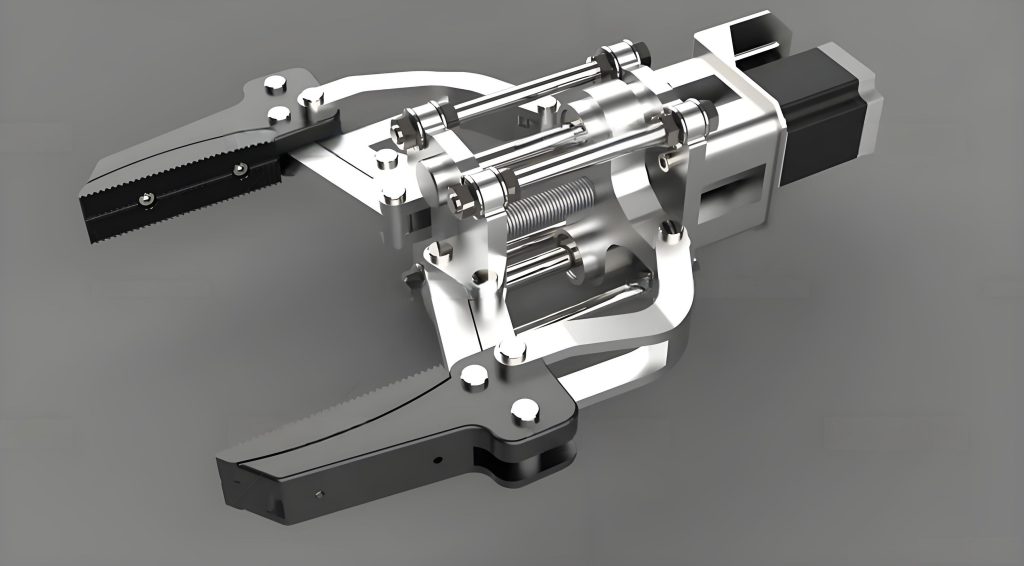
The end effector employs a modular, two-finger rotary clamp design with a distinctive asymmetric finger configuration. It is composed of four main modules: the Finger Module, the Support Module, the Transmission Module, and the Drive/Flange Module.
2.1 Finger Module: The Asymmetric Gripper
This is the core working unit. Instead of identical fingers, it features one short finger and one long finger on each side of a central “Y-shaped” knuckle. This asymmetry is fundamental to its operation:
- Short Finger: Designed to be inserted beneath the forging’s flash to initially pry and lift it from the die cavity.
- Long Finger: As the short finger lifts the forging, the long finger closes in from above to securely clamp the flash between the two fingers.
The fingers are connected via the “Y-shaped” knuckle to an inner and outer enveloping knuckle, forming a four-bar linkage mechanism. This design allows for the necessary rotational and translational movement to achieve the prying-and-clamping action.
2.2 Transmission Module: Converting Linear to Rotary Motion
This module translates the linear motion of the pneumatic cylinder’s push rod into the opening/closing rotary motion of the finger module. Its central component is a specially designed transmission block that connects to the outer enveloping knuckle of the finger module, forming a slider-crank mechanism.
A critical design innovation here is the shape of the groove in the transmission block. A traditional straight groove can lead to a kinematic dead point where the mechanism jams. To solve this, the groove was designed as a curved channel, angled 15 degrees downward at its outer end. This modification successfully eliminates the dead point, ensuring smooth and reliable operation throughout the entire stroke of the end effector. The force transmission can be analyzed by considering the mechanism’s geometry. The relationship between the cylinder stroke (input) and the finger closure (output) is governed by the linkage dimensions.
2.3 Support and Drive Modules
The Support Module forms the rigid chassis of the end effector, providing mounting points for all other modules. The Drive Module is centered on a TCM50×50S three-axis pneumatic cylinder. The required cylinder specifications were determined through subsequent dynamic simulation. The Flange Module adapts the entire assembly to the wrist of the SR165 manipulator.
2.4 Operational Sequence of the End Effector
The end effector executes a five-step process to safely extract and manipulate the hot forging:
- Prying: The end effector approaches the forging in the die with fingers open. The short fingers slide under the flash.
- Clamping: The cylinder actuates, causing the short fingers to lift (pry) and the long fingers to close downward, securely pinching the flash.
- Leveling: Once clear of the die, the manipulator adjusts its orientation to bring the forging to a horizontal plane, with the short fingers on the bottom.
- Flipping: The entire end effector (or the robot’s wrist) rotates 180°, positioning the longer, more supportive fingers underneath the forging for a more stable carrying posture.
- Placing/Releasing: The forging is transported and accurately placed into the next die or onto a transfer bed, after which the end effector releases it.
3. Kinematic and Dynamic Simulation of the End Effector
To validate the design and size the actuator, a multi-body dynamics simulation was performed using ADAMS. The model incorporated material properties (42CrMo steel for transmission parts, 06Cr25Ni20 stainless steel for others) and appropriate joints (revolute, translational, contacts). A simulated 25 kg forging was used as the load.
3.1 Kinematic Analysis
The simulation confirmed the motion sequence over a 3-second period: clamping (0-1s), hold (1-2s), and 180° flip (2-3s). The key result was the required stroke of the pneumatic cylinder’s push rod. The displacement curves for two symmetric push rods are conceptually represented by the function $y(t)$, where a step change occurs during the clamping phase.
The analysis showed that the push rod must travel a minimum of 14.5 mm to achieve full finger closure. This directly informed the selection of a 50 mm stroke cylinder to provide ample margin. The motion of the transmission block and the change in distance between the long and short fingers were also tracked, confirming the mechanism’s correct operation without interference or dead points.
3.2 Dynamic Analysis
The dynamic simulation provided critical data for sizing the pneumatic system. The primary output was the force required from the cylinder push rod. The simulated force profile $F_{rod}(t)$ peaked during the clamping action against the forging. The maximum required force was found to be:
$$ F_{rod}^{max} = 964.38 \\, \\text{N} $$
This value is essential for calculating the necessary cylinder bore diameter. The theoretical force output of a pneumatic cylinder is given by:
$$ D = \\sqrt{\\frac{4 \\cdot F}{\\pi \\cdot \\eta \\cdot P}} $$
Where:
- $D$ = Cylinder bore diameter (m)
- $F$ = Required force = 964.38 N
- $P$ = Supply pressure = 0.6 MPa (6×10⁵ Pa)
- $\eta$ = Cylinder efficiency (assumed 0.9)
Substituting the values:
$$ D = \\sqrt{\\frac{4 \\times 964.38}{\\pi \\times 0.9 \\times 6 \\times 10^5}} \\approx 0.0478 \\, \\text{m} = 47.8 \\, \\text{mm} $$
This calculation confirmed that a standard 50 mm bore cylinder (like the TCM50) is adequately sized for the end effector. The forces at the pin-transmission block interfaces and at the finger-forging contact points were also analyzed. The contact forces on the long fingers, which bear the primary load during carrying, averaged approximately 60 N, with peaks near 190 N.
| Contact Pair | Min Force (N) | Max Force (N) | Avg Force (N) |
|---|---|---|---|
| Finger 1 (Long) | 2.87 | 164.38 | 58.62 |
| Finger 2 (Long) | 9.78 | 187.37 | 64.04 |
4. Finite Element Analysis for Structural Integrity
Static structural analyses were conducted using ANSYS Workbench on the two most critically loaded modules: the Transmission Module and the Finger Module.
4.1 Transmission Module Analysis
The transmission module assembly (including the push rod and block) was constrained appropriately, and the maximum simulated push rod force of 970 N was applied as the load.
Results:
- Maximum Total Deformation: 0.482 mm, located on the cylinder push rod.
- Maximum Equivalent Elastic Strain: 0.0037994.
The corresponding stress level implied by this strain is well below the yield strength of 42CrMo steel, confirming the module’s safety factor under operational loads.
4.2 Finger Module Analysis
A static analysis was performed on the long finger, applying a conservative point load of 190 N (based on dynamic simulation peaks) to its tip.
Results:
- Maximum Total Deformation: 0.189 mm at the fingertip.
- Maximum Equivalent Elastic Strain: 0.00034405.
This very low strain value confirms that the finger, fabricated from 06Cr25Ni20 stainless steel, possesses substantial strength reserves and will not plastically deform during the gripping and handling of the forging.
5. Conclusion
The design and analysis of a specialized end effector for hammer die forging automation has been presented. The key outcomes are:
- The developed asymmetric two-finger, rotary clamp end effector successfully addresses the core challenge of handling hot forgings by gripping the flash, thereby preventing damage to the critical workpiece body.
- The innovative curved-groove design in the transmission block effectively eliminates kinematic dead points, ensuring reliable operation.
- Kinematic and dynamic simulation using ADAMS provided essential design parameters: a minimum cylinder stroke of 14.5 mm and a maximum required actuation force of 964.4 N. This data validated the selection of a TCM50×50S pneumatic cylinder.
- Finite Element Analysis confirmed the structural integrity of the end effector. Both the transmission and finger modules exhibited maximum deformations below 0.5 mm and equivalent strains (0.0038 and 0.00034 respectively) that are orders of magnitude below the yield limits of their respective materials.
This work demonstrates a viable and robust end effector solution. The integration of this end effector with an industrial manipulator like the SR165 provides the necessary technical foundation for automating hammer die forging processes, ultimately contributing to the advancement of intelligent, safer, and less labor-intensive forging production lines.