
In this article, we explore the technological landscape of end effectors used in fruit picking automation. The end effector, as a critical component of robotic systems, directly influences harvesting efficiency, precision, and fruit quality. We analyze the current status of various end effector types, including flexible and rigid designs, as well as shearing and suction-based mechanisms. Drawing from research and developments, we summarize preliminary achievements in improving harvesting efficiency and reducing labor dependency. Furthermore, we discuss challenges such as adaptation to planting patterns and autonomous robot positioning. Finally, we propose future directions focusing on the integration of agricultural machinery with agronomy, enhancement of end effector versatility, and the pursuit of more efficient and intelligent fruit harvesting solutions.
The global fruit cultivation industry is a cornerstone of agricultural economies, vital for producing fruits and nuts to meet rising health-conscious demands. However, profitability is often constrained by high labor costs and inefficiencies in harvesting, which typically account for a significant portion of production expenses. With increasing labor costs and an aging workforce, automation through harvesting robots has emerged as a key solution. Among robotic components, the end effector plays a pivotal role in ensuring successful fruit detachment with minimal damage. The design of an end effector must account for diverse fruit characteristics, such as shape, size, and sensitivity to pressure. While advancements in end effector technology have propelled automation forward, challenges remain in adapting to variable agricultural environments. This article delves into the technical nuances of end effectors, examining their mechanisms, performance, and future potential. We emphasize the importance of the end effector in achieving low-damage, high-efficiency harvesting, and we highlight how innovative designs can overcome existing limitations.
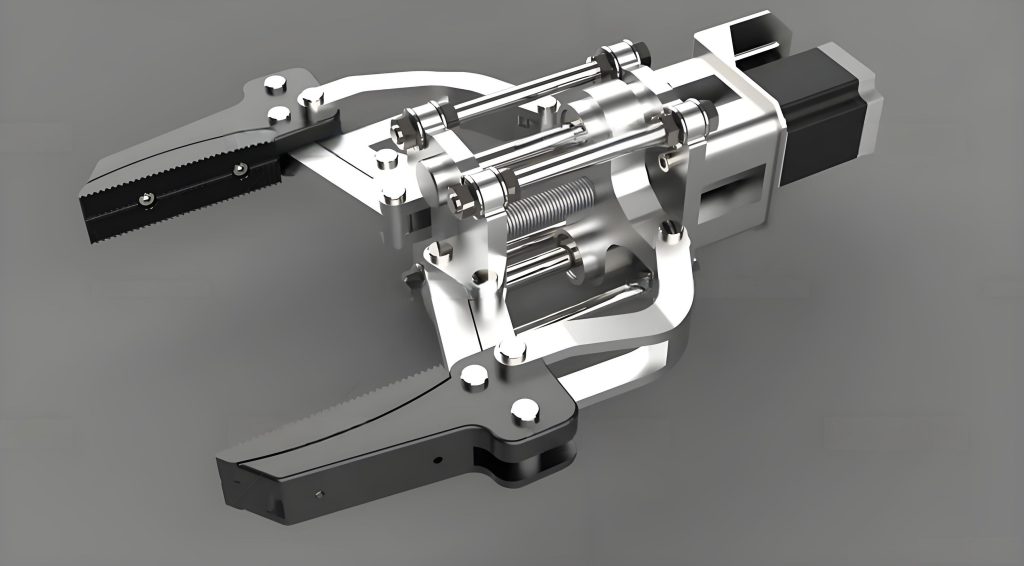
To understand the evolution of end effectors, we first categorize them based on mechanical properties: flexible and rigid end effectors. Flexible end effectors are designed to conform to fruit shapes, reducing stress concentration and minimizing bruising. They often employ pneumatic or tendon-driven mechanisms to achieve compliant grasping. For instance, pneumatic multi-joint flexible end effectors use inflatable bladders or soft actuators to wrap around fruits gently. The bending behavior of such end effectors can be modeled using constant curvature kinematics. Consider a flexible finger composed of multiple segments; the relationship between input pressure and bending angle can be expressed as: $$ \theta_i = k_i P_i $$ where $\theta_i$ is the bending angle of segment $i$, $P_i$ is the applied pressure, and $k_i$ is a constant dependent on material properties and geometry. For an entire finger with $n$ segments, the total curvature $\kappa$ is approximated by: $$ \kappa = \sum_{i=1}^{n} \frac{\theta_i}{L_i} $$ where $L_i$ is the length of each segment. This allows for precise control of grasping force distribution. In practice, flexible end effectors have demonstrated success in harvesting delicate fruits like tomatoes and strawberries, with studies reporting reduced damage rates below 5%. The adaptability of these end effectors makes them suitable for unstructured environments where fruit poses vary widely.
In contrast, rigid end effectors rely on stiff materials and precise actuation to grasp fruits. They typically feature multi-finger designs driven by servomotors or pneumatic cylinders. The grasping force is often controlled through feedback systems using pressure or torque sensors. For a rigid two-finger gripper, the force exerted on a fruit can be described by: $$ F_g = \frac{T}{r} \eta $$ where $F_g$ is the grasping force, $T$ is the motor torque, $r$ is the effective radius at the contact point, and $\eta$ is the efficiency factor accounting for friction and mechanism losses. To prevent fruit damage, force thresholds are set based on fruit compressive strength. For example, kiwifruit can withstand forces up to 10 N without bruising, so end effectors are programmed to limit $F_g$ below this value. Rigid end effectors excel in speed and durability, with some achieving harvesting cycles under 2 seconds and success rates over 90%. However, they require accurate positioning to avoid misalignment that could cause punctures or scratches. The table below summarizes key parameters for flexible and rigid end effectors based on reported studies.
| End Effector Type | Actuation Method | Typical Grasping Force Range | Adaptability to Fruit Shapes | Damage Rate (%) | Harvesting Cycle Time (s) |
|---|---|---|---|---|---|
| Flexible End Effector | Pneumatic/Tendon-driven | 0.5 – 5 N | High | < 5 | 3 – 10 |
| Rigid End Effector | Servomotor/Pneumatic | 2 – 15 N | Moderate | 2 – 10 | 1 – 5 |
Beyond flexibility and rigidity, end effectors can be classified by their detachment mechanism: shearing and suction-based designs. Shearing end effectors target fruit stems, making them ideal for cluster fruits like grapes or cherries. They integrate clamping fingers and cutting blades to sever stems without contacting the fruit body. The cutting force required depends on stem diameter and toughness. For a circular stem, the shear stress $\tau$ needed for cutting is: $$ \tau = \frac{F_c}{A_s} $$ where $F_c$ is the cutting force and $A_s$ is the cross-sectional area of the stem. Experimental data show that for grape stems, $F_c$ typically ranges from 2 to 8 N. Shearing end effectors often incorporate vision systems to locate stems accurately, but challenges arise when stems are occluded by foliage. Success rates for such end effectors vary from 80% to 95%, with damage primarily due to misalignment rather than cutting action.
Suction-based end effectors, on the other hand, use negative pressure to adsorb fruits, minimizing physical contact. They consist of soft suction cups connected to vacuum pumps. The adsorption force $F_a$ is given by: $$ F_a = P_a \cdot A_c $$ where $P_a$ is the pressure difference (vacuum level) and $A_c$ is the effective contact area. For spherical fruits like apples, $A_c$ approximates a circle, so $F_a$ scales with fruit radius. However, irregularities on fruit surfaces (e.g., stems or dimples) can break the seal, reducing $F_a$. To compensate, adaptive suction cups with flexible rims are used. Suction end effectors are praised for low damage rates (often below 2%), but they struggle with non-spherical fruits or those with rough surfaces. Moreover, they may inadvertently harvest unripe fruits if selectivity relies solely on vision. The following table contrasts shearing and suction end effectors.
| End Effector Type | Target Component | Typical Force/ Pressure | Fruit Types | Success Rate (%) | Advantages |
|---|---|---|---|---|---|
| Shearing End Effector | Stem | 2 – 8 N cutting force | Cluster fruits (grapes, cherries) | 80 – 95 | Preserves fruit clusters; efficient for multiple fruits |
| Suction End Effector | Fruit surface | 20 – 60 kPa vacuum | Spherical fruits (apples, oranges) | 85 – 98 | Minimal contact; low damage; fast detachment |
To synthesize these insights, we analyze the characteristics of the four primary end effector types: flexible, rigid, shearing, and suction. Each end effector type has distinct operational principles and suitability based on fruit properties. For instance, the choice of an end effector often hinges on fruit susceptibility to static pressure injury. Flexible end effectors distribute pressure evenly, making them ideal for delicate fruits like berries. Rigid end effectors, while potentially causing stress concentration, are robust for thicker-skinned fruits such as citrus. Shearing end effectors excel in harvesting efficiency for stem-based detachment, while suction end effectors offer gentle handling for easily bruised spherical fruits. The decision matrix for selecting an end effector can be framed as an optimization problem: minimize damage $D$ while maximizing efficiency $E$, subject to constraints like fruit geometry $G$ and environmental conditions $C$. We express this as: $$ \text{Maximize } Z = w_1 E – w_2 D $$ subject to $$ f(G, C) \leq F_{\text{max}} $$ where $w_1$ and $w_2$ are weights, and $f(G, C)$ represents mechanical constraints (e.g., grasping force limits). This formulation underscores the trade-offs in end effector design.
In practical applications, the performance of an end effector is also influenced by integration with robotic systems. For example, the kinematic model of a robotic arm affects the end effector’s positioning accuracy. Consider a serial manipulator with $n$ joints; the end effector pose $\mathbf{x}$ is given by the forward kinematics: $$ \mathbf{x} = f(\mathbf{q}) $$ where $\mathbf{q}$ is the joint angle vector. For precise fruit picking, the end effector must align with the fruit’s location $\mathbf{x}_f$, detected by vision sensors. The error $\mathbf{e} = \mathbf{x}_f – \mathbf{x}$ is minimized using control algorithms. However, in dense orchards, occlusions and varying fruit poses increase $\mathbf{e}$, challenging the end effector’s effectiveness. Thus, advancements in end effector technology must go hand-in-hand with improvements in perception and control.
Despite progress, end effectors face significant challenges in real-world deployment. First, the diversity of fruit growth postures poses a major hurdle. In traditional orchards, fruits grow in unstructured patterns, making it difficult for end effectors to achieve optimal alignment. This is exacerbated by the lack of agronomic practices tailored for robotic harvesting. For instance, tree training systems that promote uniform fruit placement could enhance end effector accessibility. Second, existing planting modes often involve high-density layouts, limiting the operational space for robots. This not only reduces harvesting efficiency but also increases the risk of fruit or plant damage. To address this, we need synergistic approaches where planting configurations are optimized for robotic workflows, balancing density with robot maneuverability. Third, the generalizability of end effectors is limited. Most end effectors are designed for specific fruit types, necessitating frequent changes or multiple robots for mixed orchards. This raises costs and complexity. A promising direction is modular end effector design, where interchangeable components (e.g., different finger tips or suction cups) allow one end effector to handle various fruits. Such modularity could be quantified by a versatility index $V$, defined as: $$ V = \frac{N_{\text{fruit types}}}{N_{\text{modules}}} $$ where higher $V$ indicates better adaptability with fewer modules.
Looking ahead, the future of fruit picking end effectors lies in intelligent, adaptive systems. We envision end effectors equipped with multimodal sensors (e.g., tactile, force, vision) that provide real-time feedback for dynamic adjustment. For example, a flexible end effector could use pressure mapping to modulate grasping force continuously, ensuring safe handling even for irregular fruits. Moreover, the integration of machine learning can enable end effectors to learn optimal grasping strategies from data, improving success rates over time. Another key area is the development of universal end effector platforms that combine multiple functionalities, such as simultaneous suction and cutting. This could be modeled as a hybrid system where the end effector switches modes based on fruit detection: $$ \text{Mode} = \begin{cases} \text{Suction} & \text{if } d_{\text{stem}} > \text{threshold} \\ \text{Shearing} & \text{otherwise} \end{cases} $$ where $d_{\text{stem}}$ is the distance to the stem. Such adaptability would significantly enhance the end effector’s range of applications.
In conclusion, end effectors are pivotal to the advancement of automated fruit harvesting. Through this analysis, we have examined the technical nuances of various end effector types, highlighting their strengths and limitations. The end effector’s role in reducing labor dependency and improving fruit quality cannot be overstated. However, to achieve widespread adoption, we must overcome challenges related to planting patterns, robot autonomy, and end effector versatility. Future research should focus on the co-design of agronomic practices and robotic systems, fostering an ecosystem where end effectors operate seamlessly in optimized environments. Additionally, innovations in materials, actuation, and control will drive the next generation of end effectors toward greater efficiency and intelligence. By embracing these directions, we can unlock the full potential of robotic fruit picking, ensuring sustainable and profitable agriculture for years to come.
To further illustrate the technical details, we present a comprehensive table summarizing the operational parameters and performance metrics of different end effector types based on aggregated research. This table serves as a reference for designers and researchers aiming to select or develop end effectors for specific applications.
| End Effector Type | Typical Fruits | Grasping/Detachment Mechanism | Control System | Average Success Rate (%) | Average Damage Rate (%) | Cycle Time (s) | Key Challenges |
|---|---|---|---|---|---|---|---|
| Flexible End Effector | Tomato, Strawberry, Blueberry | Pneumatic inflation or tendon-driven wrapping | Pressure feedback, PID control | 88 – 94 | 3 – 8 | 4 – 12 | Slow response; limited force for large fruits |
| Rigid End Effector | Kiwifruit, Apple, Orange | Motor-driven finger closure | Force/torque feedback, impedance control | 90 – 96 | 2 – 10 | 2 – 6 | Risk of bruising; requires precise alignment |
| Shearing End Effector | Grape, Cherry, Lychee | Stem clamping and cutting | Vision-guided positioning, PWM for blades | 82 – 95 | 1 – 5 (stem-related) | 3 – 8 | Stem occlusion; difficulty in dense clusters |
| Suction End Effector | Apple, Peach, Plum | Vacuum adsorption | Pressure sensors, vision for targeting | 85 – 98 | < 2 | 1 – 5 | Seal breaking on irregular surfaces; non-selectivity |
In addition to tabular summaries, mathematical modeling plays a crucial role in end effector design. For instance, the dynamics of a fruit during detachment can be described using Newton’s laws. When an end effector applies a force $\mathbf{F}$ to detach a fruit of mass $m$, the equation of motion is: $$ m \ddot{\mathbf{x}} = \mathbf{F} – \mathbf{F}_{\text{stem}} – \mathbf{F}_{\text{gravity}} $$ where $\mathbf{F}_{\text{stem}}$ is the stem attachment force and $\mathbf{F}_{\text{gravity}}$ is gravitational force. By characterizing $\mathbf{F}_{\text{stem}}$ as a function of stem properties, end effectors can be tuned to apply optimal detachment forces. Similarly, for suction end effectors, the Bernoulli equation can model airflow: $$ P + \frac{1}{2} \rho v^2 = \text{constant} $$ where $P$ is pressure, $\rho$ is air density, and $v$ is flow velocity, aiding in the design of efficient vacuum systems. These models underscore the interdisciplinary nature of end effector development, blending mechanics, fluid dynamics, and control theory.
As we push the boundaries of end effector technology, it is essential to consider economic and scalability factors. The cost-effectiveness of an end effector depends on its durability, maintenance requirements, and compatibility with existing robotic platforms. For example, a modular end effector that reduces downtime for changes could lower overall operational costs. Furthermore, field trials in diverse orchards are necessary to validate end effector performance under real-world conditions. We encourage collaborative efforts between engineers, agronomists, and farmers to iteratively refine end effector designs, ensuring they meet practical needs. Ultimately, the goal is to create end effectors that are not only technologically advanced but also accessible and reliable for widespread agricultural use.
In summary, this article has provided an in-depth exploration of end effectors for fruit picking. From flexible and rigid mechanisms to shearing and suction methods, each end effector type offers unique advantages tailored to specific harvesting scenarios. The integration of sensors, control algorithms, and agronomic insights will drive future innovations. We emphasize that the end effector is more than just a tool; it is the interface between robot and crop, where precision and care converge to transform agriculture. By continuing to research and develop smarter, more adaptable end effectors, we can pave the way for a future where automated fruit harvesting is efficient, sustainable, and universally adopted.