
In the context of automated greenhouse operations, the task of replugging—removing inferior or non-germinated seedlings from trays to make space for healthy ones—presents a significant challenge. Conventional needle-type end effectors, while simple and compact, often compromise the integrity of the seedling plug during extraction. Their limited contact area with the substrate (the growth matrix) frequently leads to breakage and collapse, leaving a substantial amount of residual matrix within the tray cell. This residue is detrimental as it reduces the available space and potentially the vitality of the subsequently transplanted healthy seedling. To address this critical issue, this study focuses on the design, simulation, and experimental validation of a novel spade-type end effector, engineered specifically to maximize substrate removal during the extraction of inferior plugs.
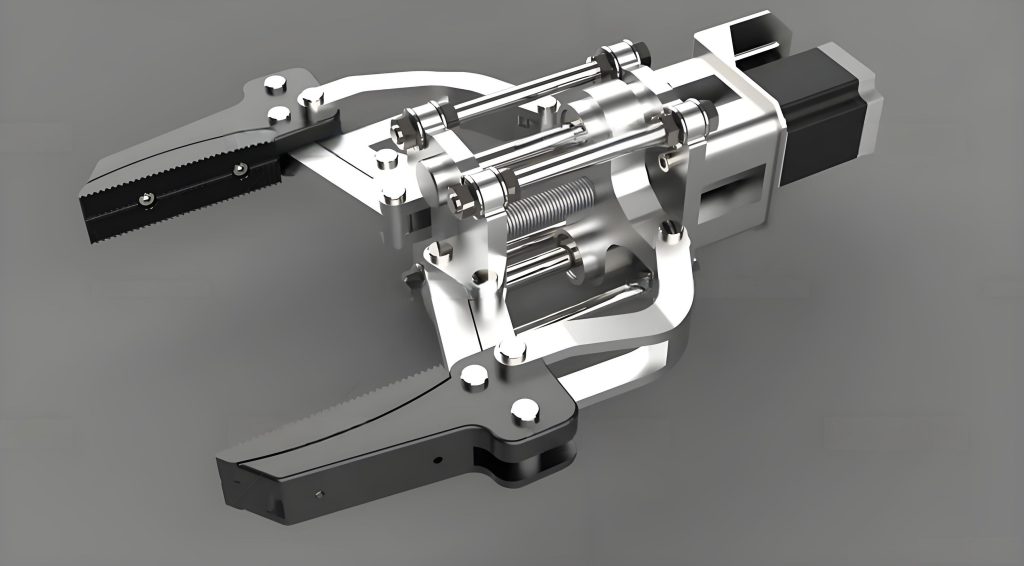
The proposed spade end-effector fundamentally differs from needle-based designs by employing a wrapping action. It consists of four thin, flexible spades arranged to match the trapezoidal cross-section of a standard 128-cell plug tray. These spades, actuated by a double-acting pneumatic cylinder, slide down along the inner walls of the cell, effectively isolating the substrate plug from the tray walls before lifting. This design aims to increase the contact area between the end effector and the substrate, thereby distributing the extraction forces more evenly and reducing the stress concentration that causes plug failure. The primary performance metric is the matrix removal rate, defined as the percentage of substrate mass successfully extracted from a cell, with the goal of minimizing residue.
The mechanics of substrate extraction can be modeled through static force analysis. During the upward motion of the end effector, the substrate plug is subjected to a total extraction force, $F_T$, provided by the spades, and a total resistance force, $F_Z$, which opposes removal. The resistance is the sum of the gravitational force of the plug ($G$) and the adhesive force between the substrate and the plastic tray ($F_j$). For successful and intact extraction, two conditions must be met. First, the extraction force must overcome the resistance: $F_T > F_Z$. Second, and more critically for preventing breakage, the total resistance must not exceed the maximum cohesive force within the substrate mass itself, $F_{\alpha max}$. If $F_Z > F_{\alpha max}$, the internal bonds of the substrate fail, leading to fracture, collapse, and residual matrix left behind. This analysis highlights that the success of the spade end-effector is intrinsically linked to the mechanical properties of the substrate—specifically, the balance between substrate-tray adhesion and substrate-substrate cohesion.
$$F_Z = G + F_j$$
$$F_Z < F_T \leq F_{\alpha max}$$
To qualitatively investigate the extraction process and the role of cohesion, a Discrete Element Method (DEM) simulation was conducted using EDEM software. The substrate was modeled as spherical particles with bonding contacts using the Hertz-Mindlin with Bonding model. This model allows particles to bond, simulating the cohesive strength of moist substrate, and these bonds break when stress exceeds defined normal and shear limits. The simulation replicated the spade end-effector’s insertion and lifting sequence. The key finding was that by parametrically increasing the critical normal and shear stress values (simulating higher cohesive strength), the incidence of substrate fracture during extraction was significantly reduced. The substrate plug remained more intact, leading to less residue in the simulated cell. This simulation confirmed the theoretical principle that enhancing the internal cohesion of the substrate is a viable pathway to improving the performance of the extraction end effector.
The bonding forces and moments in the DEM model between two particles are governed by the following equations, where bond breakage occurs upon exceeding the critical stress:
$$F_n = -v_n K_n A \Delta t, \quad F_t = -v_t K_t A \Delta t$$
$$T_n = -\omega_n K_n J \Delta t, \quad T_t = -\omega_t K_t \frac{J}{2} \Delta t$$
Bond breakage occurs when:
$$\sigma_{max} < \frac{-F_n}{A} + \frac{2T_t}{J}R_B, \quad \tau_{max} < \frac{-F_t}{A} + \frac{T_n}{J}R_B$$
Guided by the simulation, the core experimental work focused on quantitatively measuring how substrate properties influence the adhesive and cohesive forces. The two primary controllable factors in a greenhouse setting are substrate composition (ratio of peat, vermiculite, and perlite) and moisture content. A specialized test platform was developed, centered around a novel “combined disc” apparatus attached to a universal testing machine. This apparatus features separate inner and outer discs. To measure adhesion (substrate-to-tray force), only the inner disc’s surface is covered with tray-material (PVC), and it is lifted alone after compaction, measuring the force required to separate the substrate from the disc. To measure cohesion (substrate internal strength), the entire disc assembly is lifted, measuring the force to fracture the substrate column itself. The measured forces are then converted to pressure (force per unit area) for comparison: adhesion pressure $p_1$ and cohesion pressure $p_2$.
| Test Variable Combination | Substrate Ratio (Peat:Vermiculite:Perlite) | Relative Moisture Content (%) |
|---|---|---|
| 1, 4, 7, 10, 13 | 6:3:1 | 50, 55, 60, 65, 70 |
| 2, 5, 8, 11, 14 | 6:2:2 | 50, 55, 60, 65, 70 |
| 3, 6, 9, 12, 15 | 7:2:1 | 50, 55, 60, 65, 70 |
The results from the combined disc tests revealed clear trends. The adhesion pressure $p_1$ increased monotonically with higher moisture content for all substrate mixes. In contrast, the cohesion pressure $p_2$ initially increased with moisture but then plateaued or slightly decreased at the highest moisture levels. The critical insight is the condition where $p_2 > p_1$, implying that the substrate’s internal strength is greater than its stickiness to the tray, which is theoretically favorable for clean extraction by the end effector. The pressure difference $(p_2 – p_1)$ was most pronounced at 60% moisture content.
| Relative Moisture (%) | Adhesion Pressure, $p_1$ (Pa) 6:3:1 | Cohesion Pressure, $p_2$ (Pa) 6:3:1 | Pressure Difference $(p_2-p_1)$ (Pa) |
|---|---|---|---|
| 50 | 421.29 | 445.85 | 24.56 |
| 55 | 510.55 | 530.51 | 19.96 |
| 60 | 615.71 | 764.33 | 148.62 |
| 65 | 829.40 | 820.27 | -9.13 |
| 70 | 1231.43 | 891.72 | -339.71 |
A two-factor analysis of variance (ANOVA) on the pressure difference confirmed that moisture content had an extremely significant effect (P < 0.01), while the substrate ratio and its interaction with moisture were not statistically significant. Therefore, moisture content is the dominant controllable factor. The optimal theoretical condition identified was a relative moisture content of 60% with a substrate ratio of 6:3:1, where the positive difference between cohesion and adhesion was maximal. This condition should, in principle, allow the spade end-effector to perform best, as the substrate is strong enough internally to be lifted as a coherent plug, overcoming its adhesion to the tray.
Finally, practical validation tests were conducted with the physical spade end-effector mounted on a positioning platform. Substrate with a 6:3:1 ratio was prepared at five different moisture levels (50% to 70%). For each level, the end effector performed extraction operations on 20 cells filled with substrate (simulating inferior, rootless plugs). The matrix removal rate was calculated for each extraction. The results strongly corroborated the mechanical measurements.
| Relative Moisture Content (%) | Average Matrix Removal Rate (%) | Standard Deviation (%) |
|---|---|---|
| 50 | 62.3 | 0.06 |
| 55 | 63.8 | 0.07 |
| 60 | 70.8 | 0.04 |
| 65 | 54.7 | 0.04 |
| 70 | 51.3 | 0.05 |
The performance of the spade end-effector peaked precisely at 60% moisture, achieving an average removal rate of 70.8%, which was significantly higher than at other moisture levels. The removal rate curve exhibited an inverted-U shape, increasing to a maximum at 60% and then falling. This aligns perfectly with the cohesion-adhesion balance theory: at lower moisture, cohesion is too low; at higher moisture, adhesion becomes excessively high and potentially cohesion weakens due to saturation, both leading to plug failure and more residue. The optimal operational window is where internal cohesion is robust and greater than adhesion.
In conclusion, this study successfully designed and validated a novel spade-type end effector for the specific task of removing substrate from plug trays. The wrapping action of this end effector, combined with operation under substrate conditions that favor high internal cohesion relative to tray adhesion, significantly improves the matrix removal rate. The DEM simulation provided qualitative validation of the design concept, while the innovative combined disc test method quantified the key substrate property thresholds. The identified optimal condition—60% relative moisture with a peat-vermiculite-perlite mix of 6:3:1—provides a concrete agronomic guideline for seedling cultivation when automated replugging with such an end effector is planned. This research demonstrates that the effectiveness of a transplanting end effector is not solely determined by its mechanical design but is also critically dependent on the tailored management of the biological material with which it interacts.