
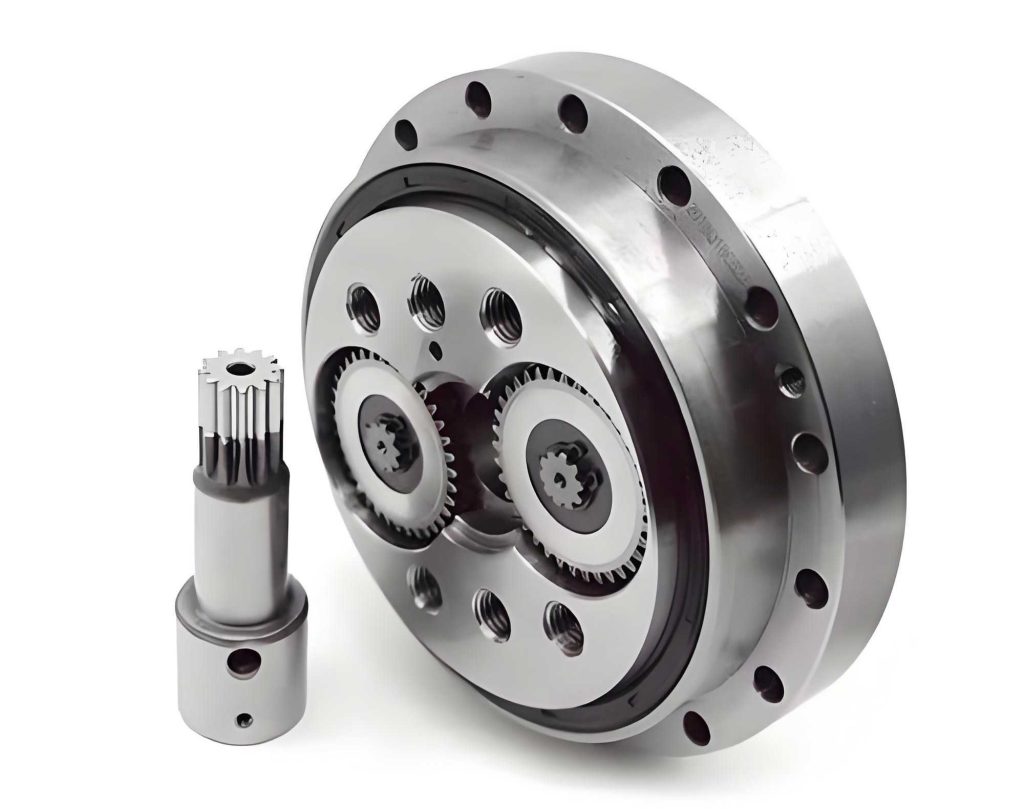
In the field of high-precision industrial robotics, the RV reducer plays a critical role due to its compact design, high torque capacity, and exceptional accuracy. The cycloidal wheel, a core component of the RV reducer, requires ultra-precise manufacturing to meet stringent specifications such as dimensional errors within ±2 μm, surface roughness of Ra 0.4, and indexing errors between teeth of one arc-minute. Achieving these tolerances heavily depends on the motion accuracy of the grinding machine used in the final shaping process. In this article, I will delve into a comprehensive error analysis and modeling of the grinding system for an RV reducer cycloidal wheel, leveraging multi-body system theory to quantify the impact of machine tool inaccuracies on the final gear profile. My focus is on establishing a robust error model that can predict machining precision and guide compensation strategies, thereby enhancing the overall performance of RV reducers in robotic applications.
The grinding process for cycloidal wheels typically involves form grinding, where a shaped grinding wheel profiles the tooth flank in a multi-axis coordinated motion. Any deviations in the machine’s geometric and kinematic parameters can lead to significant errors in the generated tooth geometry, affecting the RV reducer’s transmission accuracy and longevity. Traditional error modeling approaches, such as geometric error matrices or rigid body kinematics, often suffer from limitations in applicability and complexity. To address this, I adopt a multi-body system (MBS) framework, which simplifies the complex grinding system into interconnected bodies with defined relative motions. This method allows for systematic analysis of both static and dynamic errors across all axes of the machine tool. Throughout this discussion, I will emphasize the importance of the RV reducer’s precision requirements, as any improvement in grinding accuracy directly translates to better performance in robotic systems where RV reducers are extensively deployed.
Multi-body system theory provides a powerful tool for describing the kinematics of mechanical systems by breaking them down into simpler bodies and analyzing the relative motions between adjacent pairs. In my approach, I consider each moving component of the grinding machine—such as slides, spindles, and workpieces—as individual bodies. For two adjacent bodies, say body Bi (the lower-order body) and body Bj (the higher-order body), I define coordinate systems attached to each. The ideal relative position and motion between them can be described using vectors, but in reality, errors perturb these relationships. Specifically, I account for position errors (e.g., misalignments) and displacement errors (e.g., inaccuracies in linear or rotary movements). The position of any point P on body Bj relative to the coordinate system of Bi can be expressed as:
$$ \mathbf{P} = \mathbf{q}_{jl} + \mathbf{q}_{je} + \mathbf{s}_{jl} + \mathbf{s}_{je} + \mathbf{r}_j $$
where \(\mathbf{q}_{jl}\) is the ideal position vector, \(\mathbf{q}_{je}\) is the position error vector, \(\mathbf{s}_{jl}\) is the ideal displacement vector, \(\mathbf{s}_{je}\) is the displacement error vector, and \(\mathbf{r}_j\) is the vector of point P in body Bj’s local coordinates. This formulation captures both nominal and erroneous behaviors, which is essential for accurate error modeling in RV reducer manufacturing.
To translate this into a mathematical model suitable for computer analysis, I use Denavit-Hartenberg (D-H) homogeneous transformation matrices. These 4×4 matrices efficiently represent rotations and translations between coordinate systems. For the error-free case, the transformation from body Bj to Bi can be written as:
$$ \mathbf{P}_{ji} = \mathbf{S}_{ijp} \mathbf{S}_{ijs} \mathbf{S}_{jr} $$
where \(\mathbf{S}_{ijp}\) is the relative position transformation matrix, \(\mathbf{S}_{ijs}\) is the relative motion transformation matrix, and \(\mathbf{S}_{jr}\) is the local coordinate matrix of point P. When errors are included, the equation expands to:
$$ \mathbf{P}_{ji} = \mathbf{S}_{ijp} \mathbf{S}_{ijpe} \mathbf{S}_{ijs} \mathbf{S}_{ijse} \mathbf{S}_{jr} $$
Here, \(\mathbf{S}_{ijpe}\) and \(\mathbf{S}_{ijse}\) are the error transformation matrices for position and displacement, respectively. This extended model forms the basis for my error analysis of the grinding system, enabling me to quantify how individual error sources propagate to the final grinding point on the cycloidal wheel of the RV reducer.
Now, let me apply this theoretical framework to a specific grinding machine: the LFG-3540 type CNC cycloidal wheel form grinder. This machine features four axes of motion: the Z-axis for lateral movement of the workpiece, the Y-axis for controlling depth of cut, the X-axis for vertical movement of the grinding wheel spindle, and the A-axis for indexing the workpiece. Each axis contributes geometric errors that affect the grinding precision. I categorize these errors into static errors (independent of position) and motion errors (dependent on position). Static errors include perpendicularity errors between axes, such as \(\varepsilon_{xy}\), \(\varepsilon_{xz}\), and \(\varepsilon_{yz}\) between the linear axes, and \(\varepsilon_{xa}\) and \(\varepsilon_{ya}\) between the linear axes and the rotary A-axis. Motion errors, derived from rigid body kinematics, consist of six error components per axis: three linear displacement errors and three angular displacement errors. For example, for the X-axis, the errors are \(\delta_x(x)\), \(\delta_y(x)\), \(\delta_z(x)\) (linear errors along x, y, z directions) and \(\varepsilon_x(x)\), \(\varepsilon_y(x)\), \(\varepsilon_z(x)\) (angular errors around x, y, z axes). Similar errors exist for the Y-axis, Z-axis, and A-axis. The table below summarizes all geometric error parameters considered in my analysis for the RV reducer grinding system.
| Error Type | Linear Displacement Errors | Angular Displacement Errors | Cross-Axis Errors |
|---|---|---|---|
| X-axis motion | \(\delta_x(x)\), \(\delta_y(x)\), \(\delta_z(x)\) | \(\varepsilon_x(x)\), \(\varepsilon_y(x)\), \(\varepsilon_z(x)\) | \(\varepsilon_{xy}\), \(\varepsilon_{xz}\), \(\varepsilon_{yz}\) |
| Y-axis motion | \(\delta_x(y)\), \(\delta_y(y)\), \(\delta_z(y)\) | \(\varepsilon_x(y)\), \(\varepsilon_y(y)\), \(\varepsilon_z(y)\) | \(\varepsilon_{xa}\), \(\varepsilon_{ya}\) |
| Z-axis motion | \(\delta_x(z)\), \(\delta_y(z)\), \(\delta_z(z)\) | \(\varepsilon_x(z)\), \(\varepsilon_y(z)\), \(\varepsilon_z(z)\) | – |
| A-axis rotation | \(\delta_x(a)\), \(\delta_y(a)\), \(\delta_z(a)\) | \(\varepsilon_x(a)\), \(\varepsilon_y(a)\), \(\varepsilon_z(a)\) | – |
This comprehensive error set, totaling 29 parameters, captures the primary sources of inaccuracy in the grinding machine. By quantifying these errors, I can model their collective impact on the RV reducer’s cycloidal wheel profile.
Next, I abstract the grinding system into a multi-body system with two distinct kinematic chains: the “bed-workpiece” branch and the “bed-grinding wheel” branch. The bed serves as the inertial reference frame. The topological structure of the system can be represented using a low-order body array, which defines the hierarchical relationships between bodies. Let me denote the bodies as follows: body 1 (bed), body 2 (Z-slide), body 3 (headstock), body 4 (A-axis), body 5 (cycloidal wheel) for the workpiece branch; and body 6 (Y-slide), body 7 (X-slide), body 8 (wheelhead), body 9 (grinding wheel) for the grinding wheel branch. The low-order body operator L is used to express these relationships. For instance, \(L^1(5) = 4\) indicates that the first lower-order body of the cycloidal wheel (body 5) is the A-axis (body 4). The complete low-order body array is shown in the table below, which is essential for constructing the transformation matrices sequentially along each branch.
| Body k | \(L^1(k)\) | \(L^2(k)\) | \(L^3(k)\) | \(L^4(k)\) | \(L^5(k)\) |
|---|---|---|---|---|---|
| 1 (bed) | 0 | 0 | 0 | 0 | 0 |
| 2 (Z-slide) | 1 | 0 | 0 | 0 | 0 |
| 3 (headstock) | 2 | 1 | 0 | 0 | 0 |
| 4 (A-axis) | 3 | 2 | 1 | 0 | 0 |
| 5 (cycloidal wheel) | 4 | 3 | 2 | 1 | 0 |
| 6 (Y-slide) | 1 | 0 | 0 | 0 | 0 |
| 7 (X-slide) | 6 | 1 | 0 | 0 | 0 |
| 8 (wheelhead) | 7 | 6 | 1 | 0 | 0 |
| 9 (grinding wheel) | 8 | 7 | 6 | 1 | 0 |
With the topology established, I proceed to assign coordinate systems to each body. The inertial coordinate system is fixed to the bed (body 1), aligned with the machine’s reference axes. For other bodies, I define coordinate systems based on their ideal orientations and positions at the machine zero point. For instance, the A-axis coordinate system is oriented by rotating the bed system by perpendicularity errors \(\varepsilon_{xa}\) and \(\varepsilon_{ya}\), while the grinding wheel coordinate system is aligned with the X-slide system after accounting for cross-axis errors. The positions of body coordinate systems are defined relative to their lower-order bodies, with offsets such as \(\mathbf{q}_5 = [q_{5x}, q_{5y}, q_{5z}, 1]^T\) for the cycloidal wheel relative to the A-axis, and \(\mathbf{q}_9 = [q_{9x}, q_{9y}, q_{9z}, 1]^T\) for the grinding wheel relative to the wheelhead. The grinding point P has local coordinates \(\mathbf{S}_{5r} = [x_w, y_w, z_w, 1]^T\) on the cycloidal wheel and \(\mathbf{S}_{9r} = [x_t, y_t, z_t, 1]^T\) on the grinding wheel.
Using the D-H transformation matrices, I derive the complete error model for the grinding system. For the “bed-workpiece” branch, the transformation from the cycloidal wheel (body 5) to the bed (body 1) is given by the product of matrices for each adjacent pair. Similarly, for the “bed-grinding wheel” branch, I compute the transformation from the grinding wheel (body 9) to the bed. The general form for a transformation between bodies Bi and Bj, including errors, is as shown earlier. For example, the transformation from the Z-slide (body 2) to the bed (body 1) involves the ideal motion matrix for Z-axis translation and the error matrix encapsulating motion errors like \(\delta_x(z)\) and \(\varepsilon_z(z)\). Writing out all matrices explicitly would be lengthy, but I can summarize key transformations. The ideal motion matrix for a linear translation along Z is:
$$ \mathbf{S}_{12s} = \begin{bmatrix}
1 & 0 & 0 & 0 \\
0 & 1 & 0 & 0 \\
0 & 0 & 1 & z \\
0 & 0 & 0 & 1
\end{bmatrix} $$
and its associated error matrix is:
$$ \mathbf{S}_{12se} = \begin{bmatrix}
1 & -\varepsilon_z(z) & \varepsilon_y(z) & \delta_x(z) \\
\varepsilon_z(z) & 1 & -\varepsilon_x(z) & \delta_y(z) \\
-\varepsilon_y(z) & \varepsilon_x(z) & 1 & \delta_z(z) \\
0 & 0 & 0 & 1
\end{bmatrix} $$
Similarly, for the A-axis rotation, the ideal motion matrix for rotation by angle \(\alpha\) is:
$$ \mathbf{S}_{34s} = \begin{bmatrix}
\cos\alpha & -\sin\alpha & 0 & 0 \\
\sin\alpha & \cos\alpha & 0 & 0 \\
0 & 0 & 1 & 0 \\
0 & 0 & 0 & 1
\end{bmatrix} $$
and its error matrix includes terms like \(\delta_x(a)\) and \(\varepsilon_x(a)\). By multiplying all matrices along each branch, I obtain the overall transformation for point P relative to the bed. Let \(\mathbf{P}_w\) denote the position of P via the workpiece branch and \(\mathbf{P}_t\) via the grinding wheel branch. These are calculated as:
$$ \mathbf{P}_w = \mathbf{S}_{12p} \mathbf{S}_{12pe} \mathbf{S}_{12s} \mathbf{S}_{12se} \mathbf{S}_{23p} \mathbf{S}_{23pe} \mathbf{S}_{23s} \mathbf{S}_{23se} \mathbf{S}_{34p} \mathbf{S}_{34pe} \mathbf{S}_{34s} \mathbf{S}_{34se} \mathbf{S}_{45p} \mathbf{S}_{45pe} \mathbf{S}_{45s} \mathbf{S}_{45se} \mathbf{S}_{5r} $$
$$ \mathbf{P}_t = \mathbf{S}_{16p} \mathbf{S}_{16pe} \mathbf{S}_{16s} \mathbf{S}_{16se} \mathbf{S}_{67p} \mathbf{S}_{67pe} \mathbf{S}_{67s} \mathbf{S}_{67se} \mathbf{S}_{78p} \mathbf{S}_{78pe} \mathbf{S}_{78s} \mathbf{S}_{78se} \mathbf{S}_{89p} \mathbf{S}_{89pe} \mathbf{S}_{89s} \mathbf{S}_{89se} \mathbf{S}_{9r} $$
After performing these matrix multiplications symbolically, I arrive at explicit expressions for the coordinates of P in the bed coordinate system. For the workpiece branch, the x-coordinate is:
$$ x_{w0} = \delta_x(a) \cos\alpha – \delta_y(a) \sin\alpha + \delta_x(z) + (x_w + q_{5x})[\cos\alpha – \varepsilon_z(z) \sin\alpha – \varepsilon_z(a) \sin\alpha] – (y_w + q_{5y})[\sin\alpha + \varepsilon_z(z) \cos\alpha + \varepsilon_z(a) \cos\alpha] + (z_w + q_{5z})[\varepsilon_{xa} + \varepsilon_y(z) + \sin\alpha + \varepsilon_x(a) \sin\alpha + \varepsilon_y(a) \cos\alpha] $$
The y and z coordinates are similarly derived. For the grinding wheel branch, the x-coordinate is:
$$ x_{t0} = x + \delta_x(x) + \delta_x(y) + x_t + q_{9x} – (y_t + q_{9y})[\varepsilon_{xy} + \varepsilon_z(x) + \varepsilon_z(y)] + (z_t + q_{9z})[\varepsilon_{xz} + \varepsilon_y(x) + \varepsilon_y(y)] $$
with corresponding expressions for y and z. These equations encapsulate the influence of all 29 error parameters on the grinding point position.
For precision grinding of the RV reducer’s cycloidal wheel, the fundamental requirement is that the grinding wheel contacts the workpiece at the exact theoretical point on the tooth profile at every instant. This implies that the position of point P computed via both branches must be equal: \(\mathbf{P}_w = \mathbf{P}_t\). Setting the corresponding components equal yields a set of constraint equations that represent the conditions for accurate grinding. The full constraint equation system is:
$$ \begin{aligned}
&\delta_x(a) \cos\alpha – \delta_y(a) \sin\alpha + \delta_x(z) + (x_w + q_{5x})[\cos\alpha – \varepsilon_z(z) \sin\alpha – \varepsilon_z(a) \sin\alpha] – (y_w + q_{5y})[\sin\alpha + \varepsilon_z(z) \cos\alpha + \varepsilon_z(a) \cos\alpha] + (z_w + q_{5z})[\varepsilon_{xa} + \varepsilon_y(z) + \sin\alpha + \varepsilon_x(a) \sin\alpha + \varepsilon_y(a) \cos\alpha] = \\
&x + \delta_x(x) + \delta_x(y) + x_t + q_{9x} – (y_t + q_{9y})[\varepsilon_{xy} + \varepsilon_z(x) + \varepsilon_z(y)] + (z_t + q_{9z})[\varepsilon_{xz} + \varepsilon_y(x) + \varepsilon_y(y)]
\end{aligned} $$
$$ \begin{aligned}
&\delta_x(a) \sin\alpha + \delta_y(a) \cos\alpha + \delta_y(z) + (x_w + q_{5x})[\cos\alpha + \sin\alpha + \varepsilon_z(a) \cos\alpha] + (y_w + q_{5y})[\cos\alpha – \varepsilon_z(z) \sin\alpha – \varepsilon_z(a) \sin\alpha] – (z_w + q_{5z})[\varepsilon_{ya} + \varepsilon_x(z) + \sin\alpha + \varepsilon_x(a) \cos\alpha – \varepsilon_y(a) \sin\alpha] = \\
&x[\varepsilon_{xy} + \varepsilon_z(y)] + y + \delta_y(x) + \delta_y(y) + (x_t + q_{9x})[\varepsilon_z(x) + \varepsilon_z(y) + \varepsilon_{xy}] + y_t + q_{9y} – (z_t + q_{9z})[\delta_y(x) + \delta_y(y) + x(\varepsilon_{xy} + \varepsilon_z(y)) + y]
\end{aligned} $$
$$ \begin{aligned}
&z + \delta_z(a) + \delta_z(z) – (x_w + q_{5x})\{\varepsilon_y(a) + \cos\alpha[\varepsilon_{xa} + \varepsilon_y(z)] – \sin\alpha[\varepsilon_{ya} + \varepsilon_x(z)]\} + (y_w + q_{5y})\{\varepsilon_x(a) + \cos\alpha[\varepsilon_{ya} + \varepsilon_x(z)] + \sin\alpha[\varepsilon_{xa} + \varepsilon_y(z)]\} + z_w + q_{5z} = \\
&\delta_z(x) + \delta_z(y) – x[\varepsilon_{xz} + \varepsilon_y(y)] – (x_t + q_{9x})[\varepsilon_y(x) + \varepsilon_y(y) + \varepsilon_{xz}] + (y_t + q_{9y})[\varepsilon_{yz} + \varepsilon_x(x) + \varepsilon_x(y)] + z_t + q_{9z}
\end{aligned} $$
These equations are nonlinear due to trigonometric functions and products of error terms, but they can be linearized for small errors, which is typical in precision machining. By solving this system, I can predict the machining accuracy of the RV reducer cycloidal wheel given the error parameters. Conversely, if the desired grinding accuracy is specified, I can use these equations to derive tolerance limits for the machine errors, guiding the design and calibration of the grinding system.
To illustrate the practical application, consider evaluating the grinding precision for a specific RV reducer. The error parameters can be obtained from machine tool calibration standards, such as JB/T 8772.1-1998 for geometric accuracy testing. Substituting these values into the constraint equations allows computation of the deviation \(\mathbf{E} = \mathbf{P}_w – \mathbf{P}_t\), which quantifies the grinding error. For instance, if the linear error parameters are on the order of micrometers and angular errors in arc-seconds, the resulting profile error on the cycloidal wheel can be assessed. This predictive capability is invaluable for quality control in RV reducer manufacturing, as it enables proactive error compensation through CNC adjustments or mechanical tweaks.
In summary, my analysis demonstrates that multi-body system theory provides a robust framework for error modeling in complex grinding machines used for RV reducer components. By decomposing the system into bodies, defining error parameters, and establishing transformation matrices, I have derived a comprehensive model that links machine tool inaccuracies to the final gear profile. The constraint equations serve as a precision grinding condition, offering a tool for both error prediction and tolerance allocation. This work underscores the importance of meticulous error analysis in achieving the high precision required for RV reducers, which are pivotal in advanced robotics. Future research could extend this model to include thermal errors, dynamic effects, or integration with real-time compensation systems, further enhancing the manufacturing accuracy of these critical components.
Throughout this discussion, I have emphasized the role of the RV reducer in robotic systems and how grinding accuracy impacts its performance. The methodologies presented here are not limited to cycloidal wheels but can be adapted to other precision gear grinding processes. By continually refining error models and compensation strategies, manufacturers can push the boundaries of RV reducer quality, contributing to more reliable and efficient robotic applications. The integration of such analytical tools into machine tool design and operation will be key to meeting the ever-tightening tolerances in high-tech industries.