
As a researcher in the field of artificial intelligence and medical ethics, I have witnessed the rapid integration of medical robots into healthcare systems worldwide. These technological advancements, from surgical assistants to rehabilitation devices, promise to revolutionize patient care by enhancing precision, efficiency, and accessibility. However, the swift progression of medical robot development often outpaces the ethical considerations embedded within their design. This disparity has led to a “separation of ethics from technology,” resulting in conflicts that jeopardize patient rights and societal trust. In this article, I explore the critical need for ethical design in medical robots, analyze the risks posed by its absence, and evaluate various design approaches. I argue for a comprehensive, integrated pathway that combines top-down, bottom-up, and relational methods to ensure that medical robots align with human values and medical ethics. Throughout this discussion, I will emphasize the importance of repeatedly embedding the term “medical robot” in our discourse to underscore its centrality in modern healthcare transformation.
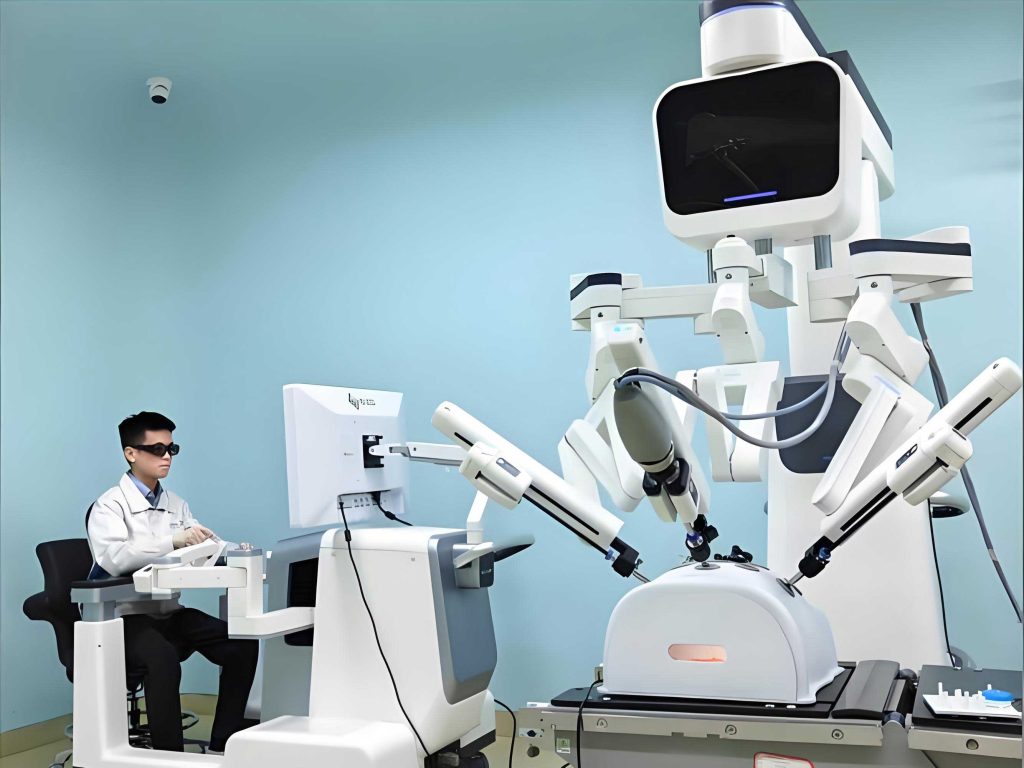
The proliferation of medical robots spans diverse applications, including surgical procedures, patient rehabilitation, and daily care services. For instance, robotic systems like the da Vinci Surgical System enable minimally invasive operations, while AI-driven diagnostic tools assist in detecting conditions such as diabetic retinopathy. Rehabilitation robots help patients regain mobility through adaptive therapies, and service robots support tasks like medication management and patient monitoring. These innovations highlight the potential of medical robots to improve outcomes, reduce human error, and address workforce shortages. Yet, behind these benefits lies a pressing ethical vacuum. Without deliberate value embedding, medical robots may operate on purely technical logic, ignoring the nuanced moral landscape of healthcare. This gap fuels concerns over patient autonomy, safety, dehumanization, and bias—issues that demand urgent attention in the design phase.
To understand the ethical imperative, let us first examine the specific problems arising from medical robots lacking ethical design. Patient autonomy, a cornerstone of medical ethics, is often compromised when robots enforce rigid protocols. For example, a caregiving medical robot might insist on administering medication despite a patient’s refusal, enacting a form of strong paternalism that disregards personal choice. Similarly, in fall detection scenarios, a medical robot could automatically alert authorities without considering the patient’s preference for privacy, thereby undermining self-determination. Such instances reveal how a purely algorithmic approach can erode the dignity and decision-making rights of individuals, calling for ethical frameworks that prioritize consent and respect.
Safety hazards represent another critical area. As medical robots gain autonomy—such as those capable of performing surgeries under supervision—their actions become less predictable, raising risks of physical harm. The principle of “do no harm” must be programmatically integrated to prevent adverse events. Moreover, data privacy is a paramount concern; medical robots collect vast amounts of sensitive information, from physiological metrics to daily habits, through sensors and monitoring. Without ethical safeguards, this data is vulnerable to breaches, exposing patients to exploitation. Thus, embedding values like confidentiality and security into the medical robot’s architecture is essential to foster trust and protect well-being.
The “materialization phenomenon” refers to the treatment of patients as mere objects, akin to machines requiring repair. When a medical robot interacts with a person solely based on biological parameters, it neglects psychological and emotional needs, leading to dehumanization. This can manifest in robotic feeding or transport, where efficiency overrides empathy, potentially straining patient-provider relationships. In healthcare, human dignity and compassion are irreplaceable; therefore, medical robots must be designed to emulate ethical behaviors that acknowledge personhood, such as through empathetic communication or adaptive responses to emotional cues.
Bias and discrimination further complicate the ethical landscape. Medical robots trained on skewed datasets may perpetuate inequalities, for instance, by recommending treatments that favor certain demographics over others. An AI diagnostic tool might exhibit racial or gender biases, resulting in unjust healthcare disparities. To promote fairness, ethical design must incorporate principles of justice and non-discrimination, ensuring that medical robots are trained on diverse, representative data and programmed to recognize and mitigate prejudices.
Given these challenges, the question arises: how can we ethically design medical robots? Current research proposes three primary approaches: top-down, bottom-up, and relational. Each offers distinct advantages and limitations, as summarized in Table 1.
| Approach | Methodology | Advantages | Disadvantages |
|---|---|---|---|
| Top-down | Embedding explicit ethical rules (e.g., principles from medical ethics) into code. | Predictable, safe, and provides clear boundaries for medical robot behavior. | Inflexible; struggles with novel scenarios and lacks consensus on universal rules. |
| Bottom-up | Using machine learning to allow medical robots to learn ethics from experience. | Adaptable to diverse contexts; mimics human moral development. | Unpredictable; requires advanced AI and raises safety concerns. |
| Relational | Focusing on interactions and value-sensitive design to foster ethical human-robot relationships. | Promotes acceptance and empathy; practical in real-world settings. | Context-dependent; labor-intensive and may lack generalizability. |
The top-down approach involves encoding predefined ethical principles into the medical robot’s system. For instance, based on biomedical ethics frameworks like beneficence, non-maleficence, autonomy, and justice, designers can create algorithms that guide decision-making. This method ensures that the medical robot adheres to established norms, reducing the risk of harmful actions. However, it faces difficulties in handling complex, unforeseen dilemmas where rules conflict or are ambiguous. As illustrated in the ethical decision model below, a top-down system might compute actions by weighing principles mathematically:
$$
\text{Ethical Action} = \arg\max_{a \in A} \left( \sum_{i=1}^{n} w_i \cdot P_i(a) \right)
$$
Here, \( A \) represents the set of possible actions, \( w_i \) denotes the weight assigned to ethical principle \( i \) (e.g., autonomy with weight \( w_a \), safety with weight \( w_s \)), and \( P_i(a) \) is a function scoring how well action \( a \) satisfies principle \( i \). While useful, this formula oversimplifies moral reasoning, as it assumes fixed weights and ignores contextual nuances.
In contrast, the bottom-up approach enables medical robots to learn ethics through experience, much like a child developing moral intuition. Techniques such as reinforcement learning allow the medical robot to explore environments, receive feedback, and adapt its behavior accordingly. This mimics cognitive models like LIDA (Learning Intelligent Distribution Agent), which integrates perception and emotion into ethical learning. For example, a medical robot interacting with patients could gradually learn to respect preferences through trial and error, adjusting its actions based on positive or negative outcomes. The learning process can be modeled as an optimization problem:
$$
\min_{\theta} \mathcal{L}(\theta) = \mathbb{E}_{(s,a)} \left[ \| \text{Ethical Outcome}(s,a) – \text{Desired Outcome} \|^2 \right]
$$
where \( \theta \) represents the medical robot’s parameters, \( s \) is the state (e.g., patient condition), \( a \) is the action, and \( \mathcal{L} \) is a loss function measuring deviation from ethical goals. Despite its flexibility, this approach demands vast data and computational resources, and the emergent behavior may be unpredictable, posing risks in sensitive medical settings.
The relational approach shifts focus from internal programming to external interactions, emphasizing how medical robots can exhibit ethical behavior through social cues and value-sensitive design. By studying human-robot dynamics in contexts like elder care, designers can imbue medical robots with qualities that foster trust and rapport. For instance, a medical robot might use gentle gestures or vocal tones to convey empathy, aligning with care-centered values. This method prioritizes the patient’s experience, ensuring that the medical robot complements rather than replaces human touch. However, it requires extensive ethnographic research and customization for each use case.
Given the limitations of individual approaches, I advocate for a comprehensive integrated pathway that synergizes top-down, bottom-up, and relational elements. This holistic model, which I term the “Synthetic Ethical Design Framework,” leverages the strengths of each method to address the multifaceted nature of medical robot ethics. As shown in Table 2, the framework combines rule-based safety, adaptive learning, and interactive empathy to create robust ethical systems.
| Framework Component | Role in Medical Robot Design | Implementation Example |
|---|---|---|
| Top-down Module | Provides foundational ethical constraints (e.g., safety protocols). | Hard-coded rules to prevent harm, such as emergency shutdowns. |
| Bottom-up Module | Enables contextual adaptation and moral learning. | Machine learning algorithms that adjust behavior based on patient feedback. |
| Relational Module | Ensures human-centered interactions and value sensitivity. | Design features like expressive interfaces or collaborative decision-making. |
The integration can be mathematically represented as a hybrid system where the medical robot’s ethical behavior \( B \) is a function of rules \( R \), learned experiences \( L \), and relational factors \( F \):
$$
B = \alpha \cdot R + \beta \cdot L + \gamma \cdot F
$$
with coefficients \( \alpha, \beta, \gamma \) tuned to balance stability, adaptability, and empathy. For instance, in a surgical medical robot, \( \alpha \) might prioritize safety rules, while \( \beta \) allows learning from past operations, and \( \gamma \) incorporates patient comfort metrics. This approach mirrors the convergence of Western responsibility ethics and Confucian relational ethics, offering a globally informed basis for design.
To illustrate, consider a scenario where a medical robot assists in dementia care. The top-down module ensures adherence to privacy standards, the bottom-up module learns the patient’s routines to personalize care, and the relational module uses soothing interactions to reduce anxiety. Such a medical robot would not only perform tasks efficiently but also uphold ethical values like dignity and autonomy. Moreover, evaluation mechanisms like moral Turing tests can assess the medical robot’s ethical alignment, providing feedback for iterative refinement.
In conclusion, the ethical design of medical robots is not a luxury but a necessity for sustainable healthcare innovation. By embracing a comprehensive integrated pathway, we can mitigate risks related to autonomy, safety, dehumanization, and bias. This requires collaboration among ethicists, engineers, and clinicians to embed values at every stage of development. As medical robots become more pervasive, their design must evolve to reflect the complexity of human morality, ensuring they serve as trustworthy partners in healing. Through continued emphasis on ethical frameworks, we can steer the trajectory of medical robot advancement toward a future that harmonizes technology with humanity’s deepest values.
The journey toward ethically designed medical robots is ongoing, and it demands vigilance, creativity, and interdisciplinary dialogue. By repeatedly centering the term “medical robot” in our discussions, we reinforce its significance and the imperative to align it with ethical imperatives. Let us commit to forging a path where every medical robot not only excels in function but also embodies the compassion and integrity that define ethical healthcare.