
As a researcher in the field of technology ethics, I have observed the rapid integration of medical robots into healthcare systems worldwide. These intelligent systems, powered by artificial intelligence and robotics, are revolutionizing medical practices, from surgical procedures to rehabilitation and patient care. However, with this transformative advancement comes a myriad of ethical concerns that demand urgent attention. In this article, I will explore the ethical risks associated with medical robot applications and propose governance pathways from a stakeholder perspective. The goal is to provide a comprehensive analysis that highlights the importance of ethical foresight in the development and deployment of medical robots.
The adoption of medical robots has accelerated due to societal needs such as aging populations and the demand for precision medicine. For instance, surgical robots enable minimally invasive procedures with enhanced accuracy, while rehabilitation robots assist in physical therapy, and service robots streamline hospital logistics. These applications demonstrate the potential of medical robots to improve healthcare efficiency and patient outcomes. Yet, as I delve deeper, it becomes evident that these benefits are accompanied by significant ethical challenges. Through this discussion, I aim to shed light on these issues and advocate for proactive governance measures.
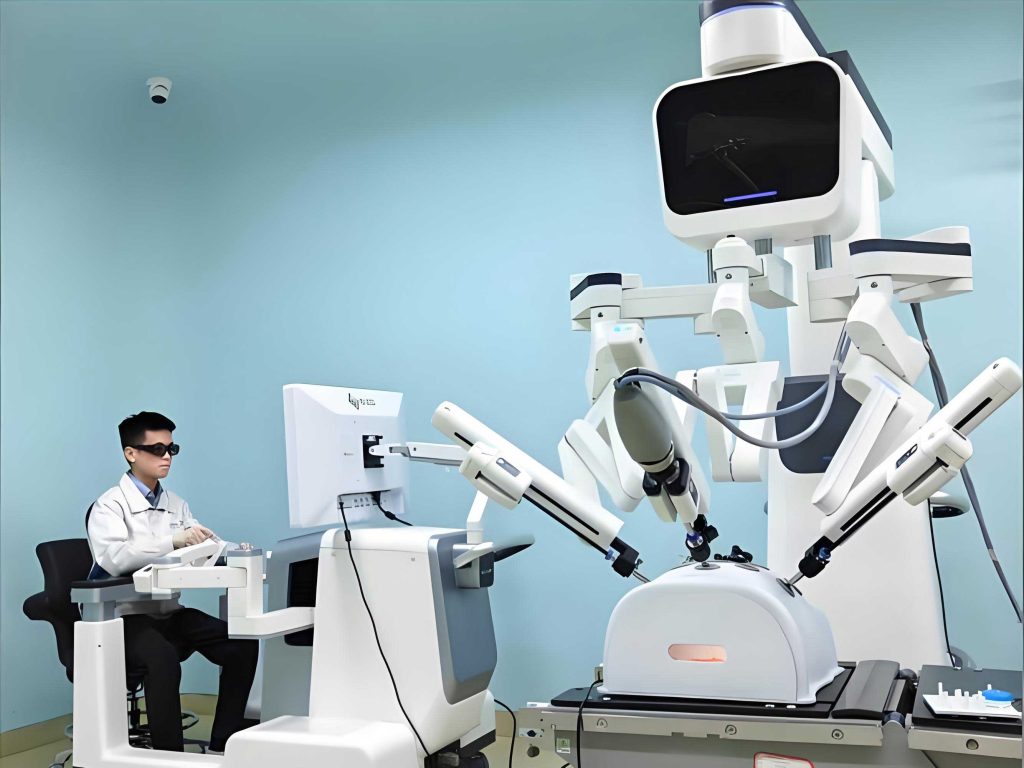
To structure this analysis, I will first outline the multidimensional applications of medical robots, followed by an examination of ethical risks using a stakeholder framework. I will then present governance strategies to mitigate these risks, incorporating tables and formulas to summarize key points. Throughout, I will emphasize the term “medical robot” to reinforce the focus on this technology. Let’s begin by exploring how medical robots are being used in various healthcare settings.
Multidimensional Applications of Medical Robots
Medical robots have permeated diverse healthcare scenarios, each offering unique advantages. I categorize these applications into three main areas: surgical robots, rehabilitation and assistive robots, and medical service robots. Each type of medical robot addresses specific medical needs, but they all share common ethical implications.
Surgical Robots: These medical robots, such as the da Vinci system, allow surgeons to perform complex procedures with high precision through minimally invasive techniques. The key benefits include enhanced 3D visualization, tremor filtration, and improved dexterity. For example, a surgical medical robot can reduce patient recovery time and minimize surgical errors. However, the reliance on such medical robots raises questions about safety and human skill degradation.
Rehabilitation and Assistive Robots: These medical robots aid patients in regaining motor or cognitive functions. Examples include exoskeletons like HAL and wearable devices that provide movement assistance. The interaction between the medical robot and the patient is crucial here, as it involves direct physical contact and emotional engagement. The effectiveness of a rehabilitation medical robot often depends on its ability to adapt to individual patient needs, but this personalization can lead to privacy concerns.
Medical Service Robots: These medical robots handle logistical tasks in hospitals, such as dispensing medication, transporting supplies, or providing patient guidance. They enhance operational efficiency but may reduce human interaction in caregiving. For instance, a nursing medical robot can assist with patient lifting, but its use might compromise the human touch essential in healthcare.
To summarize these applications, I present a table that highlights the key features and ethical considerations for each type of medical robot:
| Type of Medical Robot | Key Applications | Ethical Considerations |
|---|---|---|
| Surgical Robot | Minimally invasive surgery, precision control | Safety risks, surgeon dependency |
| Rehabilitation Robot | Motor function recovery, cognitive therapy | Privacy risks, patient autonomy |
| Service Robot | Hospital logistics, patient assistance | Job displacement, human interaction loss |
This table illustrates how each medical robot category introduces distinct ethical challenges. As I proceed, I will delve into these risks in more detail, but first, let’s establish a theoretical framework for analysis.
Theoretical Framework: Stakeholder Theory
In assessing the ethical risks of medical robots, I adopt the stakeholder theory, which posits that multiple parties are involved in the lifecycle of a technology. For medical robots, the key stakeholders include management entities (e.g., government regulators), designers (e.g.,研发机构 and companies), suppliers (e.g., healthcare providers), and demand-side users (e.g., patients). Each stakeholder group has unique interests and resources that influence the ethical governance of medical robots.
From my perspective, understanding these stakeholders is essential for effective risk mitigation. For instance, designers of medical robots focus on innovation and market competitiveness, while patients prioritize safety and privacy. To capture these dynamics, I propose a formula that represents the ethical risk (ER) as a function of stakeholder interactions:
$$ ER = f(S_m, S_d, S_s, S_u) $$
where \( S_m \) represents management stakeholders, \( S_d \) denotes designers, \( S_s \) signifies suppliers, and \( S_u \) stands for users. This function implies that ethical risks arise from the interplay among these groups. For example, if a medical robot designer neglects safety protocols, it increases the risk for users. To elaborate, I have developed a table summarizing the roles and impacts of each stakeholder in the context of medical robot ethics:
| Stakeholder Group | Role in Medical Robot Ecosystem | Key Ethical Concerns |
|---|---|---|
| Management (Government) | Policy-making, regulation, oversight | Ensuring compliance,公平分配 of medical robot resources |
| Designers (研发机构) | Innovation, product development | Embedding ethical principles in medical robot design |
| Suppliers (Healthcare Providers) | Deployment, operation, maintenance | Responsible use of medical robots, patient safety |
| Users (Patients) | End-users, beneficiaries | Privacy, autonomy, trust in medical robot systems |
This stakeholder analysis helps me identify the sources of ethical risks, which I will now explore in depth. The integration of medical robots into healthcare necessitates a balance between technological progress and ethical responsibility, and I believe that a collaborative approach among stakeholders is key to achieving this balance.
Ethical Risks in Medical Robot Applications
As I examine the ethical landscape, I identify five primary risks associated with medical robots: safety risks, privacy risks, moral risks, liability risks, and justice risks. Each risk category stems from the complex interactions between humans and medical robots, and they often overlap in practice.
Safety Risks: The direct interaction between medical robots and humans poses inherent safety hazards. For example, a surgical medical robot malfunction could cause physical harm to a patient. Moreover, over-reliance on medical robots may lead to skill atrophy among healthcare professionals. I conceptualize safety risk (SR) using a probability-based formula:
$$ SR = P(f) \times C(f) $$
where \( P(f) \) is the probability of a medical robot failure, and \( C(f) \) is the consequence of such failure. This highlights the need for robust design and testing of medical robots to minimize risks.
Privacy Risks: Medical robots often collect sensitive patient data, such as health records and behavioral patterns. Unauthorized access or data breaches can compromise patient privacy. The privacy risk (PR) can be modeled as:
$$ PR = D_s \times V_e $$
where \( D_s \) represents the sensitivity of data collected by the medical robot, and \( V_e \) denotes the vulnerability of the system to breaches. Ensuring data security is crucial for any medical robot deployment.
Moral Risks: These involve questions about the moral agency of medical robots. For instance, should a medical robot be held accountable for its actions? The debate over the moral status of medical robots is ongoing, with implications for responsibility allocation. I view moral risk (MR) as a function of autonomy (A) and ethical ambiguity (E):
$$ MR = A \times E $$
As medical robots become more autonomous, their moral risks increase, necessitating clear ethical guidelines.
Liability Risks: When harm occurs, determining liability for a medical robot incident is complex. Is it the designer, the operator, or the medical robot itself? Liability risk (LR) depends on the legal framework and the degree of human oversight. I express this as:
$$ LR = L_g \times H_o $$
where \( L_g \) is the legal gaps in medical robot regulation, and \( H_o \) is the level of human oversight. Addressing liability requires updated laws for medical robot technologies.
Justice Risks: The high cost of medical robots may exacerbate healthcare inequalities. Access to advanced medical robot treatments might be limited to affluent populations, creating a digital divide. Justice risk (JR) can be quantified as:
$$ JR = I_a \times C_b $$
where \( I_a \) is the inequality in access to medical robots, and \( C_b \) is the societal cost of such disparities. Promoting equitable distribution of medical robot benefits is essential.
To consolidate these risks, I provide a table that summarizes their key aspects and examples related to medical robots:
| Ethical Risk Type | Description in Medical Robot Context | Example Scenario |
|---|---|---|
| Safety Risk | Physical harm due to medical robot malfunction or misuse | A surgical medical robot causes internal injury during operation |
| Privacy Risk | Unauthorized access to patient data collected by medical robots | Health records from a rehabilitation medical robot are hacked |
| Moral Risk | Unclear moral responsibility for medical robot actions | A medical robot makes a life-or-decision without human input |
| Liability Risk | Difficulty assigning blame for medical robot-related incidents | Patient sues after a service medical robot error, but fault is unclear |
| Justice Risk | Unequal access to medical robot technologies | Only wealthy hospitals can afford advanced medical robot systems |
This comprehensive overview of ethical risks underscores the need for effective governance. In the next section, I will propose pathways to address these challenges, drawing on my stakeholder analysis.
Governance Pathways for Ethical Risks
Based on my analysis, I recommend five governance pathways to mitigate the ethical risks of medical robots. These pathways align with the stakeholder roles and emphasize collaboration and proactive measures.
Integrating Responsible Innovation into Design: Designers of medical robots should adopt a responsible innovation approach, embedding ethical principles from the outset. This involves using value-sensitive design techniques for medical robots to ensure they align with human values. I propose a design framework where ethical compliance (EC) is a key metric:
$$ EC = \sum_{i=1}^{n} (V_i \times W_i) $$
where \( V_i \) represents ethical values (e.g., safety, privacy) and \( W_i \) their weights in the medical robot design process. By prioritizing EC, designers can create safer and more ethical medical robots.
Establishing Strict Ethical Review Systems: Management stakeholders, such as government agencies, should implement ethical review committees for medical robot deployments. These committees would assess risks and approve projects based on ethical criteria. The review process can be modeled as a decision function:
$$ D = \begin{cases}
\text{Approve} & \text{if } ER < \text{threshold} \\
\text{Reject} & \text{otherwise}
\end{cases} $$
where ER is the ethical risk score calculated from stakeholder inputs. This ensures that only ethically sound medical robots are deployed.
Protecting User Rights: Suppliers and healthcare providers must safeguard patient rights when using medical robots. This includes ensuring informed consent, data protection, and autonomy. For instance, patients should have the right to opt-out of medical robot-assisted treatments. I frame this as a rights protection index (RPI):
$$ RPI = \frac{R_u}{R_t} $$
where \( R_u \) is the number of user rights upheld in medical robot interactions, and \( R_t \) is the total rights considered. A high RPI indicates better protection for medical robot users.
Building Moral Capacity in Medical Robots: To address moral risks, medical robots should be equipped with ethical decision-making algorithms. This involves programming medical robots with ethical rules or enabling them to learn from human moral judgments. The moral capacity (MC) can be expressed as:
$$ MC = A_e \times L_m $$
where \( A_e \) is the algorithmic ethical reasoning ability of the medical robot, and \( L_m \) is its learning capability from moral scenarios. Enhancing MC helps medical robots act more ethically.
Improving Legal Regulations: Management stakeholders should update laws to clarify liability and justice issues for medical robots. This includes defining the legal status of medical robots and ensuring equitable access. A regulatory effectiveness score (RES) can be used:
$$ RES = \frac{C_l}{G_l} $$
where \( C_l \) is the clarity of laws regarding medical robots, and \( G_l \) is the coverage of legal gaps. Higher RES leads to reduced liability and justice risks for medical robots.
To illustrate how these pathways interact, I present a table linking governance measures to stakeholder responsibilities and ethical risk reduction:
| Governance Pathway | Primary Stakeholder(s) Involved | Targeted Ethical Risk(s) | Expected Outcome for Medical Robots |
|---|---|---|---|
| Responsible Innovation | Designers | Safety, Moral Risks | Ethically designed medical robots with minimized harm potential |
| Ethical Review Systems | Management, Suppliers | All Risks | Systematic approval of medical robots based on ethical standards |
| User Rights Protection | Suppliers, Users | Privacy, Justice Risks | Enhanced trust and fairness in medical robot applications |
| Moral Capacity Building | Designers, Suppliers | Moral, Liability Risks | Medical robots capable of ethical decision-making |
| Legal Regulation Improvement | Management | Liability, Justice Risks | Clear accountability and equitable access to medical robots |
These pathways, when implemented collectively, can foster a robust governance framework for medical robots. In my view, stakeholder collaboration is essential to ensure that medical robots serve humanity ethically and effectively.
Conclusion
In this article, I have explored the ethical risks and governance of medical robots from a stakeholder perspective. The widespread adoption of medical robots offers tremendous benefits for healthcare, but it also introduces significant ethical challenges, including safety, privacy, moral, liability, and justice risks. Through my analysis, I have highlighted how stakeholders—management, designers, suppliers, and users—play critical roles in mitigating these risks.
I propose that integrating responsible innovation, establishing ethical reviews, protecting user rights, building moral capacity, and improving legal regulations are key pathways to ethical governance. By embracing these measures, we can ensure that medical robots are developed and deployed in ways that prioritize human well-being and societal values. The future of medical robots depends on our ability to balance innovation with ethics, and I believe that a stakeholder-centered approach is the way forward.
As I reflect on this topic, I am convinced that ongoing dialogue and adaptation are necessary. The field of medical robots is evolving rapidly, and ethical frameworks must evolve alongside. By fostering collaboration among all parties involved, we can harness the potential of medical robots to transform healthcare while upholding the highest ethical standards. Let us move forward with a commitment to responsible and inclusive innovation in the realm of medical robots.