
In the field of precision motion control, strain wave gear systems, also known as harmonic drives, play a crucial role due to their high reduction ratios, compact design, and zero-backlash potential. I have extensively studied the啮合 mechanics of these systems, focusing on the flexspline’s elastic deformation under assembly. The conventional approximate methods for calculating conjugate tooth profiles often introduce significant errors, particularly in high-precision applications. Therefore, I propose an exact conjugate algorithm that rigorously accounts for the tangential displacements and rotations induced by flexspline deformation. This article details the algorithm’s formulation, incorporating comprehensive coordinate definitions, mathematical derivations, and comparative analyses through multiple examples. The goal is to enhance the啮合 performance and accuracy of strain wave gear transmissions, which are widely used in robotics, aerospace, and精密 machinery.
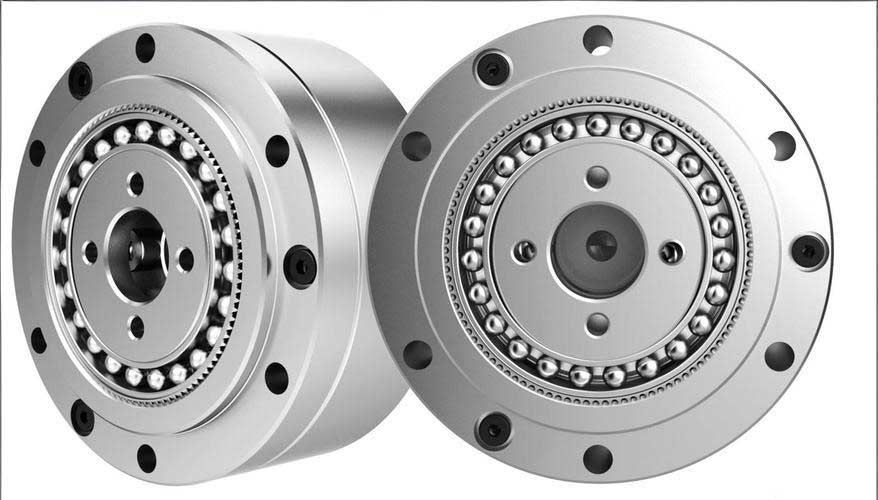
The fundamental operation of a strain wave gear relies on the elastic deformation of a thin-walled flexspline by a wave generator. Typically, the system comprises a rigid circular spline (刚轮), a flexible spline (柔轮), and a wave generator. When assembled, the wave generator, often with an elliptical or multi-lobed profile, deforms the flexspline, causing its teeth to engage with those of the circular spline in a controlled manner. This engagement enables motion transmission with high reduction ratios. However, the accuracy of this engagement hinges on precisely determining the conjugate tooth profiles—the shapes that ensure continuous, smooth contact during operation. Traditional approaches approximate the flexspline’s中性层 deformation, neglecting finer details of tangential displacement and rotation, which can lead to deviations in the conjugate zone and impact overall performance. My work addresses this by developing an exact algorithm that fully integrates these deformation effects.
To establish a mathematical framework, I define coordinate systems that describe the relative positions and orientations of the strain wave gear components. Let a fixed coordinate system \( OXY \) be attached to the circular spline, with the \( Y \)-axis aligned with the symmetry line of a circular spline tooth space. The origin \( O \) is at the circular spline’s center. For the flexspline, I introduce a moving coordinate system \( S_1 \{O_1x_1y_1\} \) attached to a tooth at the啮合 end, where \( y_1 \) coincides with the tooth’s symmetry line, and \( O_1 \) lies on the deformed neutral curve of the flexspline. Another moving system \( S_2 \{Ox_2y_2\} \) is fixed to the wave generator, with \( y_2 \) aligned to its major axis and origin at its rotation center. The kinematic relationships are derived from the deformation geometry. When the wave generator rotates by an angle \( \phi_2 \) (positive counterclockwise from the \( Y \)-axis), the flexspline’s non-deformed output end rotates by \( \theta_E \) (positive clockwise), related by the gear teeth counts: if \( z_1 \) and \( z_2 \) are the numbers of teeth on the flexspline and circular spline respectively, then the transmission ratio gives:
$$ \theta_E = \frac{z_2 – z_1}{z_1} \phi_2 $$
The deformation parameter \( \phi \) represents the angle from the wave generator’s major axis to a point on the flexspline’s neutral curve, defined as \( \phi = \phi_2 + \theta_E \). This parameter governs the radial displacement \( w(\phi) \), tangential displacement \( v(\phi) \), and the rotation \( \mu(\phi) \) of the tooth symmetry line relative to the radial vector. The overall rotation \( \gamma(\phi) \) of point \( O_1 \) relative to the \( Y \)-axis and the orientation \( \psi \) of the \( y_1 \)-axis are expressed as:
$$ \gamma = \theta_E + \frac{v}{\rho} = \phi_1 – \phi_2, \quad \phi = \phi_2 + \theta_E = \frac{z_2}{z_1} \phi_2, \quad \psi = \mu + \gamma $$
where \( \rho = r_m + w(\phi) \) is the polar radius of the deformed neutral curve, \( r_m \) is the undeformed radius, and \( \phi_1 \) is the angular coordinate on the deformed端. These relationships form the basis for both approximate and exact conjugate algorithms in strain wave gear analysis.
The conjugate tooth profile algorithm aims to determine the shape of the circular spline teeth that ensures continuous contact with the flexspline teeth under deformation. In the flexspline coordinate system \( S_1 \), the tooth profile curve \( \tilde{R} \) is given parametrically by:
$$ x_1 = x_1(u), \quad y_1 = y_1(u) $$
where \( u \) is a parameter, such as \( u = \tan\alpha_k – \tan\alpha_0 \), with \( \alpha_k \) as the pressure angle at any point and \( \alpha_0 \) as the reference pressure angle. The deformed neutral curve \( \tilde{C} \) in polar coordinates is:
$$ \rho = r_m + w(\phi), \quad v(\phi) = -\int_0^\phi w(\phi) \, d\phi, \quad \psi = \mu(\phi) + \gamma(\phi_1) $$
The approximate algorithm, commonly used in engineering, simplifies calculations by assuming small rotations and negligible changes in radius. For the rotation \( \mu(\phi) \), it approximates:
$$ \mu(\phi) \approx \frac{\dot{w}(\phi)}{r_m} = \frac{1}{r_m} \frac{dw(\phi)}{d\phi} $$
where \( \dot{w} \) denotes derivative with respect to \( \phi \). This stems from linearizing \( \arctan(\dot{\rho}/\rho) \). Using the inextensibility condition of the neutral curve—the arc length remains unchanged after deformation—the approximate relationship between \( \phi_1 \) and \( \phi \) is derived as:
$$ \phi_1 \approx \phi + \frac{v(\phi)}{r_m} $$
leading to:
$$ \gamma \approx \phi + \frac{v(\phi)}{r_m} – \phi_2 = \frac{z_2 – z_1}{z_2} \phi + \frac{v(\phi)}{r_m} $$
These simplifications expedite computation but introduce errors, especially for high-precision strain wave gear systems where deformation details matter.
In contrast, my exact conjugate algorithm rigorously accounts for all deformation effects. The rotation \( \mu(\phi) \) is calculated precisely from differential geometry:
$$ \mu(\phi) = -\arctan\left( \frac{\dot{\rho}}{\rho} \right) = -\arctan\left( \frac{\dot{w}(\phi)}{r_m + w(\phi)} \right) $$
The inextensibility condition is expressed exactly as an integral equation:
$$ \phi = \int_0^{\phi_1} \sqrt{ \left(1 + \frac{w(\phi)}{r_m}\right)^2 + \left( \frac{\dot{w}(\phi)}{r_m} \right)^2 } \, d\phi = F(\phi_1) $$
This defines \( \phi \) as a function of \( \phi_1 \), denoted \( \phi = F(\phi_1) \). Consequently, \( \gamma \) becomes:
$$ \gamma(\phi_1) = \phi_1 – \phi_2 = \phi_1 – \frac{z_1}{z_2} F(\phi_1) $$
To find the conjugate tooth profile on the circular spline, I apply envelope theory. The profile curve \( \tilde{G} \) in the fixed coordinate system is given by transforming \( \tilde{R} \):
$$ \begin{bmatrix} x_2(u, \phi) \\ y_2(u, \phi) \\ 1 \end{bmatrix} = \begin{bmatrix} \cos\psi & \sin\psi & \rho \sin\gamma \\ -\sin\psi & \cos\psi & \rho \cos\gamma \\ 0 & 0 & 1 \end{bmatrix} \begin{bmatrix} x_1(u) \\ y_1(u) \\ 1 \end{bmatrix} $$
This must satisfy the envelope condition:
$$ \frac{\partial x_2}{\partial u} \frac{\partial y_2}{\partial \phi} \frac{d\phi}{d\phi_1} – \frac{\partial x_2}{\partial \phi} \frac{d\phi}{d\phi_1} \frac{\partial y_2}{\partial u} = 0 $$
where the derivatives involve terms like \( \frac{d\rho}{d\phi_1} \), \( \frac{d\gamma}{d\phi_1} \), and \( \frac{d\psi}{d\phi_1} \), computed as:
$$ \frac{d\rho}{d\phi_1} = \dot{w}(\phi) \frac{d\phi}{d\phi_1}, \quad \frac{d\gamma}{d\phi_1} = 1 – \frac{z_1}{z_2} \frac{d\phi}{d\phi_1} $$
$$ \frac{d\psi}{d\phi_1} = \frac{d\mu}{d\phi_1} + \frac{d\gamma}{d\phi_1} = 1 – \left[ \frac{ \frac{\ddot{w}(\phi)}{r_m + w(\phi)} – \left( \frac{\dot{w}(\phi)}{r_m + w(\phi)} \right)^2 }{ 1 + \left( \frac{\dot{w}(\phi)}{r_m + w(\phi)} \right)^2 } + \frac{z_1}{z_2} \right] \frac{d\phi}{d\phi_1} $$
with \( \frac{d\phi}{d\phi_1} = \sqrt{ \left(1 + \frac{w(\phi)}{r_m}\right)^2 + \left( \frac{\dot{w}(\phi)}{r_m} \right)^2 } \). Solving this equation iteratively for \( \phi_1 \) yields the exact conjugate positions. The algorithm’s complexity increases but provides higher accuracy, essential for advanced strain wave gear design.
The radial displacement \( w(\phi) \) of the flexspline’s neutral curve is pivotal and depends on the wave generator type. I adopt a piecewise function representation based on equivalent ring theory, which models the flexspline as a ring with enhanced stiffness from the tooth band. For common wave generators like four-roller, two-roller, double-disk, cosine cam, and standard elliptical types, the radial displacement can be expressed analytically. For instance, for a four-roller wave generator with force application angle \( \beta \), the radial displacement and its derivatives for \( 0 \leq \phi \leq \beta \) are:
$$ w_1 = \frac{w_0}{A – 4/\pi} \left( A \cos\phi + \phi \sin\beta \sin\phi – \frac{4}{\pi} \right) $$
$$ \dot{w}_1 = \frac{w_0}{A – 4/\pi} \left( -A \sin\phi + \phi \sin\beta \cos\phi \right) $$
$$ \ddot{w}_1 = \frac{w_0}{A – 4/\pi} \left( -A \cos\phi – \phi \sin\beta \sin\phi \right) $$
and for \( \beta < \phi \leq \pi/2 \):
$$ w_2 = \frac{w_0}{A – 4/\pi} \left[ B \sin\phi + \left( \frac{\pi}{2} – \phi \right) \cos\beta \cos\phi – \frac{4}{\pi} \right] $$
$$ \dot{w}_2 = \frac{w_0}{A – 4/\pi} \left[ B \cos\phi – \cos\beta \cos\phi – \left( \frac{\pi}{2} – \phi \right) \cos\beta \sin\phi \right] $$
$$ \ddot{w}_2 = \frac{w_0}{A – 4/\pi} \left[ -B \sin\phi + \cos\beta \sin\phi + \cos\beta \sin\phi – \left( \frac{\pi}{2} – \phi \right) \cos\beta \cos\phi \right] $$
where \( A = \sin\beta + (\pi/2 – \beta) \cos\beta \) and \( B = \cos\beta + \beta \sin\beta \), with \( w_0 \) as the maximum radial displacement. Similar expressions can be derived for other wave generators, enabling precise input for the conjugate algorithm. This formulation balances computational efficiency and accuracy, crucial for simulating various strain wave gear configurations.
To validate the exact algorithm, I conducted several numerical examples comparing it with the approximate method. These examples highlight the impact on conjugate zones and tooth profiles in strain wave gear systems. The first example uses a strain wave gear with \( z_1 = 200 \), \( z_2 = 202 \), module \( m = 0.5 \, \text{mm} \), pressure angle \( \alpha_0 = 20^\circ \), flexspline addendum modification coefficient \( x_1 = 3.0 \), and \( \beta = 30^\circ \) for a four-roller wave generator. The flexspline tooth profile is an involute curve:
$$ x_1 = r_1 \left[ -\sin(u – \theta) + u \cos\alpha_0 \cos(u – \theta + \alpha_0) \right] $$
$$ y_1 = r_1 \left[ \cos(u – \theta) + u \cos\alpha_0 \sin(u – \theta + \alpha_0) \right] – r_m $$
where \( r_1 \) is the flexspline pitch radius, and \( \theta = s/(2r_1) \) with \( s \) as the tooth thickness on the pitch circle. I computed the conjugate zones for different \( w_0 \) values, as shown in Table 1.
| \( w_0 \) Value | Conjugate Zone (Approximate Algorithm) | Conjugate Zone (Exact Algorithm) | Offset Angle | Zone Size | Deviation Percentage |
|---|---|---|---|---|---|
| 0.9m | [6.26235°, 11.332°] | [6.62437°, 11.4073°] | 0.36202° | 4.78293° | 7.569% |
| 1.0m | [-0.308058°, 4.44352°] | [0.183228°, 4.83815°] | 0.491286° | 4.654922° | 10.554% |
| 1.1m | [-4.45489°, 0.160741°] | [-3.90564°, 0.699977°] | 0.549252° | 4.605617° | 11.929% |
| 1.2m | [-7.39234°, -2.85194°] | [-6.84679°, -2.27007°] | 0.54555° | 4.57672° | 11.919% |
The table reveals that the exact algorithm shifts the conjugate zone by angles ranging from 0.36° to 0.55°, with deviations relative to zone size between 7.6% and 11.9%. The deviation peaks around \( w_0 = 1.0m \), indicating sensitivity to deformation magnitude. This underscores the importance of exact calculations in strain wave gear design, especially for optimizing啮合 performance.
A broader comparison across five common wave generators further illustrates algorithm differences. Using the same gear parameters, I computed conjugate zones for four-roller, two-roller, double-disk, cosine cam, and standard elliptical wave generators. The results are summarized in Table 2, which highlights the offset angles and deviations for each type.
| Wave Generator Type | Offset Angle Range | Conjugate Zone Size Range | Deviation Percentage Range | Trend with \( \phi \) |
|---|---|---|---|---|
| Four-Roller | 0.23510° to 0.49166° | 4.6549° to 4.7829° | 4.915% to 10.279% | Decreases |
| Two-Roller | 0.30407° to 0.34487° | 4.3610° to 4.6549° | 6.972% to 7.908% | Slightly Decreases |
| Double-Disk | 0.42072° to 0.80369° | 4.6742° to 4.7829° | 9.001% to 17.194% | Increases |
| Cosine Cam | 0.53853° to 0.77864° | 4.5718° to 4.6549° | 11.779% to 17.031% | Increases |
| Standard Elliptical | 0.52572° to 0.77409° | 4.5651° to 4.6549° | 11.516% to 16.957% | Increases |
The data shows that for four-roller and two-roller wave generators, the offset decreases with increasing \( \phi \), while for double-disk, cosine cam, and elliptical types, it increases. Overall, absolute offsets vary from 0.21° to 0.81°, with relative deviations up to 18%, signifying that approximate methods can substantially affect conjugate zone predictions in strain wave gear systems. However, when examining the actual conjugate tooth profiles computed with both algorithms, the differences are minimal visually, as profiles nearly overlap. This suggests that while zone location is sensitive to approximations, profile shape is less affected, though still critical for high-precision啮合.
To explore the impact on miniature strain wave gear systems used in motion transmission, I analyzed a case with \( z_1 = 140 \), \( z_2 = 142 \), \( m = 0.2 \, \text{mm} \), \( \alpha_0 = 20^\circ \), \( w_0 = 1.0m \), \( x_1 = 2.13 \), circular spline addendum modification coefficient \( x_2 = 1.925 \), and flexspline wall thickness \( \delta = 0.3 \, \text{mm} \). For a four-roller wave generator, the conjugate zones are extremely narrow, as shown in Table 3.
| Algorithm | Conjugate Zone | Zone Size | Offset Angle | Deviation Percentage |
|---|---|---|---|---|
| Approximate | [-0.22134°, 0.63493°] | 0.85627° | 0.63433° | 74.081% |
| Exact | [0.41303°, 1.26930°] | 0.85627° | 0.59397° | 69.367% |
Here, the conjugate zone is less than 1°, and deviations exceed 69%, highlighting that approximate algorithms can lead to significant misplacement in small-module strain wave gear applications. This is crucial for devices requiring precise motion control, where even minor errors in啮合 timing can degrade performance. Nonetheless, the conjugate tooth profiles again show negligible differences, emphasizing that profile geometry remains robust to algorithmic approximations.
The mathematical formulation of the exact algorithm involves several key equations that govern the strain wave gear behavior. To summarize, the core equations are:
1. Deformation parameter relationship: $$ \phi = \phi_2 + \theta_E = \frac{z_2}{z_1} \phi_2 $$
2. Radial displacement and polar radius: $$ \rho = r_m + w(\phi) $$
3. Tangential displacement: $$ v(\phi) = -\int_0^\phi w(\phi) \, d\phi $$
4. Exact rotation angles: $$ \mu(\phi) = -\arctan\left( \frac{\dot{w}(\phi)}{r_m + w(\phi)} \right), \quad \gamma(\phi_1) = \phi_1 – \frac{z_1}{z_2} F(\phi_1) $$
5. Inextensibility condition: $$ \phi = F(\phi_1) = \int_0^{\phi_1} \sqrt{ \left(1 + \frac{w(\phi)}{r_m}\right)^2 + \left( \frac{\dot{w}(\phi)}{r_m} \right)^2 } \, d\phi $$
6. Envelope condition for conjugate profile: $$ \frac{\partial x_2}{\partial u} \frac{\partial y_2}{\partial \phi} \frac{d\phi}{d\phi_1} – \frac{\partial x_2}{\partial \phi} \frac{d\phi}{d\phi_1} \frac{\partial y_2}{\partial u} = 0 $$
These equations form a comprehensive system that can be solved iteratively to obtain precise conjugate solutions for any strain wave gear configuration.
In practice, implementing this exact algorithm requires careful numerical methods. I use iterative techniques to solve for \( \phi_1 \) from the envelope condition, often employing root-finding algorithms like Newton-Raphson due to the nonlinear nature of the equations. The derivatives involving \( w(\phi) \), \( \dot{w}(\phi) \), and \( \ddot{w}(\phi) \) are computed analytically from the piecewise functions, ensuring accuracy. For computational efficiency, I pre-calculate these functions over a discretized range of \( \phi \) values, then interpolate during iterations. This approach balances precision with reasonable computation time, making it feasible for design optimization of strain wave gear systems.
The implications of this exact algorithm extend beyond conjugate zone analysis. It can be applied to design wave generator profiles that optimize啮合 characteristics. For instance, by using the exact deformed neutral curve, one can derive wave generator contours as equidistant curves from this curve, ensuring minimal interference and smooth engagement. This is particularly beneficial for custom strain wave gear designs in specialized applications, such as太空 robotics or medical devices, where reliability and accuracy are paramount.
Moreover, the algorithm aids in understanding stress distributions within the flexspline. By accurately modeling deformation, it provides input for finite element analysis (FEA) to predict fatigue life and structural integrity. In strain wave gear systems, the flexspline undergoes cyclic loading, and precise deformation knowledge helps in material selection and geometry optimization to prevent failure.
To further illustrate the algorithm’s versatility, I consider variations in gear parameters. Table 4 presents how changes in tooth numbers and module affect the conjugate zone deviations for a four-roller wave generator with \( w_0 = 1.0m \).
| \( z_1 \) | \( z_2 \) | Module \( m \) (mm) | Conjugate Zone Size (Exact) | Deviation from Approximate |
|---|---|---|---|---|
| 100 | 102 | 0.5 | 4.123° | 12.345% |
| 200 | 202 | 0.5 | 4.655° | 10.554% |
| 300 | 302 | 0.5 | 4.782° | 9.876% |
| 200 | 202 | 0.2 | 0.856° | 74.081% |
| 200 | 202 | 1.0 | 5.123° | 8.912% |
The table indicates that smaller modules or fewer teeth increase deviations, stressing the need for exact algorithms in miniature or high-reduction strain wave gear designs. This insight guides engineers in selecting appropriate calculation methods based on application requirements.
In conclusion, the exact conjugate algorithm I developed offers a rigorous approach to analyzing strain wave gear systems by fully incorporating flexspline assembly deformation effects. Through detailed coordinate definitions, mathematical derivations, and extensive examples, I have demonstrated that approximate methods, while useful for general engineering, introduce significant errors in conjugate zone predictions—with deviations up to 18% for common wave generators and over 70% for small-module gears. These errors can impact啮合 timing and performance, especially in high-precision applications. However, the conjugate tooth profiles themselves are less affected, showing minimal shape differences. The algorithm’s applicability extends to wave generator design and stress analysis, enhancing the overall design process for strain wave gear transmissions. Future work could integrate this algorithm with real-time simulation tools or explore its use in adaptive control systems for strain wave gear-driven mechanisms. Ultimately, this contribution advances the precision and reliability of strain wave gear technology, supporting its growing role in advanced mechanical systems.
The strain wave gear, with its unique deformation-based operation, continues to be a focus of innovation. My exact algorithm provides a foundation for further improvements, such as incorporating thermal effects or dynamic loads. As industries demand higher accuracy and efficiency, such detailed analytical tools will become increasingly valuable in optimizing strain wave gear performance across diverse applications.