
In recent years, the field of bionic robotics has seen remarkable advancements, with multi-legged bionic robots emerging as a focal point due to their superior adaptability in complex terrains. As a researcher, I have embarked on a project to explore the motion control principles of these bionic robots using the Explorer modular robotic platform. This article details our experimental journey, from platform overview to hardware design and gait implementation, emphasizing the integration of mechanical, electronic, and computational aspects. The bionic robot concept is central to our work, aiming to mimic biological locomotion for enhanced mobility. Throughout this study, we leverage tables and formulas to summarize key findings, ensuring a comprehensive analysis. The Explorer platform provides a flexible foundation, allowing us to construct and program various bionic robot configurations, with a focus on multi-legged designs that imitate creatures like lizards. Our goal is to advance the understanding of bionic robot dynamics and control, paving the way for applications in search, rescue, and exploration. The bionic robot’s ability to navigate uneven surfaces makes it a promising technology, and our experiments seek to optimize its performance through systematic design and testing.
The Explorer modular robotic platform is a versatile toolkit that facilitates rapid prototyping of bionic robots. We utilized its components to build multi-legged bionic robots, starting with an overview of the platform. The platform includes mechanical parts like links, plates, and frames; control boards such as Basra and ARM7; actuators like servo motors and DC motors; and sensors including infrared, grayscale, and ultrasonic units. For our bionic robot experiments, we focused on the Basra main control board, which is based on Arduino and features an ATmega328 processor. It offers 14 digital I/O pins, 6 analog inputs, and programmable interfaces via C/C++ in IDEs like Arduino IDE. We paired it with the Bigfish expansion board, which provides interfaces for servos, DC motors, and sensors, enhancing connectivity for our bionic robot constructions. The software platform, Arduino IDE, enabled graphical and code-based programming for motion control algorithms. Sensors played a crucial role: grayscale sensors for line tracking and edge detection, and near-infrared sensors for obstacle avoidance. These components collectively form the backbone of our bionic robot systems, allowing us to implement and test various designs. To summarize the platform’s key elements, we present Table 1, which outlines the primary modules used in our bionic robot experiments.
| Component Type | Specific Model/Name | Function in Bionic Robot | Parameters/Notes |
|---|---|---|---|
| Main Control Board | Basra (Arduino-based) | Central processing for bionic robot motion control | ATmega328, 14 I/O pins, 6 analog inputs |
| Expansion Board | Bigfish | Interface for actuators and sensors in bionic robot | Servo ports, motor drivers, LED matrix |
| Actuator | Servo Motor | Joint movement in bionic robot limbs | Torque: 2.5 kg-cm, speed: 0.12 sec/60° |
| Actuator | DC Motor | Driving eccentric wheels in bionic robot legs | Voltage: 6V, speed: 100 RPM |
| Sensor | Grayscale Sensor | Line tracking for bionic robot navigation | Range: 0.7-3 cm, infrared-based |
| Sensor | Near-Infrared Sensor | Obstacle detection for bionic robot avoidance | Range: up to 20 cm, susceptible to ambient light |
| Software | Arduino IDE | Programming bionic robot gait and control | Graphical and C/C++ programming support |
Building on this platform, we designed two types of multi-legged bionic robots: one driven by DC motors for mechanical rhythm-based motion, and another by servo motors for joint-based imitation of biological gait. The DC motor-driven bionic robot employs an eccentric crank-rocker mechanism, where a single motor rotates an eccentric wheel to generate leg movement. This design mimics the rhythmic motion of arthropods, with legs following a sinusoidal trajectory. We developed 3D models using CAD software to simulate the bionic robot structure before physical assembly. The four-legged bionic robot model consists of linkages and wheels, and by combining two such units, we created an eight-legged bionic robot capable of turning through differential speed control. The motion equation for the leg trajectory in this bionic robot can be approximated as a harmonic function. For a leg attached to an eccentric wheel, the vertical displacement \( y \) as a function of time \( t \) is given by:
$$ y(t) = A \sin(\omega t + \phi) $$
where \( A \) is the amplitude determined by the eccentricity, \( \omega \) is the angular velocity of the motor, and \( \phi \) is the phase difference between legs. For our bionic robot, we set \( \phi = 180^\circ \) between contralateral legs to achieve alternating strides. The hardware construction involved assembling mechanical parts from the Explorer kit, resulting in a functional bionic robot that can perform basic locomotion. The eight-legged bionic robot was equipped with grayscale and near-infrared sensors for autonomous behaviors like line following and obstacle avoidance. This bionic robot demonstrates how mechanical design can emulate biological rhythm, but it lacks the joint flexibility of real creatures. Therefore, we progressed to a servo-driven bionic robot for more nuanced gait studies.
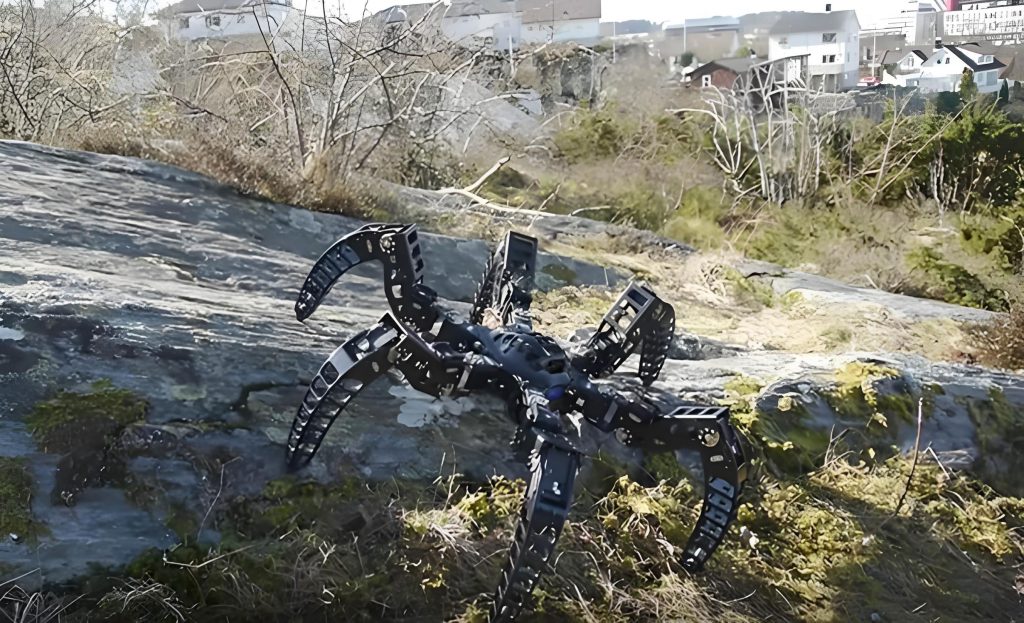
The servo-driven bionic robot focuses on imitating lizard locomotion, which involves jointed limb movements. We designed a four-legged bionic robot with two degrees of freedom per leg: a shoulder joint for horizontal swing (simulated by a servo motor) and an elbow joint for vertical lift (another servo motor). This bionic robot structure allows us to program precise joint angles, replicating the limb coordination observed in lizards. Using 3D modeling, we optimized the joint placements and linkage lengths to ensure stability. The bionic robot’s torso was kept simple, as our priority was limb motion analysis. The kinematic equations for each leg of this bionic robot can be derived using forward kinematics. For a leg with shoulder angle \( \theta_s \) and elbow angle \( \theta_e \), the foot position \( (x, y) \) relative to the body is:
$$ x = L_s \cos(\theta_s) + L_e \cos(\theta_s + \theta_e) $$
$$ y = L_s \sin(\theta_s) + L_e \sin(\theta_s + \theta_e) $$
where \( L_s \) and \( L_e \) are the lengths of the upper and lower leg segments, respectively. In our bionic robot, we set \( L_s = 5 \, \text{cm} \) and \( L_e = 4 \, \text{cm} \) based on the Explorer parts. This model helps us compute joint angles for desired foot trajectories, essential for programming the bionic robot’s gait. The physical assembly used servo motors, links, and hinge joints, resulting in a bionic robot capable of articulated motion. This design highlights the versatility of bionic robots in mimicking complex biological systems, and we used it to study lizard-inspired gaits in detail.
Gait design is crucial for the bionic robot’s locomotion efficiency. We analyzed lizard movement through video observations and biological studies, breaking it down into four key states: torso bending and limb swinging. The bionic robot must replicate these states through coordinated servo movements. We defined a gait cycle with five states for our bionic robot, as summarized in Table 2. Each state specifies the elbow joint (extended for support or contracted for swing) and shoulder joint position (forward or backward). This table guides the programming of the bionic robot’s motion sequence.
| Gait State | Left Front Elbow | Left Front Shoulder | Right Front Elbow | Right Front Shoulder | Left Rear Elbow | Left Rear Shoulder | Right Rear Elbow | Right Rear Shoulder | Description |
|---|---|---|---|---|---|---|---|---|---|
| State 1 (Standby) | 0 (Contracted) | b (Back) | 0 | b | 0 | b | 0 | b | Bionic robot in upright pose, all limbs grounded |
| State 2 (Swing 1) | 1 (Extended) | b | 0 | f (Forward) | 0 | f | 1 | b | Left front and right rear support; right front and left rear swing forward |
| State 3 (Support 1) | 0 | f | 1 | f | 1 | f | 0 | b | Right front and left rear support; left front and right rear swing forward |
| State 4 (Swing 2) | 0 | f | 1 | b | 1 | b | 0 | f | Right front and left rear push back; left front and right rear hold contracted |
| State 5 (Support 2) | 1 | b | 0 | b | 0 | b | 1 | f | Left front and right rear push back; right front and left rear hold contracted |
The gait cycle from State 2 to State 5 forms a continuous loop for bionic robot locomotion. We programmed this using Arduino IDE, setting servo angles based on the table. For example, in State 2, the shoulder servos for right front and left rear legs rotate to \( \theta_s = 30^\circ \) forward, while elbow servos extend to \( \theta_e = 0^\circ \). The control algorithm for the bionic robot iterates through these states with timing delays to simulate natural speed. The relationship between joint angles and time can be modeled as piecewise functions. For a leg swinging forward in State 2, the shoulder angle \( \theta_s(t) \) changes linearly:
$$ \theta_s(t) = \theta_{\text{start}} + (\theta_{\text{end}} – \theta_{\text{start}}) \frac{t}{T} $$
where \( \theta_{\text{start}} = -20^\circ \), \( \theta_{\text{end}} = 30^\circ \), and \( T \) is the swing duration. This ensures smooth motion for the bionic robot. We tested the bionic robot on various surfaces, observing that it successfully imitated lizard-like stepping, though without torso flexion, the stride length was limited. The bionic robot’s performance confirmed the effectiveness of our gait design, highlighting the importance of bio-inspired control in bionic robotics.
To further analyze the bionic robot’s dynamics, we derived equations for stability and energy efficiency. The bionic robot’s center of mass (CoM) trajectory during gait affects balance. For a quadruped bionic robot in State 2, the CoM position \( \mathbf{r}_{\text{CoM}} \) can be computed as:
$$ \mathbf{r}_{\text{CoM}} = \frac{\sum_{i=1}^4 m_i \mathbf{r}_i}{\sum_{i=1}^4 m_i} $$
where \( m_i \) and \( \mathbf{r}_i \) are the mass and position of leg \( i \). Assuming symmetric mass distribution in our bionic robot, we minimized CoM fluctuation to prevent tipping. Additionally, the torque \( \tau \) required at each servo joint of the bionic robot is given by:
$$ \tau = I \alpha + m g l \sin(\theta) $$
where \( I \) is the moment of inertia, \( \alpha \) is angular acceleration, \( m \) is leg mass, \( g \) is gravity, \( l \) is lever arm, and \( \theta \) is joint angle. For our bionic robot, we estimated \( \tau \approx 0.5 \, \text{Nm} \) per servo, within the motor specs. These calculations helped optimize the bionic robot’s design for reduced power consumption. We also conducted experiments with sensor integration, programming the bionic robot to avoid obstacles using near-infrared sensors. The control logic involved if-then rules: if sensor detects an object within 10 cm, the bionic robot alters its gait to turn. This autonomous capability enhances the bionic robot’s applicability in real-world scenarios.
In conclusion, our experimental research on multi-legged bionic robots using the Explorer platform demonstrates the synergy between modular hardware and bio-inspired software. We developed two bionic robot types: a DC motor-driven version for rhythmic motion and a servo-driven version for articulated gait imitation. The bionic robot designs were validated through 3D modeling, physical construction, and programming, with gait tables and kinematic formulas guiding motion control. The bionic robot successfully emulated lizard locomotion, underscoring the potential of bionic robots for adaptive mobility. Future work will focus on enhancing the bionic robot with more sensors, dynamic balance algorithms, and swarm coordination. This study contributes to the growing field of bionic robotics, offering insights into how bionic robots can bridge biological principles and engineering innovation. The bionic robot remains a key tool for exploring autonomous systems, and our experiments pave the way for more advanced bionic robot applications in diverse environments.