
In the context of modern engineering education, the integration of artificial intelligence and robotics has become a pivotal component. As an educator and researcher in this field, I have focused on developing experimental teaching methods that enhance students’ understanding and innovation capabilities. This article explores the design and implementation of gait control for a humanoid robot, emphasizing the use of inertial sensors and mathematical models to achieve stable locomotion. The humanoid robot serves as an excellent platform for students to apply theoretical knowledge in mechanics, electronics, and computer science, fostering a hands-on learning experience that aligns with the demands of new engineering disciplines.
The humanoid robot, with its bipedal structure, presents unique challenges in balance and motion coordination. In our laboratory, we have developed a custom humanoid robot model named CCNU-1, which features multiple degrees of freedom to simulate human-like movement. The design of this humanoid robot involves careful consideration of joint configurations and actuator placements to enable complex maneuvers such as walking, turning, and standing. Below is a table summarizing the degrees of freedom for the CCNU-1 humanoid robot, which highlights the kinematic structure essential for gait design.
| Joint | Degrees of Freedom | Description |
|---|---|---|
| Ankle | 2 (forward and twist) | Controls foot orientation and stability. |
| Knee | 1 (forward) | Enables leg flexion and extension. |
| Hip | 3 (forward, lateral, rotation) | Facilitates leg movement in multiple planes. |
| Total per Leg | 6 | Each leg has 6 degrees of freedom. |
| Overall Robot | 18 | Combined degrees for both legs and torso. |
This configuration allows the humanoid robot to perform a wide range of motions, but the core challenge lies in designing a stable gait. Gait design for a humanoid robot involves planning sequential movements that maintain balance while propelling the robot forward. Key principles include shifting the center of gravity, coordinating limb movements, and ensuring smooth transitions between steps. In our experiments, students learn to program the humanoid robot by controlling servos that correspond to specific joints. The following table outlines the mapping between actions and servo modules for the CCNU-1 humanoid robot.
| Action | Servo Numbers | Effect on Humanoid Robot |
|---|---|---|
| Shift重心 right | 13 | Moves center of gravity to support leg. |
| Left leg extension | 14, 16 | Advances left leg forward. |
| Right leg swing | 15, 17 | Brings right leg forward for next step. |
| Balance adjustment | Multiple servos | Fine-tunes posture during motion. |
The continuous gait cycle for a humanoid robot can be broken down into phases: initial stance, weight transfer, leg swing, and foot placement. By iterating these phases, the humanoid robot achieves forward locomotion. To visualize this process, consider the following diagrammatic representation, which illustrates the sequential steps in a humanoid robot’s walk cycle.
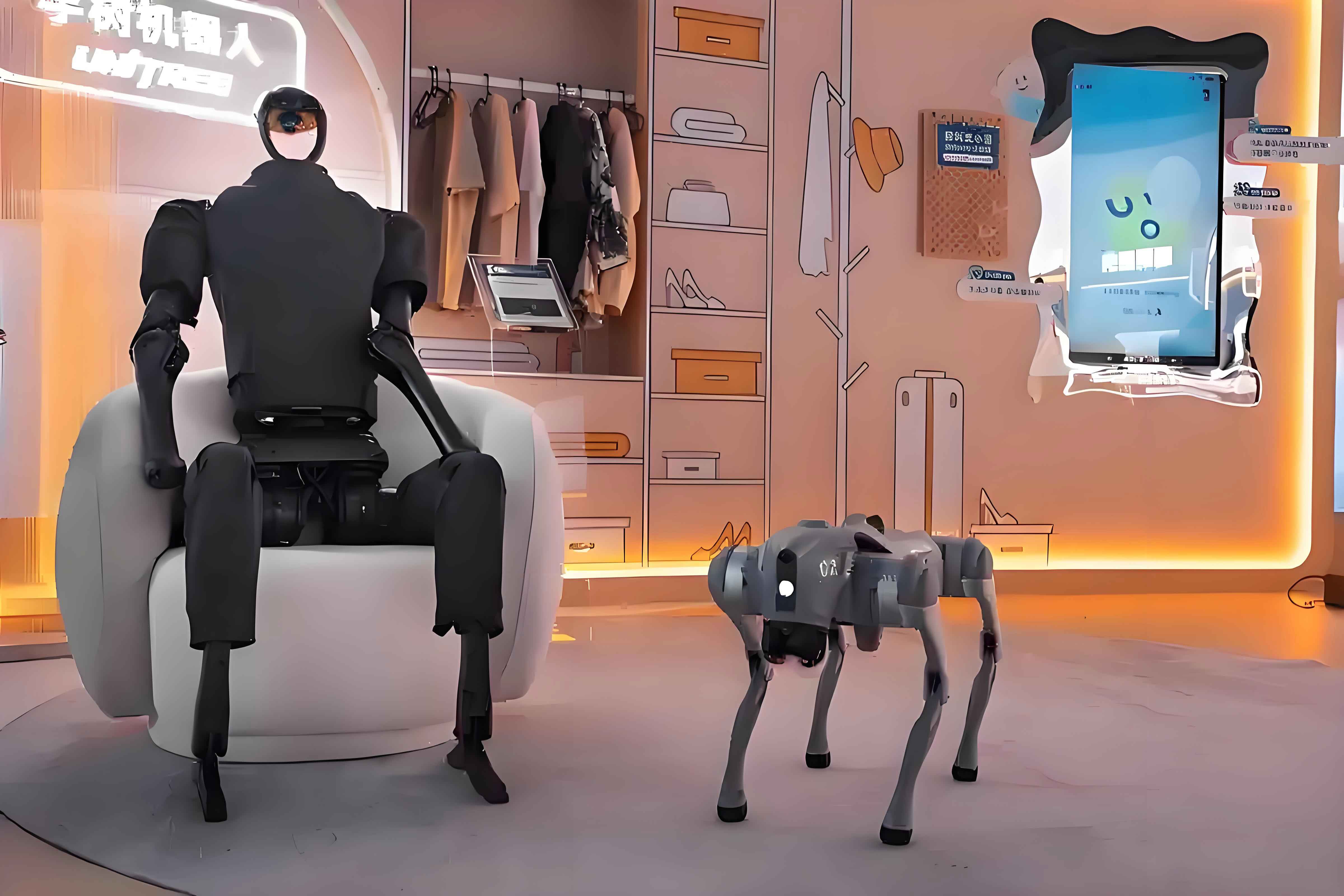
This image depicts the dynamic nature of humanoid robots in action, highlighting the integration of mechanical design and control algorithms. In our experimental setup, students simulate these steps using software interfaces, adjusting servo parameters to observe real-time changes in the humanoid robot’s posture.
Underlying the gait design is a robust mathematical framework that leverages sensor data for precise control. The humanoid robot is equipped with inertial measurement units (IMUs), such as the MPU6050, which provide quaternion data representing orientation. Quaternions are hypercomplex numbers that efficiently describe rotations in three-dimensional space. A quaternion is defined as:
$$ q = w + xi + yj + zk $$
where \( w, x, y, z \) are real numbers, and \( i, j, k \) are the fundamental quaternion units satisfying \( i^2 = j^2 = k^2 = ijk = -1 \). For a humanoid robot, the quaternion output from sensors is used to compute Euler angles—pitch, roll, and yaw—which offer an intuitive representation of attitude. The rotation matrix \( R \) derived from a quaternion is given by:
$$ R = \begin{bmatrix}
1 – 2(y^2 + z^2) & 2(xy – zw) & 2(xz + yw) \\
2(xy + zw) & 1 – 2(x^2 + z^2) & 2(yz – xw) \\
2(xz – yw) & 2(yz + xw) & 1 – 2(x^2 + y^2)
\end{bmatrix} $$
From this matrix, Euler angles can be extracted. For instance, the pitch angle \( \theta \) (rotation around the x-axis) is calculated as:
$$ \theta = \arcsin(2(xy + zw)) $$
Similarly, roll \( \phi \) and yaw \( \psi \) are obtained using inverse trigonometric functions. These calculations enable the humanoid robot to adjust its posture dynamically based on real-time sensor feedback. The relationship between quaternions and Euler angles is crucial for stabilizing the humanoid robot during gait execution, as it allows for corrective actions when deviations occur.
In our experimental teaching methodology, students engage in hands-on activities that involve programming the humanoid robot to perform predefined gaits. They start by modeling the robot in simulation software, where they define joint limits and motion trajectories. The table below summarizes the key parameters considered during this phase for the humanoid robot CCNU-1.
| Parameter | Value Range | Impact on Gait |
|---|---|---|
| Servo Angle Limits | -90° to +90° | Determines range of motion for legs. |
| Step Length | 10-20 cm | Affects stride and speed of humanoid robot. |
| Center of Gravity Height | 15-25 cm | Influences balance and stability. |
| Sampling Frequency | 100 Hz | Ensures timely sensor data processing. |
Through iterative testing, students refine the gait parameters to minimize energy consumption and prevent falls. The humanoid robot’s performance is evaluated based on metrics such as walking speed, balance retention, and smoothness of motion. This process not only deepens understanding of robotics principles but also encourages innovation, as students experiment with alternative gait patterns for the humanoid robot.
Beyond basic locomotion, we explore advanced topics like obstacle avoidance and adaptive walking for the humanoid robot. By integrating additional sensors, such as ultrasonic or vision systems, the humanoid robot can navigate complex environments. The control algorithms combine gait planning with real-time decision-making, using formulas to compute necessary adjustments. For example, if the humanoid robot encounters an incline, the pitch angle from the IMU is used to modify step height and timing. The dynamic equations of motion for a humanoid robot can be expressed using Lagrangian mechanics, where the kinetic and potential energies are modeled for each link. The general form is:
$$ L = T – V $$
where \( T \) is the total kinetic energy and \( V \) is the potential energy. For a humanoid robot with \( n \) joints, the equations of motion are derived as:
$$ \frac{d}{dt} \left( \frac{\partial L}{\partial \dot{q}_i} \right) – \frac{\partial L}{\partial q_i} = \tau_i $$
Here, \( q_i \) represents the joint angles, \( \dot{q}_i \) the angular velocities, and \( \tau_i \) the torques applied by servos. Solving these equations allows for optimal torque control, enhancing the efficiency of the humanoid robot’s movements.
In the context of experimental teaching, we emphasize collaborative projects where students work in teams to design and test their own humanoid robot variants. This fosters skills in problem-solving, programming, and systems integration. The humanoid robot platform serves as a catalyst for creativity, leading to participation in robotics competitions and research publications. Assessment of student learning includes practical demonstrations, reports on gait algorithms, and presentations on the humanoid robot’s performance improvements.
Looking ahead, we aim to incorporate machine learning techniques to enable the humanoid robot to learn gaits autonomously. Reinforcement learning algorithms, for instance, could allow the humanoid robot to optimize its walking strategy through trial and error. The reward function might be defined as:
$$ R = \alpha \cdot \text{speed} + \beta \cdot \text{stability} – \gamma \cdot \text{energy} $$
where \( \alpha, \beta, \gamma \) are weighting coefficients. By simulating thousands of gait cycles, the humanoid robot can converge to an efficient policy. This aligns with the broader trend of智能化 control in robotics, where humanoid robots become more adaptable and intelligent.
In conclusion, the experimental teaching approach centered on gait design for humanoid robots has proven effective in enhancing students’ engineering competencies. Through hands-on interaction with the humanoid robot CCNU-1, learners grasp complex concepts in dynamics, control theory, and sensor integration. The use of mathematical tools like quaternions and Euler angles provides a solid foundation for understanding orientation and motion. As we continue to refine our methods, the humanoid robot will remain a key focus in preparing the next generation of innovators for challenges in automation and artificial intelligence. Future work will expand the humanoid robot’s capabilities to include multi-modal locomotion and human-robot interaction, further enriching the educational experience.