
As a researcher deeply immersed in the field of human-robot interaction, I have always been fascinated by the potential of companion robots to forge meaningful relationships with humans. The concept of companionship, which blends attachment, intimacy, and commitment, serves as a cornerstone for understanding how these robots can integrate into our daily lives. In this article, I will delve into the intricacies of companion robots, examining how spatial distance and other non-linguistic elements influence the establishment of companionship. Through a detailed analysis of experimental findings and theoretical frameworks, I aim to provide a comprehensive perspective on the evolving role of companion robots in society.
The rise of companion robots in recent years has sparked considerable interest, as evidenced by innovations showcased at global events like CES. These robots, such as Lovot, Liku, and Kiki, emphasize emotional engagement, striving to create bonds that mimic human or pet relationships. However, surveys indicate that public comfort with robots remains low, highlighting the need for deeper exploration into how companion robots can better connect with users. My research focuses on proxemics—the study of spatial distance—as a key factor in this dynamic, but as I will demonstrate, it is just one piece of a larger puzzle.
To begin, it is essential to distinguish between social robots and companion robots. While often used interchangeably, these terms reflect different aspects of human-robot interaction. Social robots are designed to engage in social behaviors, making them appear as sociable entities. In contrast, companion robots specifically aim to build emotional relationships, characterized by companionship. This distinction is crucial because companion robots prioritize the affective bond over mere functional interaction. In my view, a companion robot must first exhibit social capabilities to transition into a companion role, as companionship relies on a foundation of social recognition.
Companionship, as defined in psychological literature, involves three intertwined emotions: attachment, intimacy, and commitment. Attachment refers to the emotional bond that ties individuals together, intimacy denotes a close, personal connection, and commitment is the dedication to maintaining the relationship over time. For companion robots, fostering these emotions requires a multifaceted approach. I propose that this can be modeled mathematically to understand their interplay. For instance, let the companionship level $C$ be a function of attachment $A$, intimacy $I$, and commitment $Co$:
$$ C = f(A, I, Co) $$
where each component can be influenced by various factors, such as spatial distance $d$, visual design $v$, and tactile feedback $t$. This leads to a more complex equation:
$$ C = \alpha \cdot A(d, v, t) + \beta \cdot I(d, v, t) + \gamma \cdot Co(d, v, t) $$
Here, $\alpha$, $\beta$, and $\gamma$ are weighting coefficients that reflect the relative importance of each emotion in companionship. This formula underscores that companionship is not solely dependent on one element but emerges from a synergy of multiple inputs.
To ground this theory, I turn to proxemics, pioneered by Hall, which categorizes interpersonal distances into intimate, personal, social, and public zones. In human-robot interaction, applying proxemics suggests that closer distances might enhance intimacy. However, my experimental findings challenge this assumption. In a controlled study, I investigated how spatial distance between a companion robot and humans affects companionship establishment. The experiment was conducted in a 10×10 square meter space, simulating typical indoor environments where companion robots operate. A prototype companion robot, designed with a cute, pet-like appearance, tracked human participants at distances of 1 meter, 0.5 meters, and 0.15 meters. Participants, all graduate students, were interviewed afterward to assess their feelings of intimacy.
The results were revealing: spatial distance did not significantly impact the perception of intimacy during movement in limited spaces. Instead, participants reported discomfort when followed closely, particularly at 0.5 meters, due to a sense of being stalked. This contradicts Hall’s proxemics, indicating that human-robot interactions diverge from human-human norms. To summarize the experimental conditions, consider the following table:
| Distance (meters) | Participant Feedback | Intimacy Level (Self-Reported) |
|---|---|---|
| 1.0 | Mild discomfort, awareness of robot | Low |
| 0.5 | High discomfort, feeling harassed | Very Low |
| 0.15 | Curiosity, perceived communication intent | Moderate |
This table illustrates that intimacy does not linearly increase with proximity; rather, other factors come into play. For example, when the companion robot made tactile contact or performed gestures like spinning, participants felt a stronger sense of connection, akin to interacting with a pet. This highlights the importance of non-linguistic elements beyond distance.
Building on this, I expanded the analysis to include visual and tactile dimensions. Visual design, such as cute aesthetics and expressive eyes, significantly boosted positive feelings toward the companion robot. Participants noted that the robot’s appearance evoked empathy, making it seem more lifelike. Tactile interactions, even gentle touches using foam materials, enhanced the perception of intimacy, as if the companion robot was seeking attention. These observations can be quantified using a multivariate model. Let the overall companionship score $C$ be expressed as:
$$ C = w_d \cdot g(d) + w_v \cdot h(v) + w_t \cdot k(t) + \epsilon $$
where $w_d$, $w_v$, and $w_t$ are weights for distance, visual, and tactile factors, respectively; $g(d)$, $h(v)$, and $k(t)$ are functions mapping these factors to companionship contributions; and $\epsilon$ represents error or other unaccounted elements. From my experiment, $w_d$ was relatively low, while $w_v$ and $w_t$ were higher, suggesting that visual and tactile cues outweigh spatial distance in building companionship.
To further elaborate, consider the role of time and shared space. Participants reported that spending extended periods with the companion robot in a confined area fostered a sense of commitment, one of the three pillars of companionship. This aligns with the idea that companionship deepens through sustained interaction, not just physical closeness. I hypothesize that commitment $Co$ can be modeled as a time-dependent function:
$$ Co(t) = Co_0 \cdot e^{\lambda t} $$
where $Co_0$ is the initial commitment level, $\lambda$ is a growth rate influenced by factors like shared activities, and $t$ is time. This exponential growth implies that long-term engagement with a companion robot can solidify the relationship, independent of distance.
Another critical aspect is the comparison between social robots and companion robots. The former focuses on social functionality, while the latter emphasizes emotional bonds. The following table categorizes social robots based on their sociability levels, adapted from existing literature:
| Sociability Level | Category | Characteristics |
|---|---|---|
| 5 | Socially Evocative Robot | Mimics human behavior, uses emotional stimuli to influence. |
| 4 | Socially Situated Robot | Aware of social context, reacts accordingly. |
| 3 | Social Robot | Meets emotional and social needs, actively interacts. |
| 2 | Socially Intelligent Robot | Possesses human-like intelligence, understands social nuances. |
| 1 | Socially Interactive Robot | Recognizes emotions, expresses personality, learns social skills. |
This taxonomy shows that companion robots often operate at higher sociability levels, integrating emotional intelligence to build companionship. However, my research indicates that even simpler companion robots, through non-linguistic cues, can achieve similar effects. For instance, the prototype used in my experiment lacked advanced AI but still elicited emotional responses through movement and design.
Reflecting on the experimental limitations, such as the small sample size and controlled environment, I acknowledge that broader studies are needed. Yet, the insights gained are valuable for designing better companion robots. The key takeaway is that proxemics alone is insufficient; designers must consider a holistic approach. Incorporating visual appeal, tactile feedback, and temporal elements can enhance companionship more effectively than optimizing distance. This is particularly relevant for companion robots intended for home use, where they share intimate spaces with users.
Now, let me integrate the provided hyperlink into the discussion. The image represents a companion robot in a domestic setting, illustrating how these robots blend into personal spaces. It serves as a visual aid to underscore the importance of design and environment in fostering companionship.
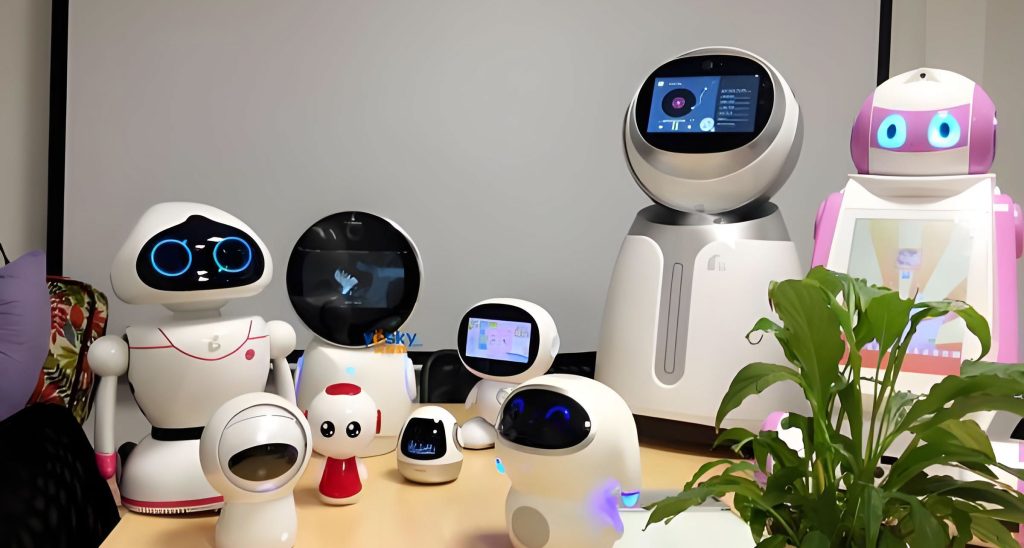
Looking ahead, future research should explore dynamic proxemics, where distance adjustments are responsive to user behavior. For example, a companion robot could modulate its proximity based on emotional cues, using sensors to detect comfort levels. This adaptive approach could be formalized with a feedback loop:
$$ d_{t+1} = d_t + \eta \cdot (C_{target} – C_{measured}) $$
where $d_t$ is the distance at time $t$, $\eta$ is a learning rate, $C_{target}$ is the desired companionship level, and $C_{measured}$ is the current assessment. Such systems would make companion robots more intuitive and responsive.
Additionally, the interplay between different non-linguistic elements warrants deeper investigation. I propose a comprehensive framework for companion robot design, summarized in the table below:
| Element | Description | Impact on Companionship | Suggested Implementation |
|---|---|---|---|
| Spatial Distance | Physical proximity between human and companion robot. | Low to moderate; can cause discomfort if not managed. | Adaptive distancing algorithms based on user preference. |
| Visual Design | Aesthetics, facial expressions, and animations. | High; evokes empathy and attachment. | Cute, anthropomorphic features with expressive eyes. |
| Tactile Feedback | Physical contact through touch-sensitive surfaces. | High; enhances intimacy and perceived lifelikeness. | Soft materials, gentle vibrations, responsive touches. |
| Temporal Factors | Duration and frequency of interaction. | High; builds commitment over time. | Regular engagement routines, memory of past interactions. |
| Auditory Cues | Non-verbal sounds, tones, and music. | Moderate; supplements emotional expression. | Soothing sounds, playful beeps to signal presence. |
This framework emphasizes that a successful companion robot must integrate multiple sensory modalities to create a rich, immersive experience. For instance, combining visual charm with occasional tactile gestures can compensate for the limited impact of spatial distance. In my experiments, participants favored these multimodal interactions, reporting higher companionship levels when the companion robot exhibited pet-like behaviors, such as nuzzling or playful spins.
Moreover, the concept of companionship can be extended to robot-robot interactions, where companion robots share information and psychological states. This mirrors human social networks and could lead to collective companionship models. Imagine a household with multiple companion robots that collaborate to support human users. The companionship dynamics might then be modeled using network theory:
$$ C_{network} = \sum_{i=1}^{n} C_i + \sum_{i<j} $$
where $C_i$ is the companionship of robot $i$ with the human, and $\phi_{ij}$ represents synergy effects between robots. Such systems could enhance overall companionship through distributed emotional support.
In conclusion, my exploration of companion robots and proxemics reveals that spatial distance is not a dominant factor in establishing companionship within limited indoor spaces. Instead, visual design, tactile feedback, and temporal engagement play more significant roles. These findings challenge traditional proxemics theories and highlight the unique nature of human-robot bonds. As companion robots evolve, designers must prioritize holistic, multimodal interactions to foster genuine companionship. Future work should involve larger-scale studies in real-world environments, incorporating adaptive algorithms and cross-cultural considerations. By embracing these insights, we can develop companion robots that not only coexist with humans but also enrich our emotional lives, paving the way for a future where technology and empathy seamlessly intertwine.
Throughout this article, I have emphasized the importance of companion robots in modern society. Their potential to provide companionship, especially in contexts like elderly care or loneliness alleviation, is immense. However, achieving this requires moving beyond simplistic metrics like distance and embracing the complexity of human emotions. As I continue my research, I aim to refine these models and contribute to the development of companion robots that truly understand and nurture companionship.