
The field of humanoid robotics has witnessed significant advancements in facial emotion expression, which serves as a critical enabler for natural human-robot interaction. This technology finds applications in diverse sectors such as healthcare, education, and social entertainment. The evolution of facial emotion expression in humanoid robots can be categorized into three distinct phases based on technological capabilities: foundational emotional expression, enhanced affective interaction, and personalized emotional resonance. Each phase has contributed to the development of biomimetic mechanical structures and multimodal affective interaction systems, leveraging innovations like the Facial Action Coding System (FACS), flexible skin materials, deep learning, and multimodal large models. This review systematically examines these advancements, highlighting key breakthroughs and future directions to foster intelligent and naturalistic development in humanoid robots.
The progression of facial emotion expression technologies reflects a shift from basic mechanical imitation to complex, AI-driven empathy. Early efforts focused on replicating fundamental human expressions through rudimentary sensors and pre-defined models, while contemporary systems integrate multimodal sensing and dynamic internal state models for proactive interaction. The integration of artificial intelligence, particularly deep learning and large language models, has further personalized emotional responses, enabling humanoid robots to achieve emotional congruence with humans. However, challenges such as the uncanny valley effect, cultural adaptability, and ethical considerations remain pivotal areas for ongoing research.
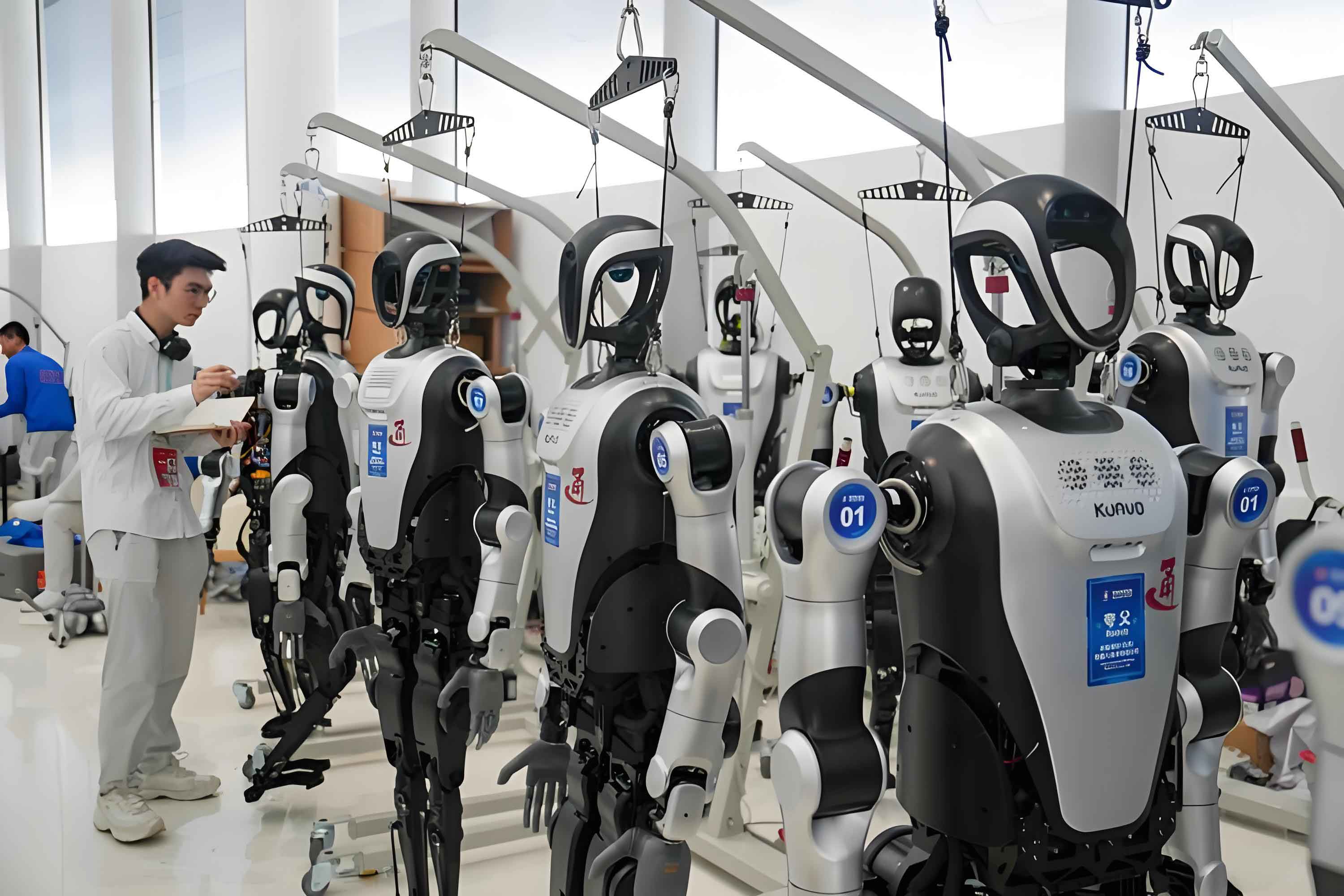
Facial emotion expression in humanoid robots relies on two core components: biomimetic mechanical structure design and multimodal affective interaction systems. The former involves creating physical mechanisms that mimic human facial musculature, while the latter encompasses computational models for emotion recognition, synthesis, and synchronization across multiple modalities. The Facial Action Coding System (FACS) provides a standardized framework for decomposing facial expressions into actionable units, facilitating precise control over robot facial movements. Concurrently, advancements in materials science have led to the development of flexible, sensor-embedded skins that enhance realism. On the computational front, emotion models like the PAD (Pleasure-Arousal-Dominance) framework and AI-driven techniques enable dynamic emotion generation and multimodal alignment, ensuring cohesive expression through facial gestures, speech, and body language.
The following sections delve into the developmental stages, structural design principles, and interaction system optimizations for humanoid robots. Tables and mathematical formulations are employed to summarize key concepts, such as the classification of representative robots and emotion modeling equations. Emphasis is placed on the role of humanoid robots in achieving lifelike expressions, with the term “humanoid robots” reiterated to maintain focus. Future research trajectories are discussed, addressing high-precision actuation, multimodal model integration, personalization, and strategies to mitigate the uncanny valley effect.
Developmental Stages of Facial Emotion Expression
The evolution of facial emotion expression in humanoid robots can be segmented into three phases, each marked by distinct technological milestones and interaction paradigms. These phases illustrate the transition from reactive systems to proactive, emotionally intelligent entities.
Phase 1: Foundational Emotional Interaction (Late 20th Century – circa 2005)
This phase was characterized by the integration of basic sensors with computational emotion models, enabling humanoid robots to perceive and respond to external stimuli with pre-defined expressions. Early humanoid robots, such as those developed by Waseda University and MIT, utilized cameras and microphones to detect human cues, triggering facial expressions through mechanical actuators. For instance, the WE-3RII robot could display six basic emotions and track objects, while Kismet engaged in infant-like social interactions by mimicking caregiver emotions. The primary goal was to establish a foundation for human-robot emotional exchange, with limited adaptability and context awareness.
Phase 2: Multimodal Fusion and Dynamic Interaction (circa 2005 – 2015)
Advancements in sensor technology and processing power facilitated the emergence of humanoid robots capable of multimodal perception and dynamic internal state modeling. Robots like Nexi and WE-4RII incorporated 3D environment recognition, tactile feedback, and chaotic neural networks to enable more nuanced interactions. This phase emphasized the fusion of visual, auditory, and tactile data for context-aware responses, moving beyond simple stimulus-reaction loops. Humanoid robots began to exhibit proactive behaviors, such as adjusting expressions based on real-time emotional assessments, and were deployed in preliminary applications in education and healthcare.
Phase 3: AI-Driven Personalized Empathy (circa 2015 – Present)
The current phase is defined by the convergence of AI, particularly deep learning and large language models, with advanced biomimetic materials. Humanoid robots like Sophia, Ameca, and Xiaoqi leverage generative models and flexible skins to produce over 60 subtle expressions, achieving high levels of realism and personalization. These systems employ multimodal large models (MLMs) for emotion understanding and response generation, allowing for adaptive interactions that resonate with individual users. Applications have expanded to include autism intervention and高端陪护, where emotional congruence is critical. The focus is on creating humanoid robots that not only mimic emotions but also foster genuine emotional bonds through continuous learning and cultural adaptation.
| Stage | Name | Institution | Year | Technical Characteristics | Functions |
|---|---|---|---|---|---|
| Mechanical Drive & Basic Expressions | Kismet | MIT | 1999 | Voice synthesis system generating infant-like sounds; built-in emotional empathy system | Recognizes emotional intent and provides feedback; learns social behaviors through interaction |
| Mechanical Drive & Basic Expressions | WE-3RII | Waseda University | 1999 | Adjustable eye control parameters for target tracking; facial expression modulation based on target position and brightness | Displays six basic expressions; 3D object recognition and tracking |
| Mechanical Drive & Basic Expressions | KOBIAN-R | Waseda University | 2012 | Integration of facial expressions and body movements for coordinated emotional expression; support for stable motion during interaction | Expresses six basic emotions; achieves holistic emotional display through face-body synergy |
| Multimodal Perception & Interaction Enhancement | WE-4RII | Waseda University | 2004 | Chaotic neural networks combined with associative memory for intelligent behavior control; multimodal coordination for affective expression | Expresses emotions via facial gestures; possesses vision, touch, hearing, and smell; enables active interaction and decision-making |
| Multimodal Perception & Interaction Enhancement | SAYA | Tokyo Tech | 2006 | Interactive communication system for emotional exchange; McKibben pneumatic actuators mimicking human muscles for facial expressions | Capable of language understanding and expression; creates realistic expressions via control of 24 artificial muscles |
| AI-Driven Personalized Empathy | Sophia | Hanson Robotics | 2015 | AI algorithms for expression and dialogue; machine learning capabilities; “Frubber” skin material | Generates over 60 facial expressions; engages in voice interaction and dynamic response |
| AI-Driven Personalized Empathy | Ameca | Engineered Arts | 2022 | Mesmer technology for biomimetic design; Tritium OS for intelligent response and cloud interaction; multimodal AI integration | High-fidelity expressions and motions; perceives objects and intrusions; capable of art and language creation |
| AI-Driven Personalized Empathy | Xiaoqi | EX-Robots | 2024 | Integration of multimodal large models, intelligent expression systems, joint mechanisms, and biomimetic skin technology | Supports interactive Q&A, expression-based interaction, action demonstration, and role-playing |
Biomimetic Facial Structure Design
The design of biomimetic facial structures is fundamental to achieving realistic emotion expression in humanoid robots. This involves the application of the Facial Action Coding System (FACS), mechanical actuation mechanisms, and advanced skin materials that collectively emulate human facial anatomy and dynamics.
Facial Action Coding System (FACS)
FACS provides a standardized methodology for decomposing facial expressions into discrete Action Units (AUs), each corresponding to specific muscle movements. In humanoid robots, FACS translates emotional states into controllable parameters, enabling precise expression generation. For example, AU12 (lip corner puller) simulates a smile, while AU4 (brow lowerer) conveys anger. The intensity of each AU is typically represented as a scalar value between 0 and 1, allowing for continuous emotion modulation. Mathematically, the emotional expression \( E \) can be modeled as a linear combination of AUs:
$$ E = \sum_{i=1}^{n} w_i \cdot \text{AU}_i $$
where \( w_i \) denotes the weight of the \( i \)-th AU, and \( n \) is the total number of AUs. However, real-time synchronization of multiple AUs poses computational challenges, necessitating optimization techniques such as reinforcement learning (RL) to achieve smooth transitions. For instance, RL-based policies can dynamically adjust AU weights based on target emotions and current states, minimizing jerky movements. Recent approaches also incorporate AI-assisted evaluation systems, where vision models provide feedback on AU expression intensity, enabling adaptive control in humanoid robots.
Mechanical Structure Design
Facial mechanical structures in humanoid robots are categorized into mechanical and biomimetic designs. Mechanical designs employ traditional components like linkages, gears, and servos to drive facial movements. For example, the KOBIAN robot uses modular mechanisms for eyebrow, eye, and mouth control, offering cost-effectiveness but limited subtlety. In contrast, biomimetic designs simulate human musculature using soft actuators, such as pneumatic artificial muscles (PAMs) or shape memory alloys, enabling nuanced expressions. Sophia robot utilizes a “flexible drive-muscle simulation” structure with Frubber skin to replicate natural wrinkles and micro-expressions. Modern humanoid robots often adopt hybrid actuation systems, combining rigid servo arrays for large-displacement regions (e.g., brows) with flexible actuators for精细 areas (e.g., lips). The control hierarchy typically involves emotion computation, kinematic mapping, and force-position hybrid control, ensuring millisecond-level dynamic expression generation.
Skin Design
Skin materials play a crucial role in the realism of humanoid robots, affecting both appearance and sensory capabilities. Silicone is widely used due to its moldability and compatibility with sensors, but it lacks the mechanical properties of human skin. Conversely, Frubber offers superior biomimetic fidelity, mimicking flesh-like elasticity and natural folds. However, high realism can trigger the uncanny valley effect, where near-human appearances evoke discomfort due to slight imperfections. To address this, algorithms like Generative Adversarial Networks (GANs) or Variational Autoencoders (VAEs) learn smooth transition paths between expressions from human databases, generating intermediate frames for seamless emotion shifts. Additionally, decay wave synthesis models facial actions as damped waves:
$$ f(t) = A e^{-\alpha t} \sin(\omega t + \phi) $$
where \( A \) is amplitude, \( \alpha \) is decay rate, \( \omega \) is frequency, and \( \phi \) is phase. Superposition of these waves enables continuous expression transitions in humanoid robots.
Despite progress, skin design faces challenges in integrating conductive materials for tactile sensing without compromising mechanical properties. Issues like signal crosstalk, insulating surface layers, and durability limit the implementation of high-density sensor networks. Recent research focuses on self-powered biomimetic e-skins that perceive multidirectional stimuli, narrowing the gap between artificial and human skin in humanoid robots.
Multimodal Affective Interaction System
Multimodal affective interaction systems form the computational core for emotion expression in humanoid robots, integrating emotion modeling, facial expression synthesis, emotional speech synthesis, and spatio-temporal alignment across modalities. These systems leverage deep learning and large language models to create cohesive, context-aware responses.
Emotion Computation Models
Emotion computation models formalize human emotions into mathematical representations, enabling humanoid robots to simulate affective states. Dimensional approaches, such as the PAD (Pleasure-Arousal-Dominance) model, map emotions to a three-dimensional space:
$$ \mathbf{e} = [P, A, D] $$
where \( P \) represents pleasure, \( A \) arousal, and \( D \) dominance. Each emotion corresponds to a point in this space, allowing for quantitative analysis. For instance, joy might be located at high \( P \) and \( A \), while sadness at low \( P \) and \( A \). Humanoid robots like WE-4RII employ chaotic neural networks to dynamically update emotional states based on external stimuli, facilitating intelligent behavior control. Advanced models incorporate game theory for emotion generation, where optimal strategies are derived from subgame perfect equilibrium, reducing dependency on external cues. AU-based models, such as AU-FEDS, generate continuous facial expressions by parameterizing AUs, enhancing the naturalness of human-robot interaction. Furthermore, large language models (e.g., GPT-3.5) interpret emotion assessment as a dialogue task, predicting and expressing emotions in real-time for humanoid robots.
Facial Expression Synthesis
Facial expression synthesis involves generating dynamic facial gestures that convey emotions accurately. Traditional methods rely on geometric features or parameterized models, but data-driven approaches now dominate. Deep generative models, such as ExGenNet, automatically learn joint configurations from expression datasets, mapping FACS AUs to physical actions. Dynamic synthesis techniques, like decay wave systems, model expressions as superimposed waves to ensure smooth transitions. The synthesis process can be formulated as an optimization problem:
$$ \min_{\theta} \mathcal{L}(E_{\text{target}}, E_{\text{synthesized}}) $$
where \( \mathcal{L} \) is a loss function comparing target and synthesized expressions, and \( \theta \) represents model parameters. This enables humanoid robots to produce nuanced expressions that adapt to contextual changes, improving engagement in social interactions.
Emotional Speech Synthesis and Multimodal Interaction Fusion
Emotional speech synthesis endows humanoid robots with expressive vocal capabilities, transforming text or emotional states into speech with affective prosody. Early methods used statistical models like Hidden Markov Models (HMMs) or Gaussian Mixture Models (GMMs), while modern approaches employ deep learning architectures, such as sequence-to-sequence models and diffusion models, for high-fidelity output. For example, frameworks based on cyclic consistent generative adversarial networks (CycleGANs) enable emotion conversion in speech, allowing robots like Erica to share empathetic experiences. The emotional speech synthesis for humanoid robots can be expressed as:
$$ S = \text{TTS}(T, \mathbf{e}) $$
where \( S \) is the synthesized speech, \( T \) is the text, and \( \mathbf{e} \) is the emotion vector. Parameters like pitch, rate, and volume are modulated according to \( \mathbf{e} \) to convey specific feelings.
Multimodal spatio-temporal alignment ensures synchronization between speech, facial expressions, and body gestures in humanoid robots. This involves feature extraction, cross-modal attention mechanisms, and sequence-to-sequence modeling to maintain coherence. For instance, Transformer-based frameworks like Q-Transformer discretize continuous actions into “action tokens,” allowing simultaneous attention to language, vision, and robot state. Similarly, platforms like Pepper use SDKs to co-adjust speech parameters and animation tasks, achieving synchronized expressions. The alignment process can be represented as:
$$ \mathbf{A} = \text{Align}(\mathbf{F}, \mathbf{S}, \mathbf{G}) $$
where \( \mathbf{F} \), \( \mathbf{S} \), and \( \mathbf{G} \) denote facial, speech, and gesture features, respectively. Generative models, such as conditional GANs, refine cross-modal expressions to reduce semantic inconsistencies, making emotional responses in humanoid robots more authentic.
| Technology | Description | Application in Humanoid Robots |
|---|---|---|
| Facial Action Coding System (FACS) | Standardized system for decomposing facial expressions into Action Units (AUs) | Enables precise control of facial movements; facilitates emotion parameterization and smooth transitions |
| Emotion Computation Models (e.g., PAD) | Mathematical representation of emotions in dimensional spaces | Supports dynamic emotion state updates and context-aware responses in humanoid robots |
| Deep Learning for Expression Synthesis | Use of neural networks to generate and optimize facial expressions | Allows for continuous, nuanced expression generation; reduces manual calibration |
| Emotional Speech Synthesis | Conversion of text/emotion into affective speech using AI models | Enhances vocal expressiveness; integrates with facial and gesture cues in humanoid robots |
| Multimodal Spatio-Temporal Alignment | Synchronization of facial, vocal, and gestural modalities | Ensures coherent emotional responses; improves naturalness in human-robot interaction |
Conclusion and Future Perspectives
Facial emotion expression in humanoid robots has evolved from basic mechanical systems to sophisticated, AI-driven platforms capable of personalized empathy. This review has outlined the developmental stages, structural design principles, and multimodal interaction systems that underpin these advancements. The integration of FACS, biomimetic materials, and deep learning has significantly enhanced the realism and adaptability of humanoid robots, enabling applications in healthcare, education, and social domains. However, several challenges persist, necessitating future research in the following areas:
First, physical implementation barriers, such as the development of high-fidelity, durable electronic skins with embedded sensors, remain critical. Overcoming issues like conductivity-mechanical trade-offs, signal interference, and long-term stability is essential for endowing humanoid robots with authentic tactile capabilities. Second, computational frameworks must address the complexity and cultural biases of multimodal large models. Model compression and edge deployment can mitigate resource constraints, while diverse, cross-cultural emotion datasets are needed to ensure global adaptability of humanoid robots. Third, the uncanny valley effect requires algorithmic solutions for seamless multimodal alignment, where expressions, speech, and gestures are perfectly synchronized to avoid dissonance. Finally, ethical considerations, such as transparency in emotion generation and data privacy, must be integrated into the design of humanoid robots to foster trust and societal acceptance.
In summary, the future of facial emotion expression in humanoid robots lies in the convergence of high-precision actuation, AI-driven personalization, and ethical alignment. By addressing these challenges, humanoid robots can transition from functional tools to empathetic companions, enriching human-robot interactions and paving the way for harmonious coexistence.