
The rapid aging of the global population presents significant societal challenges, with increasing numbers of older adults experiencing social isolation and a growing need for emotional companionship. In this context, intelligent companion robots have emerged as a promising technological intervention, designed not only for functional assistance but also for social and emotional support. The effectiveness of human-robot interaction (HRI) hinges critically on the robot’s ability to engage users naturally. Among various interaction modalities, facial expression serves as a primary and powerful channel for conveying emotional states and building rapport. However, designing appropriate facial expressions for companion robots intended for older adults remains a complex and underexplored area. This requires balancing technical feasibility, emotional clarity, and specific user acceptance patterns within an aging demographic. Traditional design approaches often lack empirical grounding tailored to the perceptual and emotional characteristics of older users. Our study addresses this gap by systematically investigating the design and evaluation of facial expressions for aging companion robots, employing a well-established psychological framework to derive actionable design insights.
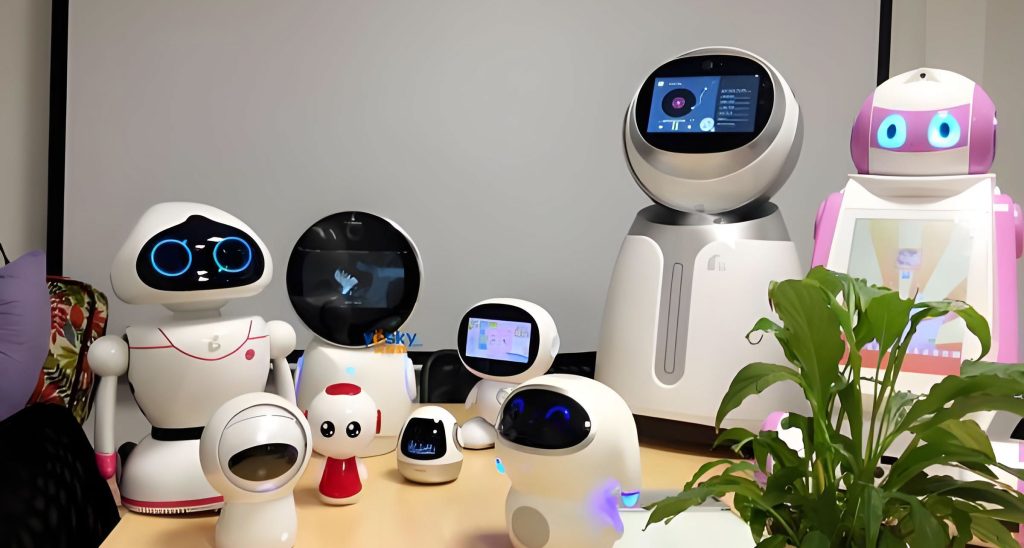
Effective interaction with a companion robot depends on its capacity for expressive communication. While significant research in affective computing and robotics has focused on expression recognition algorithms and technical synthesis, less attention has been paid to the user-centered evaluation of different expressive styles, particularly for specialized populations like older adults. The “uncanny valley” hypothesis suggests that very human-like robots can elicit feelings of eeriness and discomfort if they fall short of perfect realism. This underscores the importance of choosing an appropriate level of abstraction for a robot’s face. For an aging companion robot, expressions must be easily decodable, emotionally appropriate, and conducive to positive long-term interaction. We hypothesize that older adults may have different preferences and emotional responses to stylized expressions compared to younger users, influenced by factors such as cognitive processing speed, familiarity with technology, and social-emotional goals.
To ground our design exploration, we first analyzed established models of basic emotions. Researchers like Ekman and Izard have identified a core set of universal facial expressions. For practical application in a companion robot, we distilled these into seven fundamental types relevant to companion scenarios: Happiness, Anger, Disgust, Fear, Surprise, Sadness, and Neutral/Calm. The key design task involves transposing the anatomical features of human expressions (e.g., eyes, eyebrows, mouth) into a simplified, artificial face. We identified three prevalent stylistic approaches for this translation: Digital (abstract, geometric representations), Cartoon (simplified, exaggerated features common in animation), and Anthropomorphic (more detailed, human-like features). Each style presents different trade-offs between clarity, aesthetic appeal, and potential for uncanny effects.
To evaluate these styles, we required a robust model for measuring emotional response. The Pleasure-Arousal-Dominance (PAD) emotional state model, developed by Mehrabian and Russell, provides a three-dimensional framework for quantifying subjective emotional experience. The dimensions are:
– Pleasure (P): The degree of positive versus negative affective feeling (e.g., happy vs. sad).
– Arousal (A): The level of mental alertness and physical activation (e.g., excited vs. calm).
– Dominance (D): The sense of control over the situation versus being controlled (e.g., empowered vs. submissive).
This model is widely used in environmental psychology and HRI research because it can map a wide range of emotions onto a continuous scale. To make the rating task accessible, especially for older participants, we employed the Self-Assessment Manikin (SAM), a pictorial version of the PAD scale where users select figures representing points along each dimension. This method minimizes linguistic and cognitive load.
The core of our study was a controlled experiment designed to measure how different facial expression styles for a companion robot affect older adults’ recognition accuracy, subjective satisfaction, and PAD emotional responses, with a younger adult group serving as a comparative baseline.
Methodology
Experimental Design
We employed a 3 x 2 mixed-factorial design. The within-subjects independent variable was the Expression Style of the companion robot (Digital, Cartoon, Anthropomorphic). The between-subjects independent variable was the Age Group of the participant (Older Adults, Young Adults).
The dependent variables were:
1. Recognition Rate: The accuracy with which participants identified the intended emotion from the seven basic types.
2. Satisfaction Rating: A subjective score (1-5 Likert scale) for each expression style block.
3. PAD Scores: The ratings on the Pleasure, Arousal, and Dominance dimensions for each individual expression stimulus, obtained via the SAM.
Participants
A total of 70 participants were recruited. The Older Adult group consisted of 35 individuals (Mean age = 65.1 years, SD = 7.25). The Young Adult group consisted of 35 individuals (Mean age = 21.6 years, SD = 1.50). All participants had normal or corrected-to-normal vision and were right-handed. Informed consent was obtained from all participants prior to the study.
Stimulus Materials
Based on the analysis of human expression features and expert consultation, we created 21 unique facial expression images for the hypothetical companion robot: 7 Emotions (Happiness, Anger, Disgust, Fear, Surprise, Sadness, Neutral) x 3 Styles (Digital, Cartoon, Anthropomorphic). The features for each emotion were systematically adapted to each style. For instance, “Happiness” was represented by widened eyes, raised curved eyebrows, and an open mouth across all styles, but the graphical realization differed. All images were standardized on a light grey background.
| Emotion | Digital Style Key Features | Cartoon Style Key Features | Anthropomorphic Style Key Features |
|---|---|---|---|
| Happiness | Large circles for eyes, upward arc for mouth. | Exaggerated sparkling eyes, wide U-shaped smile. | Detailed eyes with highlights, natural smile with teeth suggested. |
| Sadness | Downward sloping line elements for eyes and mouth. | Droopy eyelids, large teardrop shape, pronounced frown. | Subtle raising of inner eyebrows, downturned corners of the mouth. |
| Anger | Sharp, angled lines converging towards the center. | V-shaped eyebrows, glaring eyes, squared mouth. | Furrowed brows, narrowed eyes, tightened lips. |
Procedure
The experiment was conducted individually in a quiet lab setting. For each of the three style blocks (order randomized), participants completed two sequential tasks:
1. Recognition Task: The 7 expression images for a given style were presented one at a time in random order. For each image, participants selected the emotion they believed it represented from the list of seven basic types.
2. PAD Rating Task: The same 7 images were presented again in a new random order. For each, participants completed the SAM scale, providing separate ratings for Pleasure, Arousal, and Dominance.
After completing both tasks for a style block, participants gave an overall satisfaction rating for that companion robot’s expression style. The total session lasted approximately 30-40 minutes.
Results and Analysis
A total of 1,470 data points were collected (70 participants x 21 stimuli). Data were analyzed using SPSS (v22.0) with descriptive statistics, analysis of variance (ANOVA), and t-tests where appropriate. The alpha level was set at .05.
Recognition Rate and Satisfaction
Recognition accuracy differed significantly between age groups and styles. The Cartoon style yielded the highest overall recognition rate, followed by the Digital and then the Anthropomorphic style. Older adults consistently had lower recognition rates than young adults across all styles.
| Style | Older Adults – Recognition | Young Adults – Recognition | Older Adults – Satisfaction | Young Adults – Satisfaction |
|---|---|---|---|---|
| Digital | 63.3% | 82.0% | 3.83 | 3.51 |
| Cartoon | 67.4% | 82.0% | 3.60 | 3.17 |
| Anthropomorphic | 62.5% | 67.3% | 3.77 | 3.23 |
For subjective satisfaction, the pattern was reversed. Older adults reported higher satisfaction with all styles compared to young adults. The Digital style was rated most satisfactory by older adults, while the Cartoon style was least liked by young adults.
PAD Emotional Response Analysis
A 2 (Age Group) x 3 (Expression Style) mixed ANOVA was conducted for each PAD dimension.
Pleasure (P): A significant main effect was found for Expression Style, $F(1.97, 133.62) = 6.06, p < .05, \eta_p^2 = .08$. Post-hoc tests indicated that certain styles elicited different levels of pleasure. Overall, older adults reported higher pleasure scores across all emotions and styles compared to young adults, particularly for neutral and negative expressions like fear or disgust.
Arousal (A): Significant main effects were found for both Age Group, $F(1, 68) = 5.15, p < .05, \eta_p^2 = .07$, and Expression Style, $F(1.84, 125.30) = 3.50, p < .05, \eta_p^2 = .05$. Older adults showed significantly higher arousal responses overall. A simple effects analysis (adjusted alpha = .016) revealed that this age difference was particularly pronounced for the Anthropomorphic style, $t(68) = 2.66, p < .016$. The emotional content also drove arousal, with expressions like Fear and Surprise generating higher arousal than Neutral or Sadness.
Dominance (D): While no significant interaction was found, older adults tended to report slightly higher dominance scores than young adults, especially for the Digital style. This suggests they felt more in control of the interaction when the companion robot’s expressions were more abstract.
The relationship between the emotional content of the expression (e.g., happy vs. sad) and the PAD scores can be modeled. For a given emotion $E$, the expected PAD vector $\vec{S}_{E}$ for a user group $G$ can be approximated as a function of the style $X$:
$$
\vec{S}_{E,G}(X) = [P_{E,G}(X), A_{E,G}(X), D_{E,G}(X)]
$$
Where our data shows that for older adults ($G=O$), the mean pleasure component is generally higher than for young adults ($G=Y$):
$$
\frac{1}{N}\sum_{E,X} P_{E,O}(X) > \frac{1}{N}\sum_{E,X} P_{E,Y}(X)
$$
And the arousal component for the anthropomorphic style $X_A$ shows a significant group difference:
$$
A_{E,O}(X_A) – A_{E,Y}(X_A) > 0
$$
| PAD Dimension | Significant Effect | F-value & Partial Eta² | Interpretation |
|---|---|---|---|
| Pleasure (P) | Expression Style | F=6.06, η²=.08 | Style influences how pleasant/unpleasant expressions feel. |
| Arousal (A) | Age Group | F=5.15, η²=.07 | Older adults feel more activated/aroused by the expressions. |
| Arousal (A) | Expression Style | F=3.50, η²=.05 | Style influences the level of activation. |
| Arousal (A) | Interaction (Simple Effect) | t=2.66* | Older adults are significantly more aroused than young adults specifically by the Anthropomorphic style. |
* from simple effects t-test.
Discussion and Design Implications
The results reveal distinct patterns in how older and younger adults perceive and emotionally respond to a companion robot’s facial expressions. The higher recognition rates for the Cartoon style, especially among older adults, align with its design principle: simplified, exaggerated features enhance clarity and reduce cognitive load for decoding. The lower recognition of Anthropomorphic expressions may stem from the “uncanny valley” effect or simply the increased complexity of more realistic features, which can be ambiguous if not perfectly rendered.
The divergence in satisfaction and PAD scores is particularly instructive. Older adults reported higher pleasure, arousal, and dominance across the board. This may be attributed to a stronger socio-emotional selectivity; older adults may approach the companion robot more with a goal of positive social and emotional engagement, leading to a more favorable and activated response. The higher arousal to Anthropomorphic style suggests they may invest more emotional attention or find human-like features more stimulating or socially relevant. Conversely, younger adults, who are more critical of technology and may have different expectations for realism, found the less abstract styles less satisfactory.
For the designer of an aging companion robot, these findings suggest a hybrid strategy. The Cartoon style’s high recognition rate is desirable for clear communication. The Digital style’s high satisfaction among older adults indicates that an abstract, clearly artificial aesthetic is not only acceptable but potentially preferred, as it aligns with the product’s technological nature and may avoid uncanny valley pitfalls. Therefore, an optimal design might synthesize elements from both: using the clear, exaggerated semantics of cartoon design (e.g., for mouth and eyebrow shapes) within a simplified, geometric “digital” framework for the overall face structure. This companion robot would prioritize legibility and a friendly, non-threatening appearance.
Furthermore, expressions for basic, high-consensus emotions like Happiness and Sadness can follow standard conventions. However, more complex emotions like Disgust, Fear, or Surprise require careful design and testing with the target audience, as our data showed greater variability in their interpretation and emotional impact. The companion robot’s emotional repertoire should be calibrated to induce positive Pleasure and a manageable level of Arousal, fostering a sense of companionship and control for the older user.
Conclusion
This study employed the PAD emotional state model to quantitatively evaluate user responses to different facial expression styles for an aging companion robot. Our experiment demonstrated that expression style significantly affects recognition accuracy, user satisfaction, and emotional response. Key findings indicate that older adults are more receptive to companion robot expressions overall, showing higher pleasure, arousal, and dominance ratings than younger adults. For practical design, a style blending the clarity of cartoon semantics with the abstract aesthetics of a digital form is recommended to maximize both recognizability and user acceptance for an older demographic.
The research has certain limitations. It focused on static images of expressions rather than dynamic interactions with a physical companion robot. The emotion set was limited to seven basic types; future work should investigate more nuanced or blended emotions. Additionally, longitudinal studies are needed to see how responses evolve over repeated interactions with a companion robot.
In conclusion, a human-centered, empirically-driven approach is essential for designing effective emotional interactions for assistive technologies. By grounding design decisions in models like PAD and testing with target users, we can create aging companion robots that are not only functional but also emotionally intelligent and genuinely supportive companions, thereby enhancing the quality of life and social connectedness for older adults.