
In recent years, the integration of agricultural equipment with information technology has significantly advanced the development of autonomous farming systems. Among these innovations, quadruped robots, often referred to as robot dogs, have emerged as promising solutions for navigating unstructured terrains like crop fields. However, the complex and uneven nature of agricultural environments, such as slippery surfaces or undulating terrain, poses a high risk of falls for these quadruped robots. Accurately predicting the critical state of a fall is crucial for enhancing the walking stability and operational efficiency of robot dogs in field conditions. In this study, I propose a novel method for predicting the fall state of quadruped robots based on inertial measurement unit (IMU) sensor signal processing. By leveraging improved population optimization (IPO) combined with variational mode decomposition (VMD) and generalized regression neural network (GRNN), I aim to develop a robust model that can preemptively identify when a robot dog is on the verge of falling, thereby enabling timely interventions.
The core of this approach involves collecting IMU data from a quadruped robot during field operations, including scenarios where the robot dog experiences slips or imbalances due to terrain irregularities. Specifically, I focus on signals such as roll and pitch angles, which reflect the robot’s orientation and are critical indicators of stability. The data is categorized into four operational states: normal walking, two critical fall stages, and a complete fall state. To handle the noisy nature of field data, I apply Gaussian denoising and normalization techniques. Subsequently, I employ an IPO algorithm to optimize the parameters of VMD, a signal decomposition method that adaptively separates the IMU signals into intrinsic mode functions (IMFs) without modal aliasing. This results in an IPO-VMD model that effectively extracts features from the signals. These features, represented as permutation entropy values, are then fed into a GRNN model, whose parameters are also optimized using IPO, forming an IPO-GRNN framework. The combined IPO-VMD-GRNN model is trained and tested on both real field data and simulated data from Gazebo software, ensuring comprehensive evaluation. Experimental results demonstrate that this model achieves low prediction errors and faster response times compared to other methods, making it a valuable tool for improving the field passability of quadruped robots.
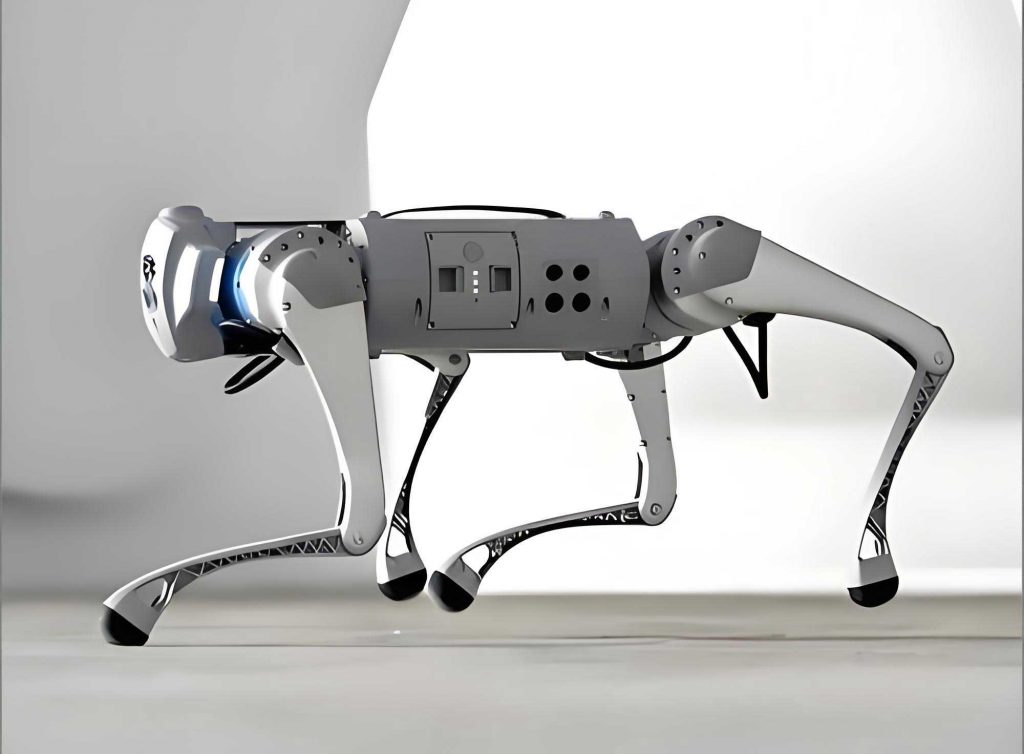
The motivation for this research stems from the increasing adoption of autonomous robot dogs in agriculture, where their ability to traverse challenging terrains can revolutionize tasks like monitoring and harvesting. However, falls not only disrupt operations but can also cause damage to the robot dog. Traditional methods for fall prediction often rely on simplified models or multiple sensors, which may lack accuracy or be cost-prohibitive. By focusing on IMU data alone, I aim to provide a cost-effective and efficient solution. The IPO algorithm enhances the optimization process by incorporating strategies from population-based methods, such as adaptive mutation and global search, ensuring that the VMD and GRNN parameters are finely tuned for high performance. This approach allows the quadruped robot to anticipate falls early, providing a window for corrective actions, such as adjusting gait or posture, thus enhancing overall reliability in field applications.
In the following sections, I will detail the signal acquisition process, the development of the IPO-VMD-GRNN model, and the experimental validation. I will also discuss the implications of this research for the broader field of agricultural robotics, emphasizing how robot dogs can benefit from advanced signal processing and machine learning techniques. Through this work, I hope to contribute to the development of more resilient and intelligent quadruped robots capable of operating autonomously in diverse environments.
Signal Acquisition and Dataset Preparation
To build a reliable dataset for fall state prediction, I conducted field experiments using a commercial quadruped robot platform, specifically designed for agricultural applications. This robot dog is equipped with an IMU sensor that captures roll and pitch angles at high frequencies, providing real-time data on its orientation. The field trials were carried out in a cornfield environment, characterized by varying terrain conditions such as grassy covers, high ridges (20 cm height), and low ridges (10 cm height). These conditions simulate typical challenges faced by quadruped robots in agriculture, where uneven surfaces can lead to foot slippage and loss of balance.
During the experiments, I observed that the fall process of the robot dog could be divided into four distinct stages: normal walking, critical fall stage 1, critical fall stage 2, and complete fall. In normal walking, the quadruped robot maintains a stable gait, but when traversing ridges, foot slippage occurs, causing the robot to tilt. In critical fall stage 1, the robot attempts to correct its posture by shifting its weight, but secondary slippage often leads to critical fall stage 2, where the risk of falling is highest. Finally, in the complete fall stage, the robot dog loses stability entirely. I collected IMU data for each stage, resulting in signal pairs for roll and pitch angles: for normal walking, for critical fall stage 1, for critical fall stage 2, and for complete fall. A total of 200 real fall events were recorded, but to address the limited dataset, I augmented it with 1,800 simulated fall scenarios generated using Gazebo software. This simulation incorporated noise to mimic real-world conditions, ensuring a diverse and robust dataset for training and validation.
The raw IMU signals are inherently noisy due to environmental factors, so I applied a Gaussian denoising algorithm to smooth the data. For example, the roll angle signal during normal walking was processed to produce a denoised version . Similarly, all other signals were denoised to enhance feature extraction. After denoising, I normalized the data to a range of [-1, 1] using zero-mean normalization, which standardizes the values and improves model stability during training. The normalization formula is given by:
$$ y = (y_{\text{max}} – y_{\text{min}}) \frac{V – x_{\text{min}}}{x_{\text{max}} – x_{\text{min}}} + y_{\text{min}} $$
where \( y \) is the normalized value, \( y_{\text{max}} \) and \( y_{\text{min}} \) are the target range limits, \( V \) is the actual parameter value, and \( x_{\text{max}} \) and \( x_{\text{min}} \) are the minimum and maximum values of the data row, respectively. This preprocessing step ensures that the input features for the prediction model are consistent and comparable, which is crucial for accurate fall state prediction in quadruped robots.
| Operational State | Roll Angle Signal | Pitch Angle Signal | Number of Samples |
|---|---|---|---|
| Normal Walking | \( f_{r1} \) | \( f_{p1} \) | 500 |
| Critical Fall Stage 1 | \( f_{r2}^{(1)} \) | \( f_{p2}^{(1)} \) | 500 |
| Critical Fall Stage 2 | \( f_{r2}^{(2)} \) | \( f_{p2}^{(2)} \) | 500 |
| Complete Fall | \( f_{r3} \) | \( f_{p3} \) | 500 |
This dataset preparation phase is essential for training the IPO-VMD-GRNN model, as it provides a foundation for extracting meaningful features that distinguish between different states of the robot dog. By combining real and simulated data, I ensure that the model can generalize well to various field conditions, enhancing its practicality for agricultural quadruped robots.
IPO-VMD Signal Feature Extraction
Variational Mode Decomposition (VMD) is a powerful signal processing technique that decomposes a signal into multiple IMFs by solving a variational problem. Unlike empirical mode decomposition (EMD), VMD avoids modal aliasing and false components, making it ideal for analyzing non-stationary IMU signals from a quadruped robot. The VMD method involves minimizing the sum of bandwidths of all modes, constrained by the reconstruction of the original signal. The optimization problem can be expressed as:
$$ \min_{\{u_k\},\{\omega_k\}} \left\{ \sum_k \left\| \partial_t \left[ \left( \delta(t) + \frac{j}{\pi t} \right) * u_k(t) \right] e^{-j\omega_k t} \right\|_2^2 \right\} \quad \text{subject to} \quad \sum_k u_k = f $$
where \( u_k \) represents the k-th IMF, \( \omega_k \) is the center frequency, \( f \) is the original signal, and \( \delta(t) \) is the Dirac delta function. The parameters to optimize in VMD are the number of IMFs \( K \) and the quadratic penalty factor \( \alpha \), which controls the bandwidth of the modes. Proper selection of these parameters is critical for effective decomposition, and I use the Improved Population Optimization (IPO) algorithm to automate this process.
The IPO algorithm is an enhanced population-based optimizer that combines elements from particle swarm optimization (PSO) and grey wolf optimization (GWO), with additional strategies like adaptive mutation and global search. It partitions the population into three groups—alpha, beta, and gamma—based on their fitness, and updates their velocities and positions iteratively. The velocity update for beta and gamma individuals is given by:
$$ v_{\beta}(m+1) = \omega’ v_{\beta m} + c_1 r_1 (p_{\beta \text{best}} – x_{\beta m}) + c_2 r_2 (g_{\beta \text{best}} – x_{\beta m}) $$
$$ v_{\gamma}(m+1) = \omega’ v_{\gamma m} + c_1 r_1 (p_{\gamma \text{best}} – x_{\gamma m}) + c_2 r_2 (g_{\gamma \text{best}} – x_{\gamma m}) $$
$$ \omega’ = \omega_{\text{max}} – (\omega_{\text{max}} – \omega_{\text{min}}) \frac{T_c^2}{T_{\text{max}}^2} $$
where \( v \) denotes velocity, \( x \) is position, \( c_1 \) and \( c_2 \) are learning factors, \( r_1 \) and \( r_2 \) are random numbers, \( p_{\text{best}} \) is the personal best, \( g_{\text{best}} \) is the global best, \( \omega’ \) is the inertia weight, and \( T_c \) and \( T_{\text{max}} \) are current and maximum iterations. For alpha individuals, the update incorporates fitness-based weighting:
$$ v_{\alpha}(m+1) = v_{\alpha m} + c_1 r_1 (p_{\alpha \text{best}} – x_{\alpha m}) + \frac{F_\gamma}{F_\alpha + F_\beta + F_\gamma} c_2 r_2 (g_{\alpha \text{best}} – x_{\alpha m}) + \frac{F_\beta}{F_\alpha + F_\beta + F_\gamma} c_3 r_3 (g_{\beta \text{best}} – x_{\beta m}) + \frac{F_\alpha}{F_\alpha + F_\beta + F_\gamma} c_4 r_4 (g_{\gamma \text{best}} – x_{\gamma m}) $$
where \( F_\alpha, F_\beta, F_\gamma \) are average fitness values. The position updates involve two steps, inspired by predation behaviors, to avoid local optima. The fitness function for IPO in VMD optimization is the sum of permutation entropies of all IMFs:
$$ F = \sum_{l=1}^K \text{PE} \langle u_l \rangle $$
where PE denotes permutation entropy, a measure of signal complexity. By applying IPO to VMD, I obtain optimal parameters \( \alpha \) and \( K \) for each IMU signal, leading to an IPO-VMD model that efficiently decomposes signals and extracts features for the quadruped robot fall prediction.
| Signal Type | Optimal \( \alpha \) | Optimal \( K \) |
|---|---|---|
| Roll Angle | 3.671 | 5 |
| Pitch Angle | 4.092 | 5 |
After decomposition, I compute the permutation entropy for each IMF, which serves as the feature vector for the GRNN model. This approach ensures that the extracted features capture the essential dynamics of the robot dog’s movement, enabling accurate fall state prediction. The IPO-VMD method demonstrates superior performance compared to traditional optimization algorithms, as it converges faster and achieves lower fitness values, highlighting its suitability for real-time applications in quadruped robots.
IPO-GRNN Model for Fall Prediction
The Generalized Regression Neural Network (GRNN) is a type of radial basis function network known for its simplicity, fast training, and strong generalization capabilities. It is particularly effective for regression tasks, making it ideal for predicting the fall state of a quadruped robot based on IMU features. The GRNN model consists of four layers: input, pattern, summation, and output. The input layer receives the feature vectors, such as permutation entropy values from VMD, and the pattern layer computes the Gaussian activation functions. The summation layer aggregates these outputs, and the final output is given by:
$$ y = \frac{\sum_{i=1}^n w_i \exp\left(-\frac{D_i^2}{2s^2}\right)}{\sum_{i=1}^n \exp\left(-\frac{D_i^2}{2s^2}\right)} $$
where \( y \) is the predicted output, \( w_i \) are the weights, \( D_i \) is the Euclidean distance between the input and training samples, and \( s \) is the smoothing factor. The smoothing factor \( s \) critically influences the model’s performance; if too small, it may overfit, and if too large, it may underfit. To optimize \( s \), I employ the IPO algorithm, resulting in an IPO-GRNN model.
The optimization process involves initializing the IPO population, where each individual represents a candidate value for \( s \). The fitness function for IPO in GRNN optimization is the root mean square error (RMSE) between the predicted and actual outputs:
$$ F_i = \sqrt{\frac{\sum_{j=1}^N (Y_j – y_j)^2}{N}} $$
where \( Y_j \) is the expected output, \( y_j \) is the actual output, and \( N \) is the number of samples. The IPO algorithm iteratively updates the population based on fitness, using the same alpha, beta, and gamma grouping as in VMD optimization. This ensures that the best \( s \) value is selected, enhancing the GRNN’s ability to generalize from the training data to unseen field data of the quadruped robot.
For the fall prediction task, I define the output labels as a score \( e \) ranging from 0 to 3, where 0 indicates normal walking, 1 and 2 represent critical fall stages, and 3 denotes a complete fall. This scoring system quantifies the fall risk, allowing the robot dog to take preventive measures. The input to the GRNN is the feature vector composed of permutation entropies from the roll and pitch angle signals, and the output is the predicted score. By training the IPO-GRNN model on the prepared dataset, I enable real-time fall state prediction for the quadruped robot.
| Operational State | Input Features | Output Score \( e \) |
|---|---|---|
| Normal Walking | PE(\( f’_{r1} \)), PE(\( f’_{p1} \)) | 0 |
| Critical Fall Stage 1 | PE(\( f’_{r2}^{(1)} \)), PE(\( f’_{p2}^{(1)} \)) | 1 |
| Critical Fall Stage 2 | PE(\( f’_{r2}^{(2)} \)), PE(\( f’_{p2}^{(2)} \)) | 2 |
| Complete Fall | PE(\( f’_{r3} \)), PE(\( f’_{p3} \)) | 3 |
The integration of IPO-VMD and IPO-GRNN creates a comprehensive framework for fall state prediction in quadruped robots. This model not only improves accuracy but also reduces computational overhead, making it suitable for deployment on embedded systems in real-world agricultural settings. In the next section, I will present the experimental results that validate the effectiveness of this approach.
Experimental Validation and Results
To evaluate the performance of the IPO-VMD-GRNN model, I conducted experiments using both real field data and simulated data from the Gazebo environment. The testing platform consisted of an Intel Core i7 processor with 16 GB RAM, and the algorithms were implemented in MATLAB 2018. I compared the proposed model against three baseline methods: VMD-BPNN (backpropagation neural network), VMD-GRNN, and PSO-VMD-GRNN. The evaluation metrics included total error (TE), mean relative error (MRE), mean square error (MSE), and average prediction response time.
First, I assessed the IPO-VMD feature extraction by applying it to roll and pitch angle signals from the quadruped robot. The decomposition results showed no modal aliasing, and the IMFs accurately represented the original signals. The permutation entropy features extracted from these IMFs were used as inputs to the prediction models. For the GRNN component, the IPO algorithm optimized the smoothing factor \( s \), leading to improved prediction accuracy. The output scores for the test samples were compared to the actual labels, and the errors were computed.
The results indicated that the IPO-VMD-GRNN model achieved a TE of 0.1467, MRE of 0.0065, and MSE of 0.0003, which were significantly lower than the baseline models. For instance, VMD-BPNN had a TE of 4.5371, MRE of 0.1236, and MSE of 0.3008, while VMD-GRNN had a TE of 1.5970, MRE of 0.0504, and MSE of 0.0437. The PSO-VMD-GRNN model performed better but still had higher errors than IPO-VMD-GRNN, with TE of 0.5137, MRE of 0.0203, and MSE of 0.0036. This demonstrates the superiority of the IPO optimization in enhancing both signal decomposition and neural network performance for the quadruped robot.
| Model | Total Error (TE) | Mean Relative Error (MRE) | Mean Square Error (MSE) |
|---|---|---|---|
| VMD-BPNN | 4.5371 | 0.1236 | 0.3008 |
| VMD-GRNN | 1.5970 | 0.0504 | 0.0437 |
| PSO-VMD-GRNN | 0.5137 | 0.0203 | 0.0036 |
| IPO-VMD-GRNN | 0.1467 | 0.0065 | 0.0003 |
In terms of response time, I measured the average prediction success time for 100 test trials under different success thresholds. The IPO-VMD-GRNN model showed faster response times compared to the baselines. For example, at a 90% success threshold, the response time was 326 ms, which was 127.75 ms faster than VMD-BPNN (513 ms), 91.5 ms faster than VMD-GRNN (420 ms), and 39.5 ms faster than PSO-VMD-GRNN (378 ms). This rapid response is crucial for real-time applications, as it allows the robot dog to react promptly to impending falls, thereby minimizing disruptions in field operations.
Furthermore, I validated the model on various terrain conditions, including grassy covers and ridge heights, and it consistently maintained high accuracy. The IPO-VMD-GRNN framework proved to be robust and adaptable, making it a reliable tool for enhancing the stability of quadruped robots in agricultural environments. These findings underscore the potential of advanced signal processing and machine learning techniques in developing intelligent robot dogs that can autonomously navigate complex terrains.
Conclusion and Future Work
In this study, I have developed and validated a fall state prediction method for quadruped robots based on IMU sensor data and the IPO-VMD-GRNN model. The key innovation lies in the integration of improved population optimization with signal decomposition and neural networks, which enables accurate and timely prediction of critical fall states. The IPO algorithm effectively optimizes the parameters of VMD and GRNN, leading to enhanced feature extraction and model generalization. Experimental results confirm that this approach outperforms existing methods in terms of error metrics and response time, providing a practical solution for improving the field passability of robot dogs.
The implications of this research extend beyond agriculture to other domains where quadruped robots are deployed, such as search and rescue or surveillance. By leveraging IMU data alone, the method offers a cost-effective alternative to multi-sensor systems, without compromising performance. Future work could focus on integrating this prediction model with real-time control strategies, such as adaptive gait adjustment or fall recovery mechanisms, to further enhance the autonomy of quadruped robots. Additionally, exploring other sensor modalities or deep learning architectures could yield further improvements. Overall, this study contributes to the advancement of intelligent robotics, paving the way for more resilient and efficient robot dogs in dynamic environments.