
The planetary roller screw mechanism (PRSM) is a high-precision, high-load mechanical transmission component that converts rotary motion into linear motion or vice versa. Its superior load-carrying capacity, high stiffness, and long life make it indispensable in critical applications such as aerospace actuation systems, precision machine tools, and heavy-duty industrial automation. The mechanism fundamentally consists of a threaded screw, a threaded nut, and multiple threaded rollers arranged in a planetary configuration. The meshing of the threads allows for force transmission across multiple contact lines, distributing the load and enabling high efficiency.
A notable derivative is the recirculating planetary roller screw mechanism (RPRSM), which features a distinct design to enable continuous motion. In this variant, the rollers are typically grooved rather than continuously threaded, and they recirculate within the nut body with the aid of a deflector or cam ring. This allows the nut to traverse the screw over long distances without a corresponding increase in nut length. However, this recirculation process, combined with high operational speeds and complex multi-contact meshing conditions, subjects the mechanism to significant dynamic loads, vibrations, and cyclic stresses. Consequently, fatigue failure at the thread contact interfaces becomes a primary life-limiting factor, moving beyond simple static strength analysis.
This article delves into the fatigue life prediction of the planetary roller screw mechanism under random vibration loading. Based on fatigue failure theory and finite element analysis (FEA), we establish a comprehensive methodology for analyzing its dynamic characteristics and estimating its service life. The process integrates modal analysis, harmonic response analysis, and random vibration fatigue simulation, comparing results with established analytical life prediction models. The goal is to identify critical failure regions and provide a theoretical foundation for the anti-fatigue design and optimization of planetary roller screw systems.
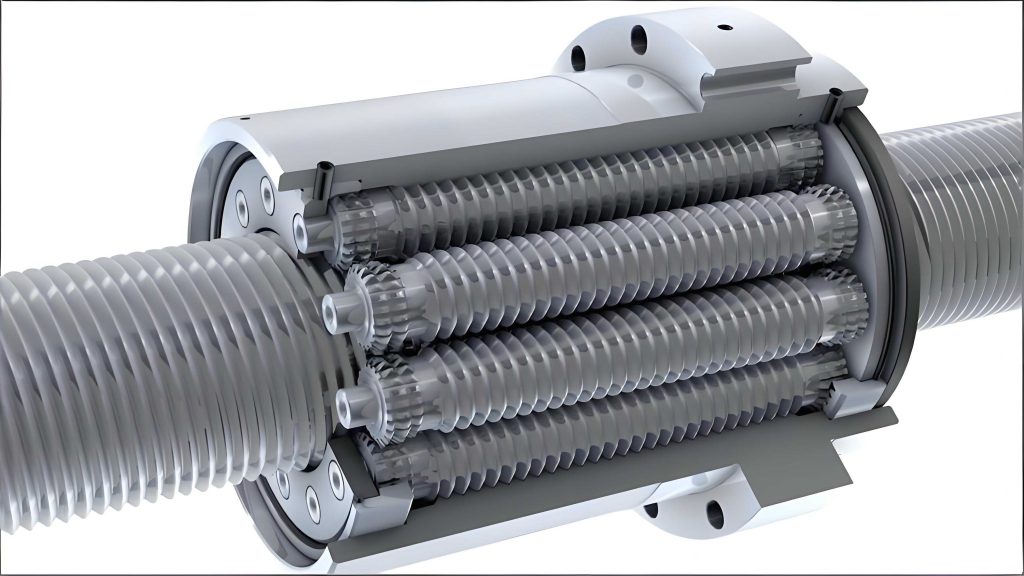
Structural and Contact Mechanics of the Planetary Roller Screw
The fundamental geometry of a planetary roller screw dictates its mechanical behavior. The contact between the screw, rollers, and nut is a complex multi-body interaction. For a standard PRSM with a thread profile angle \(\alpha\), lead angle \(\lambda\), and nominal diameter \(d\), the normal contact force \(F_n\) at a single roller-screw interface can be related to the applied axial force \(F_a\) by considering the load distribution among \(Z\) rollers and the contact angles:
$$F_n = \frac{F_a}{Z \cdot \cos\alpha \cdot \sin\lambda}$$
This normal force induces Hertzian contact stresses at the curved thread surfaces. The maximum contact pressure \(p_0\) between two cylindrical bodies (simplified model for thread contact) is given by:
$$p_0 = \sqrt{\frac{F_n E^*}{\pi R^* L_c}}$$
where \(E^*\) is the equivalent elastic modulus, \(R^*\) is the equivalent radius of curvature, and \(L_c\) is the effective contact length along the thread helix. This localized high stress is the initiation point for fatigue cracks. For the recirculating planetary roller screw mechanism, the stress state is further complicated by the transient loading as rollers enter and exit the load-bearing zone and the dynamic impacts during recirculation.
Dynamic Characterization: Modal and Harmonic Response Analysis
To assess the vibration-induced fatigue, one must first understand the dynamic characteristics of the planetary roller screw assembly. A finite element model of an RPRSM, with components modeled as GCr15 bearing steel (Elastic Modulus \(E = 219\) GPa, Poisson’s ratio \(\nu=0.3\), density \(\rho=7800\) kg/m³), is constructed. Constraint conditions simulating real mounts are applied, and contact pairs are defined between all mating threads.
Modal Analysis reveals the inherent vibration modes and natural frequencies. The first six natural frequencies and corresponding mode shapes for a representative RPRSM model are summarized below:
| Mode Order | Natural Frequency (Hz) | Primary Mode Shape Description | Max Deformation Location |
|---|---|---|---|
| 1 | 1,713.6 | Bending Vibration | Screw Shaft / Nut Housing |
| 2 | 1,714.1 | Bending Vibration | Screw Shaft / Nut Housing |
| 3 | 2,941.0 | Axial Vibration | Assembly along Axis |
| 4 | 3,995.6 | Axial Vibration | Assembly along Axis |
| 5 | 4,888.8 | Torsional Vibration | Screw Shaft |
| 6 | 4,894.9 | Torsional Vibration | Screw Shaft |
The analysis shows that lower-frequency modes are dominated by bending of the slender screw and the relatively thin nut housing, while higher frequencies correspond to axial and torsional vibrations. Symmetry in the model leads to closely spaced or repeated frequencies (e.g., modes 1 & 2, 5 & 6).
Harmonic Response Analysis is then performed to determine the system’s steady-state response to sinusoidal excitation over a frequency range (e.g., 0-6 kHz). An axial load is applied to the nut flange. The results show peak displacement, acceleration, and stress amplitudes when the excitation frequency coincides with a natural frequency, indicating resonance. The most severe stress amplification for this model occurs near the 4th mode at approximately 3,960 Hz. The stress concentration under this resonant condition is predominantly at the thread root and flank of the screw where it meshes with the rollers, identifying this as a critical region for fatigue.
Fatigue Life Prediction Methodology
Predicting the fatigue life of a planetary roller screw mechanism under random vibration requires a combination of dynamic stress response and material fatigue properties. The core relationship is described by the material’s S-N curve, often expressed as a power function:
$$S^k \cdot N = C$$
where \(S\) is the stress amplitude, \(N\) is the number of cycles to failure, and \(k\) and \(C\) are material constants. For random vibration, the stress response is characterized statistically by its Power Spectral Density (PSD), \(W(f)\). The \(i\)-th spectral moment \(m_i\) is calculated as:
$$m_i = \int_{0}^{\infty} f^i W(f) df$$
Key parameters derived from these moments include the expected rate of zero-upcrossings \(E[0+]\) and the expected peak frequency \(E[P]\):
$$E[0+] = \frac{1}{2\pi}\sqrt{\frac{m_2}{m_0}}, \quad E[P] = \frac{1}{2\pi}\sqrt{\frac{m_4}{m_2}}$$
The total fatigue damage \(D\) over time \(T\) is computed based on Miner’s linear cumulative damage rule (\(\sum D_i = 1\) implies failure). Different methods exist to estimate \(D\) from the PSD response, primarily differing in their assumed probability density function \(p(S)\) for the stress ranges.
Analytical Life Prediction Models
Four prominent models are used for analytical life prediction of structures like the planetary roller screw under random vibration:
1. Narrowband (NB) Method: Assumes the stress process is narrowband, with peaks following a Rayleigh distribution.
$$p_{NB}(S) = \frac{S}{m_0} \exp\left(-\frac{S^2}{2m_0}\right)$$
The resulting damage is:
$$D_{NB} = \frac{E[0+] T}{C} (\sqrt{2m_0})^k \Gamma\left(1+\frac{k}{2}\right)$$
2. Dirlik (DK) Method: An empirical formula that provides a closed-form solution for the rainflow amplitude distribution, often considered highly accurate for broad-band processes.
$$p_{DK}(S) = \frac{\frac{D_1}{Q}e^{-Z/Q} + \frac{D_2 Z}{R^2}e^{-Z^2/(2R^2)} + D_3 Z e^{-Z^2/2}}{\sqrt{m_0}}$$
where \(Z=S/\sqrt{m_0}\), and \(D_1, D_2, D_3, Q, R\) are parameters based on spectral moments \(m_0, m_1, m_2, m_4\). The damage integral evaluates to:
$$D_{DK} = \frac{E[P] T}{C} (\sqrt{m_0})^k \left( D_1 Q^k \Gamma(1+k) + (\sqrt{2})^k \Gamma(1+\frac{k}{2})(D_2 |R|^k + D_3) \right)$$
3. Tovo-Benasciutti (TB) Method: Estimates damage as a linear combination of the upper and lower fatigue damage intensity limits.
$$D_{TB} = [b + (1-b)\alpha_2^{k-1}] D_{NB}$$
where \(b\) is a weighting factor based on spectral parameters \(\alpha_1 = m_1/\sqrt{m_0 m_2}\) and \(\alpha_2 = m_2/\sqrt{m_0 m_4}\).
4. Zhao-Baker (ZB) Method: Models the amplitude distribution as a linear combination of a Weibull and a Rayleigh distribution.
$$p_{ZB}(S) = \left[ \kappa \alpha \beta Z^{\beta-1} e^{-\alpha Z^\beta} + (1-\kappa) Z e^{-Z^2/2} \right] / \sqrt{m_0}$$
The corresponding damage is:
$$D_{ZB} = \frac{E[P] T}{C} (\sqrt{m_0})^k \left[ \kappa \alpha^{-k/\beta} \Gamma(1+\frac{k}{\beta}) + (1-\kappa) 2^{k/2} \Gamma(1+\frac{k}{2}) \right]$$
Finite Element Based Random Vibration Fatigue Analysis
To apply these theories to the planetary roller screw mechanism, a random vibration fatigue analysis is conducted via FEA software. The process is:
- Frequency Response Function (FRF): The harmonic response analysis provides the stress transfer function \(H(f)\) for nodes in the model.
- PSD Response: A defined input acceleration PSD load (e.g., based on operational environment specifications) is combined with \(H(f)\) to compute the stress PSD response \(W_{\sigma}(f)\) at each node: \(W_{\sigma}(f) = |H(f)|^2 \cdot W_{input}(f)\).
- Fatigue Calculation: Using the material’s S-N curve (for GCr15 steel) and the DK method (commonly used in software), the software calculates the fatigue damage \(D\) and life \(N\) at each node based on the local \(W_{\sigma}(f)\) and Miner’s rule: \(T_{life} = 1/D\).
For the analyzed recirculating planetary roller screw mechanism, the results are conclusive. The stress PSD response at the critical node on the screw thread shows a dominant peak at 3,960 Hz, correlating perfectly with the harmonic response stress peak and the 4th natural mode. The fatigue life contour plots reveal that the minimum life (highest damage) location is precisely at the screw-roller thread meshing region where the harmonic stress was maximum.
The following table compares the simulation results for critical nodes with the predictions from the four analytical models, using the same input PSD and material data:
| Method / Node Data | Minimum Predicted Fatigue Life (Cycles) | Maximum Damage Value (D) | Notes |
|---|---|---|---|
| FEA Simulation (Critical Node) | 2.96 × 10⁷ | 3.38 × 10⁻⁸ | Direct software calculation using DK method. |
| Dirlik (DK) Model | 6.99 × 10⁹ | 1.43 × 10⁻¹⁰ | Analytical calculation. |
| Narrowband (NB) Model | 7.46 × 10⁹ | 1.34 × 10⁻¹⁰ | Analytical calculation. |
| Tovo-Benasciutti (TB) Model | 8.55 × 10⁹ | 1.17 × 10⁻¹⁰ | Analytical calculation. |
| Zhao-Baker (ZB) Model | 9.35 × 10⁹ | 1.07 × 10⁻¹⁰ | Analytical calculation. |
The FEA-predicted life is significantly shorter than the analytical model estimates. The mean damage from FEA (excluding extremes) shows the closest correlation with the DK model, with a relative error of approximately 10.5%. This validates the use of the DK method within the FEA software as a reasonably accurate approach for the planetary roller screw mechanism. The discrepancy between FEA and analytical models stems from factors like the complexity of the multi-contact stress state, local plasticity, and the assumptions inherent in the analytical spectral methods, which treat a single stress history rather than a complex 3D stress field.
Conclusion and Design Implications for Planetary Roller Screws
This integrated analysis of the planetary roller screw mechanism, combining finite element dynamics and fatigue theory, leads to several key conclusions and design guidelines:
1. Critical Failure Region: The thread engagement zone between the screw and the rollers is the most vulnerable location for vibration-induced fatigue failure in a planetary roller screw. This aligns with the region of maximum cyclic contact stress.
2. Resonance Dominance: The excitation at or near the assembly’s natural frequencies, particularly the axial modes (e.g., ~3,960 Hz in the studied model), causes the most severe stress amplification and consequently the greatest fatigue damage. Operational speeds and external vibration spectra should be designed to avoid these critical frequencies.
3. Methodology Validation: The Dirlik (DK) method for life prediction from PSD data shows good agreement with detailed FEA-based fatigue simulation for the planetary roller screw mechanism, making it a suitable analytical tool for preliminary design life estimates.
4. Design Optimization Directions: To enhance the fatigue life of a planetary roller screw mechanism:
- Stiffness Enhancement: Increase the bending and torsional stiffness of the screw shaft and nut housing to raise natural frequencies away from operational excitation bands.
- Stress Reduction: Optimize thread profile (root radius, flank angle) to reduce stress concentration factors at the contact interfaces. Implement precision manufacturing to minimize pitch deviations that cause uneven load distribution.
- Material & Treatment: Utilize high-strength, high-fatigue-limit materials like high-grade bearing steels. Apply surface treatments such as shot peening or nitriding to introduce beneficial compressive residual stresses in the thread roots.
- Dynamic Damping: Incorporate damping elements or materials in the housing or mounts to attenuate resonant response amplitudes.
This study provides a foundational framework for the fatigue life assessment of planetary roller screw mechanisms. Future work should involve experimental validation through accelerated fatigue testing under random vibration, investigation of the effects of different boundary conditions and multi-axial PSD loading, and the integration of thermal effects from high-speed operation into the coupled dynamic-fatigue model.