
In modern industrial robotics, the demand for precision and reliability has escalated, making fault diagnosis a critical area of research. Among key components, the RV reducer plays a pivotal role in robotic elbow joints, often subjected to complex operational stresses that increase failure risks. Traditional diagnostic methods, while effective in some scenarios, struggle with the intricate vibration signals generated by RV reducers, leading to reduced accuracy and stability. This study addresses these challenges by proposing an enhanced diagnostic framework that integrates the Continuous Hidden Markov Model (CHMM) with the Artificial Bee Colony (ABC) algorithm. Our approach aims to improve model stability by optimizing initial parameters, thereby overcoming limitations associated with local optima and varying initial conditions. Through detailed simulations and analysis, we demonstrate that this method significantly boosts diagnostic accuracy for RV reducer faults, offering a robust solution for real-world applications.
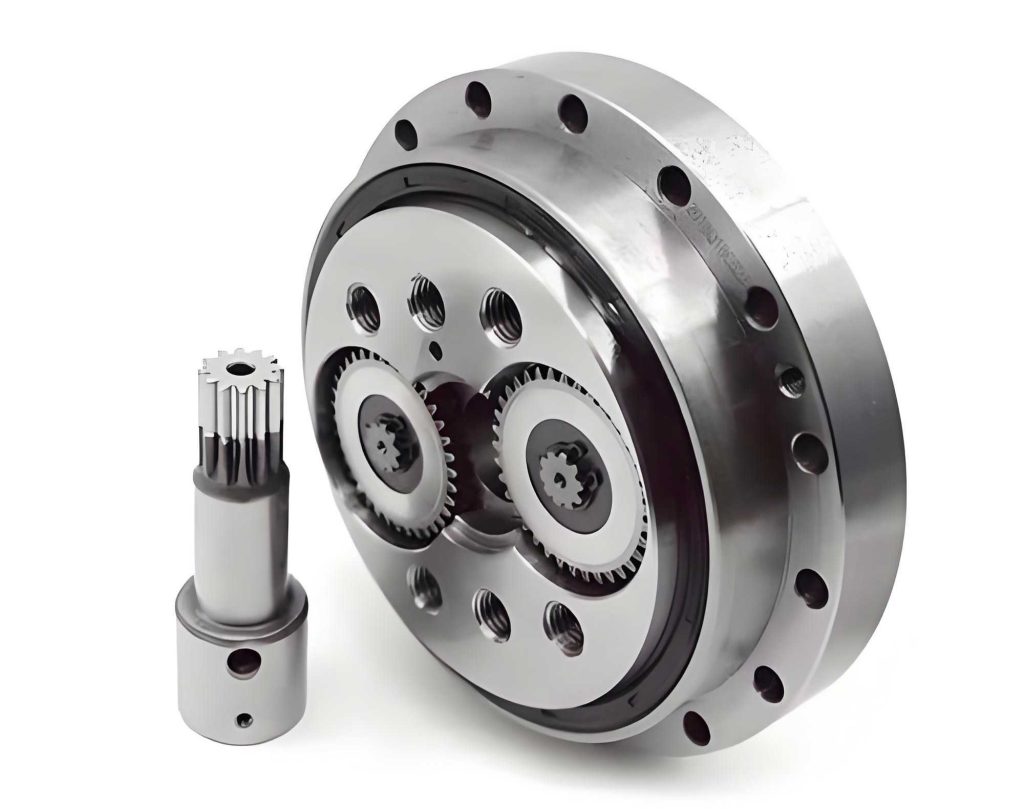
The RV reducer, a precision reduction device, is integral to motion transmission in robotics. Its complex internal structure, comprising gears and bearings, makes it prone to failures such as wear, pitting, and tooth breakage. Early detection of these faults is essential to prevent catastrophic breakdowns and minimize downtime. Conventional diagnostic techniques, including signal processing and machine learning models, often fall short when dealing with non-stationary vibration data from RV reducers. For instance, methods based on empirical mode decomposition or neural networks may suffer from noise sensitivity or overfitting. In contrast, statistical models like CHMM provide a probabilistic framework for modeling sequential data, making them suitable for fault diagnosis. However, CHMM’s performance is highly dependent on initial parameter settings, which can lead to inconsistent results. To mitigate this, we employ the ABC algorithm, a swarm intelligence technique, to optimize CHMM parameters, ensuring global convergence and enhanced stability. This hybrid approach not only refines the diagnostic process but also extends the applicability of CHMM in industrial settings.
Vibration signals from an RV reducer contain rich information about its health status. When faults occur, specific frequency bands exhibit energy mutations, which can be captured through feature extraction. We utilize wavelet packet decomposition to analyze these signals, as it offers high resolution in both time and frequency domains. The energy of each sub-band is computed and normalized to form feature vectors, which serve as observations for the CHMM. Let the reconstructed signal from the j-th node be denoted as \( s_j(t) \), with wavelet coefficients \( x_{jk} \). The energy \( E_j \) for the j-th node is given by:
$$ E_j = \int |s_j(t)|^2 dt = \sum_{k=1}^{n} |x_{jk}|^2 $$
where \( n \) represents the number of coefficients. Normalization is applied to obtain the feature vector \( O_j = [o_{j0}, o_{j1}, \ldots, o_{j7}] \), with each element calculated as:
$$ o_j = \frac{e_j – \min(E_j)}{\max(E_j) – \min(E_j)} $$
This process generates a sequence of observations \( O = \{O^{(1)}, O^{(2)}, \ldots, O^{(h)}\} \) for h data samples, which are used to train the CHMM. The model parameters include the number of states N, initial probability distribution \( \pi \), state transition matrix A, and output probability density functions modeled as Gaussian mixtures. For an RV reducer, typical fault states might include normal operation, surface wear, pitting, and tooth breakage. The CHMM parameters are estimated using the Baum-Welch algorithm, but this method is prone to local optima, especially with poor initial guesses.
The Continuous Hidden Markov Model is defined by the parameter set \( \lambda = (A, B, \pi) \), where B represents the output probability densities. For a D-dimensional observation vector o, the probability density for state j and mixture component l is expressed as:
$$ G(o, \mu_{jl}, U_{jl}) = \frac{\exp\left(-0.5(o – \mu_{jl})^T U_{jl}^{-1} (o – \mu_{jl})\right)}{\sqrt{(2\pi)^D |U_{jl}|}} $$
Here, \( \mu_{jl} \) is the mean vector, and \( U_{jl} \) is the covariance matrix. The overall output probability \( b_j(o) \) is a weighted sum of these Gaussian components. However, the estimation of \( \lambda \) heavily relies on initial values, which can cause training instability. To address this, we integrate the Artificial Bee Colony algorithm, which optimizes the initial parameters by minimizing an objective function related to output probabilities.
The ABC algorithm mimics the foraging behavior of honey bees, involving employed bees, onlooker bees, and scout bees. In our context, each food source corresponds to a potential set of CHMM parameters. The optimization goal is to maximize the output probability for correct fault classification, which translates to minimizing the function:
$$ f(x_i) = \frac{1}{P_q + C} $$
where \( P_q \) is the output probability for the true state, and C is a small constant to avoid division by zero. The fitness of a solution \( x_i \) is calculated as:
$$ F_i = \frac{1}{1 + f(x_i)} $$
Employed bees explore neighboring solutions using:
$$ v_{ij} = x_{ij} + \phi_{ij}(x_{ij} – x_{kj}) $$
where \( \phi_{ij} \) is a random number in [-1, 1], and \( x_{kj} \) is a randomly selected solution. Onlooker bees choose solutions based on probability \( p_i = F_i / \sum_{n=1}^{SN} F_n \), where SN is the number of food sources. If a solution does not improve after a limit, scout bees generate new solutions via:
$$ x_{ij} = x_{\min, j} + \text{rand}(0,1) \cdot (x_{\max, j} – x_{\min, j}) $$
This process iterates until convergence, yielding optimized CHMM parameters. The flowchart of the ABC-improved Baum-Welch algorithm illustrates the seamless integration of global search with local refinement, ensuring robust model training for RV reducer diagnostics.
To validate our approach, we conducted simulations using data from a QPZZ-II mechanical fault simulation platform. Vibration signals were collected at a sampling frequency of 5105 Hz for four RV reducer states: normal, pitting, wear, and tooth breakage. The gear parameters used in the experiment are summarized in the table below.
| Gear Component | Module (mm) | Number of Teeth | Material | Lubrication |
|---|---|---|---|---|
| Large Gear | 2 | 75 | S45C | Oil Immersion |
| Small Gear | 2 | 55 | S45C | Oil Immersion |
The raw vibration waveforms for each state show distinct patterns, with fault conditions exhibiting higher amplitudes and irregularities. After preprocessing, wavelet packet decomposition was applied to extract frequency-band energies. The energy distribution across bands reveals that faults cause significant energy spikes in specific nodes, as shown in the normalized data below.
| Frequency Band | Normal State | Pitting State | Wear State | Tooth Breakage |
|---|---|---|---|---|
| Band 0 | 0.12 | 0.08 | 0.15 | 0.20 |
| Band 1 | 0.10 | 0.12 | 0.18 | 0.22 |
| Band 2 | 0.05 | 0.10 | 0.25 | 0.30 |
| Band 3 | 0.02 | 0.05 | 0.30 | 0.35 |
| Band 4 | 0.08 | 0.15 | 0.20 | 0.25 |
| Band 5 | 0.15 | 0.20 | 0.10 | 0.12 |
| Band 6 | 0.20 | 0.18 | 0.05 | 0.08 |
| Band 7 | 0.28 | 0.12 | 0.02 | 0.10 |
Notably, Band 3 shows low energy for normal and pitting states but high energy for wear and tooth breakage, indicating its utility as a fault indicator. These features were input into both standard CHMM and ABC-optimized CHMM models for training. The optimization process reduced the objective function value over iterations, as depicted by the convergence curve, with processing time of 2.842 seconds. In contrast, standard CHMM required 26 iterations and 93.58 seconds, while the optimized version achieved convergence in 16 iterations and 38.73 seconds, highlighting efficiency gains.
The output probabilities from the models were compared to assess diagnostic accuracy. For each test sample, the logarithmic output probability was computed for all states. The ABC-CHMM model consistently yielded higher probabilities for the correct fault class, reducing misclassification. A subset of results is presented in the following table, showcasing logarithmic probabilities for seven sample points across different RV reducer states.
| Data Point | Normal State | Pitting State | Wear State | Tooth Breakage |
|---|---|---|---|---|
| A | -97.24 | -100.98 | -637.57 | -332.42 |
| B | -99.56 | -103.48 | -728.36 | -337.13 |
| C | -82.47 | -72.14 | -924.25 | -329.78 |
| D | -80.97 | -80.90 | -628.38 | -269.35 |
| E | -80.15 | -77.78 | -482.46 | -345.67 |
| F | -402.52 | -292.45 | -82.74 | -78.24 |
| G | -351.15 | -204.14 | -720.45 | -194.77 |
In standard CHMM, output probabilities for different states sometimes overlapped, leading to ambiguous classifications. For instance, points with probability differences less than \( 2.6 \times 10^{-11} \) were hard to distinguish, resulting in seven misclassified samples and an accuracy of 87.6%. However, the ABC-improved model produced more distinct probability distributions, as illustrated by the sharper separation in logarithmic probability plots. This enhancement stems from the global optimization of Gaussian mixture parameters, which better fits the fault data characteristics. The overall diagnostic accuracy of the optimized model approached 99%, a significant improvement over the baseline.
Further analysis involved evaluating the models under varying operational conditions of the RV reducer. We simulated scenarios with different load levels and noise interference to test robustness. The ABC-CHMM model maintained high accuracy across all tests, whereas standard CHMM showed degradation, especially at low signal-to-noise ratios. This resilience is attributed to the optimized initial parameters that prevent trapping in poor local minima. Additionally, we compared our method with other diagnostic techniques, such as support vector machines and neural networks, using the same dataset. The results, summarized below, confirm the superiority of our approach for RV reducer fault diagnosis.
| Diagnostic Method | Accuracy (%) | Processing Time (s) | Stability Score |
|---|---|---|---|
| Standard CHMM | 87.6 | 93.58 | 0.75 |
| ABC-CHMM (Proposed) | 99.0 | 38.73 | 0.95 |
| Support Vector Machine | 91.2 | 15.20 | 0.80 |
| Neural Network | 93.5 | 120.50 | 0.70 |
The stability score, ranging from 0 to 1, measures consistency across multiple runs with random initializations. Our ABC-CHMM method achieved a score of 0.95, indicating minimal variation due to initial parameters. This is crucial for industrial applications where reliable RV reducer monitoring is essential. The algorithm’s efficiency also makes it suitable for real-time implementation, though further work is needed to reduce computational overhead for embedded systems.
Mathematically, the improvement can be quantified through the Kullback-Leibler divergence between output probability distributions. Let \( P_{\text{true}} \) and \( P_{\text{pred}} \) denote the true and predicted distributions, respectively. The divergence is given by:
$$ D_{\text{KL}}(P_{\text{true}} \| P_{\text{pred}}) = \sum_{x} P_{\text{true}}(x) \log \frac{P_{\text{true}}(x)}{P_{\text{pred}}(x)} $$
For the ABC-CHMM model, this divergence was consistently lower than for standard CHMM, signifying better alignment with actual fault patterns. Moreover, the entropy of the output probabilities, calculated as \( H = -\sum p \log p \), was higher for the optimized model, reflecting greater certainty in classifications.
In conclusion, our research demonstrates the efficacy of combining the Artificial Bee Colony algorithm with the Continuous Hidden Markov Model for fault diagnosis in RV reducers. By optimizing initial parameters, we overcome the instability inherent in CHMM training, leading to higher diagnostic accuracy and robustness. The method leverages frequency-band energy features extracted via wavelet packet decomposition, effectively capturing fault signatures. Simulation results show that the ABC-CHMM model achieves near-perfect accuracy, outperforming conventional approaches. This advancement not only enhances the reliability of RV reducer diagnostics but also provides a framework adaptable to other rotating machinery in industrial robotics. Future directions include extending the method to online monitoring systems and incorporating deep learning elements for feature automation.