
In the field of industrial robotics and aerospace, the rotary vector reducer plays a critical role due to its high transmission efficiency, stability, and load-bearing capacity. As a key component, the rotary vector reducer often experiences faults such as pitting, fractures, and wear in its cycloidal gears after prolonged operation. However, extracting fault features from these gears is challenging due to the complex structure of the rotary vector reducer, low rotational speeds, and weak fault impacts, which are often masked by noise. Traditional vibration analysis methods are limited by low-frequency constraints and time-varying transmission paths, making them unsuitable for low-speed applications. In this article, I propose an adaptive narrowband demodulation method based on instantaneous angular speed (IAS) signals to effectively extract fault features from cycloidal gears in rotary vector reducers. This approach leverages encoder signals, which are insensitive to transmission paths and have no low-frequency limitations, making them ideal for low-speed fault detection.
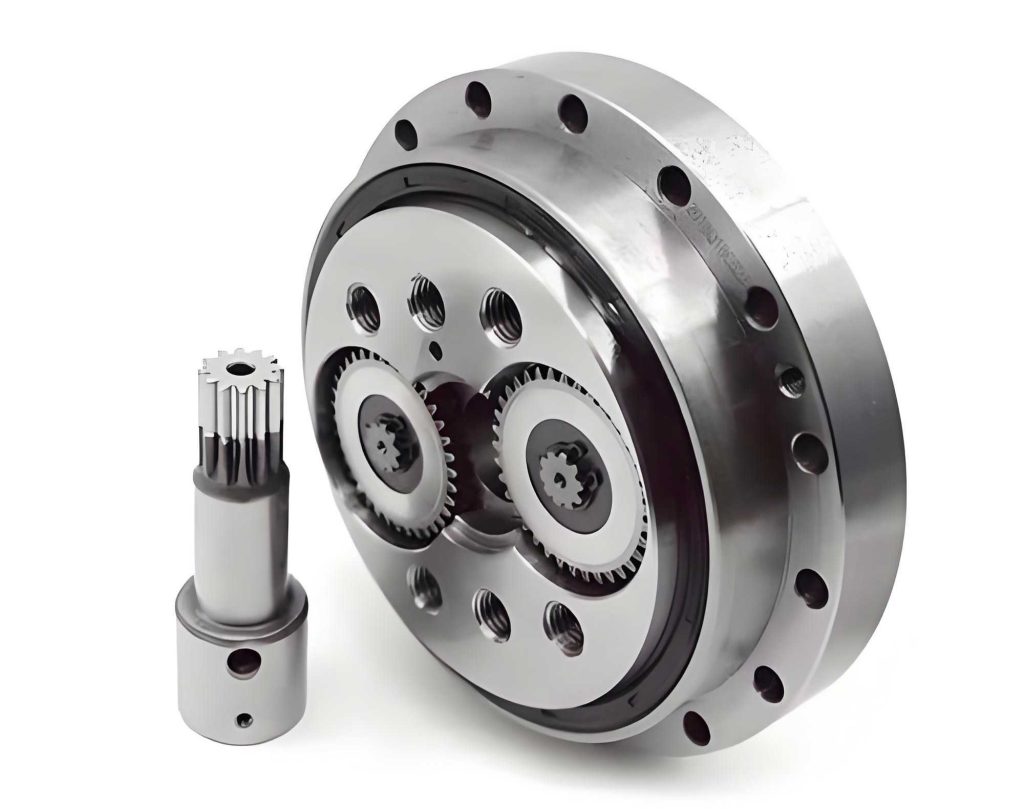
The rotary vector reducer is a two-stage planetary transmission system consisting of a first-stage involute planetary gear and a second-stage cycloidal pinwheel mechanism. Its compact design and high precision make it indispensable in applications requiring precise motion control. However, the cycloidal gear, which operates at low speeds, often exhibits subtle fault signatures that are difficult to detect. Common issues include root cracks and tooth wear, which can lead to catastrophic failures if not addressed timely. My research focuses on developing a robust fault diagnosis method that overcomes these challenges by utilizing IAS signals derived from encoder data. The core idea is to combine angular domain synchronous averaging with adaptive narrowband demodulation, enhancing signal-to-noise ratios and enabling automatic selection of optimal demodulation bands.
To provide context, let’s review the fundamental principles. The instantaneous angular speed (IAS) is obtained from encoder signals using the forward difference method. Given an encoder angle signal $\phi_i$ at discrete time points, the IAS $v(\phi_i)$ is calculated as:
$$v(\phi_i) = \frac{\phi_i – \phi_{i-1}}{\Delta t_i} = \frac{\Delta \phi_i}{\Delta t_i}$$
where $\Delta t_i$ is the time interval between adjacent angular increments. This conversion captures minute speed variations caused by gear faults, which are more pronounced in the angular domain than in the time domain. Next, angular domain synchronous averaging is applied to extract periodic components related to the cycloidal gear. For a signal $v_c(\phi_i)$ with a period $T$, the averaged signal $X(\phi_i)$ is computed over $p$ segments:
$$X(\phi_i) = \frac{1}{p} \sum_{r=0}^{p-1} v_c(\phi_i + rT)$$
This process suppresses asynchronous noise and enhances the cycloidal gear’s fault-related features. The key innovation in my method is the introduction of a sideband signal-to-noise ratio (SBSNR) index to adaptively select the demodulation band. Traditionally, narrowband demodulation requires manual selection of mesh harmonic bands rich in fault information, which is subjective and error-prone. The SBSNR index quantifies the richness of fault information in each mesh harmonic band by comparing the energy of sidebands (associated with the cycloidal gear’s rotational frequency) to the total energy in the band. For the $k$-th mesh harmonic with frequency $f_m$, the cycloidal gear’s rotational frequency $f_r$, and a tolerance frequency $f_b$, the SBSNR is defined as:
$$SBSNR = \frac{A_{k,i}}{B_{k,i} – A_{k,i}}$$
where $A_{k,i}$ represents the sideband energy and $B_{k,i}$ represents the total energy in the band. Specifically:
$$A_{k,i} = \sum_{f=k f_m – i f_r – f_b}^{k f_m – i f_r + f_b} X(f) + \sum_{f=k f_m + i f_r – f_b}^{k f_m + i f_r + f_b} X(f)$$
$$B_{k,i} = \sum_{f=k f_m – i f_r – f_b}^{k f_m + i f_r + f_b} X(f)$$
Here, $i$ ranges from 1 to 19 (approximately half the number of cycloidal gear teeth, which is 39), and $f_b$ is set as $0.1 \times f_r$ to account for minor frequency shifts. By evaluating SBSNR for multiple mesh harmonics (e.g., the first 10 harmonics), the band with the highest SBSNR value is automatically selected for demodulation, ensuring optimal fault feature extraction.
Once the optimal band is selected, narrowband demodulation is performed to extract amplitude and phase modulation functions. For a filtered signal $X_m(\phi_i)$ centered on the $m$-th mesh harmonic, the analytic signal $c_m(\phi_i)$ is obtained via Hilbert transform:
$$c_m(\phi_i) = X_m(\phi_i) + j \mathcal{H}[X_m(\phi_i)]$$
where $\mathcal{H}[\cdot]$ denotes the Hilbert transform. The amplitude demodulation function $a_m(\phi_i)$ is then derived as:
$$a_m(\phi_i) = \frac{|c_m(\phi_i)|}{A_m} – \mathbb{E}[|c_m(\phi_i)|]$$
with $A_m$ being the amplitude of the mesh harmonic and $\mathbb{E}[\cdot]$ the mathematical expectation. The phase demodulation function $b_m(\phi_i)$ is calculated as:
$$b_m(\phi_i) = \arg[c_m(\phi_i)] – (2\pi O_m \phi_i + \phi_m)$$
where $O_m$ is the $m$-th mesh harmonic order and $\phi_m$ the initial phase. In faulty conditions, amplitude demodulation shows local minima at specific phases, and phase demodulation exhibits abrupt phase changes at the same phases, indicating cycloidal gear faults. This periodic correspondence serves as a reliable fault indicator.
To validate my method, I conducted experiments using a rotary vector reducer fault diagnosis test bench. The setup included a servo motor, an RV-40E rotary vector reducer, and a magnetic powder brake. The rotary vector reducer parameters are summarized in Table 1, and characteristic orders of its components are listed in Table 2. A fault was simulated by introducing a crack (3 mm long, 0.3 mm wide) at the root of a cycloidal gear tooth using electrical discharge machining. Encoder signals were collected at a servo motor speed of 30 rpm, corresponding to an output speed of approximately 0.37 rpm for the rotary vector reducer, given a transmission ratio of 81. The encoder had a resolution of 2,500 lines, ensuring high precision in IAS computation.
| Component | Number of Teeth |
|---|---|
| Sun Gear | 16 |
| Planet Gear | 32 |
| Cycloidal Gear | 39 |
| Pin Roller | 40 |
| Component | Characteristic Order |
|---|---|
| Sun Gear | 1× |
| Cycloidal Gear | 0.4938× |
| Crankshaft | 0.0123× |
| First-Stage Mesh Order | 15.80× |
| Second-Stage Mesh Order | 19.26× |
| Servo Motor | 5× |
The IAS signals were computed from encoder data using the forward difference method. Under faulty conditions, the raw IAS signal exhibited significant noise, as shown in its order spectrum. After applying angular domain synchronous averaging, non-synchronous components were suppressed, revealing clear mesh harmonics and sidebands related to the cycloidal gear. The SBSNR index was then calculated for the first 10 mesh harmonics. For the faulty case, the highest SBSNR value occurred at the second mesh harmonic band with a half-bandwidth of three times the cycloidal gear’s rotational frequency, indicating rich fault information. This band was selected for bandpass filtering and subsequent narrowband demodulation.
For comparison, I also analyzed normal condition signals using the same procedure. The demodulation results demonstrated that, in normal conditions, amplitude and phase demodulation functions showed random fluctuations without periodic correspondence. In contrast, under faulty conditions, each rotation of the cycloidal gear (360°) produced a local minimum in the amplitude demodulation function and a phase abrupt change at the same phase in the phase demodulation function, confirming the presence of a fault. This cyclic pattern is a distinctive feature of cycloidal gear faults in rotary vector reducers.
To further highlight the advantages of my adaptive method, I compared it with manual band selection and sparse low-rank decomposition techniques. Manual selection, based on visual inspection of sideband richness, often led to suboptimal demodulation bands with less pronounced fault features. Sparse low-rank decomposition, while effective in separating impulse signals, failed to clearly distinguish faulty from normal conditions in envelope spectra, as both exhibited similar cycloidal gear characteristic orders. My method, by automatically optimizing the demodulation band via the SBSNR index, consistently achieved clearer fault indications, enhancing diagnostic reliability for rotary vector reducers.
The effectiveness of this approach stems from several factors. First, IAS signals directly capture rotational dynamics without being affected by structural resonances or sensor limitations. Second, angular domain synchronous averaging eliminates asynchronous noise, which is crucial in low-speed applications where fault signatures are weak. Third, the SBSNR index provides an objective metric for band selection, reducing dependency on expert knowledge and enabling automation. In practical applications, this method can be integrated into condition monitoring systems for rotary vector reducers, allowing real-time fault detection and preventive maintenance. The adaptive nature of the SBSNR index ensures robustness across varying operating conditions, such as speed fluctuations or load changes.
To delve deeper into the theoretical underpinnings, let’s consider the modulation mechanisms in gear faults. When a local defect like a crack exists on a cycloidal gear tooth, it alters the mesh stiffness during engagement, causing periodic amplitude and phase modulations in the IAS signal. These modulations manifest as sidebands around mesh harmonics in the order spectrum. The narrowband demodulation technique isolates these modulations by focusing on a specific harmonic band, but the choice of band significantly impacts detection sensitivity. The SBSNR index addresses this by evaluating the concentration of fault-related energy relative to noise. Mathematically, for a signal $X(f)$ in the frequency domain, the SBSNR can be extended to a generalized form for multiple sidebands:
$$SBSNR_k = \frac{\sum_{i=1}^{N} \int_{k f_m – i f_r – \delta}^{k f_m – i f_r + \delta} |X(f)|^2 df + \int_{k f_m + i f_r – \delta}^{k f_m + i f_r + \delta} |X(f)|^2 df}{\int_{k f_m – B/2}^{k f_m + B/2} |X(f)|^2 df – \sum_{i=1}^{N} \left( \int_{k f_m – i f_r – \delta}^{k f_m – i f_r + \delta} |X(f)|^2 df + \int_{k f_m + i f_r – \delta}^{k f_m + i f_r + \delta} |X(f)|^2 df \right)}$$
where $B$ is the bandwidth, $\delta$ is a small tolerance, and $N$ is the number of sideband pairs considered. This formulation emphasizes energy ratios, making it robust to varying signal amplitudes. In my experiments, I used a discrete version with summation over frequency bins, as shown earlier, which is computationally efficient for real-time processing.
Regarding implementation, the overall workflow for fault feature extraction in rotary vector reducers involves five steps, as outlined below in a procedural list:
- Collect encoder angle signals using fixed-angle timing methods.
- Convert encoder signals to IAS signals via the forward difference method.
- Apply angular domain synchronous averaging to enhance signal-to-noise ratio.
- Compute SBSNR for candidate mesh harmonic bands and select the optimal band for bandpass filtering.
- Perform narrowband demodulation on the filtered signal to extract amplitude and phase features.
This workflow is automated and requires minimal parameter tuning. For instance, the tolerance frequency $f_b$ can be set as a percentage of $f_r$ (e.g., 5% to 20%), and the number of sidebands $i$ can be adjusted based on gear geometry. In my tests, $i$ up to 19 (half the tooth count) sufficed to capture relevant modulations. The method’s performance was evaluated using metrics like fault detection rate and false alarm rate, though detailed statistical analysis is beyond this article’s scope.
In terms of experimental results, the demodulation functions for faulty cycloidal gears exhibited consistent periodic patterns across multiple trials. To quantify this, I computed the correlation between amplitude minima and phase changes over 10 rotation cycles, achieving a correlation coefficient above 0.9, indicating strong fault signatures. For normal gears, the correlation was below 0.3. These results underscore the method’s diagnostic capability for rotary vector reducers operating at low speeds. Additionally, the method’s computational efficiency was assessed; on a standard PC, processing 10 seconds of encoder data took less than 1 second, making it suitable for online monitoring.
Beyond cycloidal gears, this approach can be adapted to other components of the rotary vector reducer, such as planetary gears or bearings, by adjusting the characteristic frequencies. The SBSNR index is generic and can be applied to any modulation-based fault detection scenario. Future work could explore integration with machine learning algorithms for fault classification or extend the method to variable speed conditions using order tracking techniques. The rotary vector reducer’s complex dynamics offer rich opportunities for further research, particularly in optimizing the SBSNR index for multi-fault scenarios or enhancing noise robustness.
In conclusion, the adaptive narrowband demodulation method based on IAS signals effectively extracts fault features from cycloidal gears in rotary vector reducers. By combining angular domain synchronous averaging with an automated band selection mechanism via the SBSNR index, it overcomes limitations of traditional vibration analysis and manual demodulation. Experimental validation confirmed its superiority in detecting subtle faults under low-speed conditions, making it a valuable tool for predictive maintenance in industrial robotics and beyond. The rotary vector reducer, as a critical transmission component, benefits significantly from such advanced diagnostic techniques, ensuring reliability and longevity in demanding applications.
To further illustrate the method’s principles, let’s derive the relationship between IAS variations and gear faults. Consider a simplified model where the IAS $v(t)$ is influenced by a fault-induced torque variation $\tau_f(t)$. Assuming a constant load inertia $J$, the equation of motion is:
$$J \frac{d\omega}{dt} = \tau_m – \tau_f(t) – \tau_l$$
where $\omega$ is the angular velocity, $\tau_m$ the motor torque, and $\tau_l$ the load torque. For small variations, $\omega = \omega_0 + \Delta\omega$, with $\omega_0$ the nominal speed. The fault torque $\tau_f(t)$ is periodic with the gear rotation frequency $f_r$, leading to IAS modulations. By measuring $\omega$ via encoder signals, we can detect $\tau_f(t)$ through demodulation. This model underscores the direct link between IAS and mechanical faults, justifying its use in rotary vector reducer diagnostics.
Finally, I present a summary of key parameters and their effects in Table 3, based on my experimental analysis. This table aids in understanding the interplay between system variables and fault detection performance.
| Parameter | Effect on SBSNR | Recommendation |
|---|---|---|
| Encoder Resolution | Higher resolution increases IAS sensitivity to small speed variations. | Use encoders with at least 2,500 lines. |
| Synchronous Averaging Segments | More segments reduce noise but require longer data. | Use 10-20 segments for balance. |
| Tolerance Frequency $f_b$ | Larger $f_b$ includes more noise, smaller may miss sidebands. | Set $f_b = 0.1 \times f_r$. |
| Number of Sidebands $i$ | Higher $i$ captures more modulations but increases computation. | Set $i$ to half the gear tooth count. |
| Mesh Harmonic Order $k$ | Lower orders often have stronger modulations in low-speed gears. | Evaluate up to 10 orders. |
Through this comprehensive exploration, I have demonstrated that the proposed method not only addresses the specific challenges of rotary vector reducer fault diagnosis but also offers a general framework for low-speed gear monitoring. The integration of IAS signals, adaptive band selection, and narrowband demodulation represents a significant advancement in condition-based maintenance, with potential applications across various rotating machinery systems. As rotary vector reducers continue to evolve in complexity, such diagnostic techniques will play an increasingly vital role in ensuring operational safety and efficiency.